
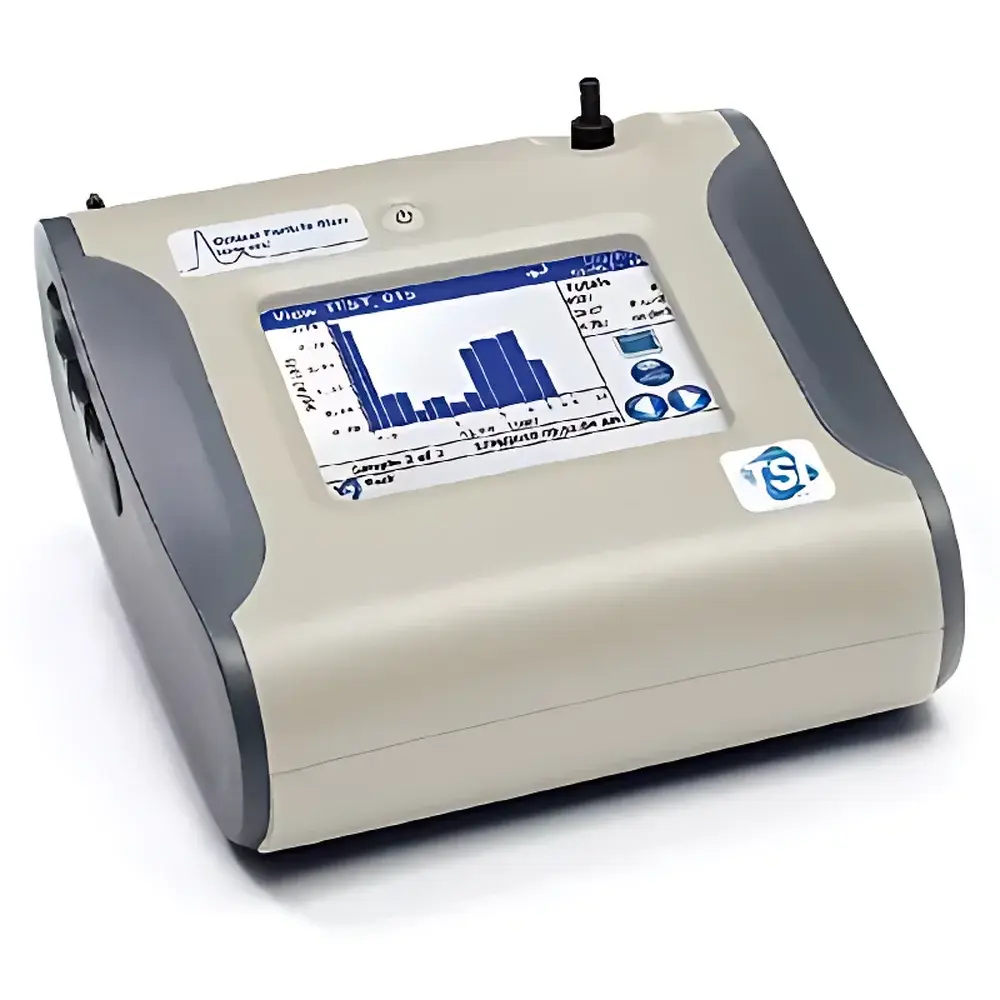
TSI Model 3330 Optical Particle Size Spectrometer
| Brand | TSI |
|---|---|
| Origin | USA |
| Model | 3330-OPS |
| Principle | Optical Single-Particle Detection (Light Scattering) |
| Sample Flow Rate | 1.0 L/min ±5% |
| Particle Size Range | 0.3–10 μm |
| Counting Concentration Range | 3,000,000 particles/L |
| Size Channels | 16 |
| Mass Concentration Range | 0.001–275,000 µg/m³ |
Overview
The TSI Model 3330 Optical Particle Size Spectrometer (OPS) is a portable, laboratory-grade aerosol instrument engineered for real-time, high-fidelity measurement of airborne particle number concentration and size distribution. Based on the principle of single-particle optical scattering—where individual particles pass through a focused laser beam and generate scattered light pulses proportional to their diameter—the 3330 delivers quantitative size-resolved data across 16 user-configurable channels from 0.3 to 10 μm. Its 120° wide-angle optical collection system maximizes photon capture efficiency, enabling robust signal-to-noise performance even at low concentrations. Factory-calibrated against NIST-traceable polystyrene latex (PSL) standards and validated per ISO 21501-4:2018, the instrument maintains metrological integrity across environmental, occupational, and research settings. Designed for field-deployable operation without compromise in analytical rigor, the 3330 integrates precision fluidics, temperature-stabilized photodetectors, and embedded signal processing architecture optimized for reproducible sizing accuracy—particularly critical at the 0.5 μm calibration point, where sizing resolution remains <5% CV.
Key Features
- Real-time optical particle counting with 16 programmable size bins spanning 0.3–10 μm
- Fixed volumetric sampling flow rate of 1.0 L/min (±5% accuracy), actively monitored and compensated via integrated mass flow sensor
- High-sensitivity photodetector array with 120° light-collection optics to minimize coincidence error and enhance detection efficiency for sub-micrometer particles
- Color touchscreen interface with intuitive navigation, onboard configuration wizard, and real-time histogram visualization
- Battery-powered operation supporting up to 12 hours of continuous field use; compatible with external 12 V DC power sources
- Onboard memory storing up to 30,000 complete spectra (time-stamped, channel-resolved counts), with automatic timestamping and GPS tagging (when paired with optional module)
- Integrated filter holder for simultaneous gravimetric or chemical analysis of collected aerosol samples
- Support for user-defined refractive index and particle density inputs to convert number distributions into mass or surface-area metrics
Sample Compatibility & Compliance
The 3330 OPS is validated for use with ambient air, indoor air, workplace atmospheres, and controlled test environments—including ducted airflow and cleanroom monitoring. It meets the performance requirements of ISO 21501-4:2018 for light-scattering airborne particle counters, including linearity, resolution, false count rate, and counting efficiency verification protocols. While not intrinsically certified for hazardous locations, it complies with IEC 61000-4 electromagnetic compatibility standards and carries CE marking for EMC and safety (EN 61326-1). For regulated applications—including occupational exposure assessment under OSHA or EU Directive 2004/37/EC—the instrument supports audit-ready data export with full metadata (flow rate, temperature, pressure, calibration ID, operator ID). Data files are structured in TSI’s standardized .tsv format, ensuring traceability and interoperability with third-party statistical analysis platforms.
Software & Data Management
Aerosol Instrument Manager™ (AIM) software—supplied standard with every 3330—provides comprehensive instrument control, real-time visualization, post-processing, and report generation. AIM enables batch spectral averaging, differential mobility correction (for non-spherical particles), and conversion between number-, surface-area-, and mass-based distributions using user-input material properties. All raw and processed datasets include embedded calibration certificates, firmware revision logs, and environmental sensor readings (temperature, relative humidity, barometric pressure). For GLP/GMP-aligned workflows, AIM optionally supports 21 CFR Part 11-compliant user authentication, electronic signatures, and immutable audit trails—configurable via role-based access controls. Export formats include CSV, Excel (.xlsx), and netCDF for integration with MATLAB, Python (pandas/xarray), or enterprise LIMS systems.
Applications
- Filter efficiency testing per ASHRAE 52.2, EN 1822, and ISO 16890 standards
- Indoor air quality (IAQ) characterization in commercial buildings, schools, and healthcare facilities
- Occupational hygiene monitoring for respirable dust, welding fume, and nanomaterial handling
- Ambient particulate matter (PM1, PM2.5, PM10) source apportionment and temporal trend analysis
- Industrial process emissions monitoring—e.g., combustion stacks, pharmaceutical dry powder handling, semiconductor fab tool exhaust
- Validation of HVAC filtration performance and duct leakage assessment
- Research in atmospheric science, aerosol-cloud interactions, and inhalation toxicology
FAQ
What calibration standards are used for factory certification?
The 3330 is calibrated using NIST-traceable polystyrene latex (PSL) spheres at 0.3, 0.5, 1.0, 3.0, and 10.0 μm, with secondary verification against ISO 21501-4 reference instruments.
Can the 3330 measure particles smaller than 0.3 μm?
No—the lower detection limit is defined by optical sensitivity and noise floor at 0.3 μm; for sub-100 nm measurements, TSI recommends the SMPS™ system (Scanning Mobility Particle Sizer) series.
Is the instrument suitable for high-humidity environments?
Yes—built-in temperature and humidity sensors enable optional hygroscopic growth correction; however, condensation on optics must be avoided via inlet heating or diffusion dryer integration.
How is data security ensured during remote deployments?
All stored spectra are encrypted at rest; AIM software supports TLS 1.2+ for secure cloud uploads, and local data exports require authenticated USB drive access.
Does the 3330 support regulatory reporting formats such as EPA Method 201A or ISO 12103-1?
While the 3330 itself does not perform gravimetric analysis, its size-resolved data feeds directly into compliance calculations required by those methods when combined with filter-based mass measurements.







