
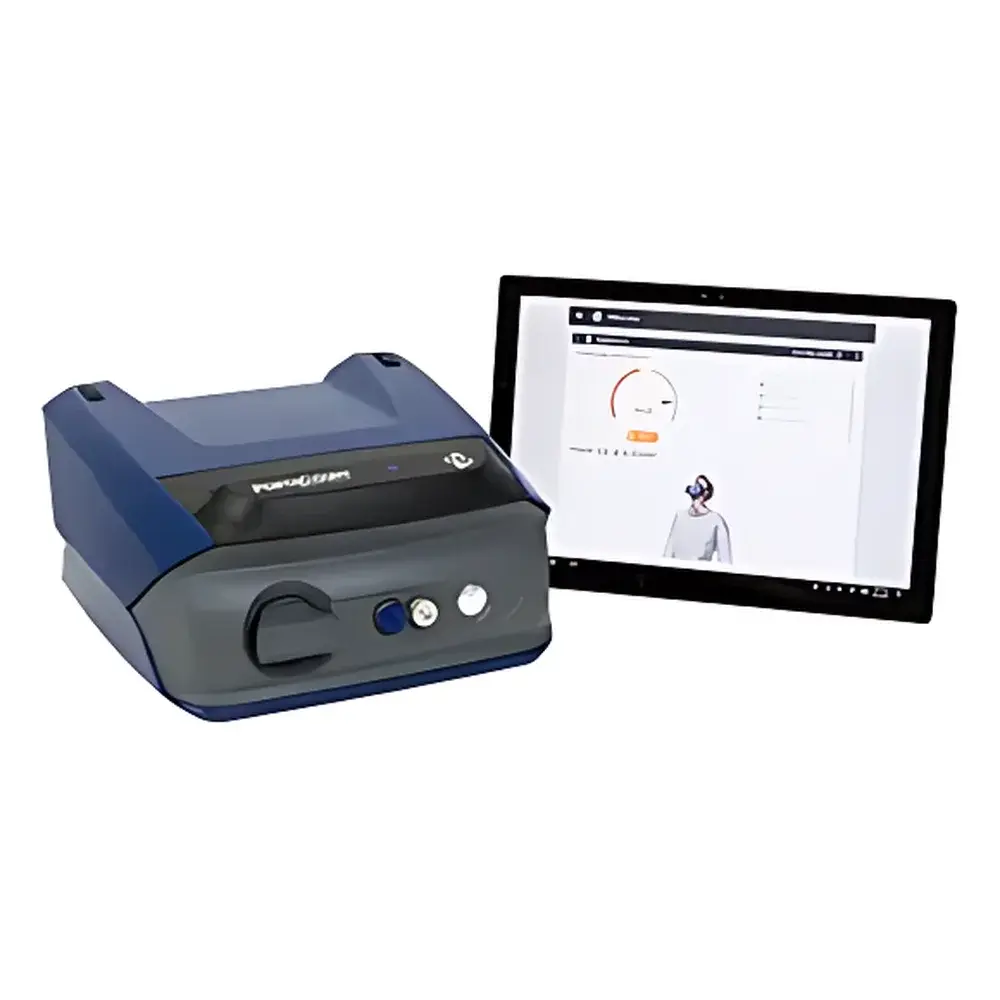
TSI PortaCount Pro+ Model 8040/8048 Respirator Fit Testing System
| Brand | TSI |
|---|---|
| Origin | USA |
| Model | 8040/8048 |
| Measurement Principle | Condensation Particle Counting (CPC)-based Quantitative Fit Testing |
| Compliance | Meets OSHA 1910.134 & ISO 16900-1 requirements |
| Operating Mode | Real-time quantitative aerosol concentration ratio analysis (facepiece-to-ambient) |
| FitCheck™ Mode | Enabled |
| On-device Animated Training Guidance | Integrated |
| Software Platform | FitPro™ Ultra v5.x (Windows/macOS/iPadOS compatible) |
| Data Management | Audit-trail enabled, CSV/PDF export, GLP-compliant session logging |
| Regulatory Alignment | Supports FDA 21 CFR Part 11 electronic signature readiness (with validated IT environment) |
Overview
The TSI PortaCount Pro+ Model 8040/8048 is a quantitative respirator fit testing (QNFT) system engineered for precision, repeatability, and regulatory alignment in occupational health and safety programs. Unlike qualitative methods relying on subjective sensory response, this instrument applies condensation particle counting (CPC) technology to measure the actual penetration of ambient aerosol particles into the respirator facepiece during standardized test exercises. It calculates a real-time fit factor—the ratio of ambient particle concentration to intramask concentration—enabling objective pass/fail determination per OSHA 1910.134 Appendix A and ISO 16900-1:2016. Designed and manufactured in Shoreview, Minnesota, USA, the system delivers traceable, operator-independent results critical for auditable respiratory protection programs across pharmaceutical manufacturing, healthcare, chemical handling, and industrial maintenance environments.
Key Features
- Real-time FitCheck™ mode: Visualizes dynamic fit factor changes during donning, adjustment, and movement—supporting empirical respirator selection and optimization prior to formal testing.
- Integrated animated training interface: On-device step-by-step video guidance ensures consistent test execution across operators and shifts, reducing inter-operator variability and retraining burden.
- Dual-model flexibility: Model 8040 supports standard QNFT protocols; Model 8048 adds Bluetooth-enabled wireless connectivity to FitPro™ Ultra software for remote monitoring and multi-station coordination.
- Ruggedized portable architecture: IP54-rated enclosure, lithium-ion battery (≥8 hours continuous operation), and ergonomic handheld form factor enable field deployment in cleanrooms, laboratories, and plant floor settings.
- Pre-validated test protocols: Built-in support for all OSHA-accepted exercises (normal breathing, deep breathing, head side-to-side, head up-and-down, talking, bending over) with automatic timing and motion cueing.
Sample Compatibility & Compliance
The PortaCount Pro+ accommodates full-facepiece respirators, half-mask elastomeric respirators, disposable filtering facepiece respirators (FFRs) including N95, N99, N100, P1, P2, P3, FFP1–FFP3, and powered air-purifying respirators (PAPRs) with tight-fitting hoods or helmets. It is not intended for loose-fitting PAPR hoods or supplied-air systems without facepiece seals. The system complies with performance criteria defined in ISO 16900-1:2016 (Respiratory protective devices — Methods of testing fit — Part 1: Determination of fit factor) and satisfies U.S. OSHA 1910.134(a)(2) and (f)(2) requirements for quantitative fit testing. When deployed with FitPro™ Ultra under controlled IT governance, it supports data integrity practices aligned with GLP and GMP expectations—including user authentication, electronic signatures, and immutable audit trails per FDA 21 CFR Part 11 Annex 11 principles.
Software & Data Management
FitPro™ Ultra software represents a comprehensive redesign of TSI’s respiratory fit testing platform. Installed on Windows 10/11, macOS 12+, or iPadOS 16+ devices, it features an intuitive ribbon-style interface modeled after mainstream productivity applications—minimizing learning curves and eliminating dedicated workstation dependencies. Each test session captures timestamped fit factor curves, exercise phase metadata, operator ID, subject ID, respirator model/lot, and environmental notes. Export formats include CSV (for LIMS integration), PDF (for HR records), and encrypted SQLite databases. Role-based access control, configurable report templates, and automated email alerts for overdue retests enhance program scalability. All data files are digitally signed and retain SHA-256 checksums to ensure forensic integrity during internal audits or OSHA inspections.
Applications
This system serves as the technical foundation for enterprise-wide respiratory protection programs requiring defensible, repeatable fit verification. Primary use cases include initial respirator selection and sizing, annual or biannual fit retesting mandated by corporate EHS policy or regulatory jurisdiction, post-facial surgery or dental work reassessment, and incident-driven requalification following workplace exposure events. It is routinely deployed in FDA-regulated sterile manufacturing suites (e.g., injectables, biologics), ISO Class 5–8 cleanrooms, hospital infection control departments, hazardous materials response teams, and mining safety compliance units. Its quantitative output directly informs respirator assignment matrices, training effectiveness metrics, and root-cause analysis of breakthrough exposures.
FAQ
Does the PortaCount Pro+ require external challenge aerosols or generated smoke?
No. It uses ambient room particulate matter (e.g., dust, HVAC emissions) as the natural challenge agent—eliminating consumables, calibration drift from aerosol generators, and procedural complexity associated with saccharin or isoamyl acetate protocols.
Can FitPro™ Ultra be deployed on shared networked tablets in high-traffic screening areas?
Yes. Multi-user profiles, auto-lock timeout, and local database encryption allow secure concurrent use across shift rotations without compromising data segregation or audit readiness.
Is calibration traceable to NIST standards?
Yes. Each unit ships with a Certificate of Calibration traceable to NIST SRM 1963 (monodisperse polystyrene latex spheres), with optional annual recalibration services available through TSI-certified service centers.
What respirator types are excluded from QNFT using this system?
Loose-fitting PAPR hoods, airline respirators without sealed facepieces, and surgical masks (not certified as respirators) fall outside the scope of ISO 16900-1 and therefore cannot be evaluated quantitatively with this instrument.
How does the system handle environmental variability—such as low ambient particle counts?
The CPC detector maintains sensitivity down to <100 particles/cm³. If ambient concentration falls below the minimum required threshold (typically ≥1000 particles/cm³), the device issues a pre-test warning and recommends relocation or temporary aerosol enhancement (e.g., brief door opening, paper tearing)—documented in the session log for transparency.
Related Products







