
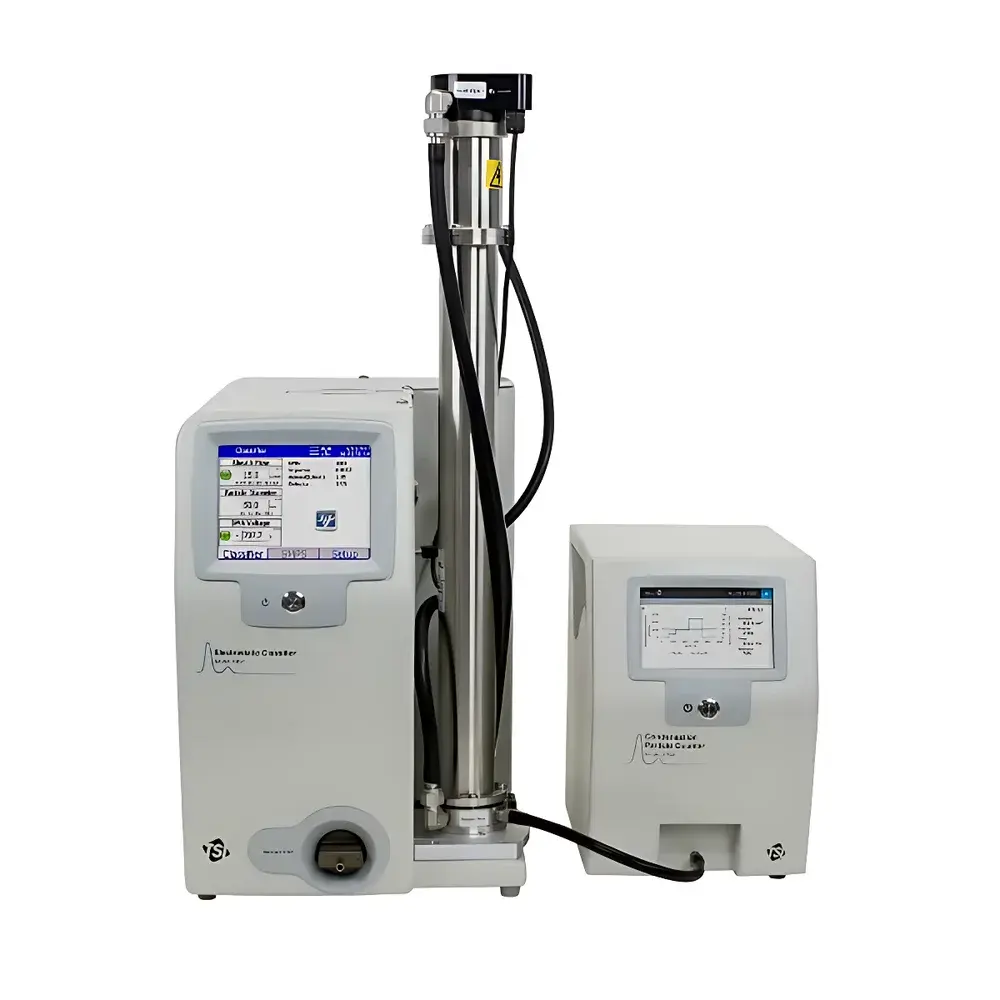
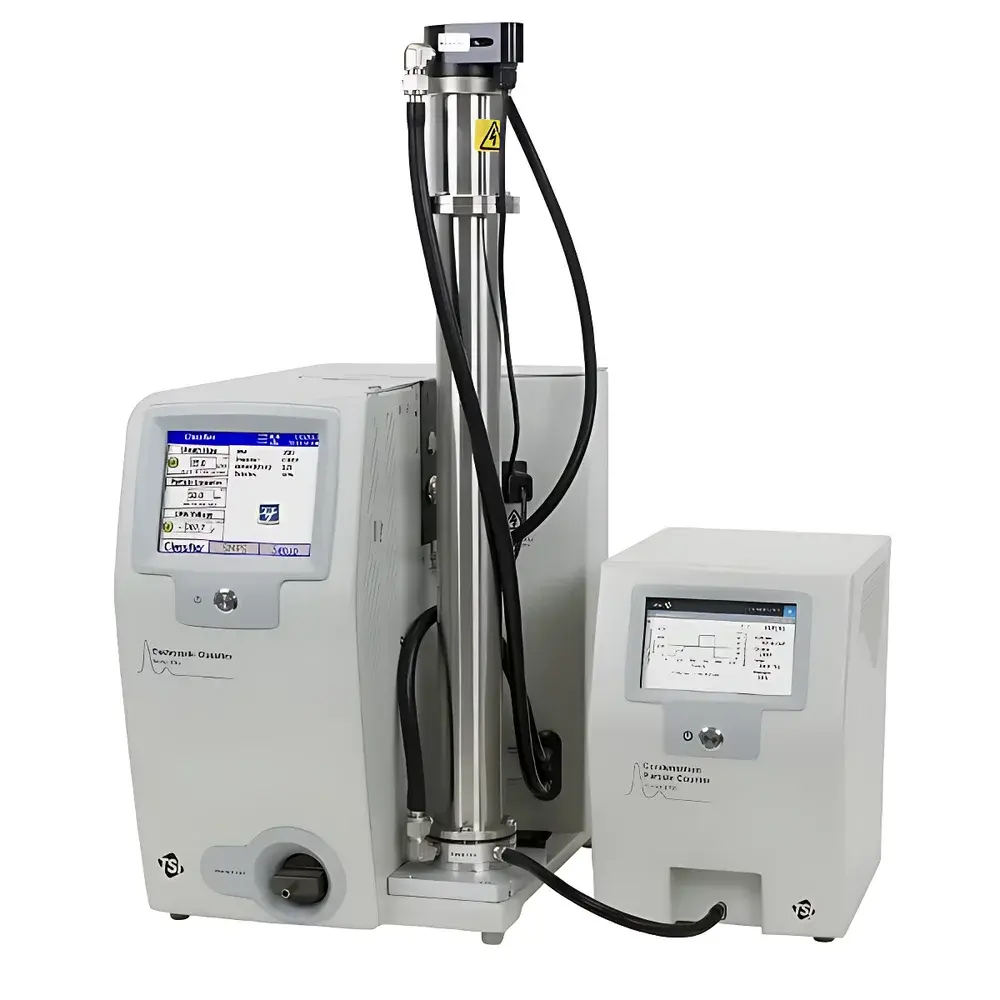
TSI SMPS-3938 Scanning Mobility Particle Sizer Spectrometer
| Brand | TSI |
|---|---|
| Origin | USA |
| Model | SMPS-3938 |
| Size Range | 2.5–1000 nm |
| Resolution | Up to 167 channels per scan |
| Scan Time | <10 s |
| Concentration Range | Up to 1×10⁷ particles/cm³ |
| Compliance | ISO 15900:2009 |
| Detector Options | Butanol or Water-based CPCs |
| Neutralizer Options | Radioactive (⁸⁵Kr) or Non-radioactive (Bipolar Corona) |
| Control Interface | Integrated touchscreen, PC-free operation |
| Software | TSIGuard™ and Instrument Manager™ (PC required for full data analysis) |
Overview
The TSI SMPS-3938 Scanning Mobility Particle Sizer Spectrometer is a high-precision, NIST-traceable instrument engineered for quantitative measurement of aerosol particle size distributions based on electrical mobility principles. Unlike optical or light-scattering techniques, the SMPS-3938 determines particle diameter by measuring the electrophoretic mobility of charged particles in a defined electric field—enabling direct, model-independent sizing without assumptions about particle morphology, refractive index, or density. This fundamental electrokinetic approach ensures metrological rigor and traceability to SI units, making the system a primary reference method for nanoparticle characterization in research, regulatory, and industrial laboratories. As the third-generation implementation of TSI’s SMPS platform, the Model 3938 integrates over three decades of validated design experience, with documented use by the U.S. National Institute of Standards and Technology (NIST) for certification of monodisperse reference aerosols at 60 nm and 100 nm.
Key Features
- High-resolution sizing capability: Configurable up to 167 mobility channels per scan, delivering fine-grained differential and integral size distribution data.
- Broad dynamic size range: Measures particles from 2.5 nm to 1000 nm in a single configuration—covering nucleation-mode nanoparticles through coarse submicron aerosols.
- Fast acquisition cycle: Full size distribution scans completed in under 10 seconds, supporting time-resolved monitoring of transient aerosol processes.
- ISO 15900:2009 compliance: Fully aligned with the international standard for differential mobility analyzers (DMAs), including calibration, uncertainty quantification, and operational validation protocols.
- Standalone touchscreen interface: Enables fully autonomous operation without external computing hardware—ideal for field deployment or cleanroom integration.
- Modular architecture: Supports interchangeable DMA columns (e.g., Long Column, Nano DMA), condensation particle counters (CPCs) including water-based (Model 3788) and butanol-based (Model 3776/3772) options, and neutralizers (⁸⁵Kr or corona discharge).
- Tool-free assembly and auto-component recognition: Simplifies system reconfiguration and minimizes setup errors during routine maintenance or method switching.
Sample Compatibility & Compliance
The SMPS-3938 is designed for gas-phase aerosol analysis under ambient or controlled conditions. It accommodates both dry and conditioned samples (e.g., after dilution, heating, or humidity control), provided inlet flow rates and particle charge equilibration are maintained per ISO 15900 requirements. The system supports discrete sampling modes—including sequential multi-point measurements—and is compatible with upstream instrumentation such as impactors, cyclones, and diffusion dryers. All critical components—including the differential mobility analyzer (DMA), CPC, and neutralizer—are calibrated using NIST-traceable standards and documented in accordance with GLP and GMP audit requirements. Data integrity meets FDA 21 CFR Part 11 criteria when used with validated TSIGuard™ software configurations featuring electronic signatures and audit trails.
Software & Data Management
Instrument control and real-time visualization are managed via the embedded touchscreen interface; however, comprehensive data acquisition, post-processing, and reporting require the TSI Instrument Manager™ software suite running on a Windows-based host computer (sold separately). The software supports automated calibration routines, mobility-to-diameter conversion using user-defined temperature/pressure inputs, and export of raw mobility spectra in ASCII or HDF5 formats. Advanced features include batch processing of time-series distributions, overlay comparison of multiple datasets, and generation of PM1, PM2.5, and PM10 mass estimates when coupled with density assumptions. All software modules undergo periodic verification against ASTM D8196-21 (Standard Practice for Aerosol Size Distribution Measurement Using Differential Mobility Analysis) and support metadata tagging for ISO/IEC 17025-compliant laboratory workflows.
Applications
- Nanomaterial synthesis and process optimization: Real-time monitoring of nucleation, growth, and agglomeration kinetics during CVD, flame spray pyrolysis, or laser ablation.
- Atmospheric science and climate research: Quantifying ultrafine particle formation events, secondary organic aerosol (SOA) evolution, and boundary layer transport dynamics.
- Combustion and engine emissions testing: Characterizing soot, ash, and metallic nanoparticle emissions across diesel, gasoline, and alternative fuel cycles per ISO 8549 and EPA Method 5D.
- Indoor air quality (IAQ) assessment: Resolving sub-10 nm indoor sources including printers, cooking, and cleaning product volatilization.
- Condensation and nucleation studies: Investigating vapor-to-particle conversion mechanisms under controlled supersaturation and thermal gradients.
- Inhalation toxicology and exposure science: Generating well-characterized challenge aerosols for in vitro and in vivo dosimetry studies compliant with OECD TG 412 and ISO 10993-12.
FAQ
Is the SMPS-3938 suitable for liquid-phase nanoparticle analysis?
No—the SMPS-3938 is specifically designed for aerosolized particles suspended in gas phase. For colloidal suspensions, offline sample preparation (e.g., nebulization followed by drying and charging) is required prior to introduction into the system.
Does the system require annual recalibration?
Yes. While the DMA geometry is mechanically stable, periodic verification of voltage calibration, flowmeter accuracy, and CPC counting efficiency is recommended every 12 months—or after any component replacement—to maintain ISO 15900 conformance.
Can non-radioactive neutralizers meet regulatory requirements for workplace monitoring?
Yes. The bipolar corona neutralizer option complies with IARC and OSHA guidelines for environments where radioactive sources are restricted, and delivers equivalent charge equilibrium performance to ⁸⁵Kr within the 2–100 nm range.
What computing hardware is required for full functionality?
A Windows 10/11 PC (Intel i5 or higher, 8 GB RAM, SSD storage) is required to run Instrument Manager™, store raw scan files, and perform advanced statistical analysis or regulatory reporting.
Is remote monitoring supported?
Yes—via Ethernet-connected operation and optional TSI CloudLink™ integration, enabling secure access to real-time spectra and alarm notifications through authenticated web interfaces.
Related Products







