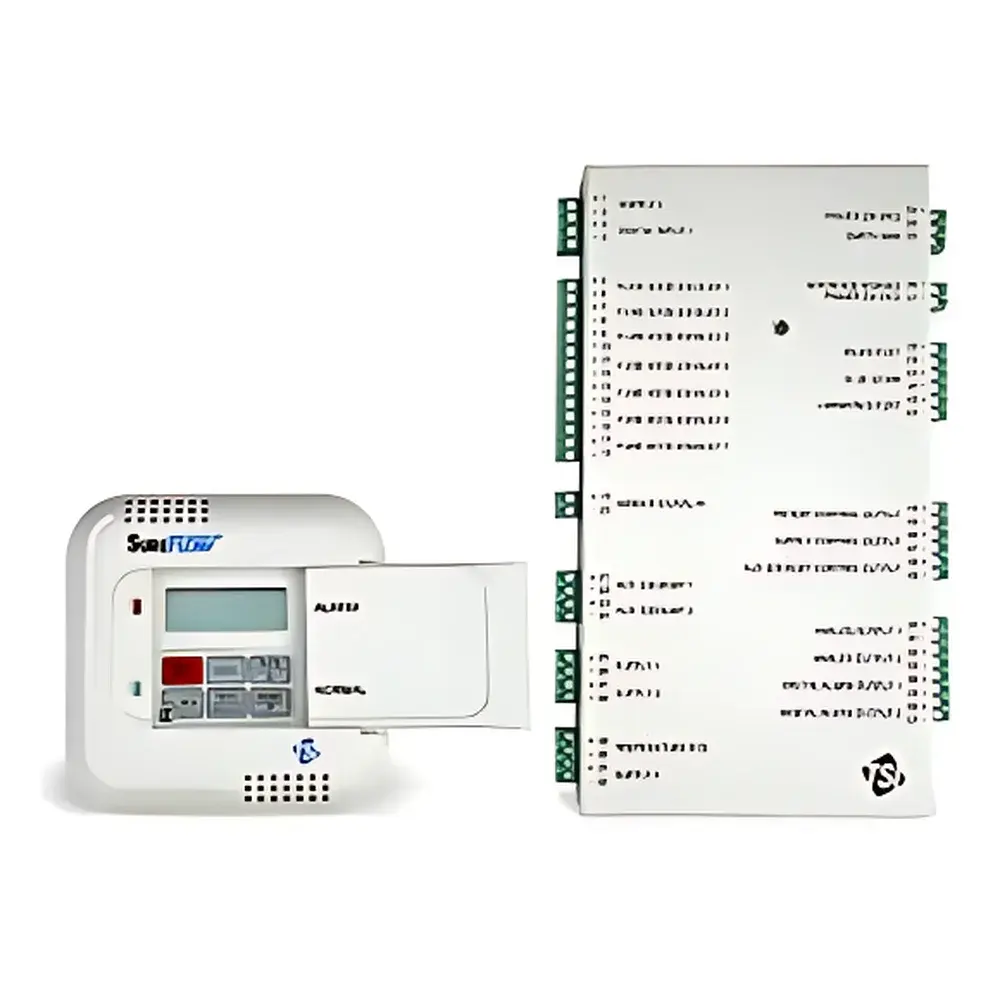
TSI SureFlow™ 8682-ST Static Pressure Controller
| Brand | TSI |
|---|---|
| Origin | USA |
| Model | 8682-ST |
| Control Channels | Up to 5 independent duct systems |
| Pressure Sensing | Differential pressure transducer input |
| Output Interfaces | Analog (4–20 mA / 0–10 V), Relay alarms, MODBUS RTU (RS-485) |
| Power Supply | 120 VAC to 24 VAC transformer included (25 VA) |
| Enclosure | NEMA 1 indoor-rated |
| Compliance | CE, RoHS |
| Software Integration | Compatible with BMS via open MODBUS protocol |
| Alarm Logic | Adjustable delay to suppress transient false alarms |
| Local Interface | Backlit keypad and LCD display with password-protected configuration |
Overview
The TSI SureFlow™ 8682-ST Static Pressure Controller is an engineered solution for precision static pressure regulation in HVAC and controlled environment applications—particularly laboratories, cleanrooms, and research facilities where stable duct static pressure is critical for safety, containment, and energy efficiency. Operating on the principle of closed-loop differential pressure feedback control, the 8682-ST continuously monitors static pressure across one or more duct sections using externally connected pressure transducers. It then dynamically modulates actuators—such as damper motors or variable frequency drives (VFDs)—to maintain user-defined setpoints within each of up to five independently configured control zones. Unlike pneumatic or analog-only controllers, the 8682-ST integrates digital signal processing, configurable alarm logic, and native MODBUS RTU communication, enabling deterministic, traceable, and auditable pressure management aligned with GLP and facility-wide building automation system (BAS) requirements.
Key Features
- Multi-Zone Static Pressure Regulation: Simultaneously controls static pressure in up to five discrete duct systems using independent setpoint, proportional-integral (PI) tuning, and output assignment per zone.
- Differential Pressure Input Flexibility: Accepts standard analog inputs (0–5 VDC, 0–10 VDC, or 4–20 mA) from calibrated differential pressure transducers; supports field-selectable sensor ranges to match application-specific full-scale requirements (e.g., ±0.1 in. w.c. to ±5.0 in. w.c.).
- Intelligent Alarm Management: Dual-stage visual (LED indicators) and audible (integrated buzzer) alerts activate when measured pressure deviates beyond programmable high/low thresholds; adjustable time-delay filter (0–300 seconds) prevents nuisance alarms during transient airflow events.
- BMS Integration Ready: Equipped with RS-485 serial interface supporting MODBUS RTU protocol—enabling bidirectional data exchange (setpoint read/write, status monitoring, alarm acknowledgment) with industry-standard DDCs, PLCs, and enterprise-level BAS platforms.
- Secure Local Configuration: Front-panel backlit LCD and membrane keypad support intuitive menu navigation; password protection (user-configurable) restricts access to calibration, setpoint, and I/O configuration functions—supporting operational integrity and audit readiness.
- Integrated Power & Interface Hardware: Includes UL-listed 120 VAC to 24 VAC, 25 VA transformer with 25 ft cable, digital I/O module, and DDC-compatible terminal block panel—reducing field wiring complexity and commissioning time.
Sample Compatibility & Compliance
The 8682-ST is designed for integration into low- to medium-pressure HVAC ductwork (typical range: ±0.05–±5.0 inches water column). It interfaces seamlessly with TSI and third-party NIST-traceable differential pressure sensors compliant with ASHRAE Guideline 1, ISO 14644-3, and ANSI/ASHRAE Standard 110. Its enclosure meets NEMA 1 specifications for indoor use in non-hazardous environments. Electromagnetic compatibility conforms to FCC Part 15 Class A and EN 61000-6-2/-6-4. The device supports configuration and operation under FDA 21 CFR Part 11–aligned workflows when deployed in regulated laboratory settings—particularly where electronic record integrity, user authentication, and change audit trails are required.
Software & Data Management
While the 8682-ST operates autonomously without PC dependency, its MODBUS RTU interface enables real-time data acquisition and remote parameter adjustment via supervisory software (e.g., Tridium Niagara, Siemens Desigo, or custom SCADA applications). All analog outputs (pressure measurement, control output signals) and discrete statuses (alarm states, valve position feedback) are addressable via standard MODBUS register mapping. Event logging—including alarm activation/deactivation timestamps, setpoint changes, and communication errors—is retained in volatile memory and accessible via MODBUS read commands. For facilities requiring long-term trend analysis, integration with cloud-based or on-premise data historians (e.g., Ignition, Canary Labs) is supported through gateway-enabled MODBUS-to-MQTT or MODBUS-to-BACnet translation.
Applications
- Research laboratory ventilation systems requiring stable negative or positive room pressure differentials per ISO 14644 and NIH Design Requirements.
- Fume hood exhaust networks where static pressure stability ensures consistent face velocity and containment performance.
- Pharmaceutical cleanroom air handling units (AHUs) needing coordinated duct pressure control across multiple supply and exhaust branches.
- University and government lab retrofits seeking centralized, scalable pressure management without replacing legacy damper actuators or VFDs.
- Energy optimization initiatives targeting fan power reduction via precise static pressure reset strategies across multi-zone systems.
FAQ
What pressure transducer types are compatible with the 8682-ST?
The controller accepts any analog-output differential pressure transducer with 0–5 VDC, 0–10 VDC, or 4–20 mA output; calibration and range scaling are performed locally via front-panel configuration.
Can the 8682-ST control both supply and exhaust ducts simultaneously?
Yes—each of the five control channels can be assigned independently to supply, exhaust, or recirculation ducts, with separate setpoints and output assignments.
Is MODBUS configuration supported out-of-the-box?
Yes—MODBUS RTU is enabled by default; no firmware update or licensing is required. Slave ID, baud rate (up to 115.2 kbps), parity, and stop bits are fully configurable.
Does the unit support fail-safe behavior upon loss of pressure signal?
Configurable “loss-of-signal” response includes hold-last-output, drive-to-minimum, or drive-to-maximum actuator positioning—programmable per channel.
How is calibration traceability maintained?
While the 8682-ST itself is not a measuring instrument, it preserves calibration integrity by accepting only externally certified transducer inputs; all configuration changes are logged with timestamp and operator ID when integrated with authenticated BMS platforms.