
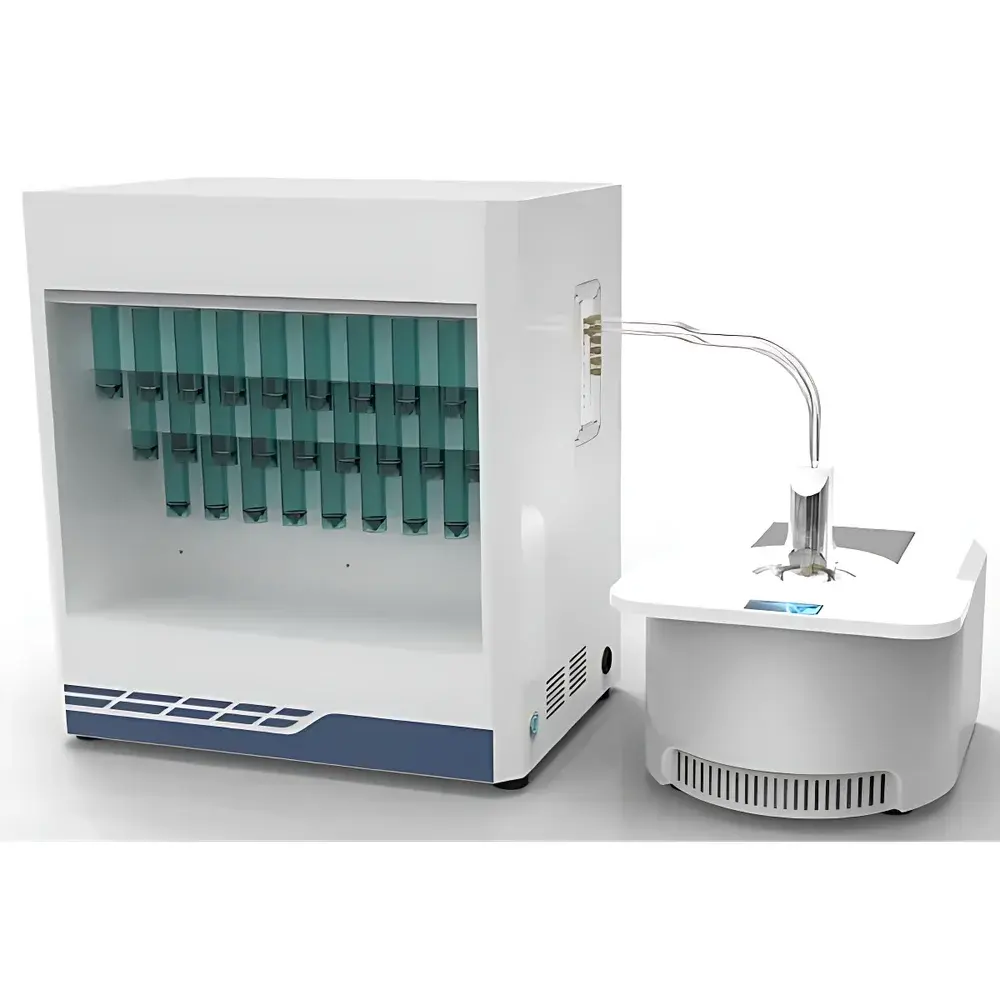
TSIKER Peptide Synthesizer Model 080 – Fully Automated Fmoc-Based Solid-Phase Peptide Synthesizer
| Brand | TSIKER |
|---|---|
| Origin | Beijing, China |
| Manufacturer Type | Direct Manufacturer |
| Origin Category | Domestic (China) |
| Model | 080 |
| Amino Acid Delivery | Fully Automated |
| Synthesis Scale | 0.025–5 mmol |
| Reactor Quantity | 1 |
| Reactor Volume Options | 10 mL, 30 mL, 125 mL, 200 mL |
Overview
The TSIKER Peptide Synthesizer Model 080 is a benchtop, fully automated solid-phase peptide synthesizer engineered for precision, reproducibility, and operational flexibility in research and early-stage GMP-adjacent peptide development laboratories. It implements the standard Fmoc (9-fluorenylmethyloxycarbonyl) strategy—widely adopted for its orthogonality, mild deprotection conditions, and compatibility with acid-labile side-chain protecting groups. The instrument performs iterative cycles of deprotection, coupling, washing, and capping within a sealed, inert reactor environment, minimizing exposure to moisture and atmospheric oxygen. Core fluidic architecture employs high-precision syringe pumps and chemically resistant solenoid valves to ensure accurate delivery of reagents—including amino acid solutions, activators (e.g., HBTU, DIC), bases (e.g., DIPEA), piperidine for Fmoc removal, and wash solvents (DMF, DCM, MeOH). Temperature is monitored in real time via integrated optical fiber probes positioned directly inside the reaction vessel, enabling closed-loop thermal feedback during exothermic coupling steps—a critical factor for suppressing racemization and improving coupling efficiency in sterically hindered sequences.
Key Features
- Fully automated amino acid addition with on-the-fly activation: Supports up to 20 standard natural amino acids pre-loaded in dedicated reservoirs; optional 10-position expansion module accommodates non-canonical or modified residues (e.g., phospho-serine, D-amino acids, N-methylated derivatives).
- Modular reactor system: Single-reactor configuration with interchangeable, solvent-resistant reaction vessels (10 mL, 30 mL, 125 mL, and 200 mL options), each fitted with a chemically inert composite lid compatible with aggressive reagents including trifluoroacetic acid (TFA) during cleavage preparation.
- Inert gas–assisted agitation: Uses nitrogen or argon sparging through a submerged porous frit to generate gentle yet uniform mixing—eliminating mechanical stirring artifacts and reducing resin bead attrition.
- Integrated waste management: 1 L corrosion-resistant waste reservoir equipped with optical overflow detection and automatic flow diversion to prevent cross-contamination or system shutdown.
- Real-time process monitoring: LED status panel provides immediate visual feedback for cycle phase, reagent delivery, temperature deviation, and error codes; all operational parameters logged timestamped and exportable.
- PC-based control interface: Windows-compatible software enables method creation, sequence import (FASTA or custom text), step-by-step protocol editing, and remote monitoring via Ethernet connection.
Sample Compatibility & Compliance
The Model 080 supports synthesis across a broad range of resin types—including Wang, Rink amide, 2-chlorotrityl, and Sieber amide resins—with loading capacities from 0.1 to 1.2 mmol/g. It accommodates both standard and low-loading resins used in difficult-sequence synthesis (e.g., aggregation-prone or hydrophobic peptides). All wetted components comply with USP Class VI biocompatibility standards and resist degradation by DMF, DCM, NMP, and TFA. While not certified for full GMP manufacturing, the system’s audit-trail-capable software, electronic signature support, and PDF report generation align with GLP and pre-GMP documentation requirements per FDA 21 CFR Part 11 guidelines. It meets ISO 9001:2015 design and manufacturing quality management standards as implemented by TSIKER.
Software & Data Management
The proprietary SynthOS™ control software runs on Windows 10/11 and provides intuitive drag-and-drop method building, real-time cycle progress visualization, and granular parameter logging (e.g., delivered volume ±1.5 µL accuracy, temperature drift <±0.3 °C, dwell times configurable in 1-second increments). Every synthesis run generates two machine-readable outputs: (1) a timestamped, digitally signed PDF report containing full reagent lot numbers, environmental logs, and step-by-step yield estimates; and (2) a structured CSV file for integration into LIMS or ELN platforms. Software updates are delivered via secure HTTPS; no cloud storage is used—data remains local unless explicitly exported by the user.
Applications
This synthesizer serves academic core facilities, biotech discovery labs, and contract research organizations engaged in epitope mapping, vaccine antigen production, peptide–protein interaction studies, and PROTAC linker optimization. Its scalable synthesis range (0.025–5 mmol) enables parallel optimization of coupling conditions for challenging sequences (e.g., poly-proline stretches, β-sheet aggregates) and rapid generation of mg-to-gram quantities for structural biology (NMR, crystallography) or pharmacokinetic profiling. Optional UV monitoring and HT resin loading modules extend utility toward high-throughput SAR screening and automated resin conditioning prior to synthesis.
FAQ
What synthesis chemistry does the Model 080 support?
It is optimized exclusively for Fmoc-based solid-phase synthesis; Boc chemistry is not supported due to incompatible deprotection solvent requirements.
Can the system perform real-time coupling monitoring?
Yes—when equipped with the optional UV monitoring module, it tracks ninhydrin or chloranil-based colorimetric assays at 570 nm or 620 nm to assess coupling completeness before proceeding to the next cycle.
Is remote operation possible?
Yes—the instrument supports TCP/IP communication and can be controlled over a local network using the SynthOS™ client; firewall-safe port configuration is included.
What maintenance intervals are recommended?
Valve and pump calibration is advised every 200 synthesis cycles or semiannually; full fluidic path cleaning with DMF and IPA is required after each synthesis batch involving strongly adsorbing residues (e.g., tryptophan-rich sequences).
Does the system support custom reagent protocols?
Yes—users may define non-standard reagents, alternative activator/base ratios, extended coupling durations, double couplings, or capping steps via editable method templates.





