
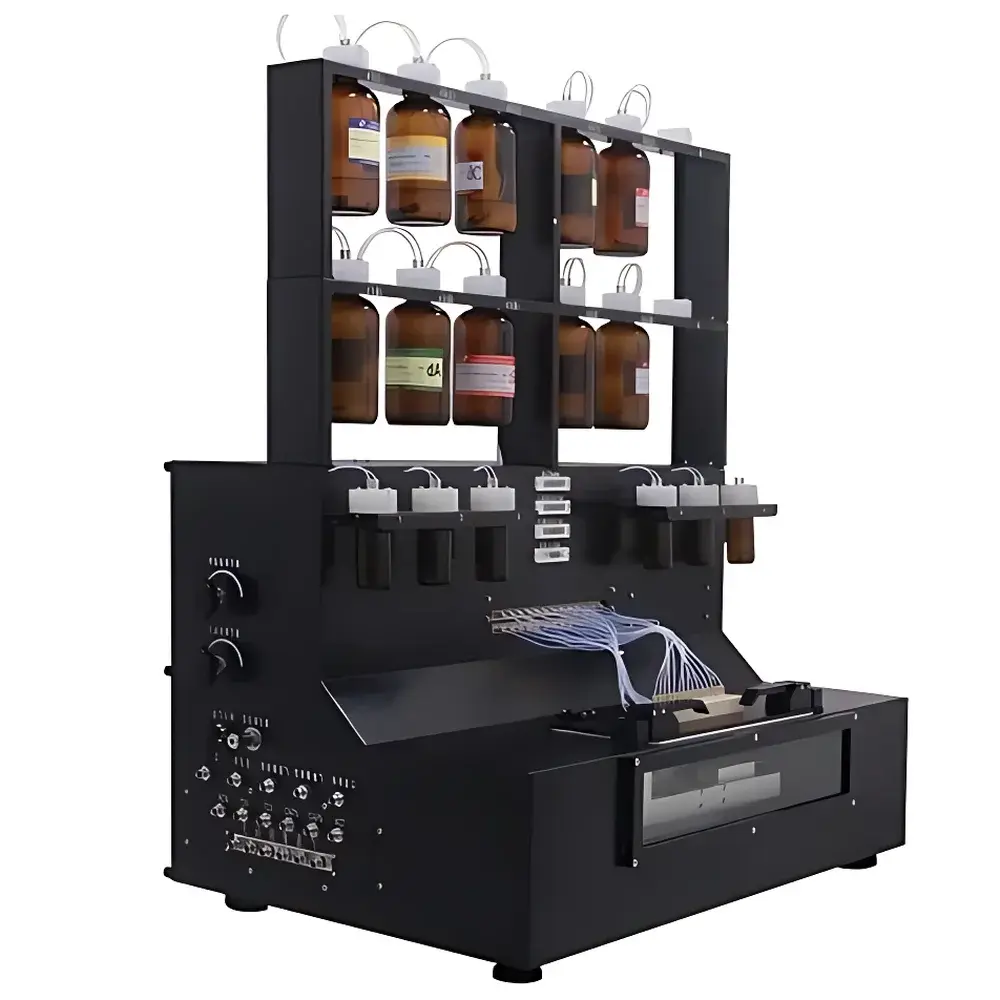
TSIKER Syn-HCY-12P Benchtop Solid-Phase Oligonucleotide Synthesizer
| Brand | TSIKER |
|---|---|
| Origin | Beijing, China |
| Manufacturer | Tsingke Biotech Co., Ltd. |
| Type | Low-throughput synthesizer |
| Coupling Efficiency | ≥99% |
| Max. Oligo Length | 200 nt |
| Channels | 12 independent synthesis columns |
| Scale Range | 10 nmol – 100 µmol per column |
| Cycle Time | ≤6 s per coupling step |
| Base Bottle Positions | 10–28 |
| Auxiliary Reagent Positions | 6–9 |
| Dimensions (L×W×H) | 850 × 550 × 1050 mm |
| Weight | 34 kg |
Overview
The TSIKER Syn-HCY-12P is a benchtop solid-phase oligonucleotide synthesizer engineered for precision, flexibility, and operational reliability in academic laboratories, diagnostic development units, and early-stage therapeutic oligonucleotide R&D environments. It implements standard phosphoramidite chemistry under inert gas (argon or nitrogen) atmosphere to synthesize unmodified and chemically modified single-stranded nucleic acids—including DNA, RNA, LNA, 2′-O-methyl, phosphorothioate (PS), dU, dI, and other non-canonical monomers. Its core architecture follows the iterative four-step cycle (detritylation, coupling, capping, oxidation/sulfurization), with real-time reaction chamber monitoring, fully isolated fluidic pathways per channel, and programmable reagent delivery logic (ACT simultaneous/alternating/mixed dispensing). Designed for low-to-moderate throughput needs, the instrument delivers up to 12 independent sequences per run—each synthesized at user-defined scales from 10 nmol to 100 µmol—with coupling efficiency consistently ≥99% across full-length 200-mer syntheses under optimized protocols.
Key Features
- Twelve physically isolated synthesis channels with dedicated reagent lines—eliminating cross-contamination and enabling concurrent synthesis of heterogeneous sequences (e.g., DNA + RNA + PS-modified probes) without manual intervention.
- Ultra-fast coupling kinetics: ≤6 seconds per phosphoramidite coupling step, enabling synthesis of a 60-mer oligo in under 90 minutes per column.
- Modular reagent management: 10–28 base bottle positions and 6–9 auxiliary reagent slots support complex modification schemes including dual-labeling, backbone modifications, and mixed-backbone designs.
- Corrosion-resistant reaction chamber with integrated waste level sensing and automated pause-on-full functionality—ensuring process integrity and operator safety.
- Transparent column carrier with real-time visual inspection capability for resin swelling, colorimetric DMT cleavage monitoring (optional), and manual troubleshooting.
- Multi-tier software security: Role-based access control with customizable operator/administrator privileges, password-protected method editing, and audit-trail-ready session logging compliant with GLP-aligned documentation practices.
- Fail-safe operation: Automatic power-down after synthesis completion, uninterruptible synthesis resume after power recovery, and on-the-fly program modification (pause/resume/edit mid-cycle).
- Inert gas enclosure with pressure-regulated argon/nitrogen purge maintains <5 ppm O₂ environment—critical for high-yield sulfurization and oxidation steps.
Sample Compatibility & Compliance
The Syn-HCY-12P supports synthesis of all standard and advanced nucleic acid chemistries used in molecular diagnostics, functional genomics, antisense therapeutics, and nanostructure assembly. Validated substrates include controlled-pore glass (CPG), polystyrene (PS), and oxalyl-functionalized supports. The system accommodates both standard and custom phosphoramidites, activators (e.g., DCI, BTT, ETT), oxidizers (I₂/H₂O/pyridine), sulfurizing agents (DdtT, Beaucage reagent), and capping solutions. All wetted materials comply with USP Class VI biocompatibility standards. While not pre-certified for GMP manufacturing, its architecture—combined with optional DMT quantification, reagent level sensors, and environmental monitoring modules—enables alignment with ISO 13485 quality system requirements and supports 21 CFR Part 11-compliant data integrity when deployed with validated software configurations and procedural controls.
Software & Data Management
The embedded Windows-based control interface features an intuitive drag-and-drop sequence editor, real-time cycle progress dashboard, and protocol versioning. Each synthesis run generates a timestamped log file containing reagent consumption records, pressure/temperature snapshots, error flags, and step-by-step execution metadata. Export formats include CSV and XML for integration into LIMS or ELN platforms. Audit trail functionality captures user login/logout events, parameter changes, and method revisions—supporting traceability in regulated research settings. Optional remote monitoring via Ethernet enables centralized fleet management across multi-instrument labs.
Applications
- High-fidelity probe synthesis for qPCR, digital PCR, and FISH assays requiring stringent purity and labeling consistency.
- Rapid prototyping of antisense oligonucleotides (ASOs), siRNA guide strands, and splice-switching morpholino analogs during target validation phases.
- Production of modified primers for next-generation sequencing library preparation, especially those incorporating terminal phosphates, spacers (e.g., C3, C6, Spacer 9, 18), or internal quenchers.
- On-demand synthesis of nucleic acid nanostructures (DNA origami staples, RNA tiles) where stoichiometric batch uniformity and scale flexibility are essential.
- Development of diagnostic panels involving multiplexed detection probes with orthogonal modifications (e.g., thiol-, azide-, or alkyne-functionalized termini for click chemistry conjugation).
FAQ
What types of nucleic acid modifications does the Syn-HCY-12P support?
It supports standard DNA/RNA synthesis as well as LNA, 2′-O-methyl, 2′-fluoro, phosphorothioate linkages, inverted dT, abasic sites, biotin, fluorescent dyes (FAM, Cy3, Cy5), and amino-/thiol-modified linkers—provided compatible phosphoramidites and corresponding activators/oxidizers are loaded.
Can I synthesize both DNA and RNA in the same run?
Yes—each of the 12 channels operates independently; different columns may be configured for DNA, RNA, or hybrid sequences using distinct reagent sets and cycle parameters.
Is the instrument suitable for GMP production?
It is designed for R&D and preclinical synthesis. For GMP manufacturing, additional qualification (IQ/OQ/PQ), change control procedures, and 21 CFR Part 11-compliant software validation would be required.
What maintenance is required for long-term reliability?
Routine maintenance includes quarterly fluidic line inspection, monthly DMT filter replacement (if equipped), annual pump calibration verification, and semiannual inert gas system leak testing—documented in the included service manual.
Does the system support third-party phosphoramidites and reagents?
Yes—no proprietary chemistry lock-in; all standard industry phosphoramidites, activators, and solvents (acetonitrile, dichloroacetic acid, etc.) are fully compatible when purity and concentration specifications are met.
Related Products




