
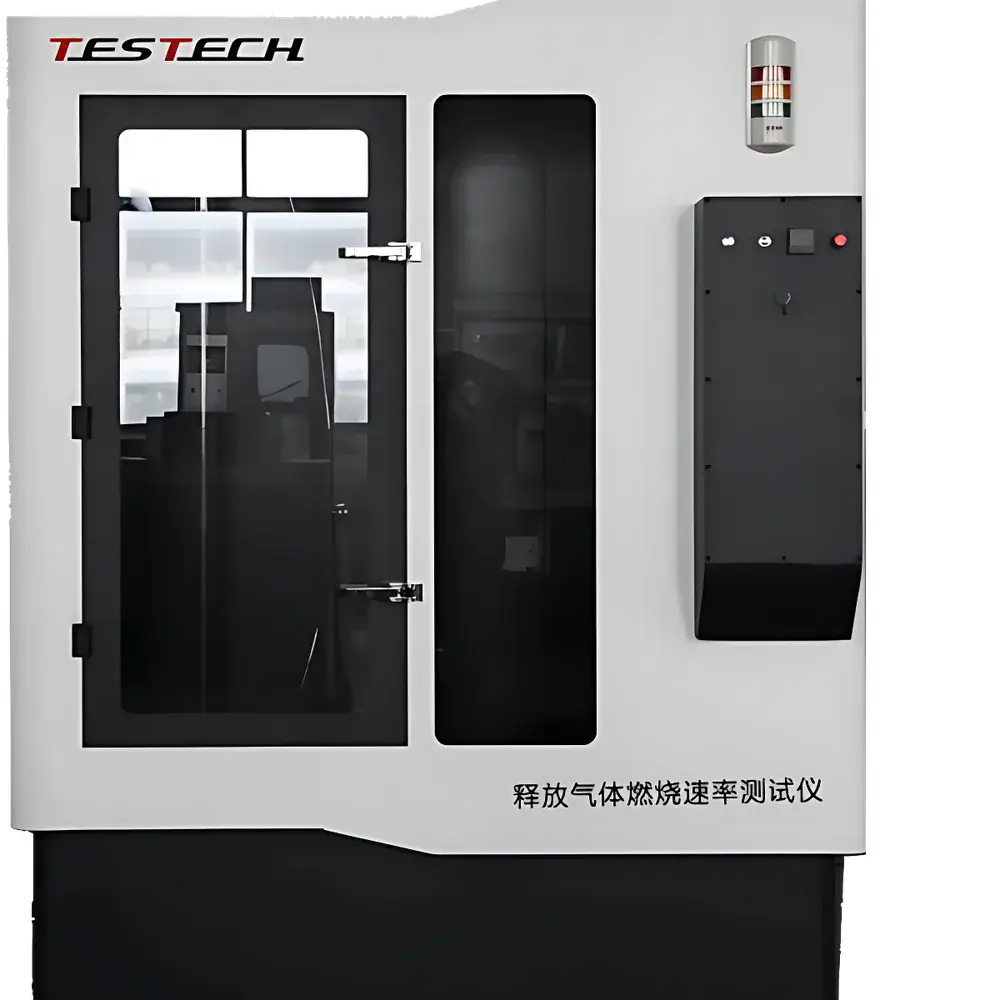
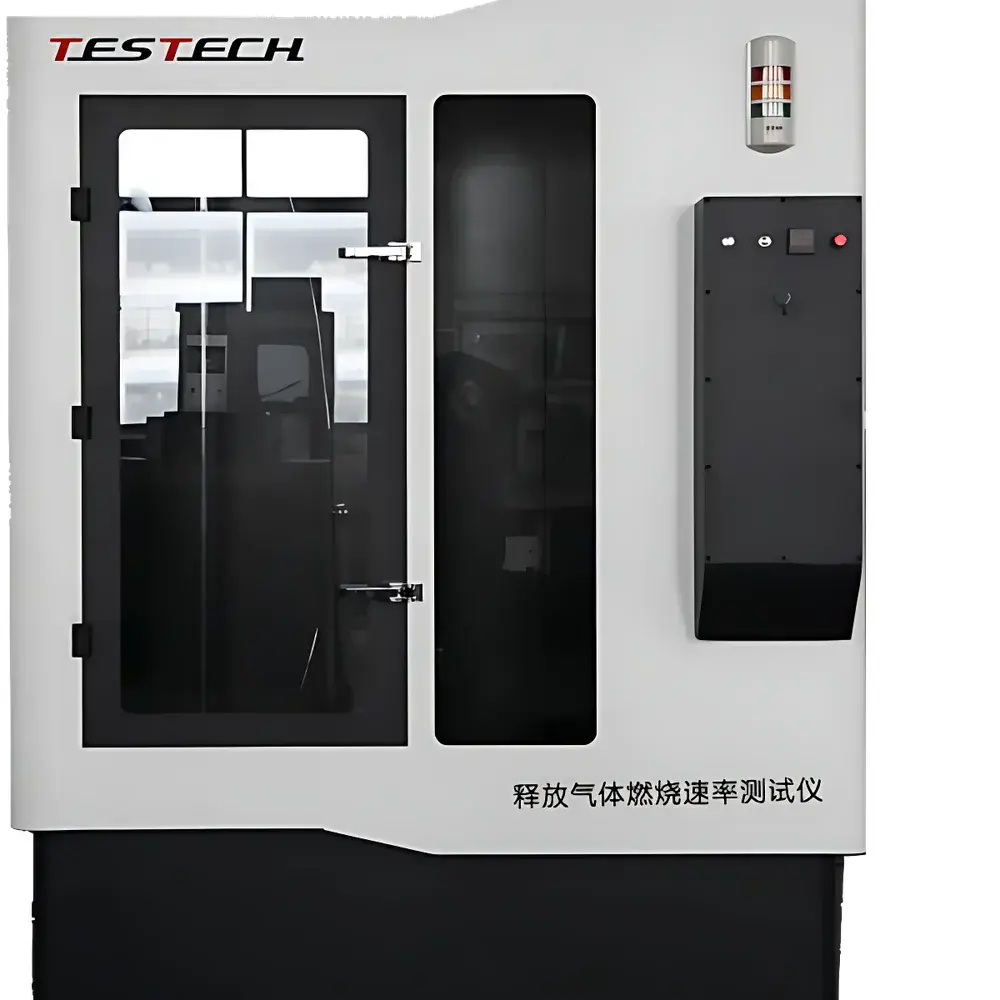
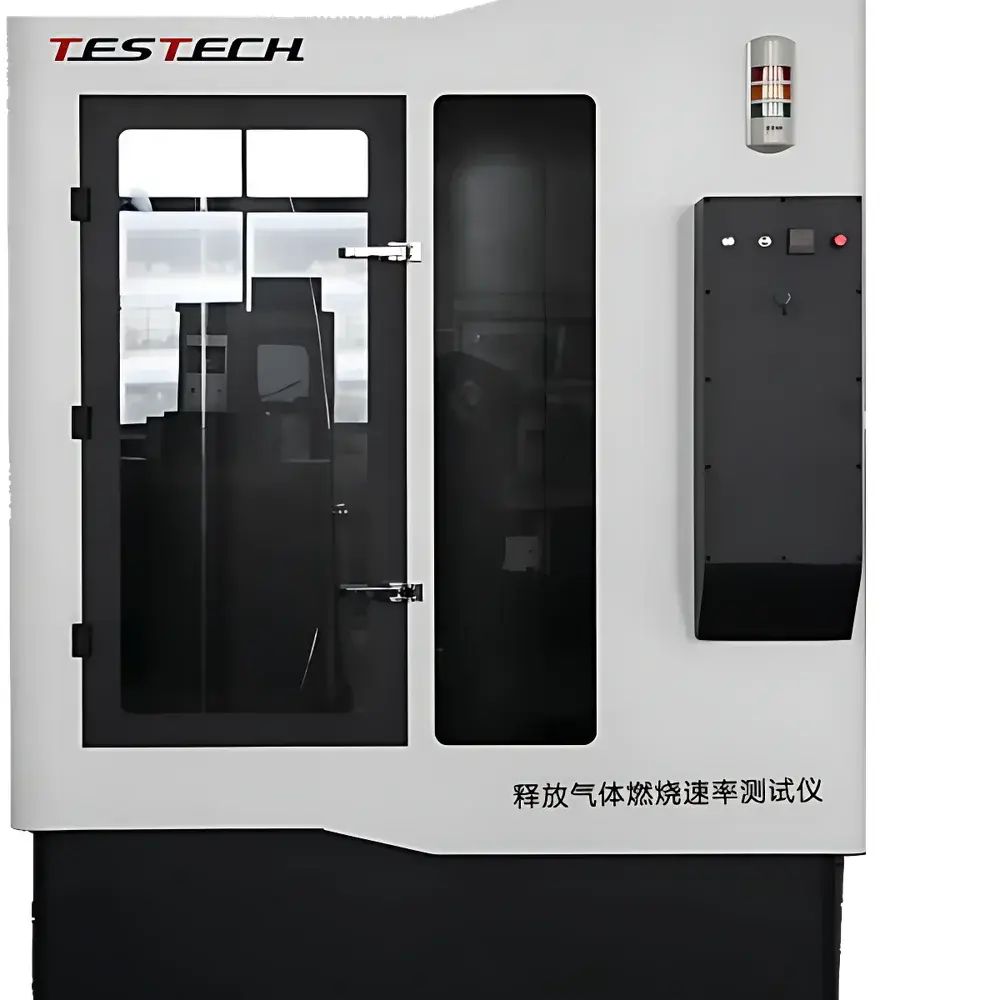
TTech ISO817 Laminar Flame Speed Measurement System
| Brand | TESTech |
|---|---|
| Model | TTech-ISO817-1 |
| Origin | Jiangsu, China |
| Manufacturer Type | Direct Manufacturer |
| Compliance Standard | ISO 817 Annex C, UL 9540A |
| Combustion Tube | Quartz glass, ID 40 mm, L 1.2 m |
| Ignition Electrodes | Tungsten wire (Ø1 mm), inter-electrode gap 6.4 mm |
| Imaging | High-speed industrial camera with flame front tracking software |
| Gas Mixing | Vacuum-assisted gas blending vessel with magnetic stirrer |
| Exhaust Treatment | Expansion chamber + acid-scrubbing wash bottle |
| Control Interface | PC-based virtual instrument platform with manual/automatic operation modes |
Overview
The TTech ISO817 Laminar Flame Speed Measurement System is a precision-engineered apparatus designed to determine the unstretched laminar burning velocity (SL0) of gaseous fuel–air mixtures under standardized conditions defined in ISO 817 Annex C and aligned with thermal runaway evaluation requirements in UL 9540A. It operates on the fundamental principle of upward-propagating flame propagation in a vertically oriented, quiescent, cylindrical combustion column—commonly referred to as the “flat-flame” or “counterflow-stabilized flame tube” method. In this configuration, a stoichiometric or lean-rich mixture is introduced at a controlled volumetric flow rate into a vertical quartz tube; ignition occurs at the base via spark discharge between tungsten electrodes, and the resulting laminar flame front ascends at a steady velocity determined by molecular diffusion, chemical kinetics, and thermal conduction. The system captures time-resolved flame morphology using synchronized high-speed imaging, enabling quantitative extraction of flame height evolution and subsequent derivation of SL0 through established correlations (e.g., the Markstein correlation for stretch-corrected velocity). This measurement is critical for characterizing flammability limits, validating kinetic mechanisms, and assessing venting design parameters in lithium-ion battery thermal runaway gas analysis.
Key Features
- Quartz combustion tube (ID 40 mm × L 1.2 m) offering optical clarity, thermal stability up to 1000 °C, and chemical inertness toward halogenated and hydrocarbon decomposition products.
- High-precision ignition assembly featuring dual tungsten electrodes (Ø1 mm) mounted symmetrically at the tube base with fixed 6.4 mm inter-electrode spacing, ensuring repeatable spark energy delivery and minimal flame anchoring disturbance.
- Integrated high-speed imaging subsystem (≥1 kHz frame rate) coupled with calibrated backlighting and proprietary flame edge detection algorithms for sub-millimeter spatial resolution in flame height tracking.
- Vacuum-assisted gas mixing station including stainless steel blending vessel, digital pressure transducers (±0.1% FS), vacuum pump (ultimate pressure ≤1 Pa), and magnetic stirrer—enabling precise preparation of multi-component gas mixtures (e.g., H2, CO, CH4, C2H4, HF, COF2) representative of LIB thermal decomposition effluents.
- Dual-stage exhaust treatment: primary expansion chamber mitigates backpressure fluctuations during transient combustion events; secondary acid-scrubbing wash bottle (filled with NaOH solution) neutralizes corrosive species such as HF and POF3 prior to safe atmospheric release.
- Modular control architecture based on LabVIEW™-driven virtual instrumentation, supporting both manual stepwise operation and automated sequence execution—including pre-purge, mixture stabilization, ignition timing, image acquisition trigger, and post-test purge cycles.
Sample Compatibility & Compliance
The TTech ISO817 system accommodates gaseous samples within standard ambient temperature and pressure (SATP) ranges, with compatibility extending to reactive mixtures containing hydrogen, hydrocarbons, carbon monoxide, and battery-specific off-gases (e.g., ethylene, vinyl fluoride, phosphorus oxyfluoride). All operational protocols adhere strictly to ISO 817:2022 Annex C (“Determination of laminar burning velocity using a cylindrical tube method”) and support data generation compliant with UL 9540A Section 9.3.2 for cell/module-level flammability assessment. The hardware design incorporates fail-safe interlocks (pressure, temperature, flame presence) and conforms to IEC 61000-6-2/6-4 electromagnetic compatibility standards. Documentation packages include traceable calibration records for pressure sensors and timing synchronization modules, facilitating GLP-compliant reporting and internal audit readiness.
Software & Data Management
Data acquisition and analysis are executed via a dedicated Windows-based application built on NI LabVIEW™ 2022. The software provides real-time monitoring of inlet pressure, mixture composition setpoints, ignition status, and frame-trigger synchronization signals. Post-acquisition, flame height vs. time curves are automatically generated from binary edge maps; SL0 is calculated using the classical relation SL0 = dH/dt × (ρu/ρb), where H is flame height, t is time, and ρu/ρb denotes unburned-to-burned gas density ratio derived from adiabatic flame temperature calculations. Raw video files (AVI/MXF), metadata logs (CSV), and processed results (PDF reports with uncertainty estimates per GUM guidelines) are stored in a hierarchical folder structure. Audit trails record user login, parameter changes, and test initiation—supporting FDA 21 CFR Part 11 compliance when deployed in regulated QA/QC environments.
Applications
- Quantitative flammability ranking of thermal runaway gases emitted from NMC, LFP, and solid-state battery cells under overcharge, crush, or thermal ramp conditions.
- Validation of detailed chemical kinetic models (e.g., San Diego Mechanism, AramcoMech) against experimental SL0 data across equivalence ratios (φ = 0.7–1.4) and initial temperatures (298–450 K).
- Supporting NFPA 855 and IEC 62933-5-2 safety code development for stationary energy storage systems (ESS) by generating input parameters for CFD-based vent sizing simulations.
- Research into flame inhibition mechanisms of novel electrolyte additives (e.g., fluorinated phosphates, ionic liquids) via comparative SL0 suppression analysis.
- Material safety data sheet (MSDS) enhancement for battery manufacturers requiring third-party verified combustion properties of off-gas surrogates.
FAQ
What standards does the TTech-ISO817-1 directly implement?
It is engineered to fulfill the experimental methodology specified in ISO 817:2022 Annex C and supports test execution aligned with UL 9540A Clause 9.3.2 for lithium battery thermal runaway gas characterization.
Can the system measure flame speed for non-stoichiometric mixtures?
Yes—gas blending controls allow continuous variation of equivalence ratio (φ) from 0.6 to 1.6, with automatic correction of SL0 for thermal expansion effects via real-time density ratio computation.
Is remote operation supported?
The system includes Ethernet-enabled I/O modules and supports secure remote desktop access for monitoring and limited control; however, ignition and gas handling operations require local safety supervision per institutional risk assessments.
How is flame propagation velocity calculated from image data?
Using edge-detection algorithms applied to grayscale intensity gradients, the software identifies the leading flame tip position frame-by-frame; linear regression of height vs. time yields the propagation rate, which is then corrected for stretch and buoyancy per ISO 817 Annex C procedures.
Does the system include calibration certificates for critical sensors?
Each unit ships with NIST-traceable calibration certificates for pressure transducers and timing synchronization modules, valid for 12 months from commissioning date.






