
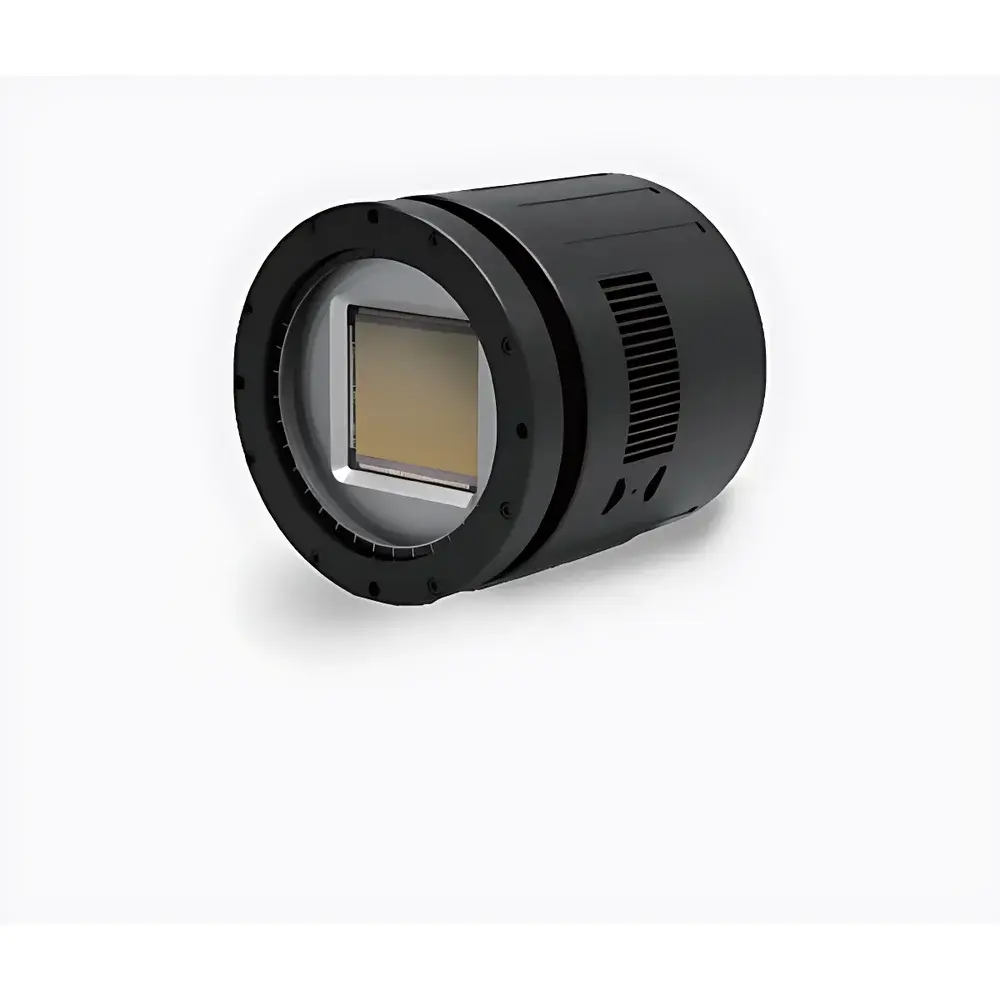
Tucsen Dhyana 6060BSI 5.4-inch Back-Illuminated sCMOS Scientific Camera
| Brand | Tucsen |
|---|---|
| Origin | Fujian, China |
| Model | Dhyana 6060BSI |
| Image Resolution | 6144(H) × 6144(V) |
| Pixel Size | 10 µm × 10 µm |
| Sensor Format | 5.4-inch |
| Readout Speed | 44 fps (full resolution, 12-bit STD) |
| Onboard Memory | 16 GB |
| Dynamic Range | 90 dB |
| Quantum Efficiency | 95% @ 580 nm |
| Full Well Capacity | 102 ke⁻ |
| Read Noise | 3 e⁻ |
| Dark Current | 0.2 e⁻/s/pixel @ −20 °C |
| Cooling | Air/Water |
| Shutter Type | Rolling |
| Bit Depth | 12/14/16-bit |
| Interface | CXP-12 |
| Trigger Latency Adjustment | 0–10 s (1 µs step) |
| GPS Timestamp Accuracy | <20 µs |
| Binning Modes | 2×2, 4×4 |
| Power Supply | 12 V / 8 A |
| Max Power Consumption | <80 W |
| Dimensions | Ø160 mm × 164 mm |
| Weight | ≤4 kg |
Overview
The Tucsen Dhyana 6060BSI is a high-performance back-illuminated scientific CMOS (sCMOS) camera engineered for demanding low-light imaging applications in life sciences, astronomy, and physical research. Built around a monolithic 5.4-inch sCMOS sensor, it delivers exceptional photon detection efficiency—95% quantum efficiency at 580 nm—enabling quantitative fluorescence, single-molecule localization microscopy (SMLM), and long-exposure astrophotography with minimal signal loss. Its large-format sensor provides a native field of view exceeding 61 mm × 61 mm (at 10 µm pixel pitch), eliminating the need for image tiling in wide-field applications such as light-sheet microscopy or macroscopic tissue imaging. The camera operates on a true scientific architecture: global trigger synchronization, hardware-timestamped acquisition, sub-microsecond timing control, and calibrated linearity across its full 16-bit dynamic range—all compliant with ISO 15739:2013 for noise and dynamic range characterization.
Key Features
- Back-illuminated sCMOS architecture: Optimized for maximum QE across visible to near-UV (350–850 nm), with peak response at 580 nm—critical for GFP, RFP, and Cy dyes.
- Large 5.4-inch sensor format: 6144 × 6144 active pixels with 10 µm square pixels yield a 61.44 mm × 61.44 mm photosensitive area—ideal for high-magnification wide-field objectives and telecentric lens systems.
- High dynamic range & low noise: 90 dB dynamic range (measured per ISO 15739), 3 e⁻ read noise (12-bit STD mode), and 102 ke⁻ full-well capacity enable simultaneous capture of dim and saturated features without clipping or gain switching artifacts.
- Precision timing infrastructure: Integrated GPS timecode (<20 µs accuracy), programmable trigger latency (0–10 s, 1 µs resolution), and multiple TTL-compatible trigger outputs (exposure, global reset, readout, logic high/low) support synchronized multi-camera or multi-instrument setups under GLP/GMP audit conditions.
- Flexible cooling & environmental control: Dual-mode thermal management (forced-air or water-cooling) maintains sensor temperature stability at −20 °C (±0.1 °C), reducing dark current to 0.2 e⁻/s/pixel—essential for exposures up to 300 seconds.
- Industrial-grade interface & reliability: CXP-12 (CoaXPress v2.0) interface ensures deterministic real-time data transfer at up to 12.5 Gbps per lane; 16 GB onboard frame buffer enables burst acquisition during host I/O bottlenecks.
Sample Compatibility & Compliance
The Dhyana 6060BSI is compatible with standard F-mount optical systems and supports mechanical and electronic shutter coordination via SMA-triggered input/output. Its monochrome design eliminates Bayer interpolation artifacts, ensuring spatial fidelity required for super-resolution techniques (e.g., STORM, PALM) and quantitative intensity measurements. The camera complies with CE, FCC, and RoHS directives. Firmware and SDK adhere to NIH ImageJ/Fiji plugin architecture and support FDA 21 CFR Part 11-compliant audit trails when integrated with validated laboratory information management systems (LIMS). Calibration metadata—including gain, offset, linearity, and dark frame profiles—is embedded in FITS and TIFF headers per IAU FITS Standard v4.0 and DICOM Supplement 171 for biomedical imaging archives.
Software & Data Management
Tucsen provides a cross-platform SDK supporting Windows (x64) and Linux (Ubuntu LTS, CentOS 7+), with native bindings for Python (NumPy/Pillow), MATLAB, LabVIEW, and C/C++. Acquisition software includes SamplePro (Windows) and command-line tools for headless operation in HPC environments. All raw frames are saved in lossless 16-bit TIFF or FITS format with embedded EXIF/FITS keywords (EXPTIME, DATE-OBS, INSTRUME, DETECTOR, GAIN, TEMPERAT). Time-stamped metadata is recorded at hardware level and preserved through post-processing pipelines—enabling traceability for ISO/IEC 17025-accredited laboratories. Optional integration with third-party platforms (MaxIm DL, MicroManager, NIS-Elements) supports automated acquisition sequences with metadata tagging aligned to MIAME and MIAPE reporting standards.
Applications
- Single-molecule fluorescence tracking and colocalization analysis
- Light-sheet fluorescence microscopy (LSFM) of cleared tissues and organoids
- Adaptive optics-assisted solar and planetary astronomy
- Time-resolved spectroscopy with gated or delayed-integration modes
- Quantitative phase imaging (QPI) and digital holographic microscopy
- High-throughput screening using wide-field epifluorescence or transmitted-light modalities
FAQ
What is the effective sensor size and why does it matter for optical system design?
The 5.4-inch diagonal corresponds to a 61.44 mm × 61.44 mm active area. This large format reduces magnification requirements and increases étendue tolerance—allowing use with lower NA objectives while preserving resolution and signal-to-noise ratio.
Does the camera support hardware binning or only software binning?
Hardware binning is not implemented; however, on-sensor region-of-interest (ROI) readout and 2×2/4×4 pixel summation in firmware provide equivalent SNR gains without sacrificing flexibility in ROI placement or timing control.
Is the CXP-12 interface compatible with existing CoaXPress frame grabbers?
Yes—the camera conforms to CoaXPress v2.0 specification and is interoperable with certified grabbers from Euresys, Bitflow, and Active Silicon, provided they support 12.5 Gbps link rates and GenICam 3.x compliance.
How is calibration traceability maintained for regulatory submissions?
Each unit ships with NIST-traceable dark, flat-field, and linearity calibration reports. Firmware embeds calibration timestamps and sensor ID in every image header, satisfying ALCOA+ principles (Attributable, Legible, Contemporaneous, Original, Accurate, Complete, Consistent, Enduring, Available) for FDA/EMA audits.
Can the camera operate continuously at −20 °C using air cooling alone?
Air cooling achieves stable −20 °C only in ambient temperatures ≤22 °C with adequate airflow (>2 m/s); for sustained operation above 25 °C ambient or in enclosed enclosures, water cooling (8–12 L/min, 18–22 °C inlet) is recommended to maintain thermal equilibrium and dark current specifications.





