
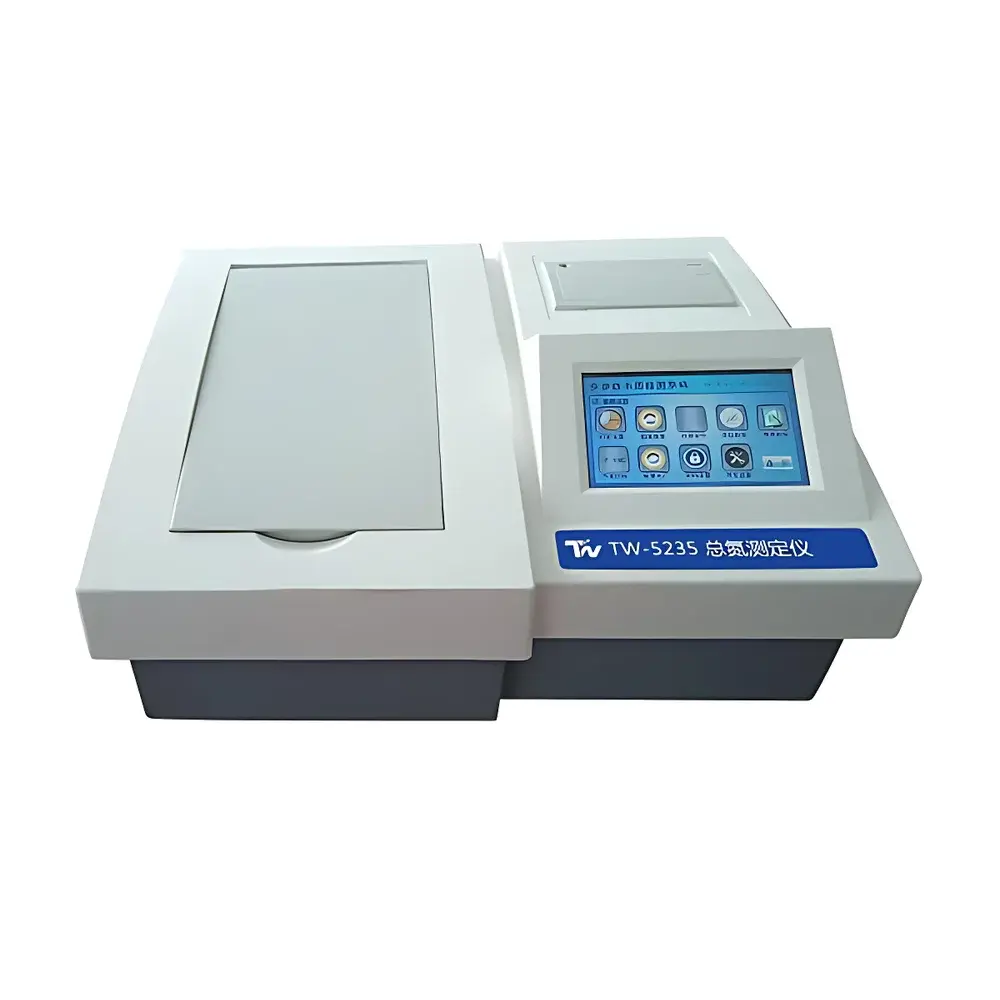
TUNE VOLT TW-5235 Total Nitrogen Analyzer
| Brand | TUNE VOLT |
|---|---|
| Model | TW-5235 |
| Origin | Beijing, China |
| Measurement Range | 0.05–100 mg/L (three sub-ranges: 0–1, 1–10, 10–100 mg/L) |
| Accuracy | ±5% or ±0.2 mg/L (whichever is greater) |
| Repeatability | ≤±3% |
| Chloride Interference Tolerance | ≤2000 mg/L |
| Digestion Temperature | 125 °C (adjustable from ambient to 180 °C) |
| Digestion Time | 30 min |
| Optical Drift | <0.002 A over 20 min |
| Dimensions | 400 × 310 × 158 mm |
| Weight | 5 kg |
| Display | Backlit LCD with Chinese menu interface |
| Data Storage | 10 calibration curves + 99 measurement records (non-volatile memory) |
| Connectivity | USB port for data export |
| Output | Integrated thermal printer |
| Light Source | High-brightness, long-life (100,000 h) imported LED |
Overview
The TUNE VOLT TW-5235 Total Nitrogen Analyzer is a benchtop spectrophotometric instrument engineered for accurate, reliable quantification of total nitrogen (TN) in aqueous environmental and industrial samples. It operates on the alkaline potassium persulfate digestion–UV spectrophotometric principle: all nitrogen species—including organic nitrogen, ammonia, nitrite, and nitrate—are oxidized to nitrate under high-temperature alkaline conditions (125 °C, 30 min), followed by UV absorption measurement at 220 nm. The system integrates a dedicated PID-controlled digestion module and an optical detection unit in a physically separated architecture—ensuring thermal isolation of sensitive photometric components and enhancing long-term baseline stability. Designed for compliance with standard methods such as HJ 636–2012 (China) and aligned with the technical intent of ISO 11905-1 (Water quality — Determination of nitrogen — Part 1: Total nitrogen after acid digestion), the analyzer delivers reproducible results across diverse matrices including surface water, wastewater effluent, drinking water pre-treatment streams, and industrial process water.
Key Features
- Modular dual-unit design: Independent high-precision digestion block and optical measurement head minimize thermal cross-talk and extend photometric system service life.
- PID temperature control with ±0.5 °C stability across 25–180 °C range; factory-optimized at 125 °C for complete TN oxidation per regulatory digestion protocols.
- Imported high-luminance LED light source (rated lifetime ≥100,000 h) coupled with precision optical filters and low-drift detector electronics—ensuring absorbance repeatability ≤±3% and 20-min drift <0.002 A.
- Large backlit LCD display with intuitive Chinese-language menu navigation; supports real-time status monitoring, parameter setting, and on-screen result review without external software.
- Non-volatile memory stores up to 10 user-defined or factory-loaded calibration curves and 99 measurement records—including sample ID, date/time stamp, measured concentration, and operator notes—with full retention during power loss.
- Integrated thermal printer enables immediate hard-copy output of results, calibration logs, and QC checks—supporting GLP-aligned documentation practices.
- Standard USB 2.0 interface facilitates secure, cable-based data transfer to Windows-based laboratory PCs; exported files are compatible with common spreadsheet and LIMS import formats (CSV, TXT).
Sample Compatibility & Compliance
The TW-5235 accommodates liquid samples with suspended solids ≤50 mg/L and chloride concentrations up to 2000 mg/L without requiring pre-dilution or masking agents—enabling direct analysis of municipal wastewater, leachate, and pretreated industrial discharges. Sample volume requirement is 10 mL per test. The instrument meets core performance criteria referenced in national standard HJ 636–2012 and demonstrates method equivalence to EPA Method 351.2 (Total Kjeldahl Nitrogen via persulfate digestion) when operated under validated conditions. Its hardware architecture and firmware logic support audit-ready operation: all calibration events, measurement timestamps, and curve parameters are logged internally and exportable. While not certified to FDA 21 CFR Part 11 out-of-the-box, the device’s deterministic data flow, non-editable record structure, and time-stamped traceability align with foundational ALCOA+ principles for regulated environmental testing laboratories.
Software & Data Management
No proprietary PC software is required for basic operation—the instrument functions autonomously with embedded firmware. However, raw data export via USB yields timestamped, tab-delimited text files containing sample ID, measurement date/time, absorbance values, applied curve ID, and final TN concentration (mg/L). These files integrate natively into Excel, LabArchives, or custom LIMS platforms. All stored curves retain their slope, intercept, correlation coefficient (r²), and validation date. Memory management includes overwrite protection for the most recent 10 records unless manually cleared, and curve deletion requires password-level confirmation to prevent accidental loss of method integrity.
Applications
- Regulatory compliance monitoring for municipal wastewater treatment plants (WWTPs) reporting to local environmental authorities.
- In-process control of denitrification efficiency in activated sludge and MBR systems.
- Baseline and trend analysis of TN loading in rivers, lakes, and reservoirs under national surface water quality assessment programs.
- QC/QA verification of nitrogen removal performance in industrial pretreatment units (e.g., food processing, pharmaceutical manufacturing, textile dyeing).
- Research-grade nutrient profiling in university environmental science and civil engineering laboratories.
- Field-deployable use in mobile labs due to compact footprint (400 × 310 × 158 mm) and low mass (5 kg).
FAQ
What digestion method does the TW-5235 employ?
It uses alkaline potassium persulfate oxidation at 125 °C for 30 minutes—consistent with HJ 636–2012 and ISO 11905-1 requirements.
Can the instrument measure samples with high chloride content?
Yes—interference is suppressed up to 2000 mg/L Cl⁻ without additional reagents or dilution.
Is the calibration curve editable or uploadable from a computer?
Calibration curves may be created, edited, and saved directly on-device using standard reference standards; external curve import is not supported.
Does the thermal printer support label paper or only plain receipt paper?
It accepts standard 57-mm-wide thermal roll paper (80 g/m²); no adhesive labels or custom media formats are compatible.
What maintenance intervals are recommended for routine operation?
Optical path cleaning every 2 weeks; digestion block inspection and O-ring replacement annually; LED intensity verification every 12 months using NIST-traceable absorbance standards.







