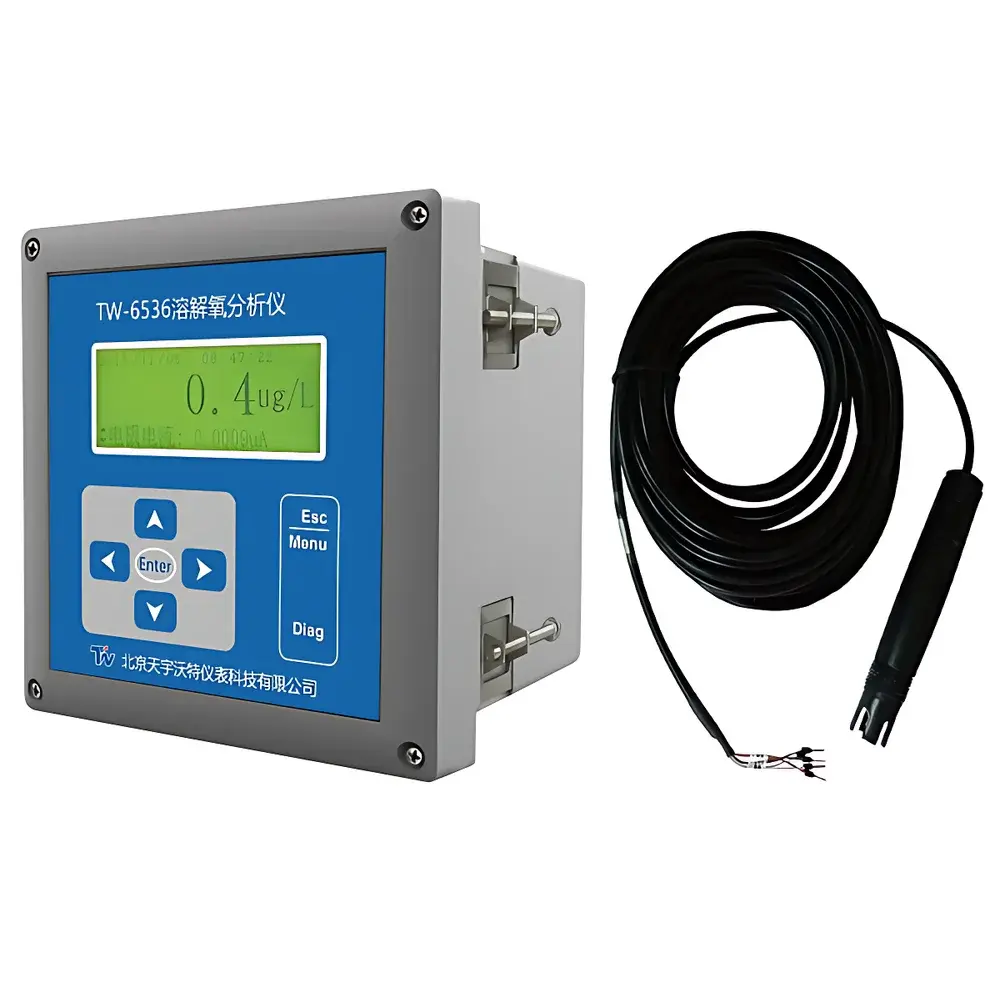
TUNE VOLT TW-6536(W) Online Dissolved Oxygen Analyzer
| Brand | TUNE VOLT |
|---|---|
| Origin | Beijing, China |
| Model | TW-6536(W) |
| Measurement Range | 0–20 mg/L |
| Resolution | 0.01 mg/L |
| Repeatability | ±1% FS |
| Stability | ±1% FS |
| Temperature Compensation Range | 5–50 °C |
| Communication Interface | RS485 (optional) |
| Dimensions | 155 mm × 155 mm × 140 mm (W × H × D) |
| Operating Ambient Temperature | 0–60 °C |
| IP Rating | IP65 |
| Output | Dual isolated 4–20 mA |
| Display | 192 × 64 dot-matrix LCD (bilingual Chinese/English) |
| Data Storage | 100,000 historical data points, 1,000 operation logs, 100 calibration records |
Overview
The TUNE VOLT TW-6536(W) Online Dissolved Oxygen Analyzer is a microprocessor-based, industrial-grade electrochemical measurement system engineered for continuous, real-time monitoring of dissolved oxygen (DO) concentration in aqueous process streams. It employs polarographic (Clark-type) or optical luminescence sensing principles—configurable per electrode module—enabling high-fidelity DO quantification across wastewater treatment plants, bioreactors, drinking water distribution networks, and industrial cooling circuits. The analyzer integrates signal conditioning, temperature compensation, digital communication, and local visualization into a single compact enclosure, conforming to IEC 61000-6-2/6-4 EMC requirements and designed for uninterrupted operation under demanding environmental conditions. Its dual-range capability (0–100 µg/L and 0–20 mg/L, auto-switched) ensures accurate detection from trace-level hypoxia to supersaturated oxygenation scenarios, supporting compliance with ISO 5814, ASTM D888, and EN 25814 standards for dissolved oxygen measurement.
Key Features
- High-resolution 192 × 64 dot-matrix graphical LCD with user-selectable bilingual interface (English/Chinese), enabling intuitive navigation and multi-parameter visualization—including real-time DO value, temperature, status flags, and alarm indicators.
- Embedded ARM Cortex-M4 processor architecture with surface-mount technology (SMT) PCB assembly, delivering enhanced thermal stability, long-term drift resistance, and robust immunity to electromagnetic interference (EMI).
- Dual isolated 4–20 mA analog outputs, independently configurable for DO concentration and/or temperature, each compliant with NAMUR NE43 fault signaling and supporting load impedances up to 800 Ω.
- Programmable temperature compensation using integrated Pt1000 or thermistor-based sensor (±0.5 °C accuracy), supporting both automatic and manual modes across 0–50 °C range to correct for oxygen solubility variations per ISO 5814 Annex A.
- IP65-rated front panel housing with reinforced polycarbonate bezel and silicone-sealed membrane keypad, certified for installation in humid, dusty, or splash-prone industrial environments.
- Comprehensive event logging system storing 100,000 timestamped DO measurements, 1,000 operational events (e.g., power cycles, mode changes), and 100 full calibration records—including date/time, calibration type (zero/span), electrode ID, and operator notes.
- Two programmable relay outputs (5 A @ 30 VDC / 250 VAC) supporting high/low limit alarms, maintenance alerts, or interlock signaling to SCADA or PLC systems.
Sample Compatibility & Compliance
The TW-6536(W) is validated for use with municipal and industrial wastewater, activated sludge effluents, potable water, boiler feedwater, and fermentation broths within pH 4–10 and conductivity < 5 mS/cm. It accommodates standard 12 mm or 16 mm diameter DO electrodes with integrated temperature sensors (e.g., TUNE VOLT DO-200 series). All wetted materials comply with USP Class VI and FDA 21 CFR 177.2600 for indirect food contact where applicable. The instrument meets CE marking requirements under the Low Voltage Directive (2014/35/EU) and EMC Directive (2014/30/EU), and supports audit-ready documentation for GLP/GMP environments through secure calibration traceability and immutable log export via RS485 Modbus RTU protocol.
Software & Data Management
Data acquisition and configuration are managed via built-in firmware supporting Modbus RTU over RS485 (optional), enabling seamless integration into existing DCS, SCADA, or IIoT platforms. Configuration parameters—including measurement units, damping time (1–60 s), alarm hysteresis, and output scaling—are accessible through the front-panel menu or remotely via standard Modbus function codes (03h/06h/10h). Historical datasets can be exported in CSV format using optional PC utility software, preserving ISO 8601 timestamps and metadata required for regulatory review. Audit trails include user authentication (via password-protected access levels), calibration verification timestamps, and change logs—all retained locally without cloud dependency.
Applications
- Real-time DO control in aerobic biological treatment stages (e.g., activated sludge, MBR, SBR) to optimize aeration energy consumption and nitrification efficiency.
- Monitoring oxygen saturation in pharmaceutical clean steam condensate loops per USP <643> and EP 2.2.43.
- Process validation in beverage production lines (e.g., carbonated soft drinks, beer) where residual DO impacts shelf-life and flavor stability.
- Early detection of anaerobic conditions in sewer force mains or lift stations to prevent hydrogen sulfide generation.
- Quality assurance in semiconductor ultrapure water (UPW) distribution systems meeting SEMI F63 specifications for DO ≤ 10 ppb.
FAQ
What electrode types are compatible with the TW-6536(W)?
The analyzer supports industry-standard polarographic (membrane-covered Clark cell) and optical luminescent DO sensors with analog 4–20 mA or digital (RS485/Modbus) output interfaces. TUNE VOLT DO-200 and DO-300 series electrodes are factory-calibrated and recommended for optimal performance.
Does the unit support automatic calibration?
No—calibration requires manual intervention using zero-oxygen (sodium sulfite) and saturated-air (or Winkler titration-verified) standards. However, all calibration parameters, dates, and operator IDs are automatically logged and retrievable.
Is the RS485 interface standard or optional?
RS485 communication is an optional hardware module; units ordered without it default to analog-only operation. When installed, it enables Modbus RTU at baud rates from 9.6 kbps to 115.2 kbps.
Can the device operate continuously at 60 °C ambient temperature?
Yes—the electronics are rated for 0–60 °C ambient operation, though extended exposure above 50 °C may reduce electrolyte evaporation interval in polarographic electrodes and is not recommended for optical sensors.
How is data integrity ensured during power interruption?
All critical parameters—including calibration coefficients, alarm thresholds, and system clock—are stored in non-volatile FRAM memory with >1 million write cycles, ensuring zero data loss during unexpected shutdowns.
Related Products