
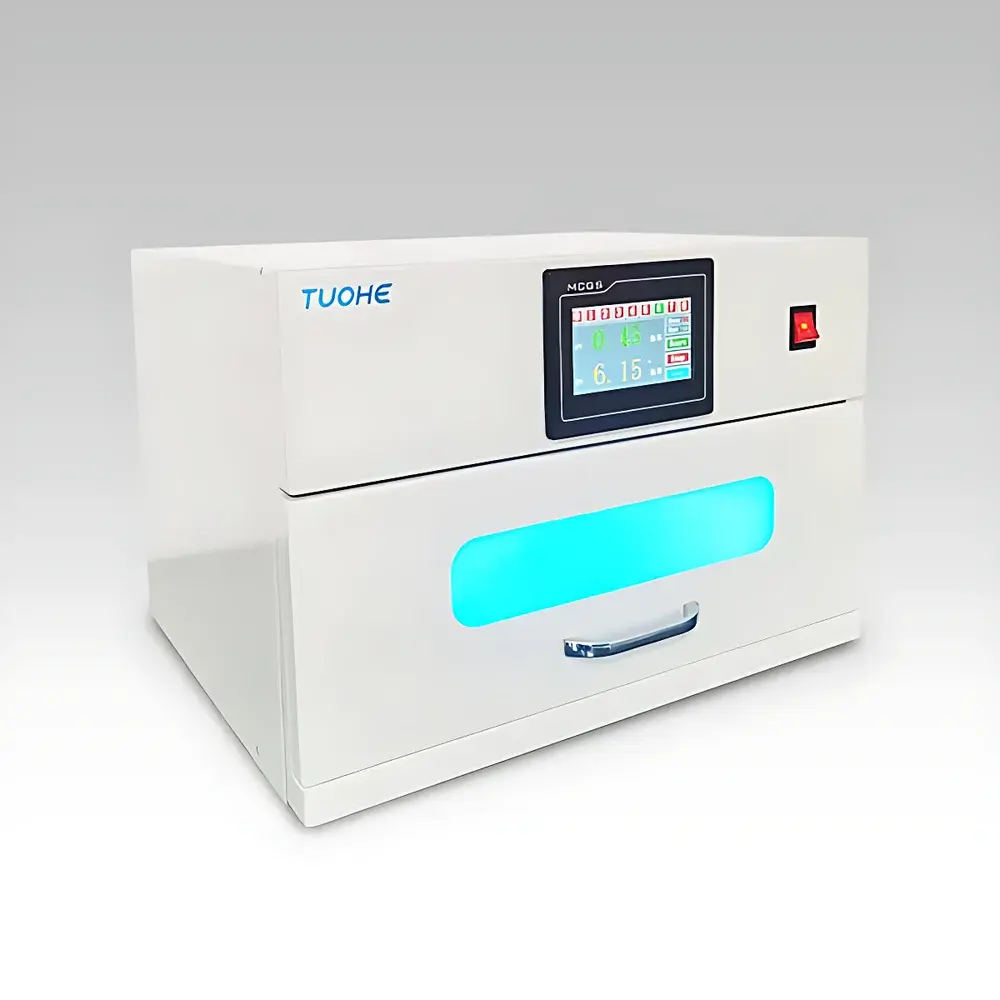
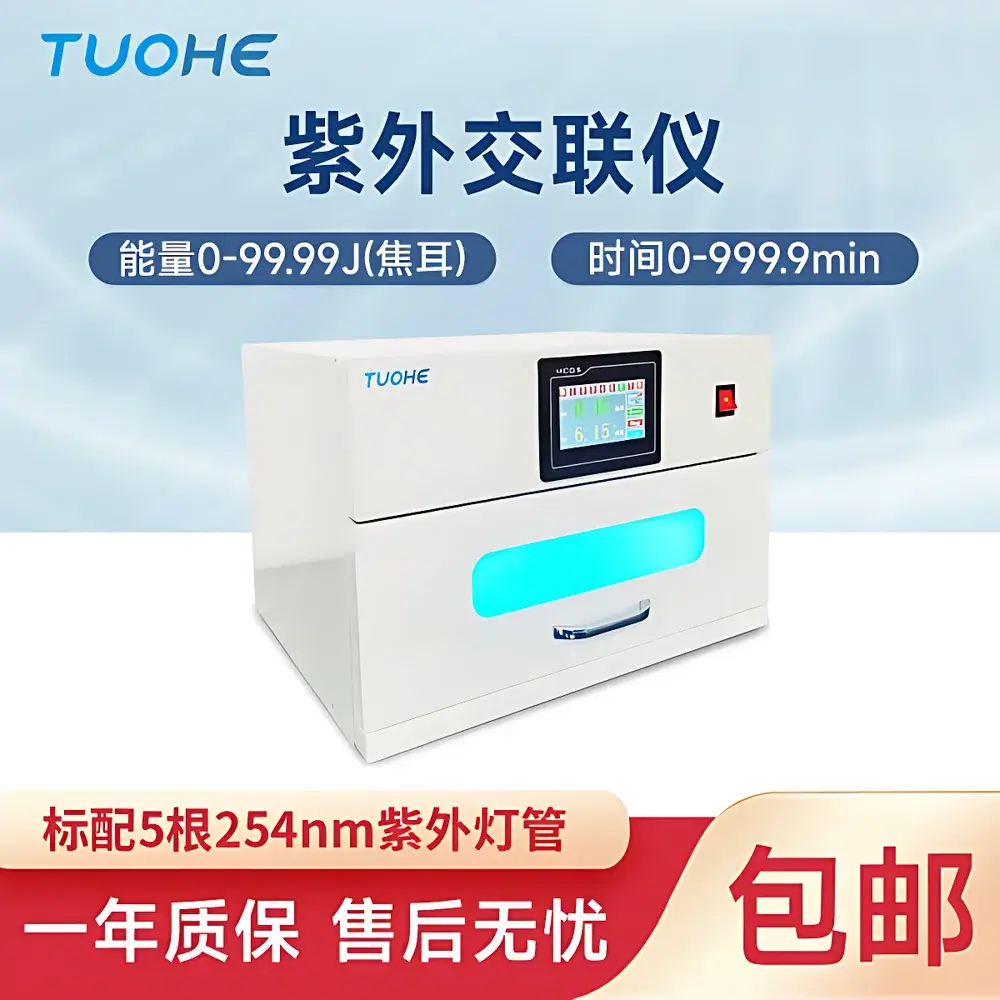
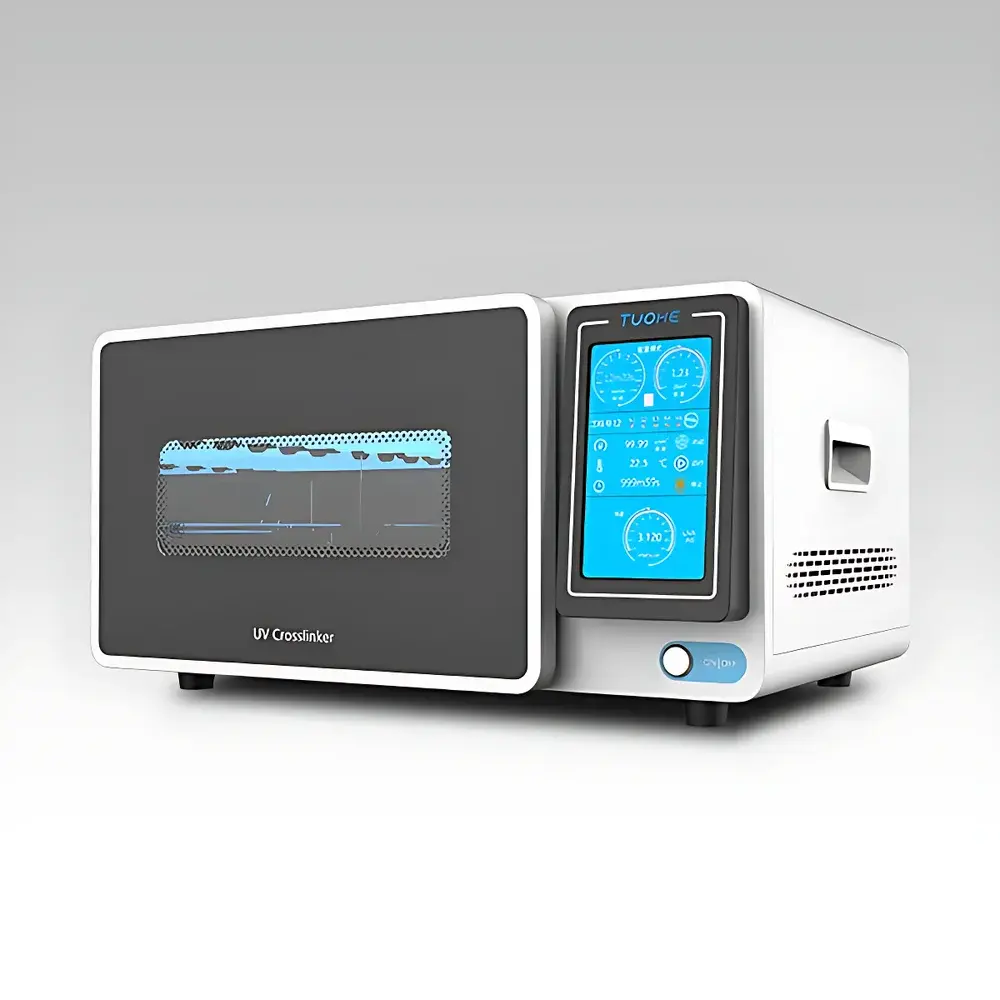
Tuo He SZ03-II UV Crosslinker
| Brand | Tuo He |
|---|---|
| Origin | Shanghai, China |
| Model | SZ03-II |
| Exposure Time Range | 0–999.9 min / 0–999 min 59 sec |
| Exposure Energy Range | 0–99.99 J |
| Chamber Dimensions | 340 mm × 260 mm × 150 mm |
| UV Wavelength | 254 nm (standard), optional 312 nm or 365 nm |
| UV Intensity | up to 5 mW/cm² |
| Lamp Configuration | 5 × 10 W UV lamps |
| Control Interface | 7-inch TFT color touchscreen |
| Energy Integration Mode | Yes (J/cm²-based auto-termination) |
| Data Storage | 9 pre-programmed protocols + manual setup for 50 protocols |
| Safety Features | Door-interlock shutdown, UV-blocking viewing window, automatic power-off on door opening |
| Power Supply | 220 V / 50 Hz / 100 W |
| Net Weight | 10 kg |
| Compliance | Designed for GLP-aligned nucleic acid immobilization workflows |
Overview
The Tuo He SZ03-II UV Crosslinker is an engineered ultraviolet irradiation system designed for precise, reproducible covalent immobilization of nucleic acids onto solid-phase membranes—primarily nylon and nitrocellulose—during Southern, Northern, and dot-blot hybridization workflows. Operating at a primary emission wavelength of 254 nm (with optional 312 nm or 365 nm lamp configurations), the instrument delivers controlled UVC radiation via five 10 W low-pressure mercury vapor lamps. Its core innovation lies in integrated radiometric energy control: a real-time UV sensor continuously measures irradiance (mW/cm²), integrates exposure over time, and automatically terminates irradiation upon reaching a user-defined energy threshold (J/cm²). This eliminates variability caused by lamp aging, ambient temperature drift, or positional inconsistencies—ensuring consistent crosslinking efficiency across instruments, operators, and timepoints. Unlike timer-only systems, the SZ03-II guarantees dosage fidelity critical for quantitative hybridization signal intensity, reduced background, and improved detection sensitivity—typically delivering 5–10× stronger hybridization signals compared to conventional oven baking.
Key Features
- Energy-integrated exposure control: Automatic termination when preset UV dose (J/cm²) is achieved—enabling method standardization across laboratories and equipment lifecycles.
- 7-inch full-color TFT touchscreen interface with intuitive icon-driven navigation, multilingual support (English/Chinese toggle), and real-time display of irradiance, cumulative energy, and elapsed time.
- Dual-mode operation: Selectable time-based (0–999.9 min) or energy-based (0–99.99 J) exposure modes; supports point-test function for rapid validation and calibration checks.
- Robust stainless-steel exposure chamber (340 × 260 × 150 mm) with UV-blocking acrylic viewport, interlocked safety door switch, and automatic lamp cutoff upon door opening.
- Persistent protocol storage: 9 factory-default methods plus capacity for 50 user-defined protocols—including wavelength selection (254/312/365 nm), dose setpoint, and ramp parameters.
- Power-loss resilience: All active settings and last-used protocol are retained in non-volatile memory during unexpected shutdowns.
- Comprehensive safety architecture: Overheat protection, lamp failure detection, and electromagnetic shielding compliant with IEC 61000-6-3 emissions standards.
Sample Compatibility & Compliance
The SZ03-II accommodates standard blotting membranes (up to 20 × 20 cm), mini-gels, microtiter plates, and polymer substrates requiring surface functionalization. It is routinely deployed in molecular biology labs adhering to ISO/IEC 17025 quality requirements for nucleic acid analysis. While not FDA-cleared as a medical device, its operational repeatability and traceable energy delivery support documentation needs for GLP-compliant studies, including those referenced in USP <1043> (Nucleic Acid-Based Assays) and ISO 20387 (Biobanking). The instrument’s energy-integration capability facilitates alignment with ASTM E2500-13 (Verification and Validation of Pharmaceutical Processes) principles where UV dose is a critical process parameter.
Software & Data Management
No external software installation is required—the embedded firmware provides complete local control, protocol recall, and real-time monitoring. All exposure logs—including date/time stamp, selected wavelength, target energy, actual delivered dose, and operator ID (manually entered)—are stored onboard and exportable via USB flash drive in CSV format. Audit trail functionality includes immutable timestamps and change history for protocol modifications, supporting basic 21 CFR Part 11 readiness when paired with institutional electronic lab notebook (ELN) systems. Internal calibration routines allow periodic verification against NIST-traceable UV radiometers, ensuring long-term metrological confidence.
Applications
- Nucleic acid immobilization: Covalent crosslinking of DNA/RNA to positively charged nylon or neutral nitrocellulose membranes prior to hybridization.
- UV-mediated DNA cleavage: Site-specific nicking in agarose gels for fragment recovery or library preparation.
- Mutagenesis support: RecA-mediated recombination assays requiring controlled UV-induced DNA damage.
- Enzyme inhibition studies: Generation of cyclobutane pyrimidine dimers (CPDs) to modulate restriction endonuclease activity.
- PCR carryover prevention: Decontamination of work surfaces, pipette tips, and reaction tubes via germicidal UVC irradiation (254 nm).
- Material science: Photochemical modification of polymer films, hydrogels, and biosensor surfaces.
FAQ
What UV wavelengths are supported, and how are lamp changes performed?
The SZ03-II ships with 254 nm lamps as standard. Optional 312 nm and 365 nm lamps can be installed manually—no tools required—via front-access lamp holders calibrated for uniform irradiance distribution.
Is energy calibration traceable to national standards?
Yes. The built-in sensor is factory-calibrated using a NIST-traceable UV-A/UV-C spectroradiometer. Users may perform field verification with external calibrated meters; internal recalibration is accessible via service mode.
Can exposure data be exported for regulatory submission?
Yes. All session records—including energy dose, duration, wavelength, and timestamp—are exportable as timestamped CSV files suitable for inclusion in study reports or quality dossiers.
Does the instrument meet electromagnetic compatibility (EMC) requirements for laboratory use?
It complies with IEC 61326-1 (Laboratory Equipment – EMC Requirements) and IEC 61000-6-3 (Emission Standard for Residential/Commercial Environments), verified per manufacturer test reports.
How is consistency maintained across multiple instruments in a core facility?
By standardizing on energy-based (J/cm²) rather than time-based protocols—and validating each unit’s irradiance output annually—the SZ03-II enables inter-instrument comparability without reliance on lamp batch matching or subjective endpoint assessment.
Related Products



