
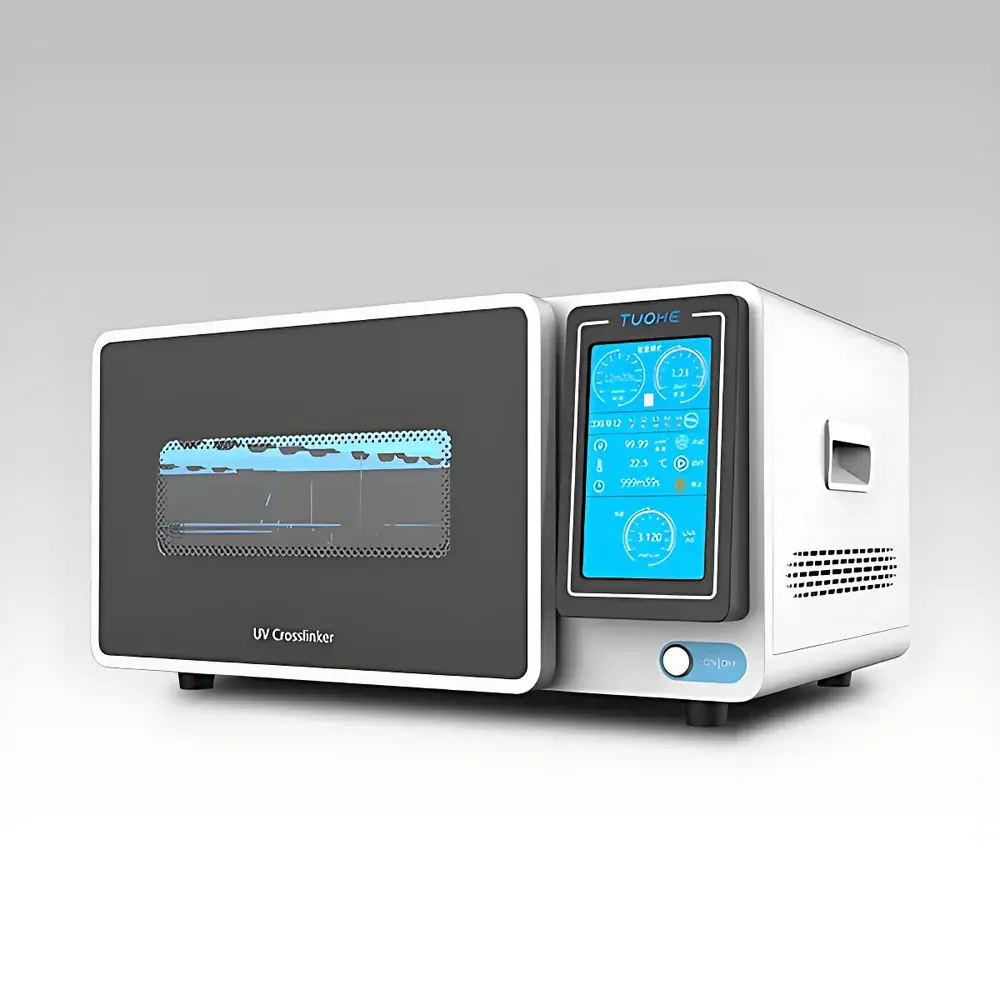
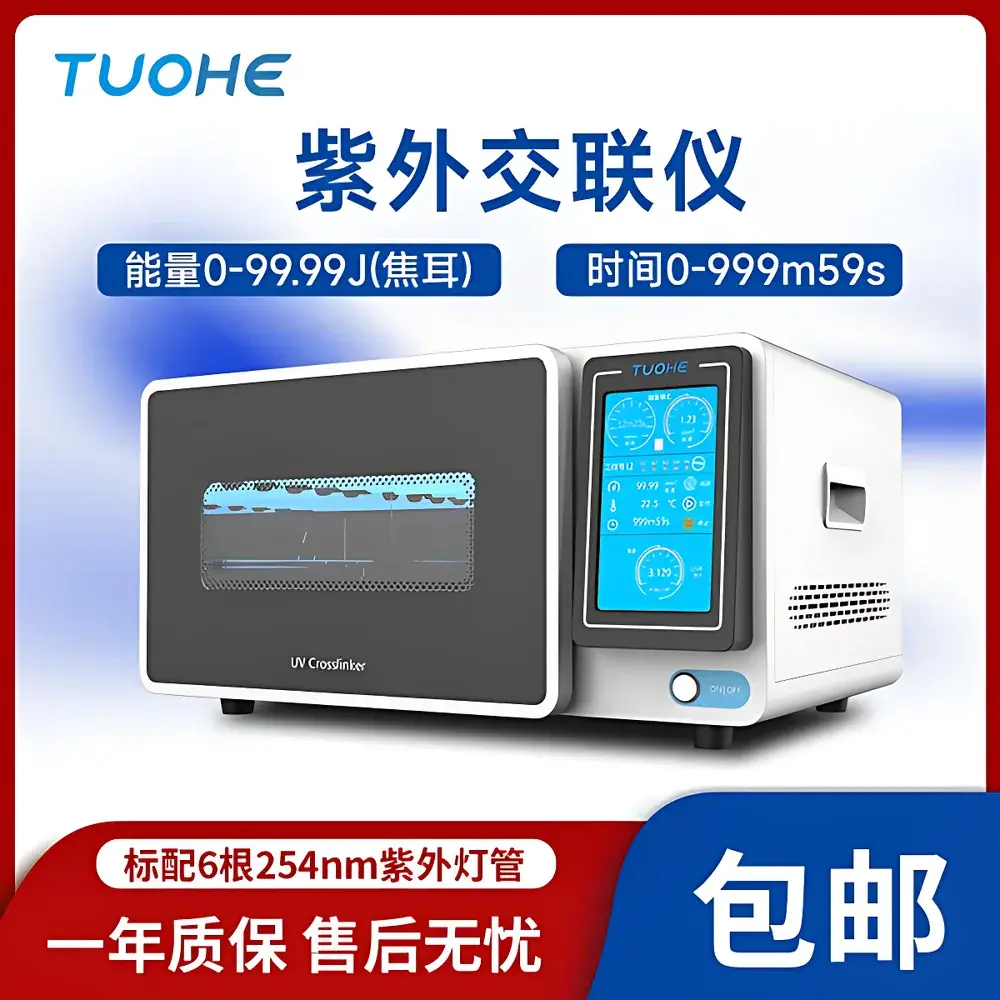
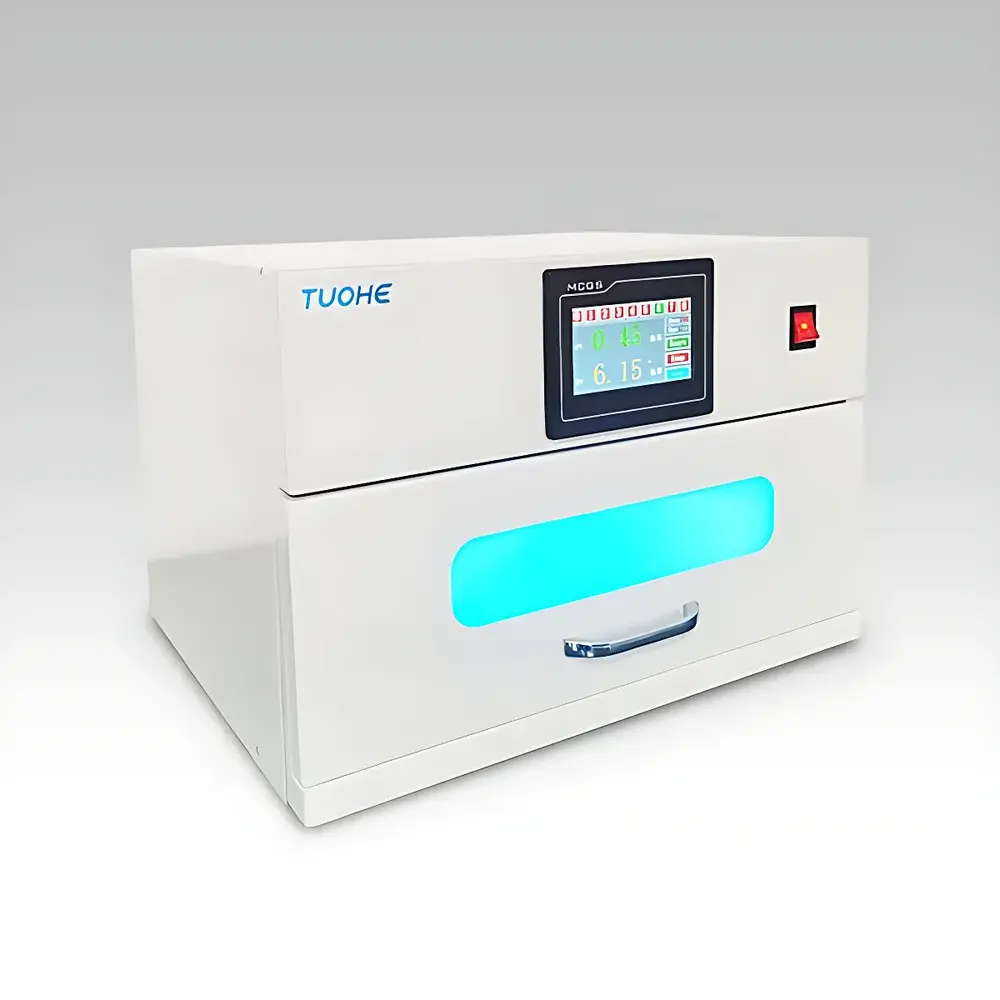
Tuo He SZ03-IID UV Crosslinker
| Brand | Tuo He |
|---|---|
| Origin | Shanghai, China |
| Manufacturer Type | Authorized Distributor |
| Country of Origin | China |
| Model | SZ03-IID |
| Price | Upon Request |
| Exposure Time Range | 0–999.9 min / 0–999 min 59 s |
| Exposure Energy Range | 0–99.99 J |
| Chamber Dimensions | 340 mm × 260 mm × 150 mm |
| UV Wavelength Options | 254 nm (standard), optional 312 nm or 365 nm |
| UV Intensity | ≤5 mW/cm² |
| Lamp Configuration | 6 × 10 W low-pressure mercury lamps |
| Data Storage Capacity | 50 user-defined protocols |
| Display | 7-inch TFT color touchscreen |
| Safety Features | Interlocked safety door, UV-blocking viewing window, automatic UV shutoff upon door opening |
| Power Supply | 220 V, 50 Hz, 100 W |
| Net Weight | 13 kg |
| External Dimensions | 550 mm × 380 mm × 290 mm |
Overview
The Tuo He SZ03-IID UV Crosslinker is a precision-engineered, microprocessor-controlled ultraviolet irradiation system designed for reproducible nucleic acid immobilization on solid supports—primarily nitrocellulose and nylon membranes—prior to hybridization in Southern, Northern, and dot-blot applications. Operating at a primary emission wavelength of 254 nm (with optional 312 nm or 365 nm lamp configurations), the instrument delivers calibrated, dose-controlled UV-C radiation based on energy-integrated dosimetry (J/cm²), rather than fixed-time exposure alone. This energy-based control mechanism ensures consistent crosslinking performance regardless of lamp aging, ambient temperature fluctuations, or minor variations in chamber geometry—critical for GLP-compliant workflows and inter-laboratory reproducibility. The system employs six 10 W low-pressure mercury vapor lamps, generating a maximum irradiance of ≤5 mW/cm² across the uniform exposure field. Its stainless-steel drawer-style chamber (340 × 260 × 150 mm) provides robust thermal and optical stability during repeated use.
Key Features
- Energy-integrated dosimetry mode: Real-time monitoring and automatic termination upon reaching user-defined UV dose (0–99.99 J), ensuring high inter-run reproducibility independent of lamp output decay.
- Dual-mode operation: Switchable between time-based (0–999.9 min) and energy-based (J/cm²) exposure control via intuitive 7-inch TFT color touchscreen interface.
- Triple-wavelength flexibility: Pre-configured 254 nm setting (optimal for thymine dimer formation in DNA-RNA hybridization); optional 312 nm (enhanced membrane compatibility) and 365 nm (milder, polymer-compatible irradiation) lamp kits available.
- Enhanced operator safety: Electromechanical door interlock halts UV emission instantly upon chamber access; UV-absorbing acrylic viewing window permits real-time monitoring without exposure risk.
- Protocol persistence: Non-volatile memory retains up to 50 user-defined exposure programs, including wavelength selection, dose/time setpoints, and calibration offsets—even after power interruption.
- Robust mechanical design: Seamless stainless-steel exposure chamber with slide-out drawer mechanism minimizes contamination risk and simplifies cleaning and maintenance.
Sample Compatibility & Compliance
The SZ03-IID accommodates standard blotting membranes (up to 20 × 20 cm), mini-gels, PCR plates, and custom substrates placed flat within its uniform irradiation zone. It supports common molecular biology workflows compliant with ISO/IEC 17025-accredited laboratory practices and aligns with recommended protocols referenced in Molecular Cloning (Sambrook & Russell) and Current Protocols in Molecular Biology. While not FDA-cleared as a medical device, its energy-calibrated operation meets internal quality assurance requirements for nucleic acid assay validation under ISO 13485 and CLIA guidelines. For UV sterilization applications (e.g., PCR workstation decontamination), the instrument satisfies basic microbiological inactivation criteria per ASTM E2197-21 (Standard Test Method for Determining UV Dose Response of Microorganisms) when used with validated exposure parameters.
Software & Data Management
The embedded firmware supports full audit-trail functionality: each executed protocol logs timestamp, selected wavelength, setpoint energy/time, actual delivered dose, lamp runtime, and operator ID (if integrated with networked LIMS). Data export is supported via USB port (CSV format) for traceability and regulatory submission. Internal calibration routines—accessible via administrator mode—allow periodic verification against NIST-traceable UV radiometers. The system adheres to ALCOA+ principles (Attributable, Legible, Contemporaneous, Original, Accurate, Complete, Consistent, Enduring, Available) for raw data integrity, facilitating 21 CFR Part 11 readiness when deployed with supplementary electronic signature infrastructure.
Applications
- Nucleic acid immobilization: Covalent crosslinking of DNA/RNA to positively charged nylon or nitrocellulose membranes, delivering 5–10× stronger hybridization signals versus thermal baking (80°C, 2 h).
- UV-mediated DNA cleavage: Site-specific nicking in agarose gels for fragment recovery or library preparation pre-processing.
- RecA-mediated recombination assays: Controlled induction of DNA damage to study homologous repair mechanisms.
- Pyrimidine dimer generation: Preparation of UV-damaged templates for restriction enzyme inhibition studies or nucleotide excision repair assays.
- PCR carryover prevention: Decontamination of pipette tips, tubes, and work surfaces by UV-induced uracil dimerization in contaminating amplicons.
- Polymer surface modification: Photochemical activation of polymeric substrates for subsequent covalent coupling of biomolecules (e.g., biosensor chip functionalization).
FAQ
What UV wavelengths are supported, and how do they differ functionally?
The SZ03-IID ships with 254 nm lamps optimized for nucleic acid crosslinking via thymine dimer formation. Optional 312 nm lamps reduce membrane damage during high-sensitivity RNA transfers, while 365 nm provides gentler irradiation suitable for protein-conjugated surfaces or photopolymer curing.
Is energy-based dosing truly independent of lamp intensity drift over time?
Yes—the integrated silicon photodiode sensor continuously measures irradiance (mW/cm²) and integrates it over time to compute cumulative fluence (J/cm²). When the target value is reached, the controller terminates exposure, compensating for lamp output degradation.
Can the instrument be validated for GMP environments?
While the base unit lacks factory-issued IQ/OQ documentation, its deterministic control logic, non-volatile protocol storage, and audit-log capability support user-led qualification under ICH Q7 and EU Annex 15 frameworks when paired with third-party radiometric calibration and procedural SOPs.
Does the system meet electrical safety standards for international use?
It complies with GB 4793.1–2019 (equivalent to IEC 61010-1:2010) for laboratory equipment safety and carries CCC certification for the Chinese market. CE marking requires local authorized representative oversight for EU deployment.
How is UV uniformity verified across the exposure chamber?
Uniformity is characterized during production using a calibrated UV mapping array (±5% deviation across central 80% area). Users may perform periodic verification using a handheld radiometer grid scan per ISO/IEC 17025 clause 6.4.3.



