
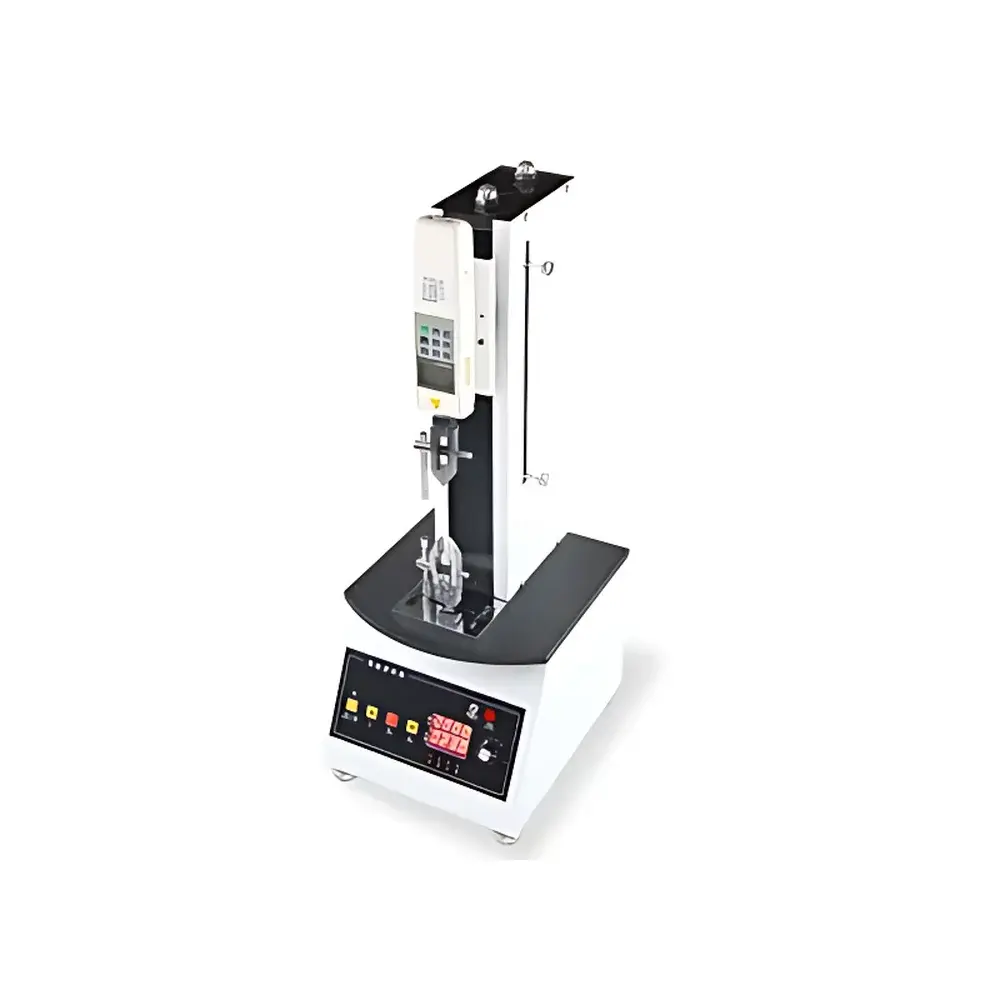
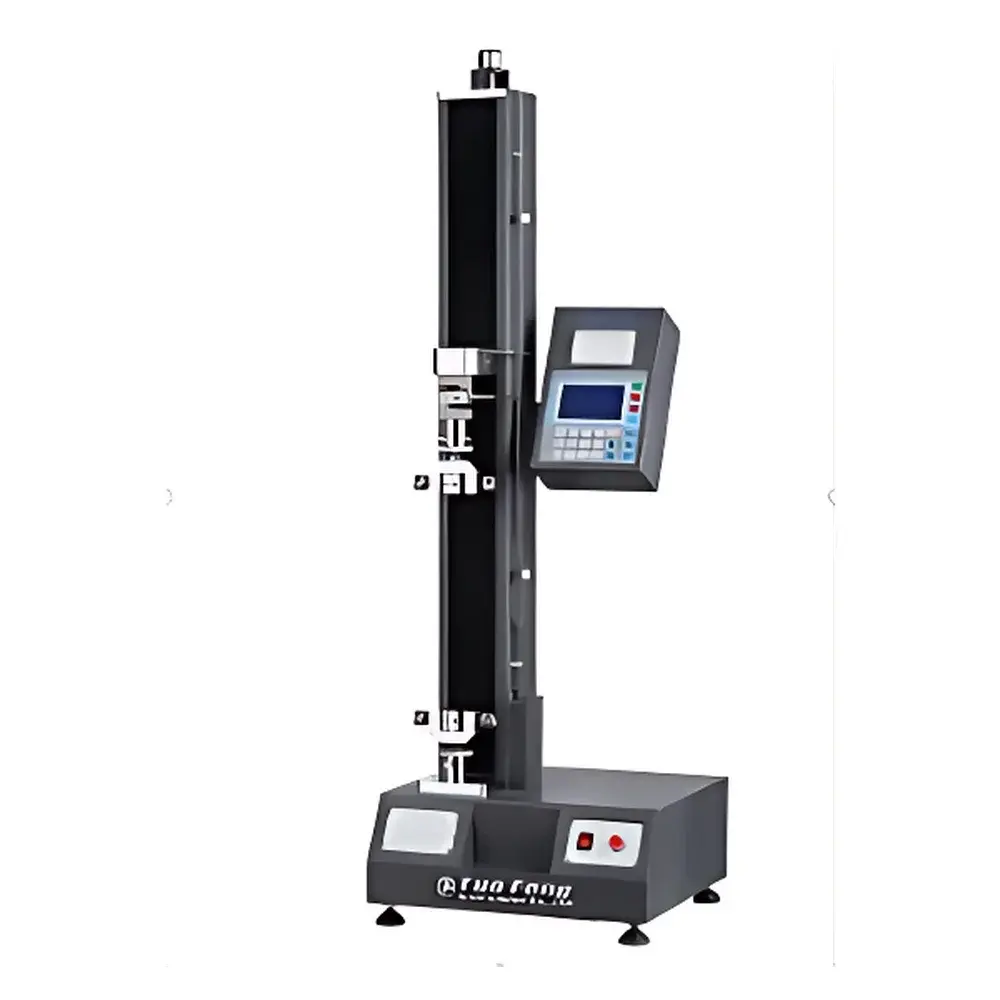
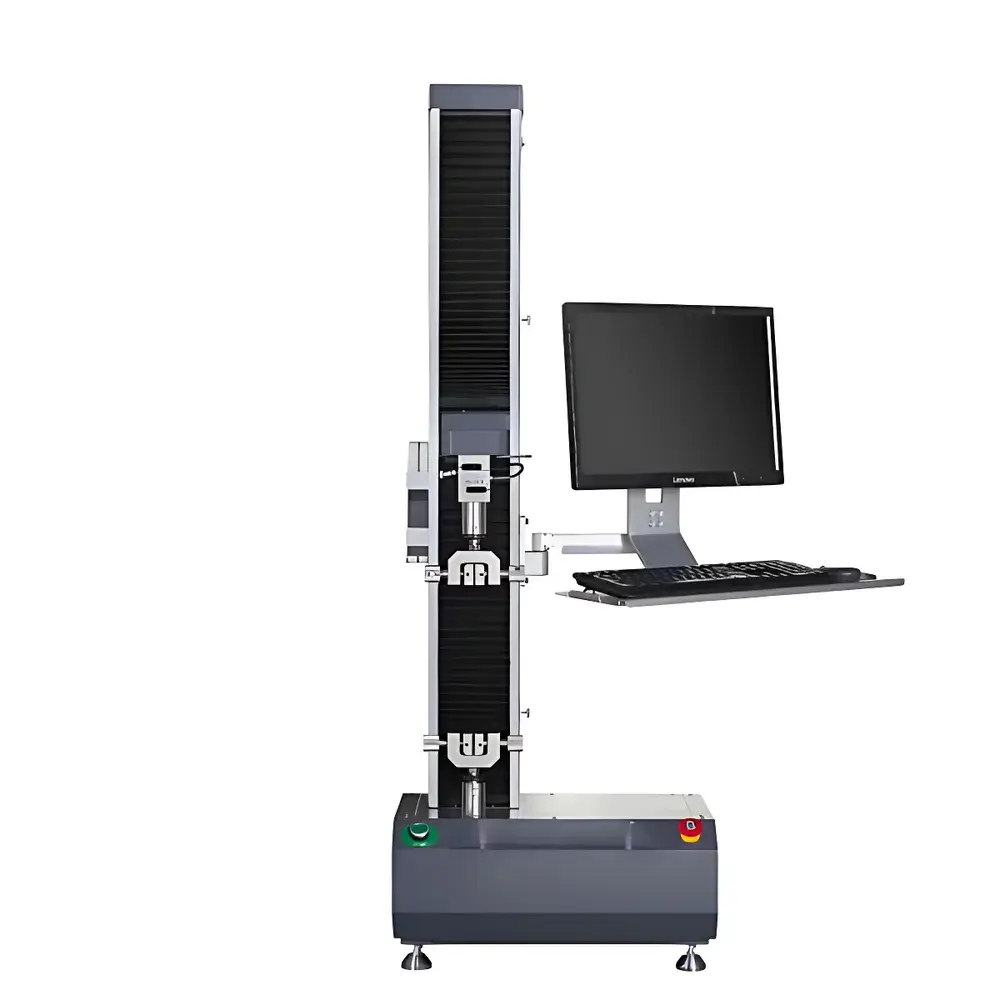
TuoFeng TFL-1 Digital Push-Pull Force Tester
| Brand | TuoFeng |
|---|---|
| Origin | Shanghai, China |
| Manufacturer Type | Direct Manufacturer |
| Product Category | Domestic |
| Model | TFL-1 |
| Instrument Type | Electronic Universal Testing Machine |
| Maximum Test Load | 100 kgf (≈981 N) |
| Load Measurement Range | 0.2–100% of Full Scale |
| Load Accuracy | ±0.5% FS |
| Test Stroke | 400 mm |
| Displacement Resolution | 0.001 mm |
| Operating Voltage | AC 220 V |
| Test Speed Range | 5–300 mm/min |
| Dimensions (W×D×H) | 350 × 380 × 900 mm |
| Net Weight | 45 kg |
Overview
The TuoFeng TFL-1 Digital Push-Pull Force Tester is an entry-level electronic universal testing machine engineered for precision mechanical property evaluation of low-to-medium strength materials under uniaxial tension, compression, peel, bend, tear, and insertion/extraction loading conditions. It operates on a servo-controlled electromechanical actuation principle, where a high-resolution load cell—calibrated to ISO 7500-1 Class 1 accuracy—and a linear encoder-based displacement measurement system jointly acquire synchronized force-displacement data in real time. Designed for routine quality control, incoming material verification, and academic instruction, the TFL-1 delivers repeatable results across diverse specimen geometries without requiring hydraulic infrastructure or complex environmental conditioning. Its modular frame architecture supports rapid fixture interchangeability, enabling seamless transition between ASTM D882 (thin plastic films), ISO 179 (impact-modified plastics), GB/T 1040 (tensile properties of plastics), and EN 13118 (adhesive bond strength) test protocols.
Key Features
- High-stability dual-column rigid frame with precision-ground lead screw and preloaded ball screw drive for minimal axial play and consistent speed fidelity across the full 5–300 mm/min range.
- Integrated digital load cell with 0.5% full-scale accuracy per ISO 376, featuring temperature-compensated strain gauge technology and factory traceable calibration certificate.
- Sub-micron displacement resolution (0.001 mm) enabled by optical encoder feedback, supporting precise yield point detection and elongation-at-break determination per ASTM E8/E8M.
- Intuitive 5-inch color TFT touchscreen interface with on-device test setup wizard, real-time curve plotting, and one-touch report generation in PDF/CSV formats.
- Standardized M6 threaded mounting holes on crosshead and base plate for direct integration with ISO 2041-compliant grips—including pneumatic film clamps, wedge-action metal grips, and peel fixtures.
- Compliance-ready firmware architecture supporting audit trail logging, user access levels (Operator/Supervisor/Admin), and password-protected method storage for GLP/GMP-aligned workflows.
Sample Compatibility & Compliance
The TFL-1 accommodates specimens ranging from ultra-thin polymer films (≥25 µm thickness) to solid metal wires (≤Φ3 mm diameter) and composite laminates up to 10 mm thick. Standard configurations support flat, cylindrical, and irregular cross-sections via adjustable jaw geometry and optional extensometer interfaces. All mechanical components meet RoHS Directive 2011/65/EU requirements. The instrument complies with electromagnetic compatibility standards IEC 61326-1:2013 and safety standard IEC 61010-1:2010. While not certified to ISO/IEC 17025 as a standalone calibration laboratory, its load cell and encoder subsystems are supplied with NIST-traceable calibration documentation valid for 12 months post-installation.
Software & Data Management
The embedded firmware includes built-in test method templates aligned with ASTM D638, ISO 527-2, and GB/T 228.1. Optional PC-based software (TuoFeng TestSuite v3.2) extends functionality with multi-curve overlay, statistical batch analysis (mean, SD, CV%), automatic pass/fail flagging against user-defined limits, and export to LIMS-compatible XML schemas. All raw data files retain native timestamping, operator ID, environmental metadata (if external sensor inputs are enabled), and digital signatures compliant with FDA 21 CFR Part 11 Annex 11 requirements when configured with Windows OS and domain authentication.
Applications
- Quality assurance of extruded plastic profiles and injection-molded housings in Tier-1 automotive supply chains.
- Tensile strength validation of medical device packaging seal integrity per ASTM F88 and ISO 11607-2.
- Peel adhesion testing of pressure-sensitive tapes and flexible printed circuit board laminates.
- Mechanical characterization of biodegradable films used in agricultural mulching applications.
- Educational demonstration of stress-strain behavior, Young’s modulus derivation, and ductile-brittle transition in undergraduate materials science laboratories.
- Wire harness pull-out force verification for aerospace wiring assemblies per SAE AS50881.
FAQ
What is the maximum allowable specimen height for compression testing?
The effective compression space between platens is 400 mm at zero load; maximum usable height depends on required stroke—e.g., 350 mm for tests requiring ≥50 mm displacement.
Can the TFL-1 be integrated into automated production line environments?
Yes—RS-232 and USB Device ports support SCADA-level command triggering (e.g., “START_TEST”, “FETCH_RESULT”) and PLC handshake protocols; optional Ethernet/IP module available upon request.
Is third-party calibration certification included with purchase?
A factory calibration report with uncertainty budget per ISO/IEC 17025 is provided; accredited third-party calibration (e.g., A2LA or UKAS) can be arranged separately.
Does the system support extensometer attachment for strain measurement?
Yes—the base model includes two M4 tapped holes on the moving crosshead for mechanical clip-on extensometers; digital video extensometry requires optional camera mount kit.
What maintenance intervals are recommended for long-term accuracy retention?
Load cell zero check every 200 hours; full recalibration recommended annually or after 5,000 test cycles—whichever occurs first. Lubrication of lead screw is required every 6 months using ISO VG 68 grease.



