
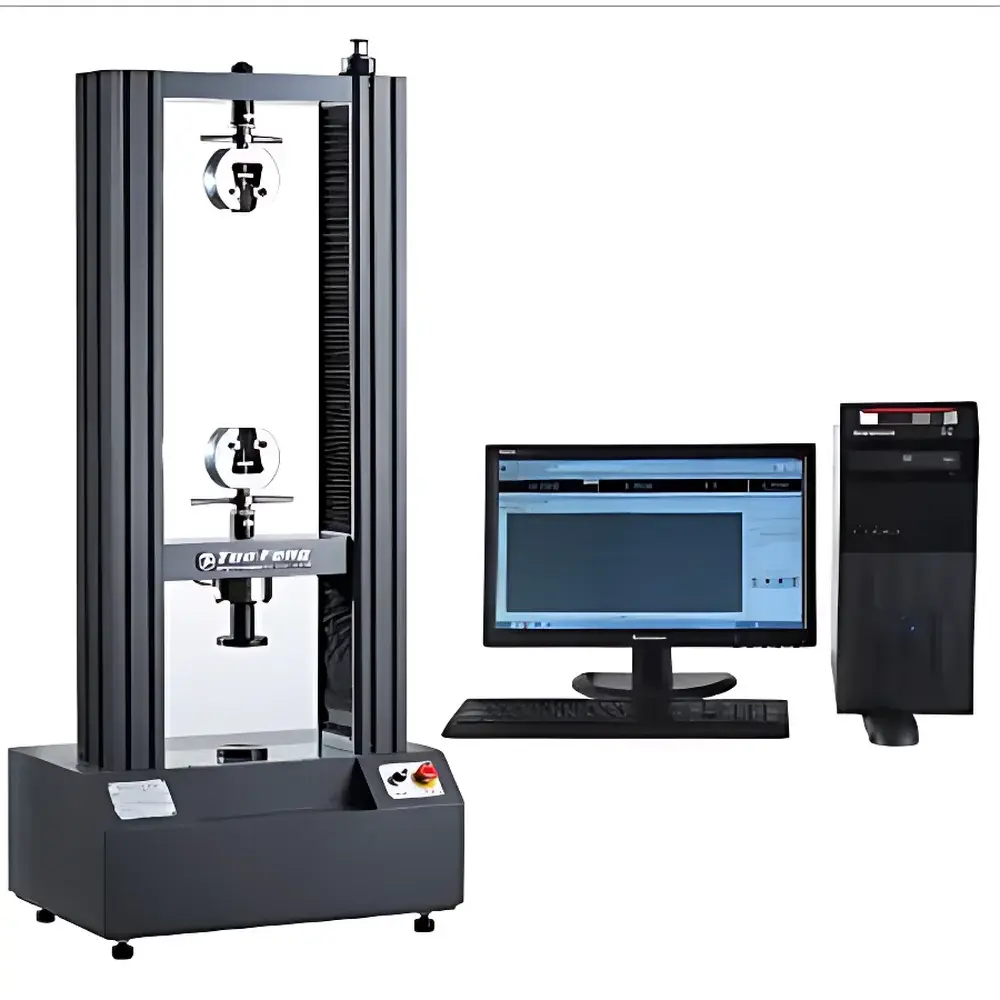
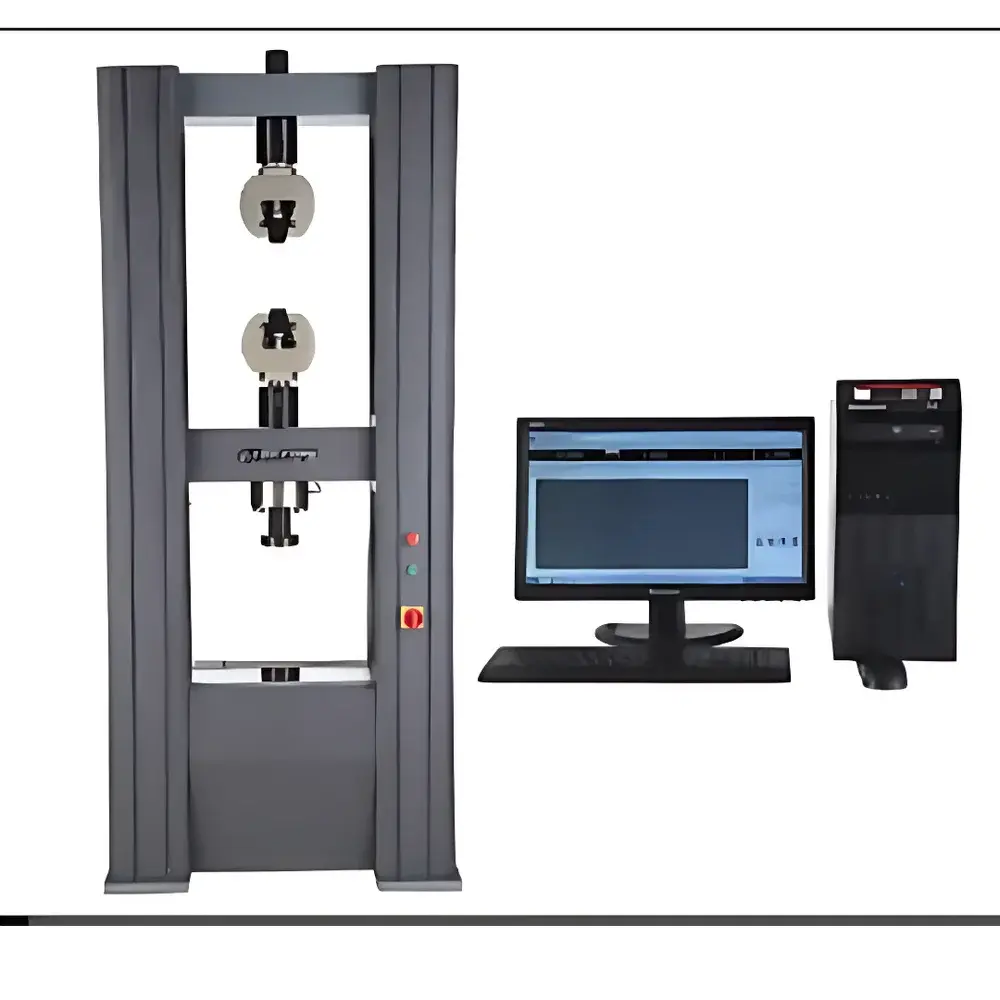
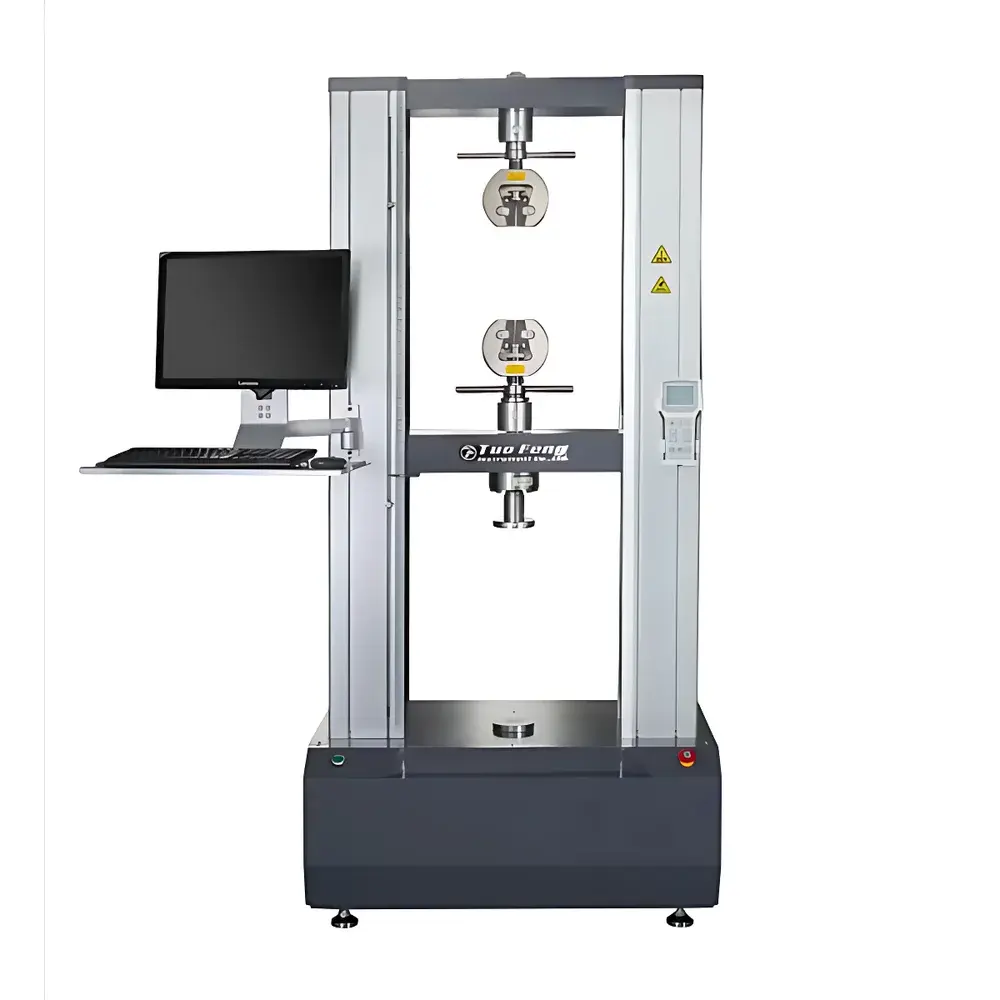
Tuofeng TFW-125 Microcomputer-Controlled Electromechanical Universal Testing Machine
| Brand | Tuofeng |
|---|---|
| Origin | Shanghai, China |
| Manufacturer Type | Direct Manufacturer |
| Model | TFW-125 |
| Instrument Type | Electromechanical Tensile Testing Machine |
| Maximum Test Load | 200 kN |
| Force Measurement Range | 0.2%–100% of Full Scale (FS) |
| Force Accuracy | ±0.5% of reading |
| Crosshead Travel | 1000 mm |
| Displacement Resolution | 0.001 mm |
| Control System | Windows-based microcomputer control |
| Drive System | Imported servo motor with precision worm-gear reducer |
| Actuation Mechanism | High-precision preloaded ball screw |
| Effective Test Width | 600 mm (customizable) |
| Speed Range | 0.001–500 mm/min (infinitely variable) |
| Displacement Measurement | Optical encoder, accuracy ±0.005% of reading |
| Deformation Measurement | Optional extensometer or large-deformation sensor (accuracy ±0.005% of reading) |
| Safety Protection | Dual electronic limit switches, emergency stop button, overload protection (>110% FS), automatic return after test |
| Software Compliance | Supports ASTM E4, E8, E9, E21, ISO 6892-1, ISO 7500-1, GB/T 228.1–2021, GB/T 16491–2008, JJG 475–2008, and other international and national standards |
Overview
The Tuofeng TFW-125 Microcomputer-Controlled Electromechanical Universal Testing Machine is a high-precision, dual-column universal testing system engineered for static mechanical property evaluation of metallic, polymeric, composite, ceramic, and elastomeric materials. It operates on the principle of controlled electromechanical force application via a servo-driven ball-screw actuator, enabling accurate load and displacement control under closed-loop feedback. Designed to meet ISO 7500-1 Class 0.5 verification requirements and compliant with ASTM E4 calibration standards, the TFW-125 delivers traceable force measurement across its full 200 kN capacity, with verified linearity from 0.2% to 100% of full scale. Its rigid frame architecture—constructed from high-tensile steel with reinforced crosshead guidance—minimizes deflection and ensures axial alignment stability during high-load compression, tension, and flexural testing. The system supports full-cycle testing protocols including ramp-to-load, hold-at-load, displacement-controlled creep, and cyclic loading sequences—critical for R&D validation and quality assurance in regulated environments.
Key Features
- High-fidelity force measurement system with ±0.5% accuracy over the entire 200 kN range, validated per ISO 7500-1 and ASTM E74
- True 0.001 mm displacement resolution maintained throughout 1000 mm travel, enabled by optical encoder feedback and zero-backlash ball screw transmission
- Dual-speed crosshead positioning (fast jog + fine-adjust mode) for rapid specimen setup and precise gage length alignment
- Integrated safety architecture: hardware-based emergency stop, dual independent software/hardware overload cutoff (>110% FS), programmable electronic end stops, and automatic return-to-initial-position function
- Modular load cell interface supporting interchangeable transducers (5 kN to 200 kN) without recalibration overhead
- Thermally stable base frame with vibration-damped mounting feet to isolate environmental perturbations during low-force measurements
Sample Compatibility & Compliance
The TFW-125 accommodates specimens ranging from thin films (<0.1 mm thickness) to structural beams (up to 600 mm wide × 1000 mm gage length), using standardized grips (pneumatic, wedge, hydraulic, or custom fixtures) and bending fixtures (3-point/4-point, compression platens, shear adapters). It fully supports multi-standard testing workflows per ASTM D638 (plastics tensile), ASTM D3039 (composite tensile), ISO 6892-1 (metal tensile), ISO 178 (flexural), ISO 148-1 (impact-ready configurations), GB/T 228.1 (Chinese metal standard), and JIS Z2241. All hardware and firmware comply with electromagnetic compatibility (EMC) directives IEC 61326-1 and safety standard IEC 61000-6-2. Mechanical design conforms to GB/T 16491–2008 (Chinese universal testing machine specification) and metrological verification requirements of JJG 475–2008.
Software & Data Management
The embedded Windows-based testing software provides full GLP/GMP-aligned data governance: audit-trail-enabled user authentication, electronic signatures, version-controlled method templates, and 21 CFR Part 11–compliant data integrity controls (including immutable raw data logging, operator action timestamps, and change history). Users may configure test methods using load-, displacement-, or strain-controlled profiles; define multi-step sequences (e.g., preload → ramp → hold → unload); and generate real-time overlays of stress–strain, load–displacement, or time–creep curves. Data export supports CSV, XML, and PDF formats with embedded metadata (operator ID, calibration certificate ID, environmental conditions). Raw test files are stored with SHA-256 hash integrity verification. Software updates are delivered via secure HTTPS channel with cryptographic signature validation—ensuring long-term compliance continuity.
Applications
The TFW-125 serves as a primary mechanical characterization platform in accredited laboratories across aerospace (e.g., titanium alloy tensile yield mapping per AMS 2300), automotive (composite crash simulation validation, rubber bushing hysteresis analysis), medical device manufacturing (ISO 14243-compliant joint implant fatigue pre-screening), wire & cable QA (IEC 60811 tensile retention post-aging), and construction materials R&D (concrete reinforcement bond strength per ASTM A944). It is routinely deployed for failure mode analysis—including ductile-to-brittle transition assessment, weld zone mechanical heterogeneity quantification, and adhesive interfacial fracture energy determination using modified DCB protocols.
FAQ
What international standards does the TFW-125 support out-of-the-box?
It includes pre-configured test templates for ASTM E8/E21, ISO 6892-1, GB/T 228.1–2021, and JIS Z2241—with all control parameters traceable to NIST-traceable calibration certificates.
Can the system be integrated into an existing LIMS or MES environment?
Yes—via OPC UA 1.03 server interface and configurable RESTful API endpoints for bidirectional data exchange (test initiation, parameter push, result pull).
Is deformation measurement included as standard equipment?
No—extensometry is optional: clip-on axial extensometers (0–50 mm, ±0.5% accuracy) or non-contact video extensometers (DIC-ready) may be added per application requirements.
What is the warranty coverage and service response protocol?
Standard 24-month parts-and-labor warranty; extended service plans include remote diagnostics, annual on-site verification, and priority SLA-backed field engineer dispatch within 72 business hours.
Does the software support multi-language UI and report generation?
Yes—UI language toggles between English, Simplified Chinese, Traditional Chinese, German, French, and Japanese; reports auto-localize units, terminology, and regulatory disclaimers per selected region.



