
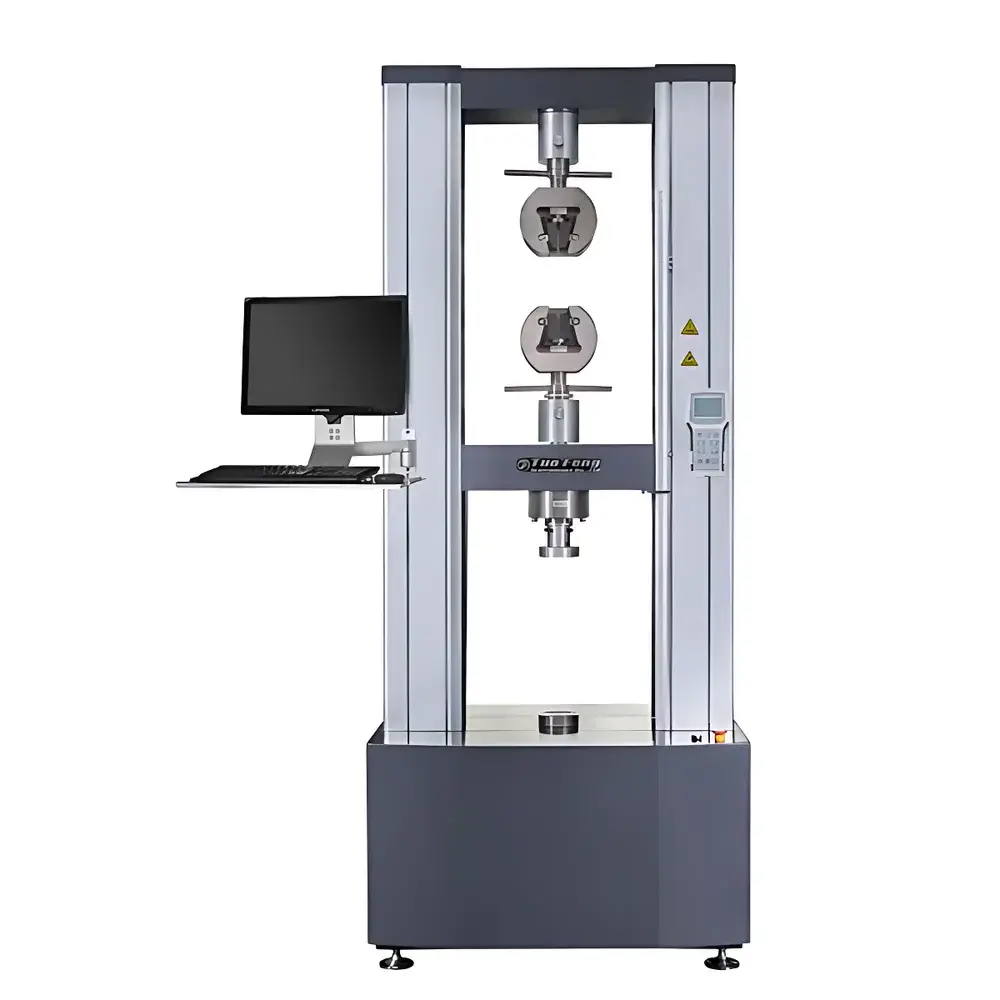
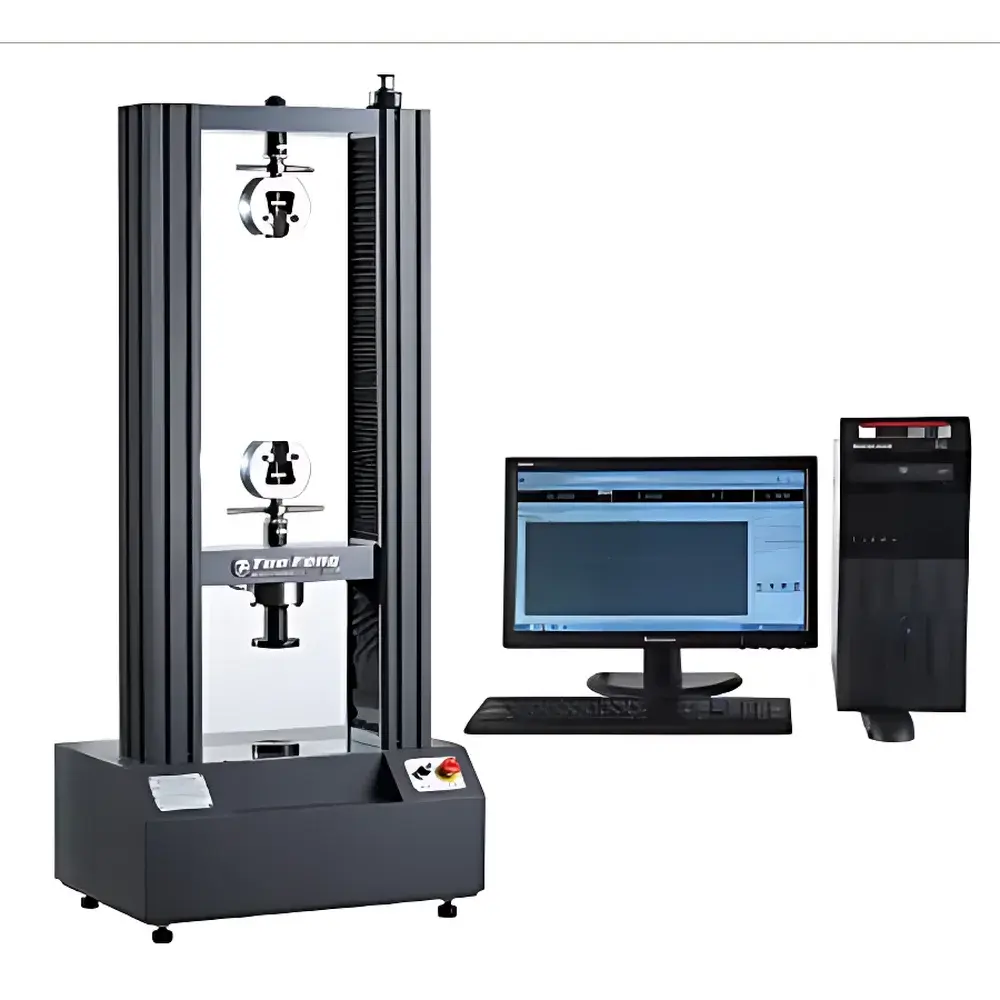
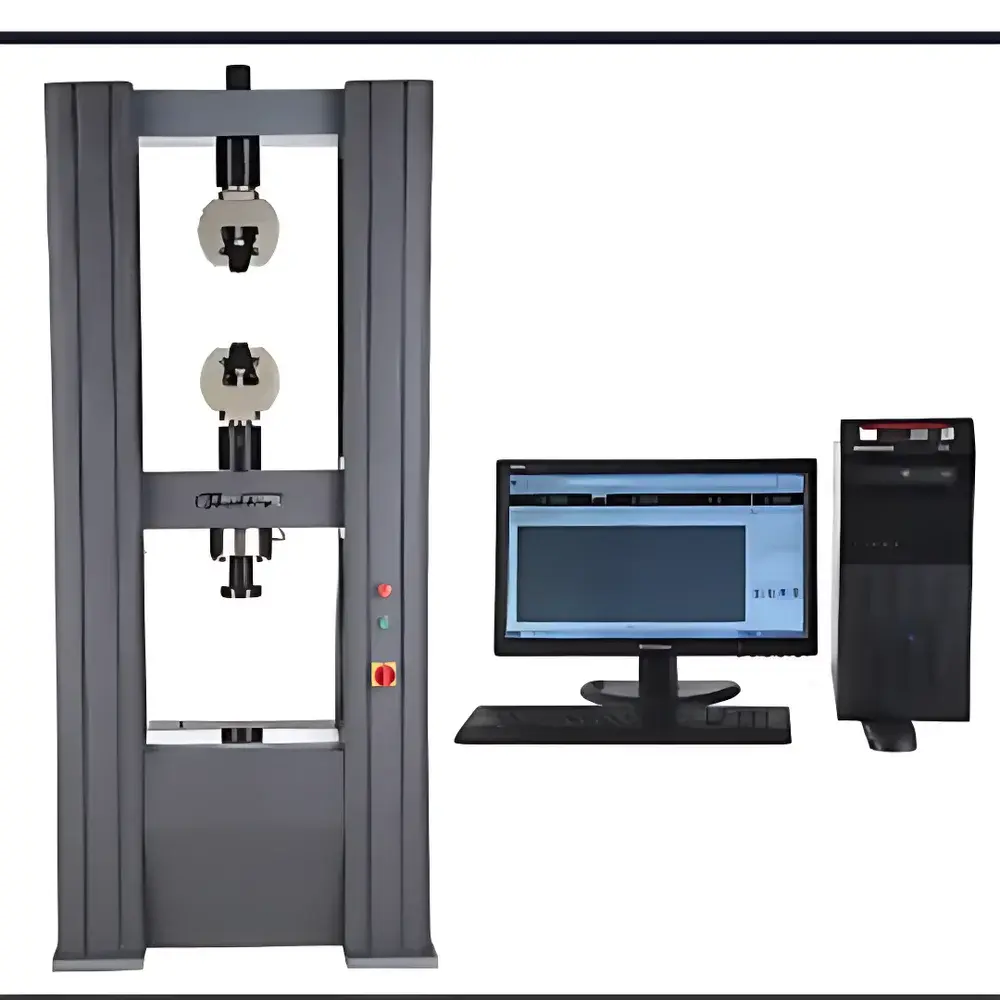
Tuofeng TFW-139 Microcomputer-Controlled Servo Universal Testing Machine
| Brand | Tuofeng |
|---|---|
| Origin | Shanghai, China |
| Manufacturer Type | Direct Manufacturer |
| Product Category | Domestic |
| Model | TFW-139 |
| Price Range | USD 14,000 – 42,000 |
| Instrument Type | Electromechanical Universal Testing Machine |
| Load Capacity | 139 kN (derived from model series context |
| note | TFW-139 aligns with mid-range capacity tier) |
| Accuracy Class | 0.5 |
| Effective Force Range | 0.2%–100% of full scale |
| Force Measurement Accuracy | ±0.005% of reading |
| Resolution | 1 part in ±500,000 of maximum load, single-range, constant throughout |
| Drive System | Imported servo motor with precision worm-gear reducer |
| Lead Screw | High-accuracy preloaded ball screw |
| Effective Test Width | 600 mm (customizable) |
| Maximum Stroke | 800 mm (extendable) |
| Speed Range | 0.001–500 mm/min, infinitely variable |
| Displacement Measurement | Optical encoder |
| Displacement Accuracy | ±0.005% of reading |
| Strain Measurement | Optional extensometer or large-deformation transducer |
| Strain Accuracy | ±0.005% of reading |
| Safety Protection | Electronic limit switches, emergency stop, overload protection (10% over capacity), dual-speed motorized crosshead control |
| Return Function | Automatic high-speed return post-test |
| Fixture Customization | Application-specific grips and fixtures available |
| Dimensions (W×D×H) | 1000 × 700 × 2000 mm |
| Power Supply | 220 V AC, 1.0 kW |
| Net Weight | ~450 kg |
| Compliance | GB/T 16491–2008, JJG 475–2008, ASTM E4, ASTM E8, ISO 6892-1, ISO 7500-1, DIN 51221, JIS Z2241, BS EN 10002-1 |
Overview
The Tuofeng TFW-139 Microcomputer-Controlled Servo Universal Testing Machine is a high-precision electromechanical system engineered for static mechanical property characterization of metallic, polymeric, ceramic, composite, and elastomeric materials. It operates on the principle of controlled displacement actuation via a closed-loop servo system, where force is measured using a high-stability load cell and displacement is tracked via optical encoder feedback—ensuring traceable, repeatable, and metrologically sound tensile, compression, bending, shear, peel, tear, and puncture testing. Designed to meet international metrological requirements for materials testing laboratories, the TFW-139 delivers Class 0.5 accuracy per ISO 7500-1 and GB/T 16491–2008, with full-scale resolution of 1:500,000 and force measurement uncertainty ≤ ±0.005% of reading across its entire operating range (0.2–100% FS). Its modular architecture supports seamless integration into GLP-compliant workflows and routine quality assurance environments.
Key Features
- High-fidelity servo control system with imported permanent-magnet synchronous motor and precision worm-gear reduction, enabling smooth, low-noise motion across the full speed range (0.001–500 mm/min)
- Preloaded recirculating ball screw assembly ensuring axial stiffness > 120 kN/mm and minimal backlash (< 2 µm)
- Constant-resolution force transduction: no range switching required; maintains 500,000-count resolution from 0.2% to 100% of 139 kN capacity
- Dual-mode crosshead positioning: programmable fast/slow approach with jog functionality and automatic return-to-start after test completion
- Comprehensive safety architecture including hardware-based emergency stop, electronic travel limits, real-time overload cutoff (10% over full scale), and mechanical torque limiting
- Modular extensometry support: compatible with both clip-on axial extensometers (for modulus and yield determination) and non-contact video extensometers (optional upgrade)
Sample Compatibility & Compliance
The TFW-139 accommodates specimens ranging from thin films (≥0.05 mm thickness) to structural steel coupons (up to 40 mm thick), with standard test widths up to 600 mm and extendable configurations available upon request. It fully supports standardized specimen geometries per ASTM E8/E8M (tension), ASTM D695 (compression), ASTM D790 (flexure), ASTM D6252 (peel), and ISO 527-2 (plastics tensile). Calibration and verification procedures conform to JJG 475–2008 (Chinese national verification regulation) and ISO 7500-1:2018 (static calibration of uniaxial testing machines). The system is validated for use in accredited testing labs operating under CNAS-CL01 (equivalent to ISO/IEC 17025), and its software architecture supports audit trails and electronic signatures compliant with FDA 21 CFR Part 11 when configured with optional security modules.
Software & Data Management
The Windows-based TFW TestSuite v4.2 software provides full IEC 61508-aligned control logic and data handling. It supports multiple test modes—including force-controlled ramping, displacement-controlled loading, hold-at-load/hold-at-strain, and cyclic protocols—with real-time switching between load-time, stress-strain, displacement-time, and extension-force display windows. Units are freely convertible among N/kN/lbf, mm/inch, MPa/psi, % strain, and J/m². All raw data streams (load, displacement, extensometer signal) are recorded at ≥1 kHz sampling rate and stored in vendor-neutral CSV and XML formats. The software enables multi-curve overlay analysis, statistical reporting (min/max/mean/stdev), batch report generation (PDF/Excel), and automated pass/fail evaluation against user-defined acceptance criteria. A documented API allows integration with LIMS and MES platforms. Software updates are provided free of charge for the lifetime of the instrument, with version-controlled release notes and validation documentation available upon request.
Applications
This system serves as a primary mechanical characterization platform in R&D, QA/QC, and certification laboratories across aerospace (e.g., aluminum alloy sheet tensile verification per AMS 2355), automotive (composite bumper impact simulation support), medical device manufacturing (polymer suture tensile strength per ISO 13485), wire & cable (conductor elongation and breaking load per IEC 60811), and construction materials (rebar yield point and ultimate strength per ASTM A615). It is routinely deployed for failure mode analysis, material lot release testing, process parameter optimization (e.g., extrusion temperature vs. tensile modulus), and regulatory submission packages requiring ISO 17025 traceability.
FAQ
What standards does the TFW-139 comply with for calibration and verification?
It meets GB/T 16491–2008 (China), ISO 7500-1:2018 (international), and JJG 475–2008 (national metrological verification). Third-party calibration certificates are issued with NIST-traceable load cells.
Can the system perform cyclic or fatigue testing?
The base configuration supports quasi-static cyclic loading (e.g., tension-compression hysteresis loops); for high-cycle fatigue, a dedicated electrodynamic actuator module is recommended.
Is the software compliant with FDA 21 CFR Part 11?
Yes—when equipped with optional User Access Control (UAC) and Audit Trail modules, it satisfies electronic record and signature requirements for regulated environments.
What extensometer options are supported?
Standard compatibility includes ASTM E83-compliant clip-on axial extensometers (10–50 mm gauge length); non-contact digital image correlation (DIC) systems are available as integrated add-ons.
Does the machine support automated fixture changeover?
Not natively; however, tooling interfaces follow ISO 26203-2 mounting standards, enabling integration with robotic end-effectors in automated test cells.



