
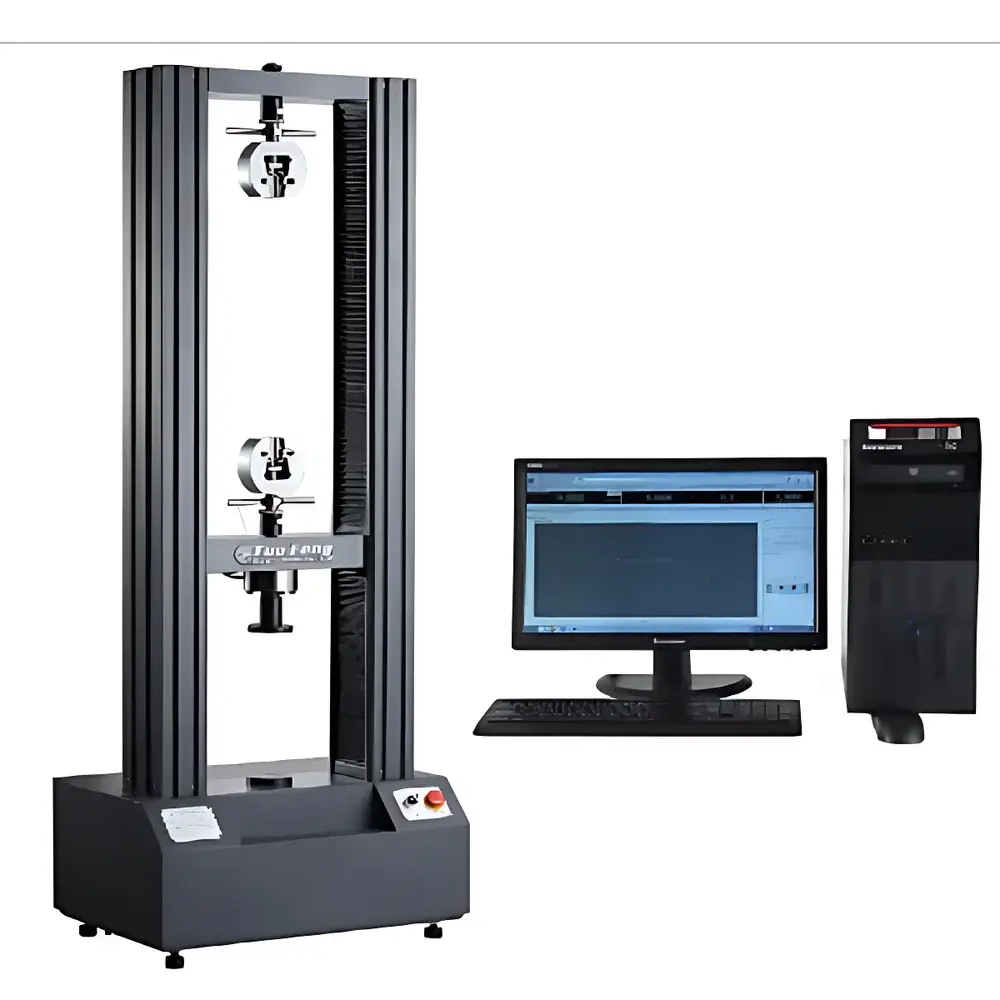
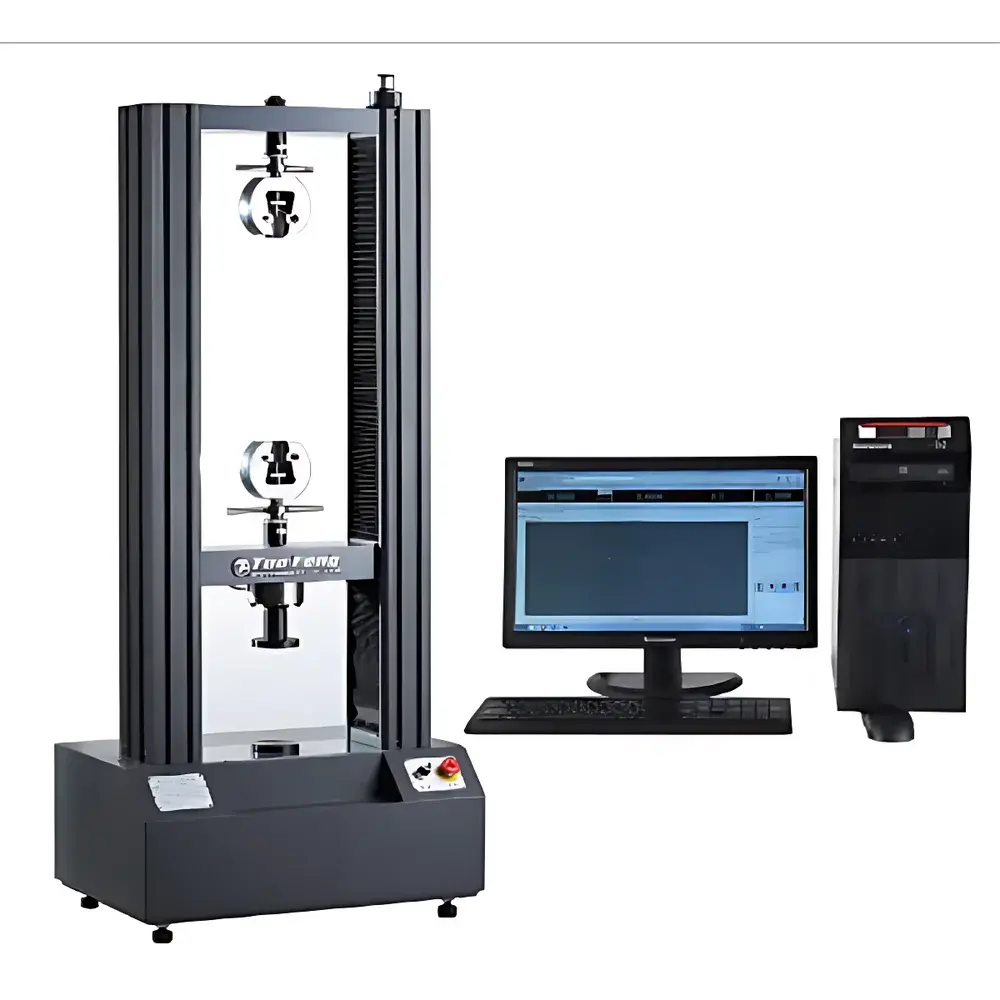
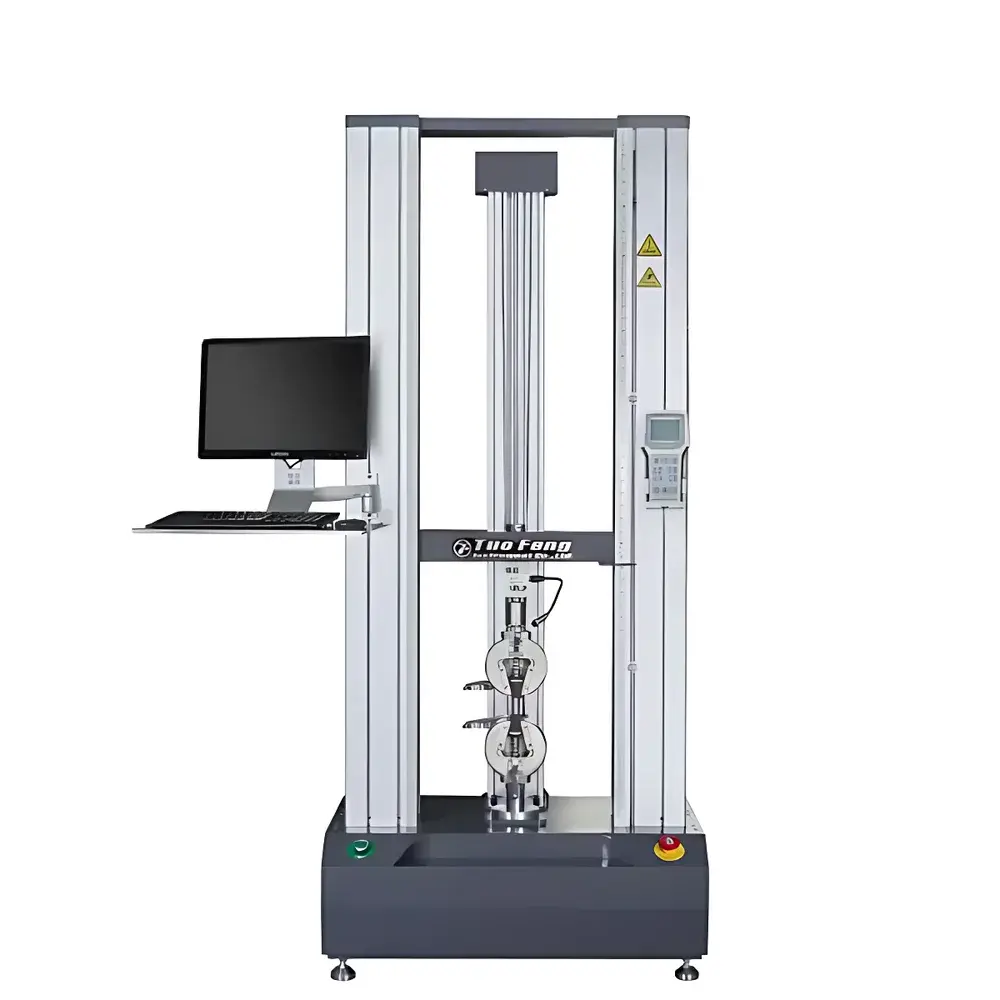
Tuofeng TFW-207 Microcomputer-Controlled Electronic Universal Testing Machine
| Brand | Tuofeng |
|---|---|
| Origin | Shanghai, China |
| Manufacturer Type | Direct Manufacturer |
| Instrument Type | Electromechanical Universal Testing Machine |
| Model | TFW-207 |
| Max. Test Load | 20 kN |
| Accuracy Class | 0.5 |
| Effective Force Range | 0.2–100% of Full Scale |
| Force Measurement Accuracy | ±0.005% of Reading |
| Force Resolution | 1/500,000 FS (single-range, constant resolution) |
| Drive System | Imported Servo Motor + Worm Gear Reducer |
| Lead Screw | High-Precision Ball Screw |
| Effective Test Width | 600 mm (customizable) |
| Stroke | 800 mm (height-adjustable) |
| Speed Range | 0.001–500 mm/min (infinitely variable) |
| Displacement Measurement | Optical Encoder |
| Displacement Accuracy | ±0.005% of Reading |
| Strain Measurement | Optional Extensometer or Large-Deformation Clip Gauge |
| Strain Accuracy | ±0.005% of Reading |
| Safety Protection | Electronic Limit Switches, Emergency Stop, Overload Protection (110% FS), Dual-Speed Motorized Crosshead Control |
| Software | Windows-Based, Multi-Language (EN/CN-Traditional/CN-Simplified), ASTM/ISO/GB/JIS/DIN/BS Compliant, GLP-Ready Data Logging with Audit Trail Support |
| Standards Compliance | GB/T 16491–2008, JJG 475–2008, ASTM E4, ASTM E8, ISO 6892-1, ISO 7500-1, EN 10002-1 |
Overview
The Tuofeng TFW-207 Microcomputer-Controlled Electronic Universal Testing Machine is an electromechanical force-testing platform engineered for precision mechanical characterization of metallic, polymeric, elastomeric, composite, and ceramic materials. It operates on the principle of controlled axial loading via a high-stiffness load frame, servo-driven ball screw actuation, and real-time closed-loop feedback of force, displacement, and strain signals. Designed to meet international metrological requirements for materials testing laboratories, the system delivers traceable, repeatable, and reproducible mechanical property data—including tensile strength, yield point, modulus of elasticity, elongation at break, compressive strength, flexural modulus, tear resistance, peel adhesion, and puncture performance—under static and quasi-static loading conditions. Its modular architecture supports seamless integration of environmental chambers, video extensometry, and digital image correlation (DIC) systems for advanced deformation analysis.
Key Features
- 0.5-class accuracy per ISO 7500-1 and GB/T 16491–2008, verified by third-party calibration certificates traceable to NIM (National Institute of Metrology, China)
- Full-scale force resolution of 1 part in 500,000 without range switching—ensuring consistent sensitivity across the entire 20 kN capacity
- Imported AC servo motor coupled with a self-locking worm gear reducer enables precise speed control from 0.001 to 500 mm/min, supporting both creep and high-speed rupture tests
- High-rigidity dual-column frame with precision-ground ball screws ensures minimal axial deflection (<0.02 mm under full load) and long-term geometric stability
- Dual-mode crosshead control: rapid positioning at up to 200 mm/min and fine adjustment at ≤0.01 mm/min for optimal specimen alignment and preload application
- Integrated safety suite including hardware-based emergency stop, programmable electronic limit switches, and automatic overload shutdown at 110% of rated capacity
- Modular fixture interface compliant with ISO 26203-2 and ASTM E1012 standards, enabling quick-swappable grips for flat, round, threaded, and custom geometries
Sample Compatibility & Compliance
The TFW-207 accommodates specimens ranging from thin elastomer strips (e.g., silicone rubber sheets per ASTM D412) to thick structural composites (e.g., carbon-fiber laminates per ASTM D3039). Standard configurations support flat specimens up to 600 mm wide and 800 mm stroke length; optional extensions accommodate larger or higher-aspect-ratio samples. The system is validated for compliance with key international standards including ASTM D412 (rubber tensile properties), ASTM D638 (plastics tensile testing), ISO 37 (vulcanized rubber), ISO 527 (plastics), GB/T 528 (Chinese rubber standard), and JIS K6251. All test routines are fully configurable to satisfy GLP and GMP documentation requirements, including user access control, electronic signatures, and 21 CFR Part 11–compliant audit trails when paired with optional software validation packages.
Software & Data Management
The embedded Windows-based testing software provides ISO/IEC 17025–aligned test execution and reporting. Users may define multi-step test protocols—including ramp-hold-relax cycles, constant-strain-rate tension, and stress relaxation—with real-time visualization of force–displacement, stress–strain, and time–deformation curves. Data export is supported in CSV, XML, and PDF formats, with metadata embedding for instrument ID, operator, calibration date, and environmental conditions. Built-in statistical tools compute mean, min/max, coefficient of variation, and confidence intervals across batched specimens. Raw data files are timestamped and cryptographically hashed to ensure integrity; all modifications are logged with user ID and timestamp. Software updates are delivered remotely with version-controlled release notes and full backward compatibility.
Applications
This system serves as a primary mechanical characterization tool across R&D, QA/QC, and regulatory submission workflows. In silicone rubber manufacturing, it quantifies tensile set, compression set (per ASTM D395), and tear propagation resistance (ASTM D624). In aerospace composites labs, it performs interlaminar shear strength (ASTM D2344) and short-beam flexure (ASTM D2734). Automotive suppliers use it for dynamic seal compression testing (SAE J2236) and hose burst evaluation (SAE J30). Academic researchers apply it to hydrogel mechanics, biodegradable polymer degradation kinetics, and nanocomposite reinforcement efficiency. Its open API also allows integration into automated material informatics pipelines.
FAQ
What standards does the TFW-207 support out-of-the-box?
It includes preconfigured test methods for ASTM D412, ASTM D638, ISO 37, ISO 527, GB/T 528, and JIS K6251, with editable parameters for custom protocol development.
Can the system be used for cyclic fatigue testing?
Yes—when equipped with optional high-frequency load cell and enhanced controller firmware, it supports low-cycle fatigue (LCF) testing up to 5 Hz with closed-loop strain control.
Is third-party calibration documentation included?
Each unit ships with a factory calibration certificate traceable to NIM; optional UKAS-accredited calibration services are available upon request.
How is data integrity ensured during long-duration creep tests?
The system employs non-volatile memory buffering and periodic auto-save (configurable interval ≥1 sec), preventing data loss during power interruption or software reset.
Does the software support multi-user role-based access?
Yes—administrator, technician, and reviewer roles can be defined with granular permissions for method editing, test execution, and report approval.



