
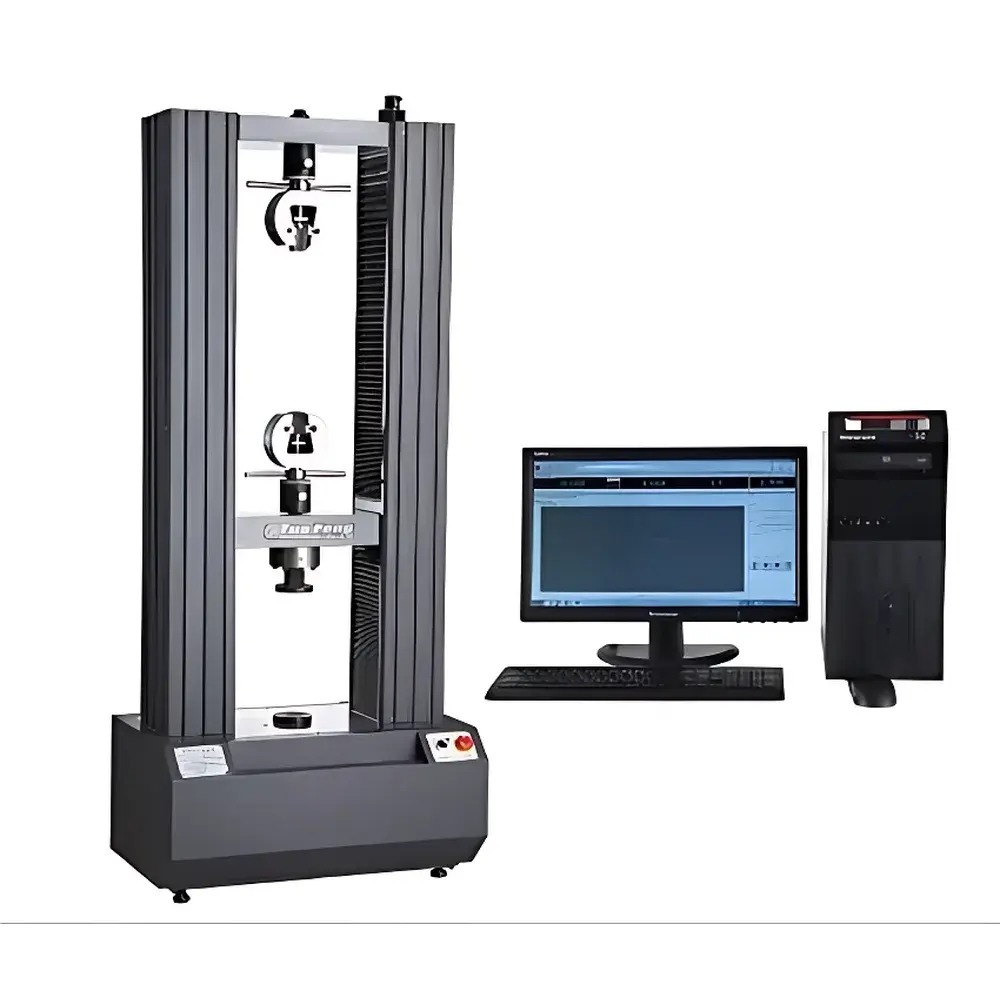
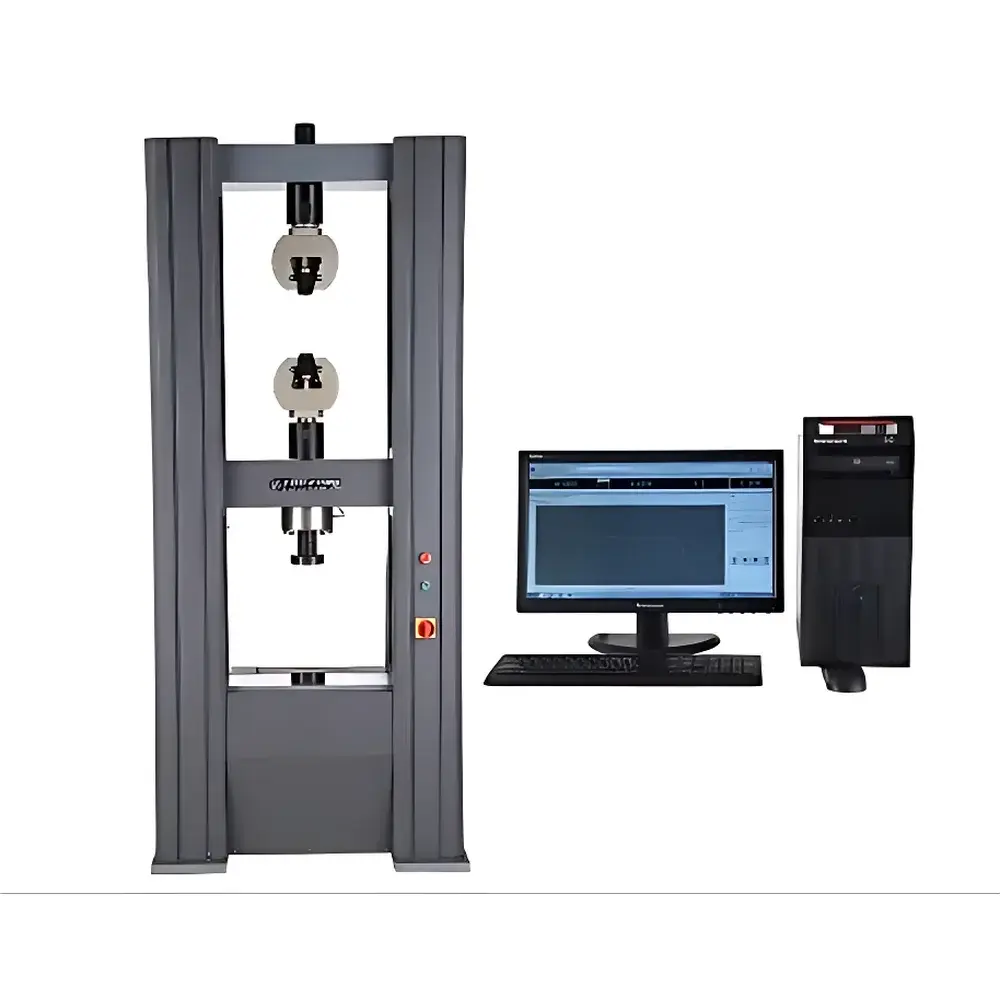
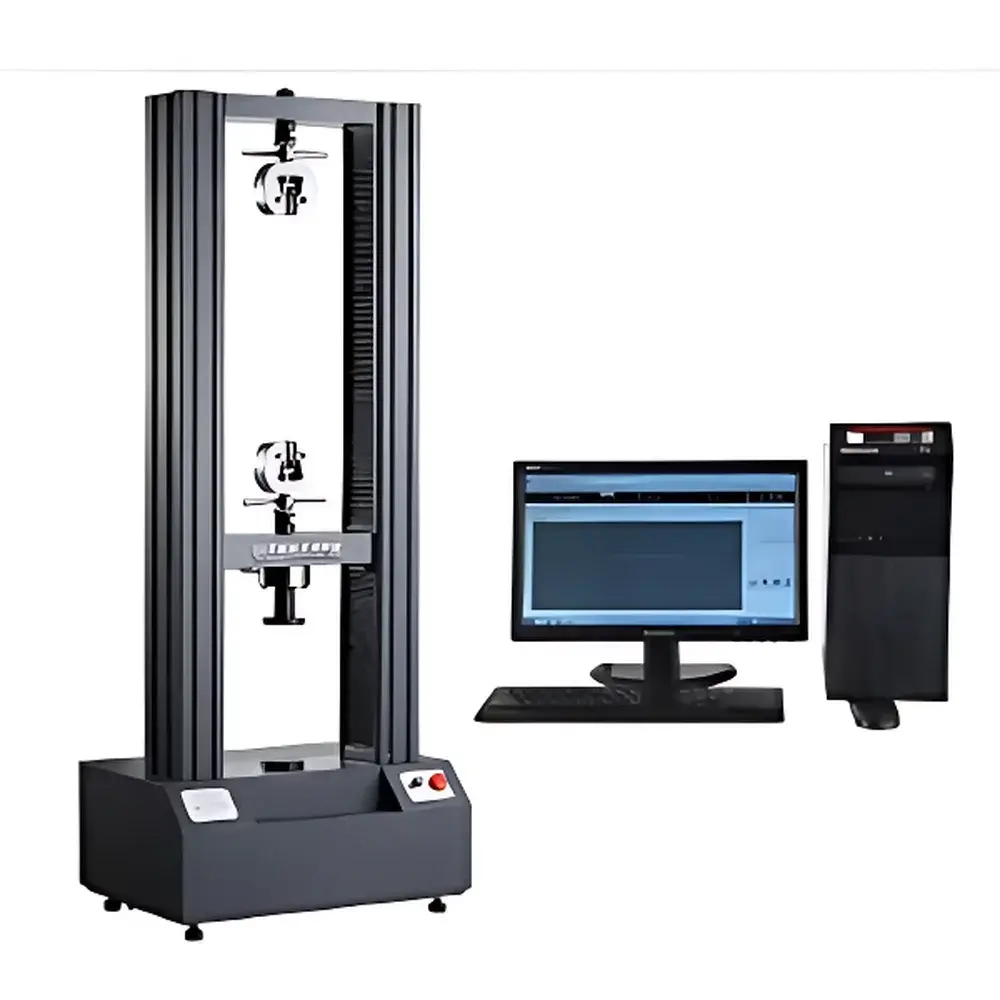
Tuofeng TFW-28 Microcomputer-Controlled Universal Testing Machine
| Brand | Tuofeng |
|---|---|
| Origin | Shanghai, China |
| Manufacturer Type | Direct Manufacturer |
| Product Category | Domestic |
| Model | TFW-28 |
| Instrument Type | Electromechanical Universal Testing Machine |
| Maximum Test Load | 20 kN |
| Accuracy Class | 0.5 |
| Effective Force Range | 0.2–100% of Full Scale |
| Force Measurement Accuracy | ±0.005% of Reading |
| Force Resolution | 1 part in ±500,000 full-scale codes (no range switching, constant resolution) |
| Drive System | Imported Servo Motor with Worm Gear Reducer |
| Lead Screw | High-Precision Ball Screw |
| Effective Test Width | 600 mm (customizable) |
| Stroke | 800 mm (extendable) |
| Speed Range | 0.001–500 mm/min (infinitely variable) |
| Displacement Measurement | Optical Encoder |
| Displacement Accuracy | ±0.005% of Reading |
| Strain Measurement | Optional Extensometer or Large-Deformation Gauge |
| Strain Accuracy | ±0.005% of Reading |
| Safety Protection | Electronic Limit Switches, Emergency Stop, Overload Protection (10% above capacity) |
| Crosshead Control | Dual-Speed (Fast/Slow) Automatic Adjustment with Point-to-Point Jog Function |
| Return Mode | Automatic or Manual High-Speed Return to Initial Position |
| Fixture Customization | Application-Specific Clamping Solutions Available |
| Dimensions (W×D×H) | 1000 × 700 × 2000 mm |
| Power Supply | 220 V, 1.0 kW |
| Net Weight | ~450 kg |
Overview
The Tuofeng TFW-28 Microcomputer-Controlled Universal Testing Machine is an electromechanical force-testing system engineered for precision mechanical property characterization of metallic, polymeric, composite, and ceramic materials. Based on the principle of controlled axial loading via high-fidelity servo-driven displacement actuation, the system applies calibrated tensile, compressive, flexural, shear, tear, peel, and puncture forces while synchronously capturing load, displacement, and strain data at sub-millisecond intervals. Its dual-column rigid frame architecture ensures minimal deflection under load, supporting high reproducibility across repeated tests—critical for quality control laboratories, R&D departments, and accredited testing facilities operating under GLP or ISO/IEC 17025 frameworks.
Key Features
- 0.5-class accuracy per GB/T 16491–2008 and JJG 475–2008, validated traceable to national metrological standards
- Full-scale force resolution of 1 part in ±500,000 without range switching—enabling seamless transition from low-force polymer creep testing to high-load metal yield evaluation
- Imported servo motor coupled with worm-gear reduction and preloaded ball screw transmission ensures smooth, backlash-free motion control and long-term positional stability
- Dual-speed crosshead movement (fast positioning + fine adjustment) with jog capability improves throughput during multi-specimen batch testing
- Integrated triple-layer safety protocol: electronic travel limits, hardware emergency stop circuitry, and software-enforced overload cutoff at 110% of rated capacity
- Modular fixture interface compatible with ASTM E8, ISO 6892-1, GB/T 228.1, and other standard-compliant grips—including wedge-action, pneumatic, hydraulic, and custom-designed solutions
Sample Compatibility & Compliance
The TFW-28 accommodates specimens ranging from thin films (≥0.05 mm thickness) to structural steel coupons (up to 30 mm thick), with adjustable test width (standard 600 mm, extendable upon request) and vertical stroke (800 mm, field-upgradable). It supports standardized test methods across major international regulatory and industrial frameworks: ASTM D638/D790/D1435/D903, ISO 527/178/37/1133, JIS K7113/K7127, DIN 53455/53504, BS EN 10002-1, and GB/T 1040/1041/1447/1449. The machine complies with GB/T 16491–2008 for manufacturing specifications and JJG 475–2008 for periodic verification. Its mechanical design meets CE machinery directive requirements (2006/42/EC) when configured with EU-certified safety components.
Software & Data Management
The Windows-based TFW-TestSuite v4.x software provides ISO/IEC 17025-aligned audit trail functionality, including user login authentication, parameter change logging, and electronic signature support for test report finalization. It supports six real-time control modes: constant rate of extension (CRE), constant rate of loading (CRL), constant stress, constant strain, hold-to-target, and cyclic loading profiles. Raw data acquisition occurs at ≥1 kHz sampling rate, with simultaneous display of up to four synchronized curves (e.g., stress–strain, load–time, displacement–time, load–extension). Units are freely convertible between SI, imperial, and legacy systems (e.g., MPa/kpsi, mm/in, N/lbf). All test results—including ultimate tensile strength, yield point (0.2% offset), Young’s modulus, elongation at break, compressive modulus, and peel adhesion energy—are auto-calculated using user-input cross-sectional area and gauge length. Reports comply with FDA 21 CFR Part 11 requirements when deployed with optional digital certificate integration.
Applications
This system serves as a primary mechanical characterization tool in sectors requiring strict adherence to material performance thresholds: aerospace component qualification (e.g., titanium alloy fasteners per AMS 2300), automotive polymer validation (PP, PA66, TPU per ISO 179/180), medical device polymer testing (ISO 5832-12, USP / extractables screening substrates), construction material certification (rebar, grout, fiber-reinforced concrete per ASTM A615/A1034), and battery separator tensile integrity assessment (per UL 1642 Annex B). Its versatility extends to academic research involving shape-memory alloys, hydrogels, and bioresorbable scaffolds where precise low-force (500%) measurement fidelity is essential.
FAQ
Does the TFW-28 support third-party calibration certificates?
Yes—factory calibration is performed using NIST-traceable deadweight standards, and certified calibration reports compliant with ISO/IEC 17025 are available upon request.
Can the system be integrated into a LIMS or MES environment?
Yes—the software includes ODBC-compliant database export and RESTful API endpoints for bidirectional data exchange with laboratory information management systems.
Is extensometer compatibility included by default?
The base configuration includes mounting interfaces for clip-on and non-contact extensometers; the sensor itself is an optional add-on selected based on strain range and resolution requirements.
What documentation is provided for regulatory submissions?
A complete Design Qualification (DQ), Installation Qualification (IQ), and Operational Qualification (OQ) package—including risk assessment (FMEA), test protocols, and raw validation data—is supplied for GxP-regulated environments.
Is remote diagnostics and software update support available?
Yes—via secure TLS-encrypted remote access with customer consent; all firmware and application updates are delivered free of charge for the product’s service life.



