
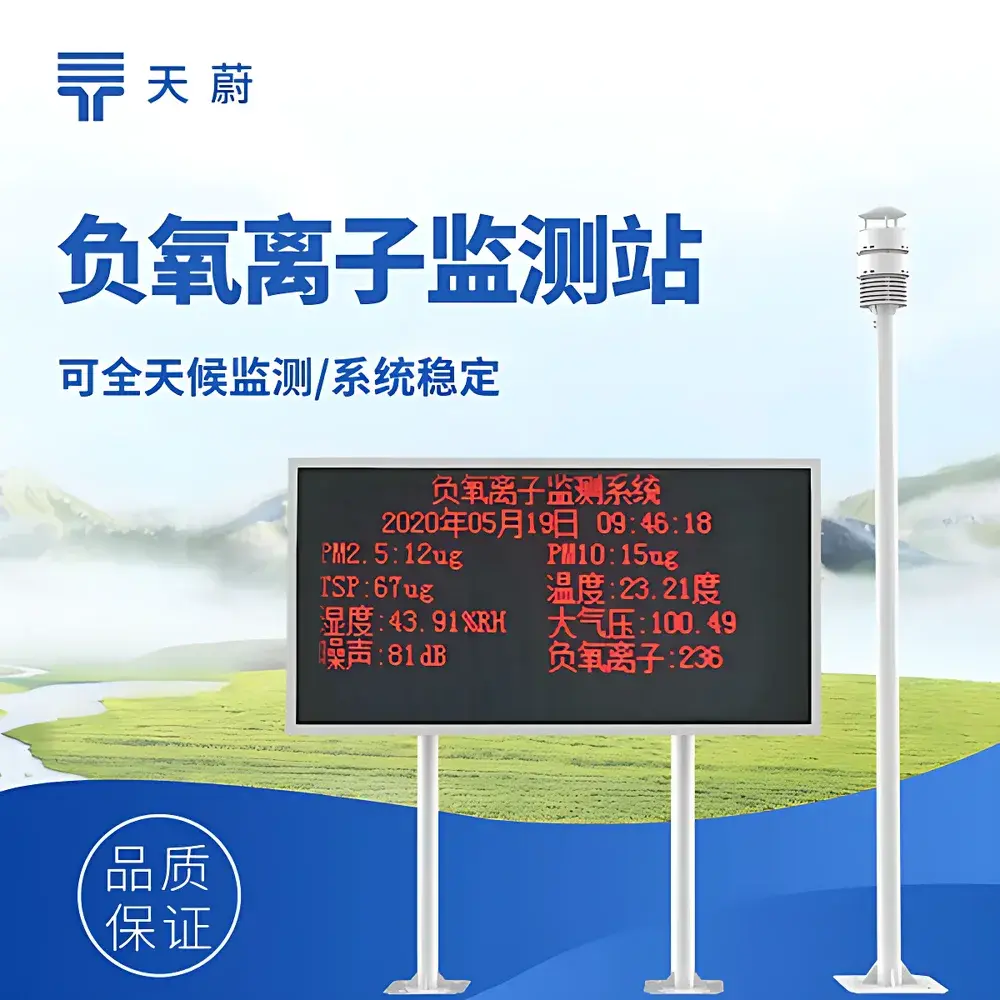
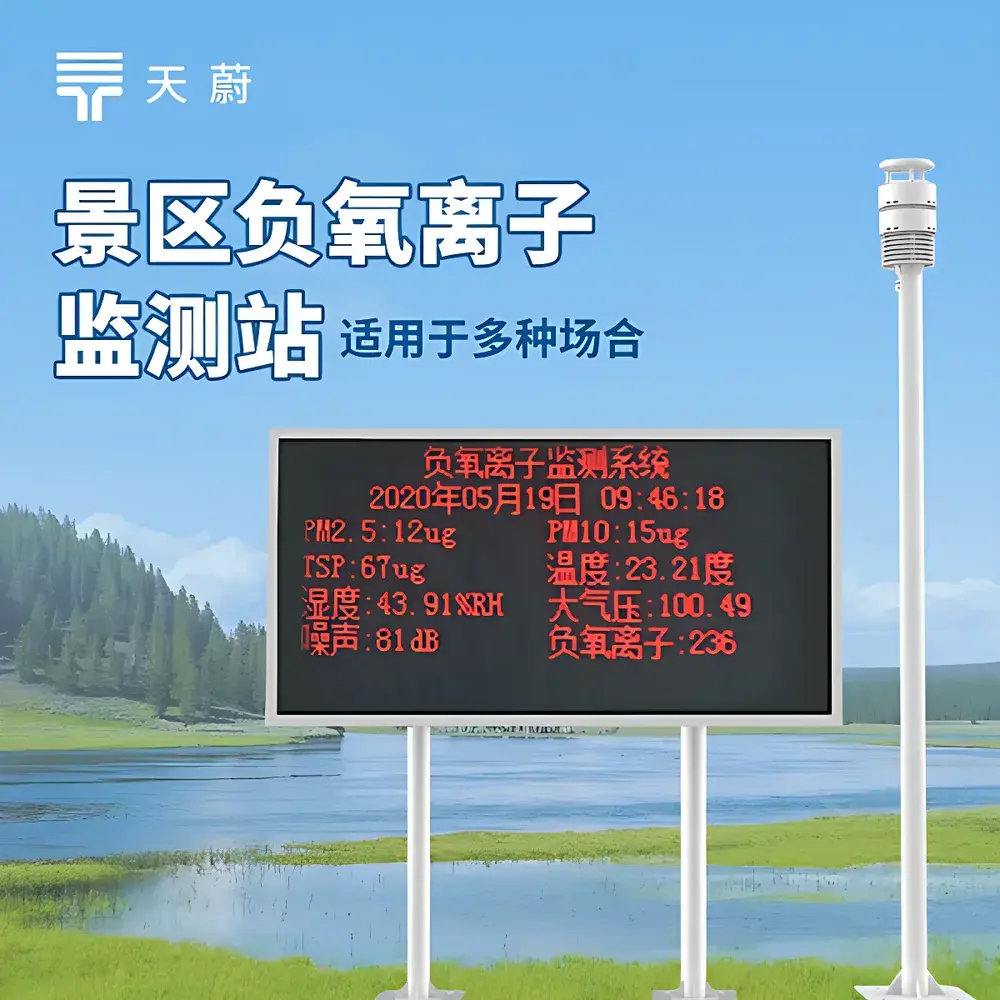
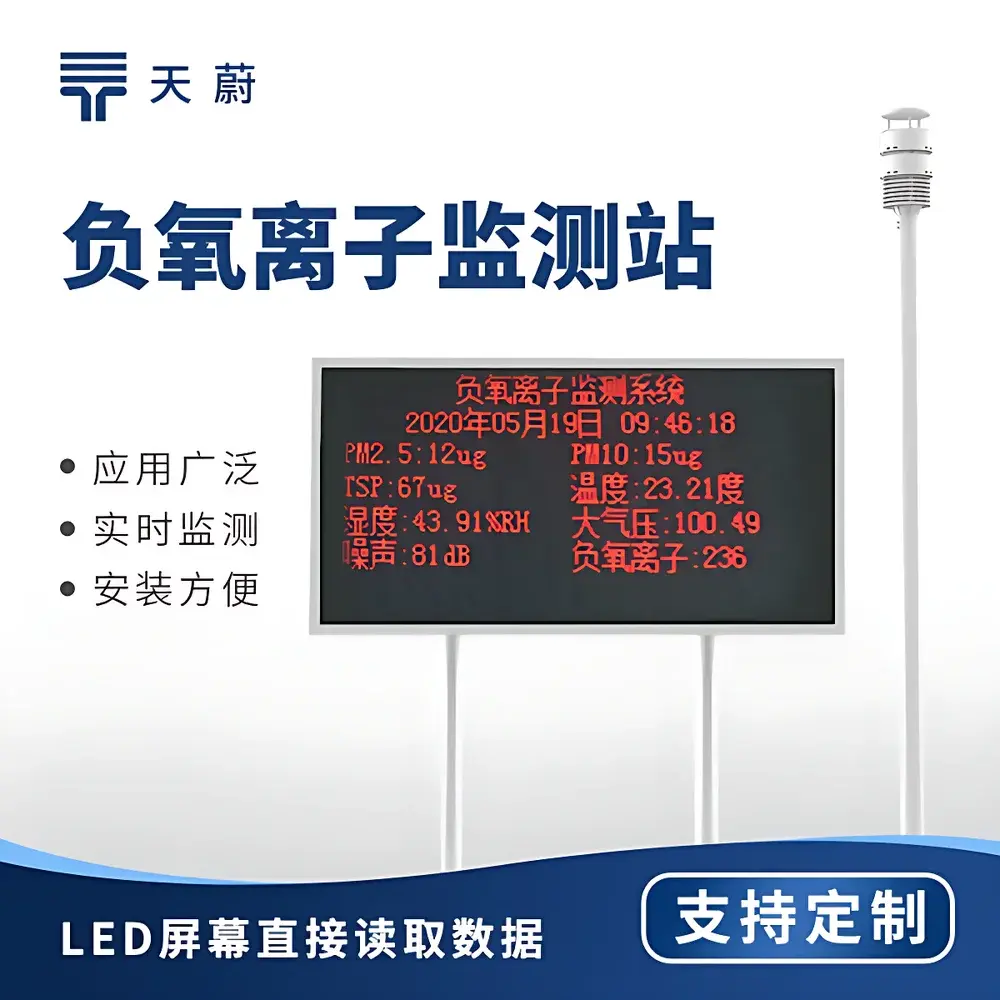
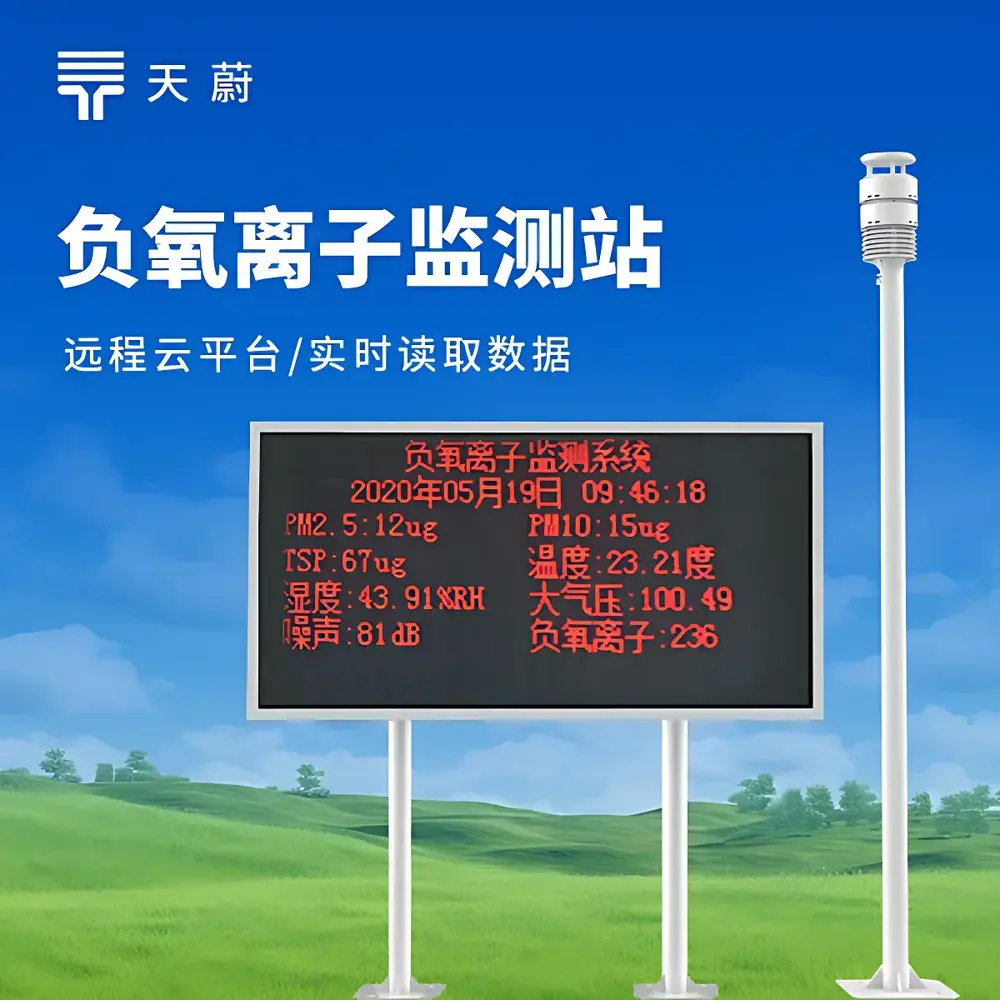
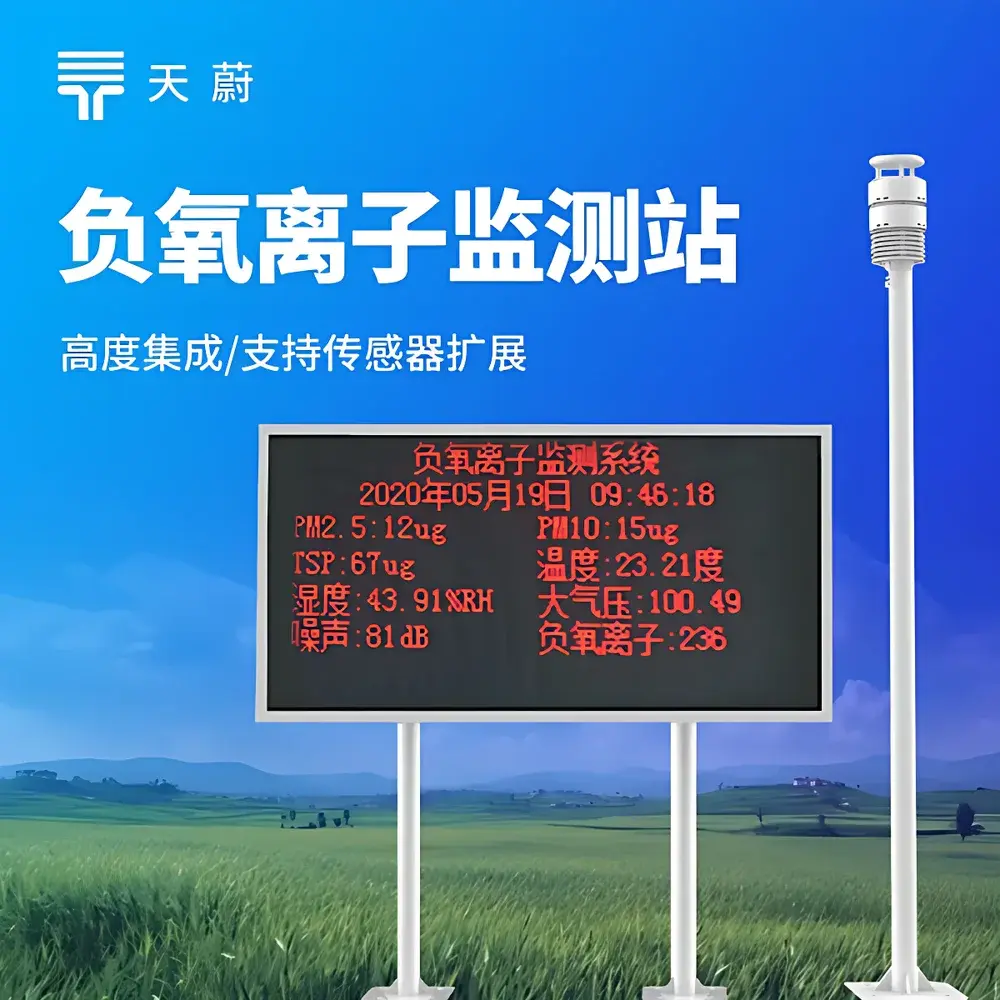
TW-FZ3 Air Negative Ion Monitoring Station by Tianwei Environmental
| Brand | Tianwei Environmental (TW) |
|---|---|
| Origin | Shandong, China |
| Manufacturer | Yes |
| Model | TW-FZ3 |
| Measurement Principle | Asymmetric Capacitive Collector with Gerdien Tube Design |
| Negative Ion Range | 0–500,000 ions/cm³ (typical ambient range) |
| Resolution | 1 ion/cm³ |
| Accuracy | ±10% of reading (calibrated against NIST-traceable reference ion generator) |
| Temperature | −40°C to +60°C (±0.3°C) |
| Humidity | 0–100% RH (±0.3% RH, capacitive sensor) |
| Wind Direction | 0–360° (±2°, ultrasonic anemometer) |
| PM2.5 | 0–1000 µg/m³ (±10%, optical scattering) |
| Noise | 30–120 dB(A) (±1.5 dB, condenser microphone) |
| Oxygen Concentration | 0–100% vol (±3% vol, electrochemical sensor) |
| Data Storage | Local SD card or embedded flash — 1 year of raw 1-min interval data |
| Communication | GPRS / LTE Cat-1 / Fiber-optic (TCP/IP) |
| Power Supply | 220 VAC ±10% or optional solar + battery (12 VDC nominal) |
| Display | 2 m × 1 m P10 monochrome LED matrix (36 modules, 32 cm × 16 cm each) |
| Structural Frame | Dual carbon-steel uprights, flanged modular assembly, rated for Typhoon Level 15 (≥45 m/s) |
| Enclosure Rating | IP65 |
| Compliance | Meets GB/T 18801–2022 (Air Ion Detector General Requirements), HJ 93–2013 (Ambient Air Particulate Matter Monitoring), and supports HJ 212–2017 (Data Transmission Protocol for Environmental Monitoring) |
Overview
The TW-FZ3 Air Negative Ion Monitoring Station is a field-deployable, multi-parameter environmental observation system engineered for continuous, unattended measurement of atmospheric negative air ions (NAIs) alongside co-located meteorological and air quality parameters. At its core, the station employs a calibrated asymmetric capacitive collector based on the Gerdien tube principle—where air is drawn through a cylindrical electrode assembly under controlled airflow, enabling quantitative charge collection proportional to ion concentration. This method ensures high sensitivity in low-concentration outdoor environments (e.g., forests, coastal zones, alpine regions) while maintaining immunity to electromagnetic interference and particulate fouling. Unlike passive diffusion-based sensors, the TW-FZ3 integrates active aspiration and temperature/humidity compensation algorithms to minimize drift across diurnal and seasonal cycles. Designed for long-term ecological monitoring, it operates reliably across extreme ambient conditions (−40°C to +60°C, 0–100% RH), making it suitable for deployment in national parks, UNESCO biosphere reserves, and urban green infrastructure projects.
Key Features
- Modular sensor architecture: All environmental modules—including NAI, temperature, humidity, PM₂.₅/PM₁₀, barometric pressure, dissolved oxygen (in ambient air), wind speed/direction, and noise—are independently replaceable via standardized RS-485 Modbus RTU interfaces.
- Dual-redundant data acquisition: Local embedded controller logs raw sensor outputs at 1-minute intervals; onboard non-volatile memory retains ≥1 year of timestamped data even during network outages.
- High-visibility local display: 2 m × 1 m P10 LED matrix provides real-time parameter readouts without requiring external devices; configurable display layouts support multilingual text and unit switching.
- Multi-path communication stack: Supports simultaneous GPRS, LTE Cat-1, and fiber-optic Ethernet connectivity; automatic failover ensures uninterrupted data telemetry to central servers.
- Structural resilience: Twin carbon-steel uprights with bolted flange joints meet GB 50009–2012 wind load standards for Typhoon Level 15 (45 m/s gusts); corrosion-resistant coating extends service life beyond 10 years in coastal or industrial settings.
Sample Compatibility & Compliance
The TW-FZ3 is validated for ambient air sampling only—not intended for indoor, ducted, or pressurized systems. Its NAI sensor complies with GB/T 18801–2022 requirements for detection limit (<50 ions/cm³), linearity (R² > 0.995 over 0–5×10⁵ ions/cm³), and repeatability (CV < 5% over 72 h). Meteorological modules conform to ISO 16096:2015 (wind sensors), IEC 60751 (RTD temperature), and GB/T 27805–2011 (noise meters). Data transmission adheres to HJ 212–2017 protocol for Chinese environmental monitoring networks, including mandatory checksums, packet sequencing, and retransmission logic. The system supports audit-ready logging for GLP-aligned field studies and meets basic cybersecurity requirements per GB/T 22239–2019 (Level 2).
Software & Data Management
The station interfaces with a browser-based, client-server (CS) cloud platform accessible via desktop or mobile browsers—no plugin or native app installation required. The platform implements role-based access control (RBAC) with granular permissions for operators, analysts, and administrators. Real-time dashboards visualize live metrics using SVG-based gauges and time-series plots; historical data queries support date-range filtering, sensor grouping, and statistical aggregation (min/max/avg/std dev). All data writes are immutable and timestamped with UTC GPS-synced clocks. Alarm triggers support SMS/email notifications with user-defined thresholds and hysteresis. Export functions generate CSV/Excel files compliant with ISO 8601 timestamps and SI units. Forwarding modules support TCP socket streaming, HTTP POST (JSON/XML), and HJ 212–2017 frame encapsulation for integration into municipal EMS or provincial EIS platforms.
Applications
- Ecological health assessment in protected areas: Quantifying NAI gradients across elevation bands, vegetation types, and proximity to waterfalls or ocean fronts to inform conservation management plans.
- Urban green space evaluation: Correlating NAI concentrations with tree canopy coverage, pedestrian flow, and traffic emissions in smart city pilot zones.
- Wellness infrastructure monitoring: Supporting evidence-based design of therapeutic landscapes in hospitals, senior living campuses, and rehabilitation centers.
- Environmental impact reporting: Providing auditable, continuous NAI baselines for EIA compliance in hydropower, wind farm, or afforestation projects.
- Academic research: Enabling longitudinal studies on atmospheric ion chemistry, aerosol–ion interactions, and biometeorological effects on human autonomic nervous function.
FAQ
What calibration standards does the negative ion sensor follow?
The sensor is factory-calibrated using a NIST-traceable radioactive ²¹⁰Po reference ion source and verified annually against a portable secondary standard (TW-CAL-2000) per GB/T 18801–2022 Annex B.
Can the system operate entirely off-grid?
Yes—when equipped with the optional solar power kit (200 W mono-Si panel + 100 Ah LiFePO₄ battery), the station sustains full functionality for ≥72 h during consecutive cloudy days.
Is raw sensor data accessible via API?
Yes—the cloud platform provides RESTful JSON APIs with OAuth 2.0 authentication for programmatic access to real-time and historical datasets, including metadata and QA/QC flags.
Does the system support third-party sensor integration?
All RS-485 Modbus RTU compliant sensors (e.g., CO₂, VOC, UV index) can be added without firmware modification; configuration is performed via web UI or configuration file upload.
How is data integrity ensured during transmission interruptions?
Local storage buffers all measurements; upon network recovery, the device performs delta-synchronized upload using sequence numbers and SHA-256 hash verification to prevent duplication or omission.
Related Products







