
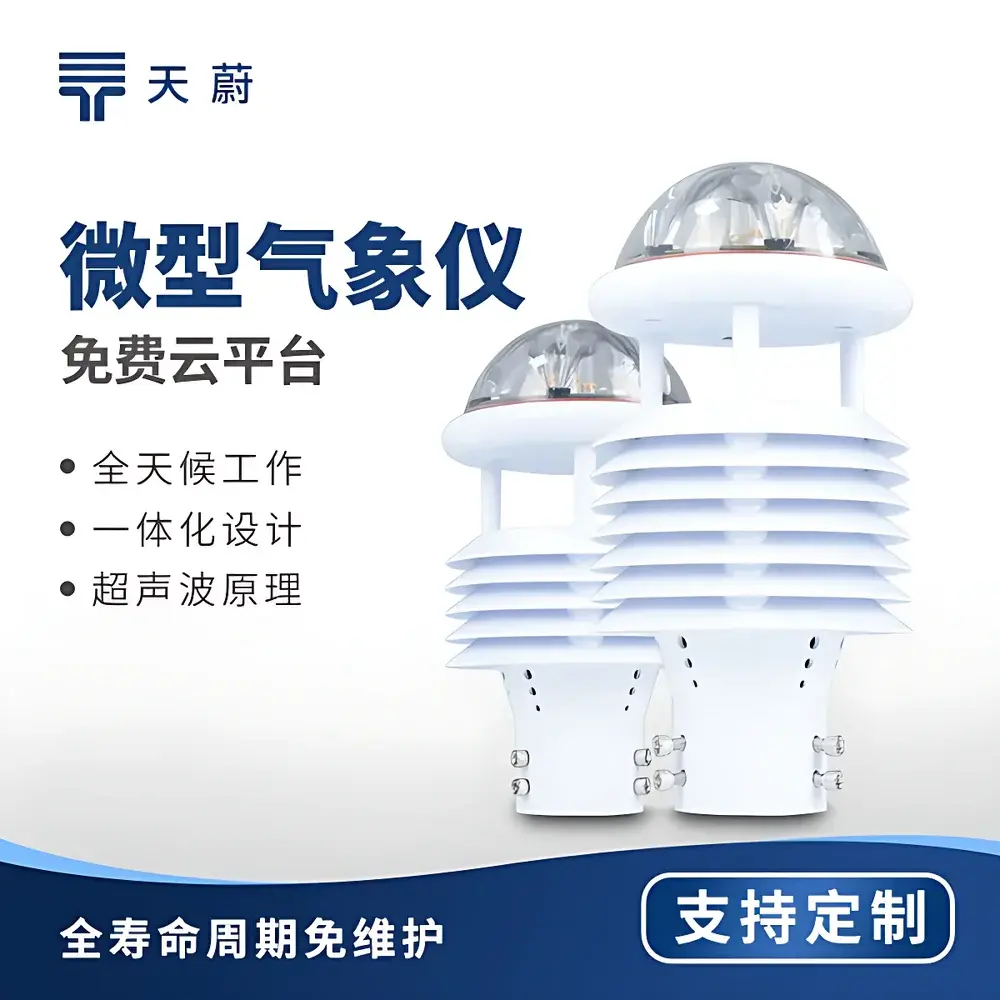

TW-WQX6 Six-Parameter Integrated Ultrasonic Weather Station
| Brand | Shandong Tianwei Environment (TW) |
|---|---|
| Origin | Shandong, China |
| Manufacturer Type | Direct Manufacturer |
| Country of Origin | China |
| Model | TW-WQX6 |
| Price | USD 780 (FOB Qingdao) |
| Communication | RS485 (MODBUS RTU), optional RS232/USB/Ethernet/Wireless (GPRS/LTE, min. 1-min interval) |
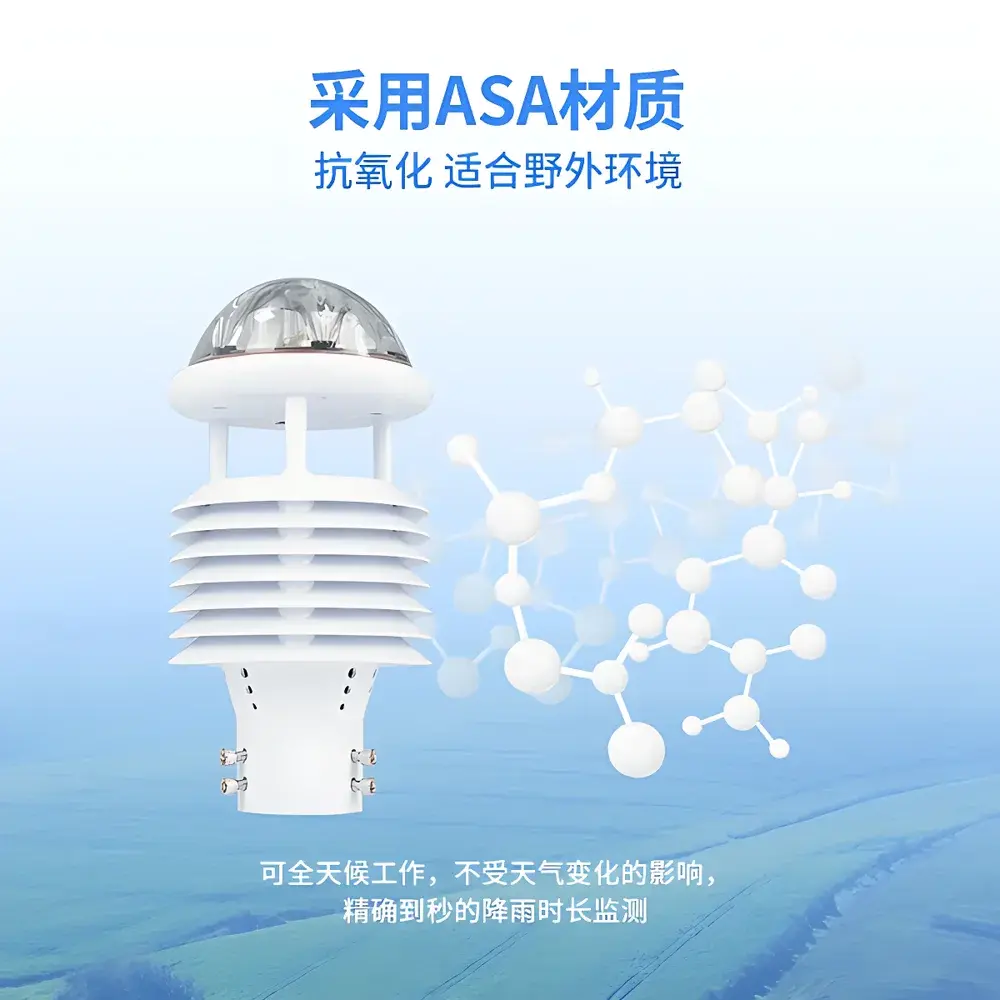
| Housing Material | UV-stabilized ASA engineering plastic |
| Mounting | Flange base with north indicator |
| Compliance | IP66, RoHS, CE-marked for industrial environmental use |
| Sensor Architecture | Solid-state, no moving parts, maintenance-free design |
Overview
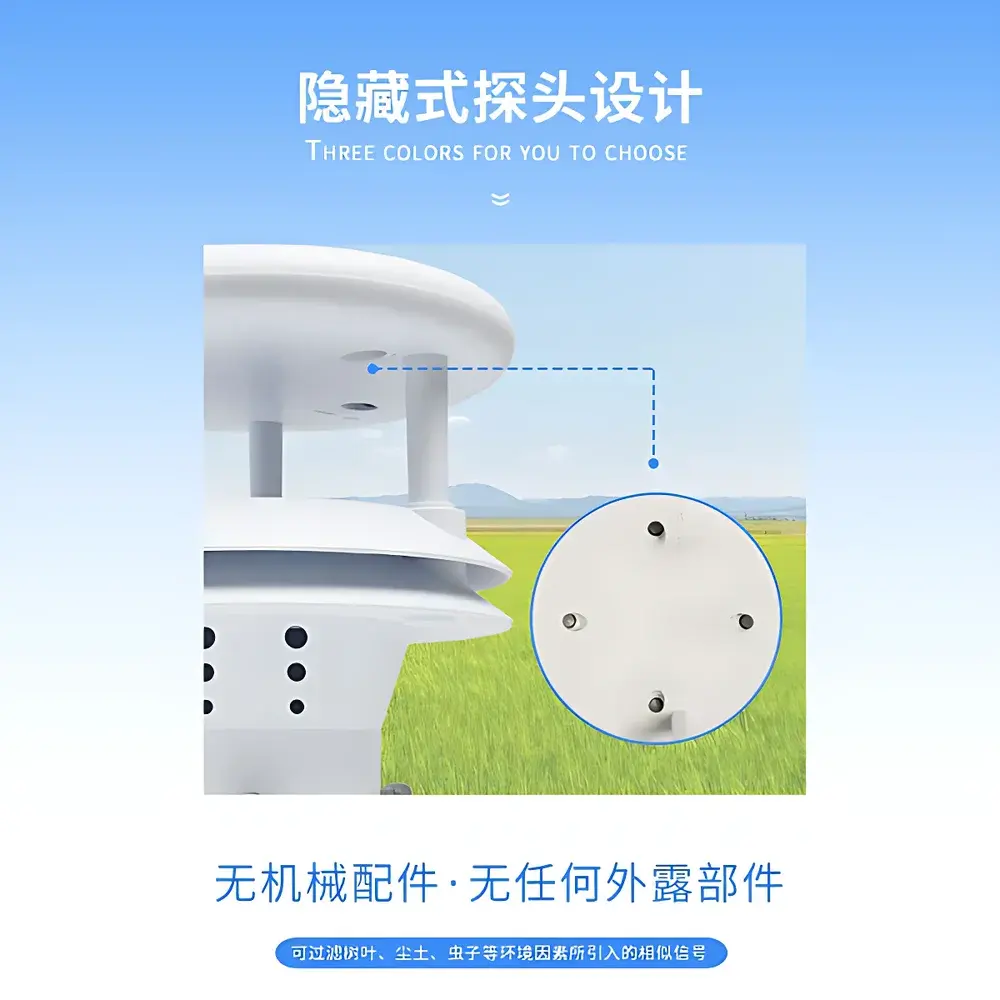
The TW-WQX6 Six-Parameter Integrated Ultrasonic Weather Station is an all-in-one micro-meteorological sensor system engineered for continuous, unattended outdoor monitoring of six core atmospheric parameters: wind speed, wind direction, ambient temperature, relative humidity, barometric pressure, and optical rainfall intensity. Unlike conventional mechanical or cup-and-vane anemometers, the TW-WQX6 employs continuous frequency-modulated ultrasonic time-of-flight (TOF) measurement—specifically, phase-difference analysis of dual-path ultrasonic signals—to derive wind vector data. This method eliminates reliance on high-precision timing circuits and mitigates measurement drift caused by thermal hysteresis, startup latency, or analog signal path delays. All six sensors are co-located within a single, compact, aerodynamically optimized housing featuring a concealed ultrasonic transducer array integrated beneath a hydrophobic, self-draining top cover—ensuring operational integrity under snow accumulation, heavy rain, or turbulent boundary-layer flow conditions. Designed for deployment in power transmission corridors, smart city infrastructure, agricultural IoT networks, and ecological research sites, the device delivers synchronized, timestamped digital output via industrial-standard RS485 MODBUS RTU protocol.
Key Features
- Integrated ultrasonic wind sensing with phase-difference wind speed/wind direction calculation—no moving parts, zero mechanical wear, and no minimum threshold (0 m/s start-up)
- Top-mounted, recessed ultrasonic transducers protected from precipitation ingress and wind shadow effects by a contoured ASA polymer shroud
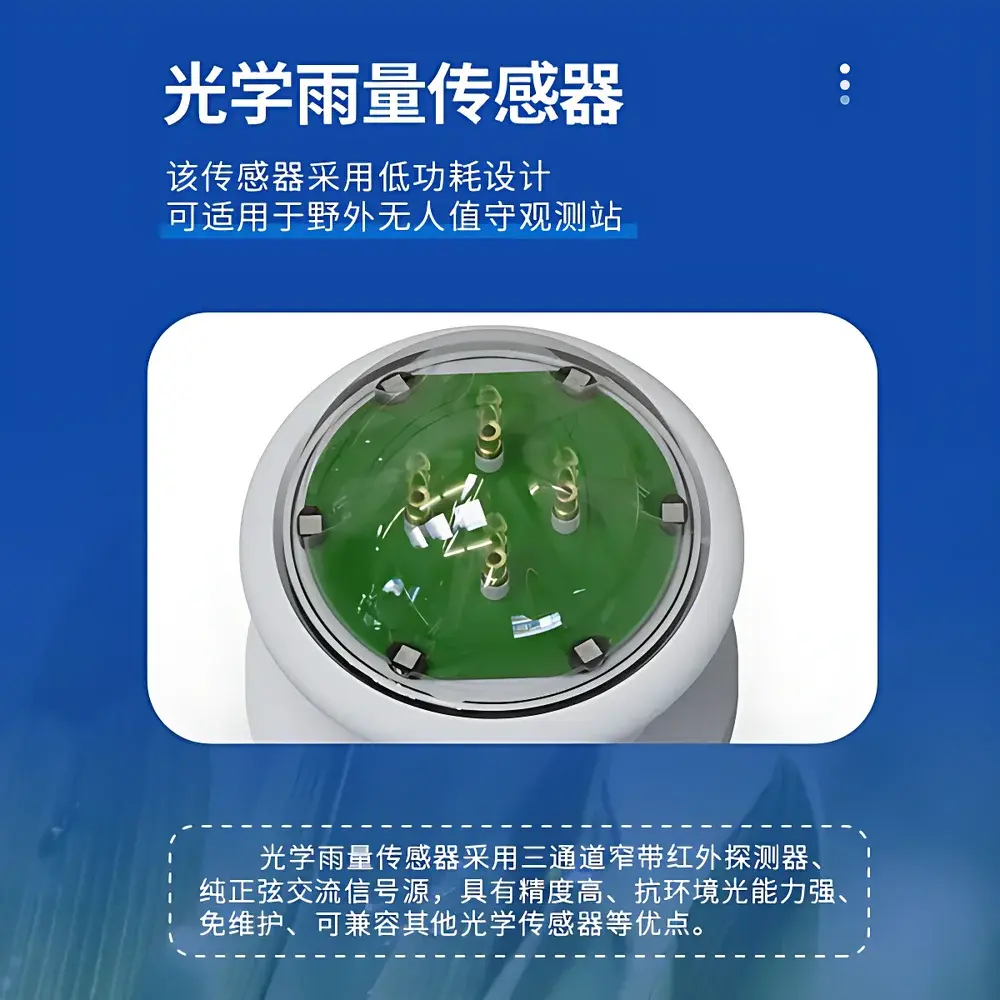
- Co-located high-accuracy digital sensors: capacitive humidity sensor (±3% RH), platinum RTD temperature element (±0.3°C), piezoresistive barometer (±0.02 hPa), and optical rain gauge with LED-based drop detection and pulse-counting logic
- Embedded watchdog timer and auto-reset circuitry ensures long-term firmware stability under voltage fluctuation or EMI exposure
- UV-resistant ASA engineering plastic enclosure rated IP66—maintains structural integrity and color stability after >10 years of direct solar exposure
- Standard RS485 MODBUS RTU interface (addressable, multi-drop capable); optional interfaces include RS232, USB-C, 10/100BASE-T Ethernet, and embedded GPRS/LTE module with configurable transmission intervals down to 60 seconds
- Quick-release bayonet-style probe mounting system prevents misalignment during transport or field installation
- No field calibration required; factory-traceable NIST-equivalent calibration certificates available upon request
Sample Compatibility & Compliance
The TW-WQX6 is validated for operation across diverse environmental regimes—from arctic (-40°C) to desert (85°C) conditions—and meets international standards for industrial-grade environmental instrumentation. Its sensor fusion architecture complies with IEC 61000-4 electromagnetic compatibility (EMC) requirements, including surge immunity (IEC 61000-4-5 Level 3) and electrostatic discharge resistance (IEC 61000-4-2 Level 4). The optical rain sensor conforms to WMO Guide to Meteorological Instruments and Methods of Observation (CIMO Guide, Chapter 12) specifications for non-mechanical precipitation measurement. Data output structure supports integration into SCADA systems compliant with IEC 60870-5-101/104 and ISO 14644 cleanroom environmental monitoring frameworks. Optional GPS/GNSS positioning and electronic compass modules enable georeferenced metadata tagging aligned with ISO 19115 geospatial metadata standards.
Software & Data Management
The TW-WQX6 operates as a plug-and-play MODBUS slave device. Raw sensor values are output as 16-bit signed integers or IEEE 754 floating-point registers, mapped to standardized MODBUS holding register addresses per parameter (e.g., wind speed @ 40001, humidity @ 40003). No proprietary software is required; integration is supported via standard MODBUS master applications (e.g., Ignition SCADA, Node-RED, LabVIEW DAQmx, or Python pymodbus). Firmware updates are performed over-the-air (OTA) via serial or Ethernet interface using secure CRC-verified binary loading. Audit-ready data logging—including sensor status flags, internal temperature diagnostics, and communication error counters—is enabled through optional external SD-card or cloud gateway modules. For regulated environments, optional firmware variants support FDA 21 CFR Part 11-compliant electronic signatures and audit trails when deployed with validated middleware platforms.
Applications
- Overhead power line condition monitoring—correlating wind shear, icing risk, and conductor galloping potential with real-time microclimate data
- Renewable energy site assessment—long-term wind resource mapping and turbine wake analysis at sub-10m resolution
- Precision agriculture—microclimatic input for irrigation scheduling, frost prediction, and disease modeling (e.g., Botrytis, Septoria)
- Urban heat island (UHI) studies—high-density deployment across street canyons and green infrastructure zones
- National weather service auxiliary networks—low-cost augmentation of synoptic station coverage in remote or mountainous terrain
- Environmental impact assessments (EIA)—baseline meteorological characterization for construction, mining, or landfill projects
FAQ
What is the measurement principle for wind speed and wind direction?
The TW-WQX6 uses continuous frequency-modulated ultrasonic waves and measures phase difference between orthogonal transducer pairs—enabling precise wind vector calculation without mechanical components or timing-critical hardware.
Does the optical rain gauge require cleaning or recalibration?
No. The LED-based optical rain sensor is sealed and self-diagnostic; it detects droplet size and fall velocity optically and requires no routine maintenance or field recalibration.
Can the device operate reliably in coastal salt-spray environments?
Yes. The ASA housing, stainless-steel fasteners, and conformally coated PCBs meet ISO 9223 C5-M corrosion class requirements for marine-exposed instrumentation.
Is MODBUS register mapping documentation publicly available?
Yes. Full MODBUS RTU register map, including scaling factors, units, and exception code definitions, is provided in the technical manual shipped with each unit and available for download from the manufacturer’s support portal.
What power supply specifications are required?
The device operates on 9–30 VDC (nominal 12 VDC), with reverse-polarity protection and undervoltage lockout; typical current draw is 85 mA at 12 VDC (standby) and 140 mA during active ultrasonic burst cycles.
Related Products







