TWK-DPH4 Insect Electroantennography (EAG) System
| Brand | Taiwolkang |
|---|---|
| Origin | Hubei, China |
| Manufacturer Type | Authorized Distributor |
| Country of Origin | China |
| Model | TWK-DPH4 |
| Instrument Type | Semi-Automatic |
| Micromanipulator Axes | X, Y, Z |
| Positioning Resolution | 0.01 mm |
| Stimulus Control | Dual-mode (Single-Pulse & Cyclic Pulse) with Compensated Airflow |
| Signal Acquisition | High-Impedance Input, 16-bit ADC, Dual-Channel Adaptive Amplification |
| Software | Real-Time EAG Waveform Visualization, ΔV Peak Annotation, Export to Excel/PNG/SVG |
| Noise Performance | Low Thermal Drift Baseline, Adjustable Bandpass Filtering, Adaptive 50/60 Hz Notch + Wavelet Threshold Denoising |
| Compliance | Compatible with GC Trigger/Synchronization Signals (TTL), Faraday Cage Integration Required |
Overview
The TWK-DPH4 Insect Electroantennography (EAG) System is a semi-automated electrophysiological platform engineered for high-fidelity recording of antenna-specific electrical responses in insects. It operates on the principle of extracellular DC-coupled potential measurement: when volatile chemical stimuli contact olfactory sensilla on the antennal surface, ligand-receptor interactions trigger depolarization across sensory neuron membranes—generating microvolt-scale voltage transients between the antenna tip (recording site) and base (reference). The system captures these transient potentials with minimal distortion, enabling quantitative analysis of olfactory sensitivity, dose-response relationships, and temporal dynamics. Designed specifically for neuroethological and chemical ecology research, the TWK-DPH4 integrates stimulus delivery, signal amplification, real-time visualization, and post-acquisition waveform annotation within a unified hardware-software architecture compliant with standard electrophysiology workflows.
Key Features
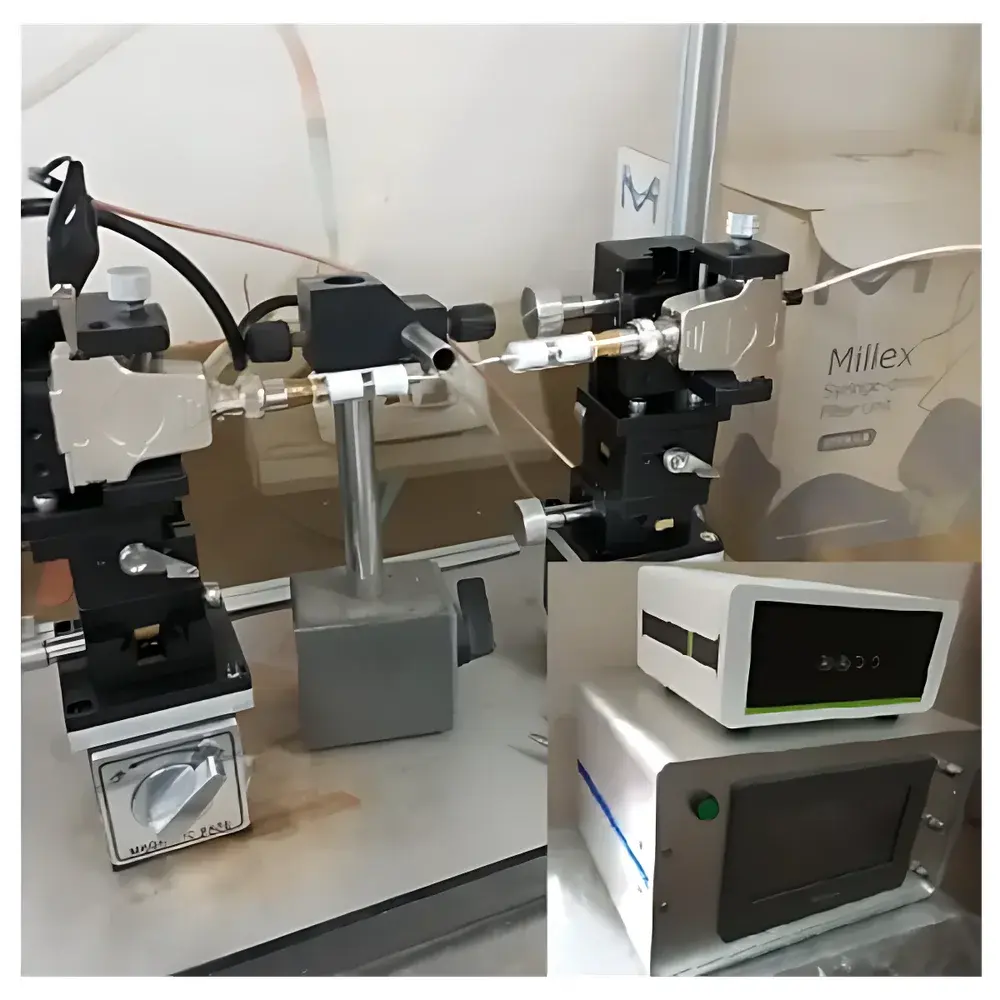
- Semi-automated micromanipulation stage with X/Y/Z orthogonal translation (0.01 mm resolution), eliminating reliance on optical alignment for antenna-electrode contact—reducing setup time and operator-induced variability.
- Dual-mode airflow stimulator (TWK-A3 controller) featuring three independently regulated gas outlets: one constant-flow clean air channel (baseline stabilization), one programmable pulse channel (stimulus delivery), and one counter-phase compensation channel (mechanical pressure nullification during pulse termination).
- Configurable stimulation protocols: single-trigger mode (footswitch or TTL input) and cyclic pulse mode (user-defined pulse duration, inter-pulse interval, and total cycle count).
- Signal acquisition module with >1013 Ω input impedance, dual-channel adaptive gain amplification (10×–1000×), and 16-bit analog-to-digital conversion at up to 10 kHz sampling rate.
- Real-time dual-trace display: synchronized overlay of EAG waveform and GC trigger/synchronization signal (TTL-compatible), facilitating precise alignment of electrophysiological response with chromatographic elution peaks.
- Onboard EAG signal simulator for system diagnostics—verifying amplifier functionality, electrode integrity, and software responsiveness prior to biological experimentation.
- Advanced digital signal processing: user-adjustable bandpass filtering (0.1–100 Hz default), adaptive 50/60 Hz notch filter, and wavelet-based threshold denoising to suppress non-stationary interference without distorting physiological transients.
Sample Compatibility & Compliance
The TWK-DPH4 supports intact antennae from Lepidoptera, Coleoptera, Diptera, and Hemiptera species, with minimal dissection requirements. Antennal mounting follows standardized protocols using glass capillary electrodes filled with Ringer’s solution and Ag/AgCl reference contacts. All measurements require operation inside a grounded Faraday cage (user-supplied) to attenuate electromagnetic interference. The system complies with GLP-aligned data integrity practices: raw waveform files are timestamped, uneditable, and stored in binary + CSV format; software enforces audit-trail logging for parameter changes and manual annotations. While not certified to ISO/IEC 17025, its signal chain design aligns with ASTM E2912-13 (Standard Guide for Electrophysiological Recording in Insects) and supports traceability required for regulatory submissions involving semiochemical bioactivity assessment.
Software & Data Management
The EW acquisition and EQ analysis suite provides real-time waveform visualization, automatic baseline detection, and ΔV peak quantification relative to pre-stimulus baseline. Users may manually annotate response onset/offset, zoom into sub-millisecond features, crop segments for comparative analysis, and export processed data to Excel (.xlsx), image formats (PNG, SVG), or MATLAB-compatible .mat files. All exported datasets retain metadata including stimulus parameters, amplifier settings, sampling rate, and system calibration constants. The software supports batch processing of multi-trial datasets and generates summary statistics (mean ± SD, coefficient of variation) per compound or concentration. No cloud storage or remote access functionality is implemented—data residency remains fully local, satisfying institutional IT security policies.
Applications
- Olfactory receptor profiling: screening synthetic or natural volatiles for antennal activation across insect taxa.
- Pheromone identification: coupling with GC-EAG to deconvolute bioactive components from complex plant or insect headspace extracts.
- Biopesticide mode-of-action studies: evaluating disruption of chemosensory signaling by candidate compounds.
- Host-plant recognition mechanisms: quantifying differential EAG amplitudes to green leaf volatiles or floral scents.
- Resistance monitoring: detecting reduced antennal sensitivity in field-collected pest populations exposed to semiochemical-based control agents.
- Neurotoxicology: assessing sublethal effects of insecticides on peripheral olfactory function.
FAQ
Is the TWK-DPH4 compatible with third-party gas chromatographs?
Yes—the system accepts standard TTL-level trigger and synchronization signals from GC units (including domestic models), enabling precise temporal alignment of EAG responses with chromatographic retention times.
What electrode types are supported?
Glass capillary electrodes (1.0–1.5 mm OD) filled with insect Ringer’s solution and connected via Ag/AgCl wires; custom electrode configurations can be accommodated upon request.
Does the system support long-duration recordings?
Yes—low thermal drift (< 0.5 µV/°C/hour) and active baseline stabilization allow stable recordings over 8+ hours, provided environmental temperature and humidity remain controlled.
Can stimulation parameters be modified during an experiment?
No—stimulus sequences are preloaded and executed as defined; however, users may pause/resume acquisition or initiate new trials without restarting the software.
Is FDA 21 CFR Part 11 compliance available?
The current software version does not include electronic signature or audit-trail modules required for Part 11 compliance; this capability may be added via optional validation package upon request.