
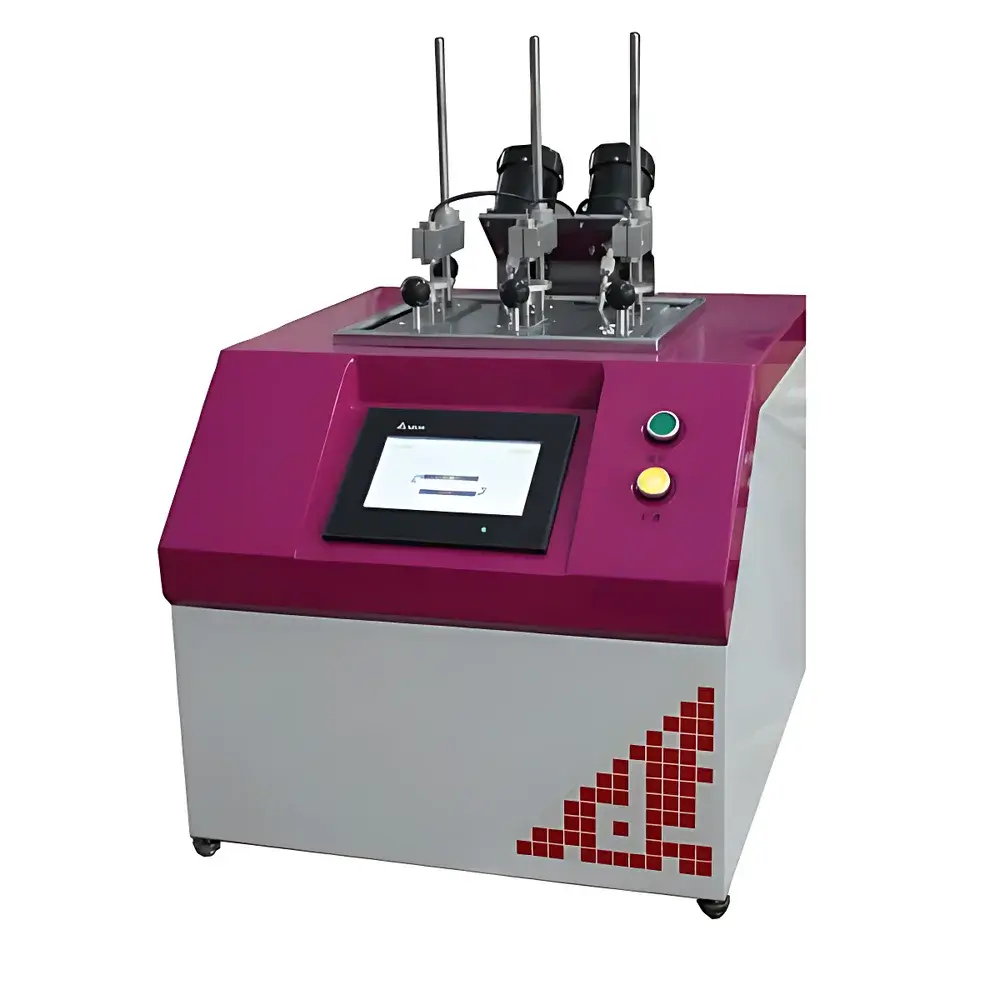
TY-5006UA Heat Deflection Temperature (HDT) and Vicat Softening Temperature (VST) Tester by TianYuan
| Brand | TianYuan |
|---|---|
| Origin | Jiangsu, China |
| Manufacturer Type | Direct Manufacturer |
| Region of Origin | Domestic (China) |
| Model | TY-5006UA |
| Temperature Control Range | RT to 300 °C |
| Heating Rate Options | (120 ± 10) °C/h or (50 ± 5) °C/h |
| Temperature Resolution | 0.1 °C |
| Deformation Measurement Range | 0–1.5 mm |
| Deformation Accuracy | ±0.001 mm |
| Sample Support Span | 64 mm or 100 mm |
| Thermal Expansion Coefficient of Test Frame | < 0.005 mm/100 °C |
| Load Rod & Platter Mass | 68 g |
| Heating Power | 4 kW |
| Dimensions (W × D × H) | 540 × 520 × 970 mm |
| Cooling Method | Natural cooling above 150 °C |
| Bath Medium | Methyl silicone oil (kinematic viscosity ~200 cSt) or transformer oil |
| Test Stations | 3 independent stations |
| Standard Compliance | GB/T 1633, GB/T 1634.1–3, GB/T 8802, ISO 306:2013, ISO 75-1–3:2003, ASTM D1525, ASTM D648 |
Overview
The TY-5006UA Heat Deflection Temperature (HDT) and Vicat Softening Temperature (VST) Tester is an industrial-grade thermal characterization instrument engineered for precise determination of thermomechanical transition temperatures in rigid polymeric materials. It operates on two standardized principles: the Vicat softening test—where a needle of defined geometry applies a constant load (10 N or 50 N) to a flat specimen while temperature rises at a controlled rate—and the heat deflection test—where a rectangular bar is subjected to a specified bending stress (0.45 MPa or 1.80 MPa) under three-point loading while immersed in a thermally regulated fluid bath. Both methods yield critical material performance indicators used in polymer specification, quality control, and regulatory documentation across automotive, electrical insulation, construction, and medical device manufacturing sectors.
Key Features
- Triple independent test stations enable concurrent execution of up to three HDT or VST determinations, improving throughput without cross-contamination or thermal interference.
- PLC-based closed-loop temperature control system with dual heating rate profiles: high-rate (120 ± 10) °C/h for rapid screening and low-rate (50 ± 5) °C/h for high-resolution compliance testing per ISO 306 and ASTM D1525.
- High-stability bath medium management: compatible with methyl silicone oil (200 cSt) or transformer oil; integrated thermal inertia compensation ensures uniform temperature distribution across all stations.
- Real-time digital deformation monitoring via three precision digital dial indicators (resolution: 0.001 mm), each calibrated traceably to national metrological standards.
- Touchscreen HMI interface with intuitive workflow navigation, real-time temperature/deformation graphing, automatic endpoint detection, and post-test curve export in CSV format.
- Robust mechanical architecture: low-expansion test frame (< 0.005 mm/100 °C), fixed support span options (64 mm or 100 mm), and standardized load rods (68 g) ensure long-term repeatability and inter-laboratory comparability.
Sample Compatibility & Compliance
The TY-5006UA accommodates standard specimens per ISO, ASTM, and GB requirements—including injection-molded plaques (GB/T 1634.2), extruded pipes and fittings (GB/T 8802), and high-strength thermoset laminates (GB/T 1634.3). Its design conforms to the mechanical and procedural constraints of ISO 306:2013 (VST), ISO 75-1–3:2003 (HDT), ASTM D1525, ASTM D648, and GB/T 1633–1634 series. All hardware components—including load application systems, bath containment, and displacement transducers—are dimensionally and functionally aligned with reference method specifications. The instrument supports full audit readiness for GLP-compliant environments through timestamped test logs, operator ID tagging, and non-editable raw data storage.
Software & Data Management
Embedded firmware provides full test lifecycle management: parameter setup (load, span, heating rate, endpoint criteria), live multi-channel plotting (temperature vs. time, deformation vs. time), automatic pass/fail evaluation against user-defined thresholds, and export of raw measurement arrays. Data files include metadata such as ambient conditions, calibration status, operator ID, and equipment serial number—facilitating traceability under FDA 21 CFR Part 11-aligned workflows when deployed with external LIMS integration. No proprietary software installation is required; exported CSV files are directly importable into statistical analysis platforms (e.g., JMP, Minitab) or QA reporting systems.
Applications
- Quality assurance of thermoplastics (e.g., ABS, PC, PP, PA6/66) and thermosets (epoxy, phenolic) prior to release.
- Material selection support for high-temperature applications including under-hood automotive components and electrical enclosures.
- Regulatory submission testing for IEC 60695-10-2 (fire hazard assessment) and UL 746B (polymeric materials evaluation).
- R&D validation of heat-resistant polymer formulations, filler-reinforced composites, and flame-retardant additives.
- Educational use in polymer science laboratories for teaching standardized thermal transition measurement methodology.
FAQ
What standards does the TY-5006UA fully support?
It complies with GB/T 1633, GB/T 1634.1–3, GB/T 8802, ISO 306:2013, ISO 75-1–3:2003, ASTM D1525, and ASTM D648.
Can the instrument perform both HDT and VST tests simultaneously?
Yes—three independent stations allow mixed-mode operation (e.g., two VST + one HDT) provided specimen geometries and loads are correctly configured per standard.
Is calibration verification documented and traceable?
Each unit ships with a factory calibration certificate referencing national metrology institute-traceable standards for temperature (Pt100 sensor) and deformation (digital indicator). Periodic verification protocols are included in the user manual.
What bath medium is recommended for extended service life?
Methyl silicone oil with kinematic viscosity of 200 cSt is preferred for stability up to 300 °C and minimal oxidative degradation over repeated thermal cycles.
Does the system meet requirements for regulated QA/QC environments?
Yes—the firmware supports electronic signatures, audit trails, and immutable data logging suitable for GLP and GMP-aligned operations when paired with validated network backup procedures.







