
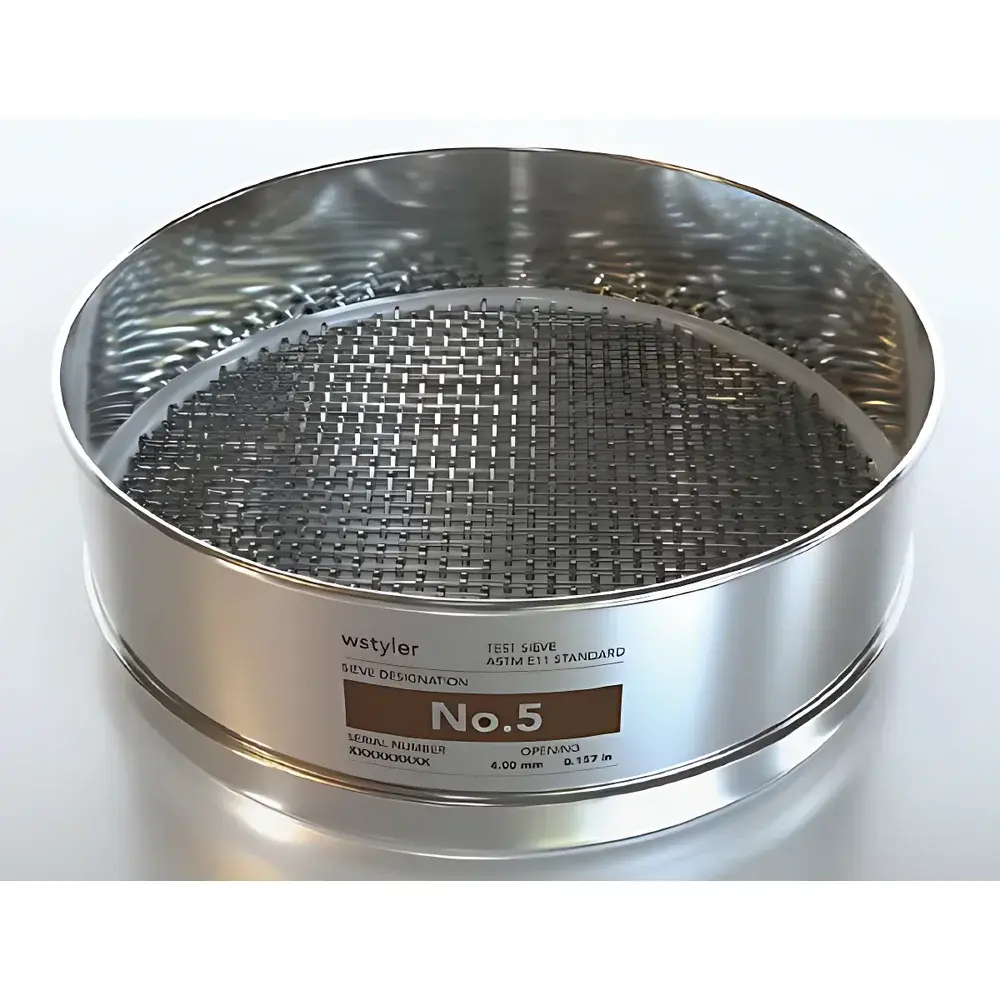
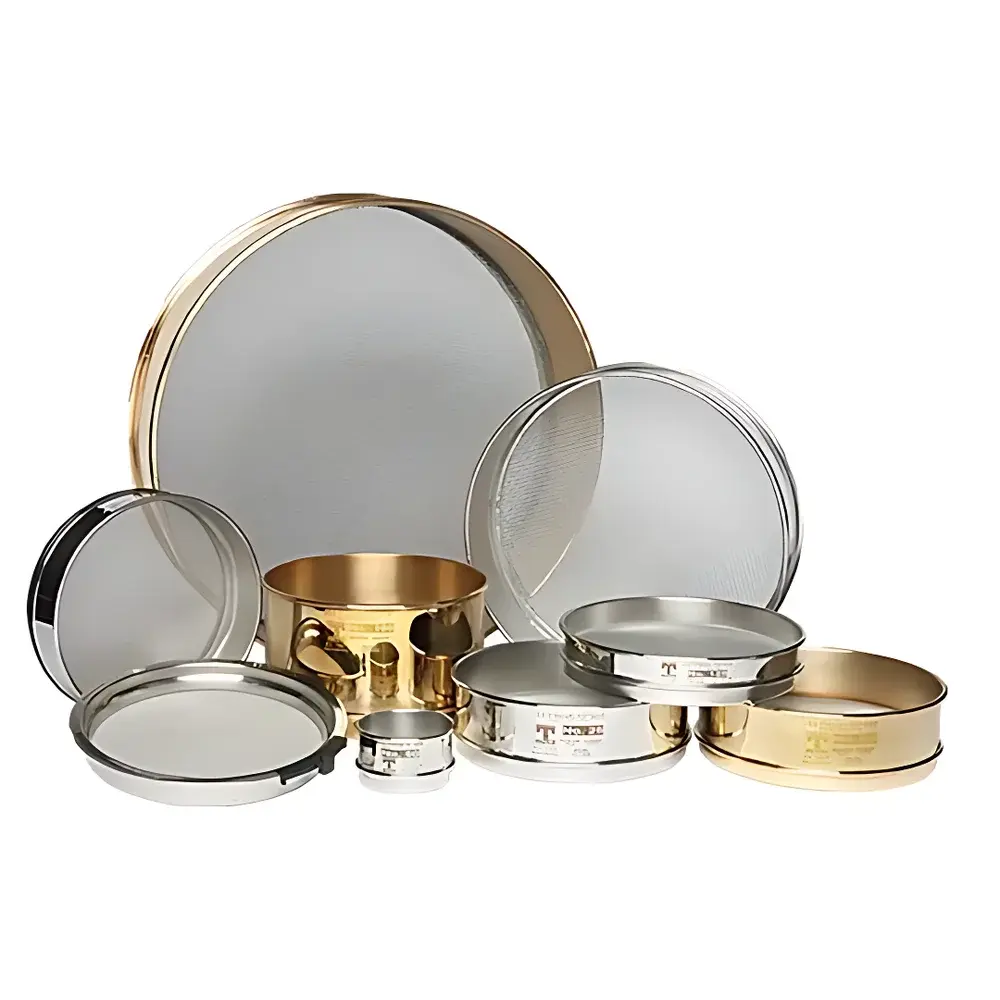
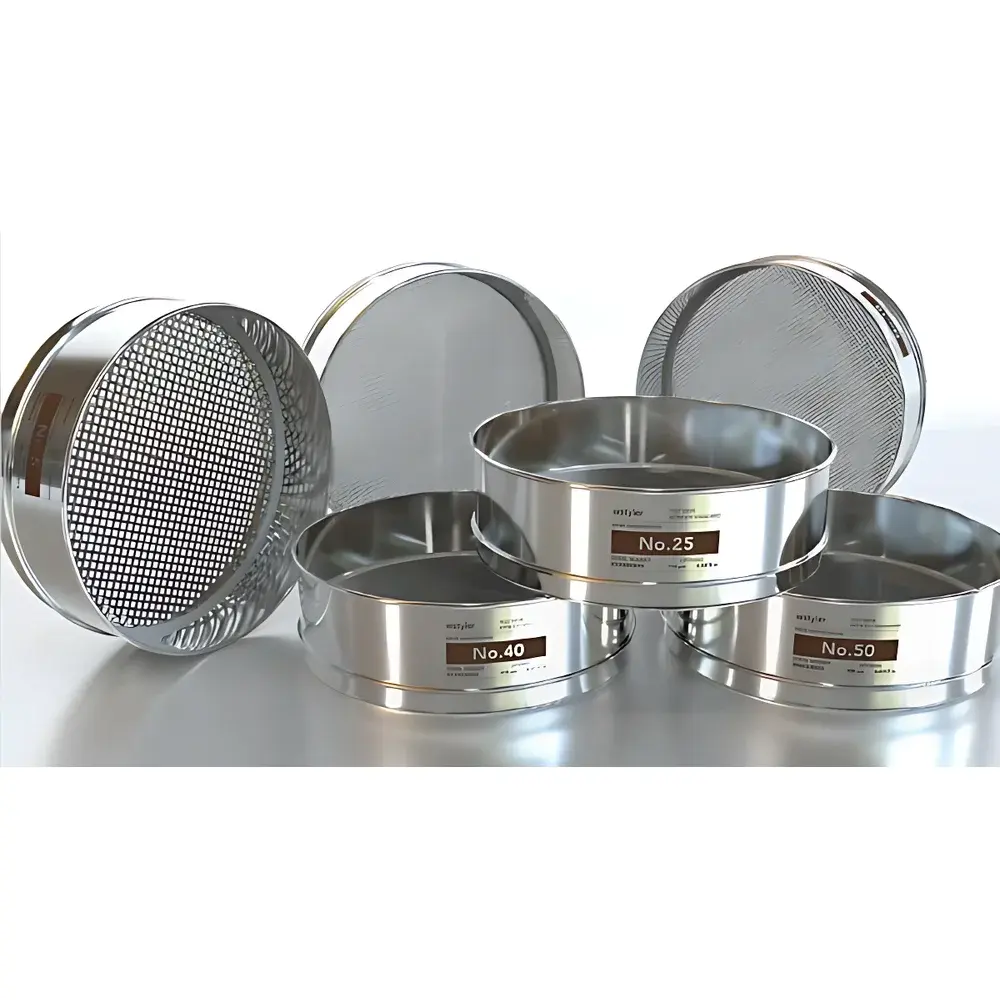
Tyler 12-inch Stainless Steel and Brass Test Sieves
| Brand | Tyler |
|---|---|
| Origin | USA |
| Model | 6662 |
| Material | Stainless steel frame with stainless steel mesh / Brass frame with stainless steel mesh / Brass frame with brass mesh |
| Compliance | ASTM E11-09 |
| Diameter | 12 inches (305 mm) |
| Available mesh sizes | US Standard No. 3½ to No. 400 (6.3 µm – 53 mm), Metric equivalents from 25.0 mm to 38 µm |
| Height options | Full (4¼"), Intermediate (3"), Half (2⅝") |
| Cloth depth | Full (3¼"), Intermediate (2"), Half (1⅝") |
Overview
The Tyler 12-inch Stainless Steel and Brass Test Sieves are precision-engineered mechanical sieving tools designed for standardized particle size distribution analysis in laboratories, quality control facilities, and R&D environments. These sieves operate on the principle of gravitational and mechanical agitation-based separation—where particles are stratified by passing through calibrated woven wire mesh under controlled vibration or hand-sieving protocols. Each sieve conforms strictly to ASTM E11-09 (Standard Specification for Woven Wire Test Sieve Cloth and Test Sieves), ensuring traceable dimensional accuracy, uniform aperture geometry, and certified compliance for regulatory reporting, method validation, and inter-laboratory comparability. Manufactured in the United States, the series includes three structural configurations: stainless steel frames with stainless steel mesh (Designation A1), brass frames with stainless steel mesh (Designation L33), and brass frames with brass mesh—each selected for specific chemical compatibility, wear resistance, or magnetic neutrality requirements.
Key Features
- Precision-woven wire cloth meeting ASTM E11-09 tolerances for aperture size, wire diameter, and open area—certified per individual sieve lot.
- Three frame-and-mesh material combinations: (1) AISI 304 stainless steel frame + 304 stainless steel mesh; (2) high-purity brass frame + 304 stainless steel mesh; (3) brass frame + brass mesh—enabling optimization for corrosive samples, non-magnetic testing, or long-term durability in abrasive applications.
- Standardized 12-inch (305 mm) nominal diameter ensures compatibility with all major mechanical sieve shakers (e.g., Gilson RX-29, Endecotts AS200, Fritsch Analysette 3), as well as manual sieving stands and nestable sieve stacks.
- Three height variants—Full (4¼” / 108 mm), Intermediate (3″ / 76 mm), and Half (2⅝” / 67 mm)—support flexibility in sample volume capacity and stack stability during multi-stage fractionation.
- Serialized units accompanied by individual Certificate of Compliance documenting mesh designation, aperture size, wire diameter, open area %, and ASTM E11-09 conformance—fully auditable for GLP, GMP, and ISO/IEC 17025 workflows.
Sample Compatibility & Compliance
These sieves are validated for dry and moderately damp particulate materials including mineral aggregates, pharmaceutical granules, metal powders, catalysts, ceramics, food ingredients, and soil fractions. The brass-mesh variant is preferred for non-ferrous, non-magnetic applications where stainless steel interference must be avoided (e.g., magnetic susceptibility testing). Stainless steel mesh versions offer superior resistance to oxidation and alkaline corrosion, while brass frames provide enhanced machinability and thermal stability in controlled-temperature environments. All models meet ASTM E11-09 dimensional and performance criteria—including maximum allowable aperture deviation (±2.5% for apertures ≥200 µm; ±5% for <200 µm), minimum open area (≥35% for coarse meshes; ≥25% for fine meshes), and frame flatness tolerance (≤0.13 mm over 305 mm). Documentation supports FDA 21 CFR Part 11–aligned data integrity when paired with compliant sieve analysis software.
Software & Data Management
While the sieves themselves are passive hardware components, they integrate seamlessly into digital particle size analysis workflows. When used with automated sieve shakers equipped with load cells and time-stamped cycle logging (e.g., Ro-Tap® SX, CISA VIBROTEST), raw mass-on-sieve data can be exported via CSV or direct USB interface to LIMS or ELN platforms. Tyler-compliant sieves are referenced in ASTM D6913 (Standard Test Methods for Particle-Size Distribution of Soil), ISO 13320 (Laser diffraction), and USP <786> (Particle Size Distribution for Pharmaceutical Powders), enabling cross-method correlation and uncertainty budgeting. Traceability is reinforced through unique serial numbers linked to calibration certificates archived per ISO/IEC 17025 Clause 6.6.
Applications
- Quality assurance of raw materials in cement, mining, and metallurgical industries per ASTM C136/C136M.
- Granule and excipient sizing in solid-dosage pharmaceutical manufacturing per USP <786> and ICH Q5A.
- Soil texture classification (sand/silt/clay fractions) per USDA and ASTM D2487.
- Validation of milling and micronization processes for battery cathode powders and additive manufacturing feedstocks.
- Research-grade particle segregation in geotechnical, environmental, and polymer composite studies requiring reproducible mechanical fractionation.
FAQ
Are these sieves supplied with calibration certificates?
Yes—each individually serialized sieve includes a Certificate of Compliance referencing ASTM E11-09, listing measured aperture size, wire diameter, open area, and lot-specific verification data.
Can I use brass-mesh sieves for acidic samples?
Brass mesh exhibits limited resistance to strong acids (e.g., HCl, HNO₃); stainless steel mesh is recommended for such applications. For mildly acidic or neutral suspensions, brass may be acceptable with post-use cleaning and passivation.
What is the maximum recommended operating temperature?
Stainless steel configurations are rated to 400 °C continuously; brass variants are limited to 150 °C due to annealing risk above this threshold.
How often should test sieves be recalibrated or recertified?
Per ASTM E11-09 Section 8.2, periodic verification is required at least annually—or after any impact, cleaning abrasion, or suspected deformation—to maintain traceability in regulated environments.
Do Tyler 12-inch sieves comply with ISO 565 and ISO 3310-1?
Yes—ASTM E11-09 is technically harmonized with ISO 3310-1:2016; aperture tolerances, wire specifications, and certification protocols are functionally equivalent across both standards.



