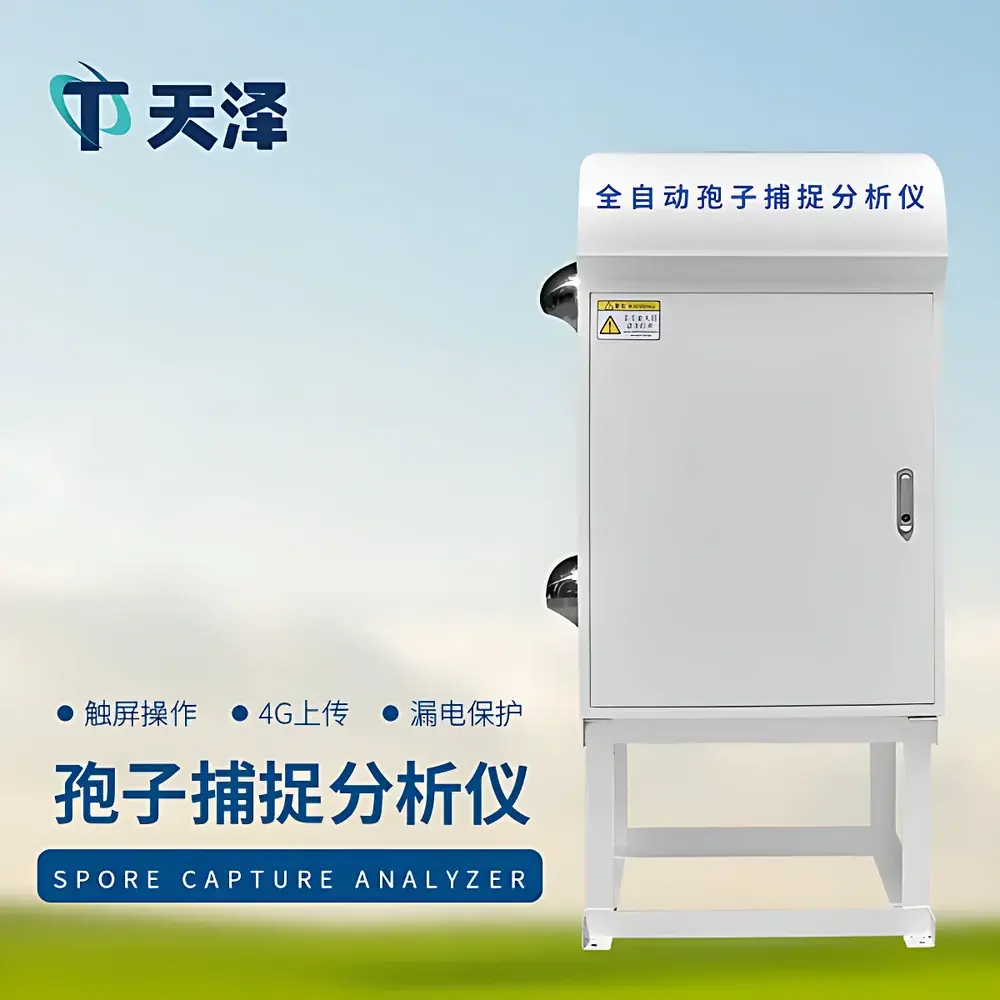
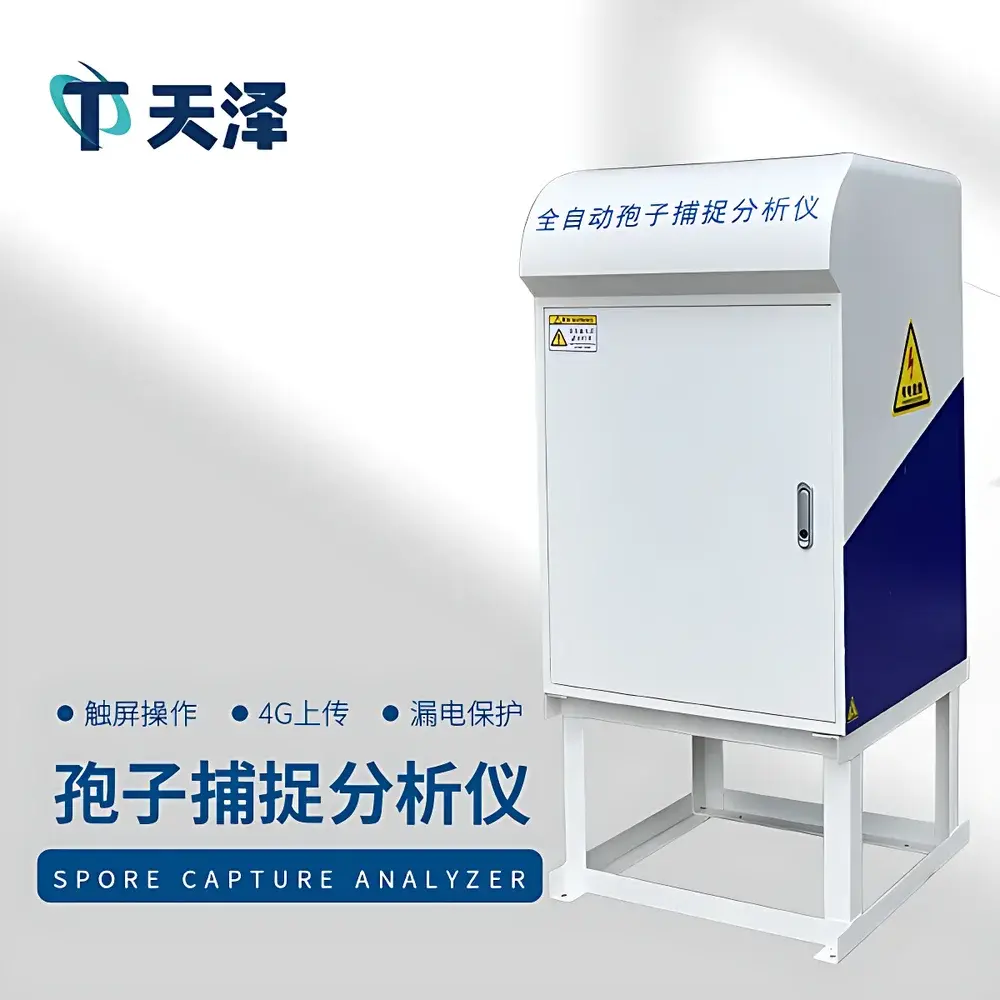
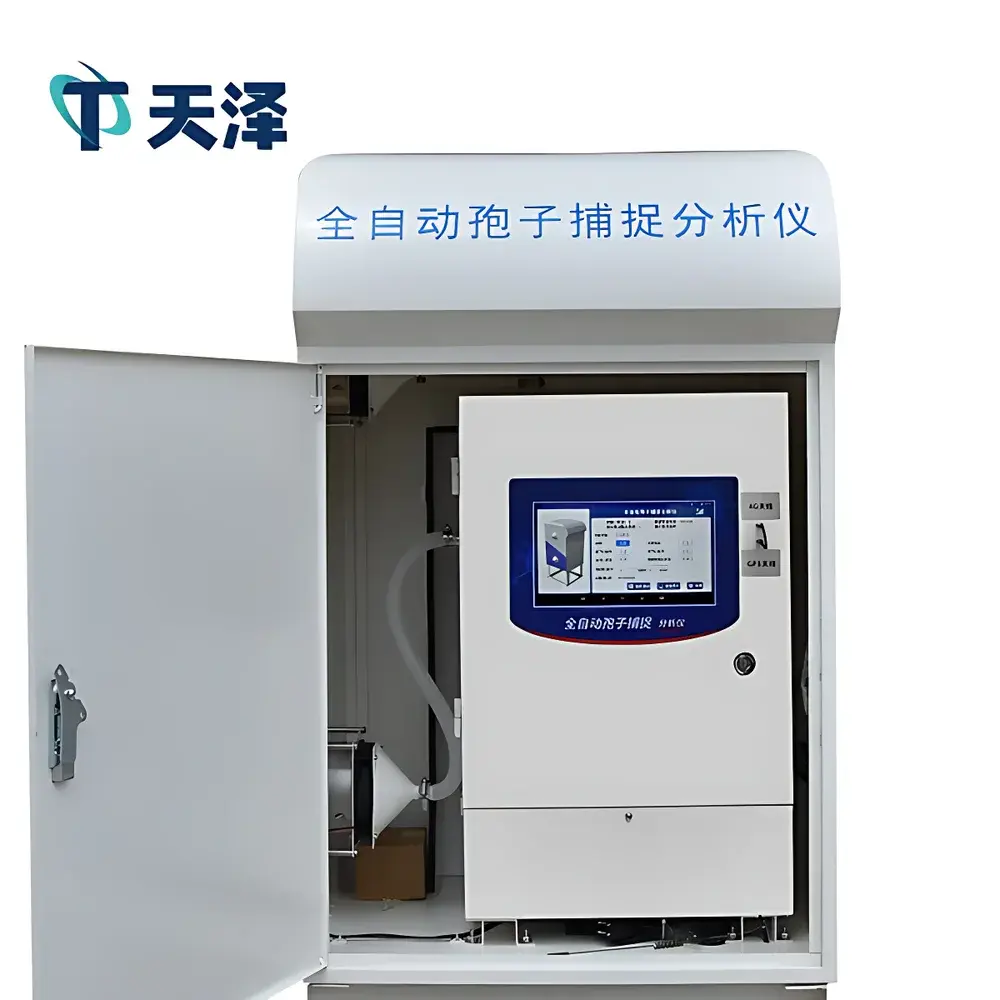
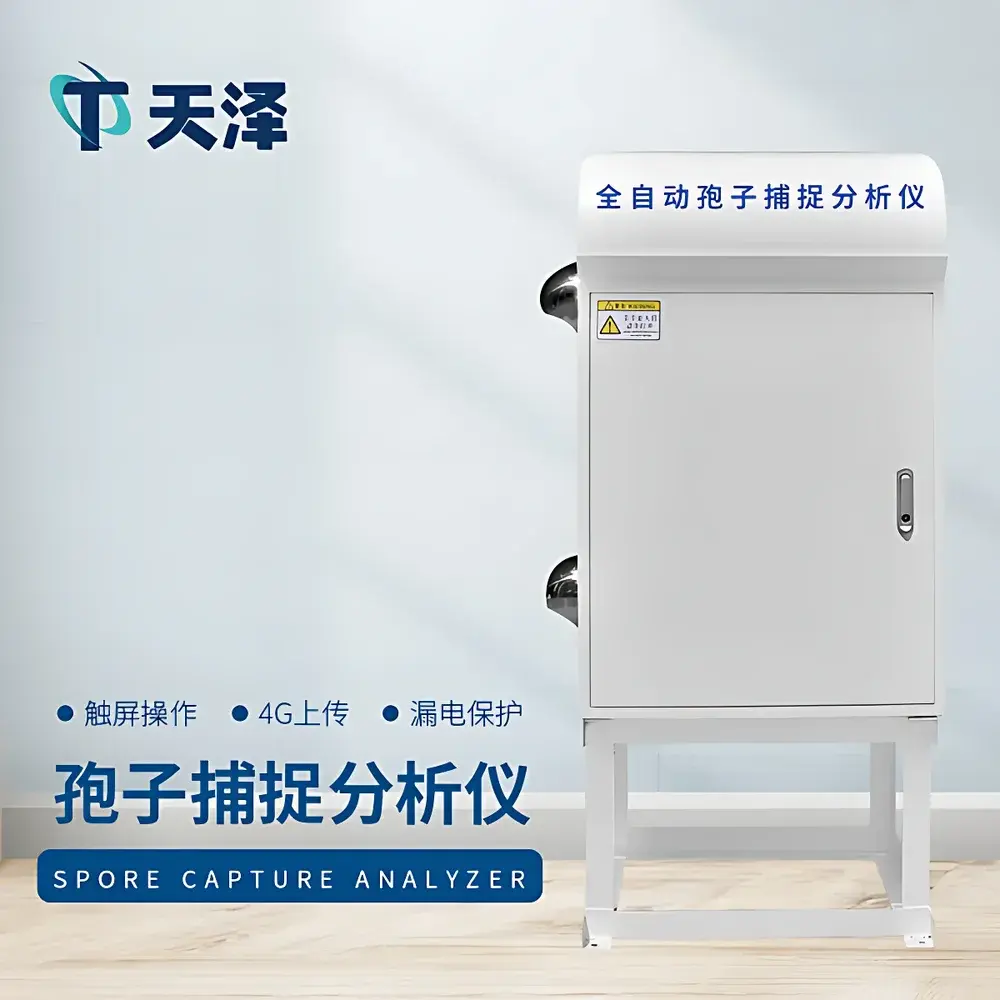
TZ-BZ1 Spore Trap by Tianze Environmental
| Brand | Tianze Environmental |
|---|---|
| Origin | Shandong, China |
| Manufacturer Type | Authorized Distributor |
| Country of Origin | China |
| Model | TZ-BZ1 |
| Price | USD 3,100 (FOB) |
| Power Supply | 220 VAC ±10%, optional 480 W / 200 Ah solar power system |
| Max Startup Power | ≤65 W |
| Continuous Operating Power | ≤50 W |
| Standby Power | ≤26.4 W |
| Dimensions (H×W×D) | 1418 × 600 × 640 mm |
| Operating Temperature | −20 °C to +70 °C |
| Relative Humidity Range | 0–95% RH (non-condensing) |
| Insulation Resistance | ≥2.5 MΩ |
| Imaging Sensor | 5 MP CMOS camera with 10× optical magnification |
| Spore Detection Range | 5–100 µm |
| Sampling Area per Frame | 50 mm × 21 mm |
| Sampling Duration Adjustable | 60–1200 min per cycle |
| Image Capture Frequency | Configurable up to 3 times daily |
| Carrier Tape Lifespan | 365 days (at 3 captures/day) |
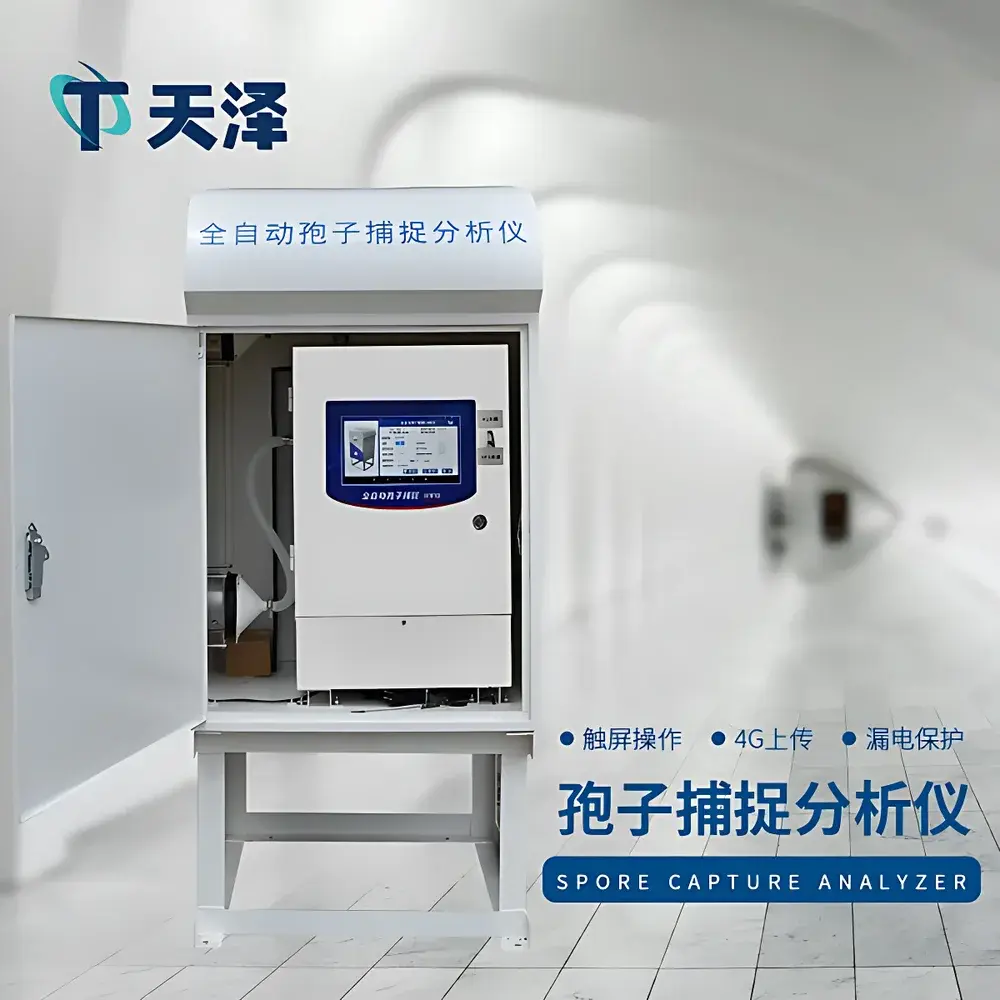
| Display | 10.1″ capacitive touchscreen running Android OS |
| Connectivity | LTE Cat-1 4G module |
| Data Upload Protocol | MQTT/HTTP RESTful API |
| Compliance | IP65-rated enclosure |
Overview
The TZ-BZ1 Spore Trap is an automated, field-deployable environmental monitoring instrument engineered for continuous, non-destructive airborne fungal spore collection and digital imaging in agricultural ecosystems. It operates on the principle of volumetric air sampling combined with high-resolution optical microscopy: ambient air is drawn through a calibrated inlet duct at controlled flow rates, directing particulates onto a continuously advancing adhesive carrier tape. A precision-stepped motor drives bidirectional tape motion (X/Y axes), enabling systematic spatial indexing of captured particles. An integrated 5-megapixel CMOS imaging system—equipped with fixed-focus optics optimized for 5–100 µm bioaerosols—captures micrographs under programmable LED illumination. All images are timestamped, geotagged (via onboard GNSS), and transmitted via LTE to a secure cloud platform for human-in-the-loop verification and statistical analysis. Designed for unattended operation across seasonal extremes, the unit complies with IP65 environmental protection and adheres to GB/T 2423 climatic stress testing protocols.
Key Features
- Bidirectional stepper motor control (X/Y axes) ensures precise carrier tape positioning and repeatable image registration.
- Smart carrier tape management system tracks cumulative usage in real time; triggers configurable alerts prior to depletion and supports password-protected manual reset.
- On-device 10.1″ Android-based HMI enables local configuration, live preview, manual capture initiation, and diagnostics without external hardware.
- Configurable sampling logic: users define start time, duration, interval, and per-cycle airflow duration (60–1200 min), supporting both scheduled and event-triggered modes.
- Optimized aerodynamic duct design minimizes turbulent recirculation, reducing particle re-entrainment and improving single-pass collection efficiency.
- Low-power architecture: ≤50 W sustained draw enables long-term deployment with optional solar-hybrid power (480 W PV + 200 Ah LiFePO₄ battery).
- Secure remote firmware updates and parameter synchronization via TLS-encrypted MQTT channels.
Sample Compatibility & Compliance
The TZ-BZ1 is validated for capturing and imaging viable and non-viable fungal propagules—including ascospores, conidia, and basidiospores—from key phytopathogens such as Puccinia spp., Blumeria graminis, Fusarium spp., and Alternaria solani. Its 50 × 21 mm sampling footprint and 5–100 µm resolution range align with ISO 21501-4 for aerosol particle sizing instrumentation. The device meets electromagnetic compatibility (EMC) requirements per GB 9254–2008 and safety standards per GB 4793.1–2007. Enclosure integrity satisfies IEC 60529 IP65, ensuring operational reliability in rain, dust, and temperature cycling environments typical of open-field agronomic deployments.
Software & Data Management
Data ingestion occurs via RESTful API or MQTT into a role-based web platform compliant with GLP-aligned audit trail requirements. Each image includes embedded metadata: UTC timestamp, GPS coordinates, tape position index, exposure settings, and device health status (voltage, temperature, tape tension). Manual annotation tools support taxonomic tagging by certified plant pathologists. Statistical dashboards generate daily spore load trends, geographic heatmaps, and phenological correlation reports exportable as CSV/PDF. Platform-level access controls enforce ISO/IEC 27001–aligned user permissions, while all remote commands (e.g., mode switching, motor actuation) are logged with operator ID and timestamp for traceability.
Applications
The TZ-BZ1 serves as a core component in early-warning systems for cereal rusts, powdery mildews, and foliar blights across wheat, barley, maize, and vegetable production zones. It supports regulatory compliance reporting under national phytosanitary frameworks (e.g., China’s Ministry of Agriculture and Rural Affairs Notice No. 212/2022). Research applications include spore dispersal modeling, fungicide resistance monitoring via morphological variance tracking, and validation of atmospheric transport simulations. Integration with third-party weather APIs enables conditional sampling triggered by dew point thresholds or wind vector alignment—enhancing predictive accuracy beyond fixed-interval protocols.
FAQ
Does the TZ-BZ1 require periodic calibration of its imaging system?
No routine optical recalibration is required; the fixed-focus lens assembly is factory-aligned to maintain sub-5 µm pixel resolution across its operational thermal range (−20 °C to +70 °C). Verification images are captured during boot-up and logged for QA review.
Can raw image data be exported for offline analysis?
Yes—authenticated users may download full-resolution TIFF sequences with EXIF metadata via the platform’s Data Export module, preserving original sensor output without cloud-side compression artifacts.
Is the carrier tape compatible with downstream DNA extraction protocols?
The standard acrylic-based adhesive tape preserves nucleic acid integrity for up to 14 days under ambient storage; validated extraction yields >85% of spiked Botrytis cinerea genomic DNA using commercial kits (QIAGEN DNeasy Plant Mini Kit).
How does the system handle network outages?
All images and metadata are buffered in encrypted local eMMC storage (≥32 GB) and automatically retransmitted upon connection restoration, with sequence-numbered queuing to prevent duplication or loss.
What cybersecurity measures protect device-to-cloud communication?
TLS 1.2+ encryption secures all data in transit; device authentication uses X.509 client certificates; OTA updates are cryptographically signed and verified prior to installation.