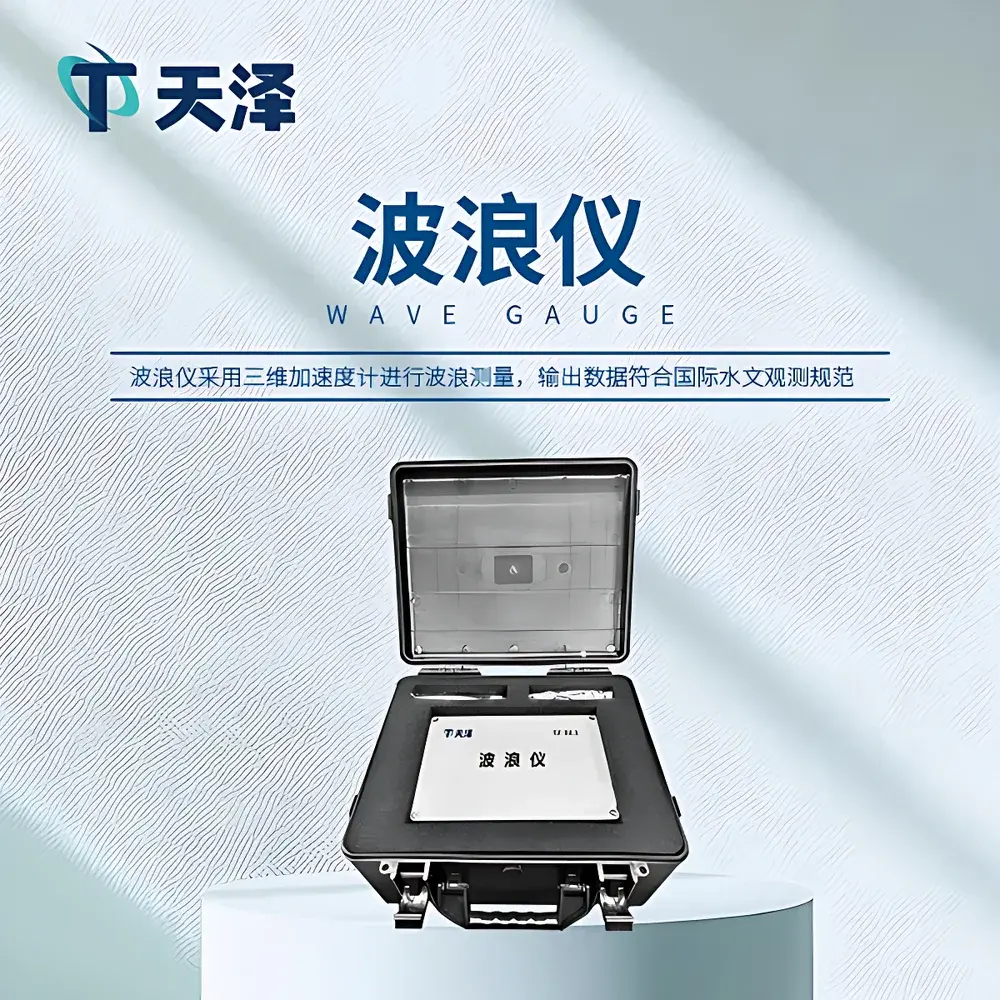
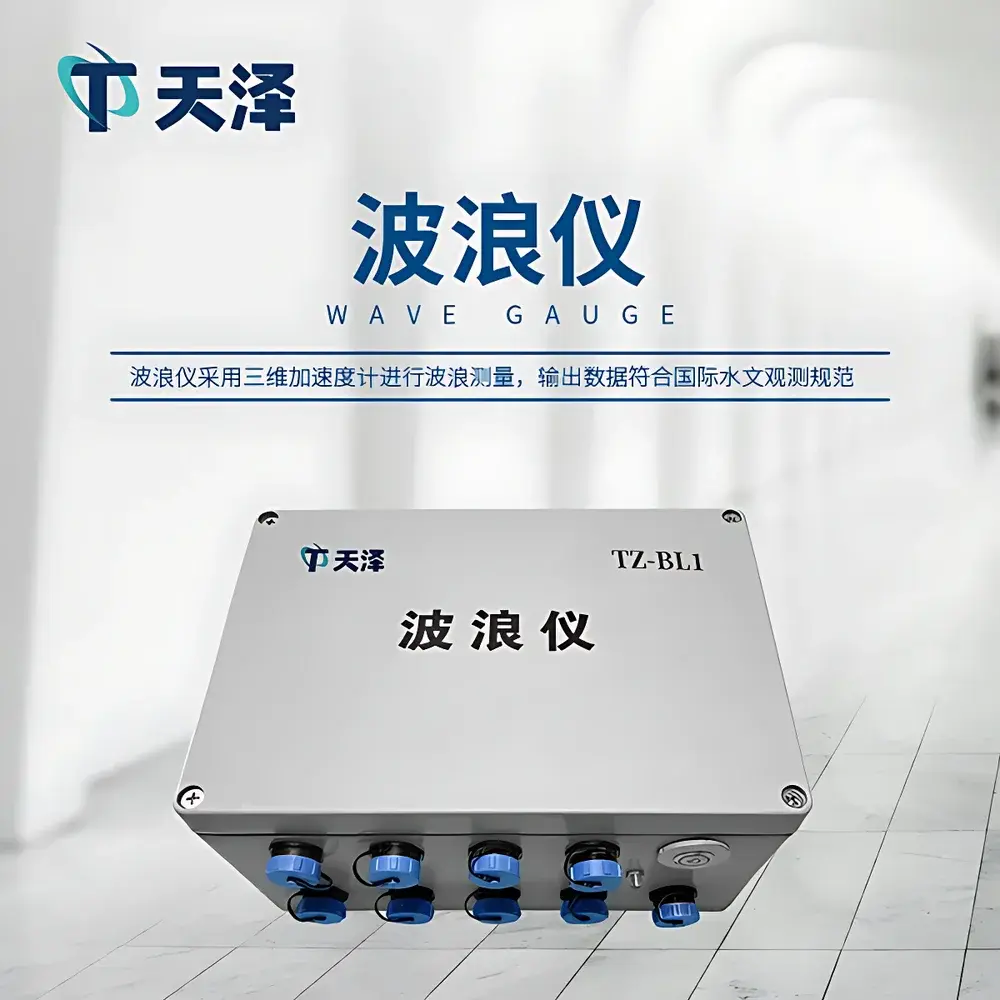
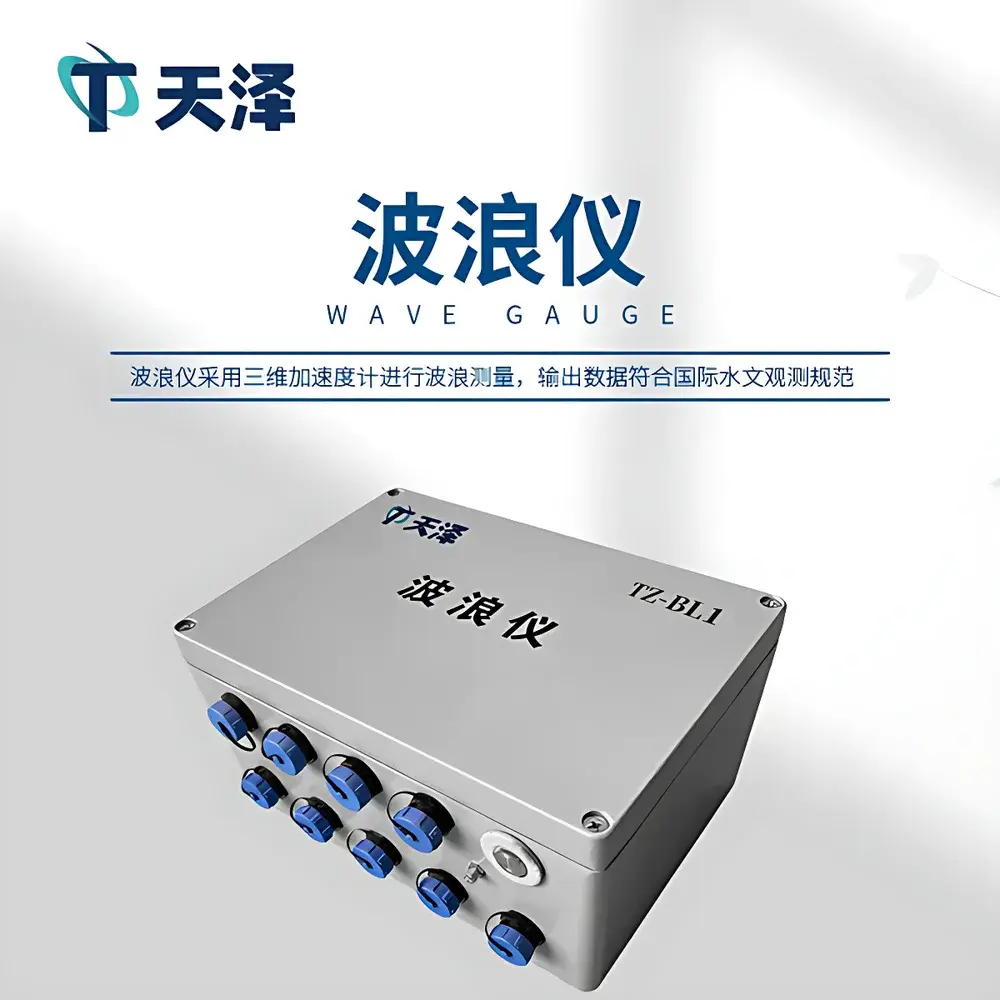
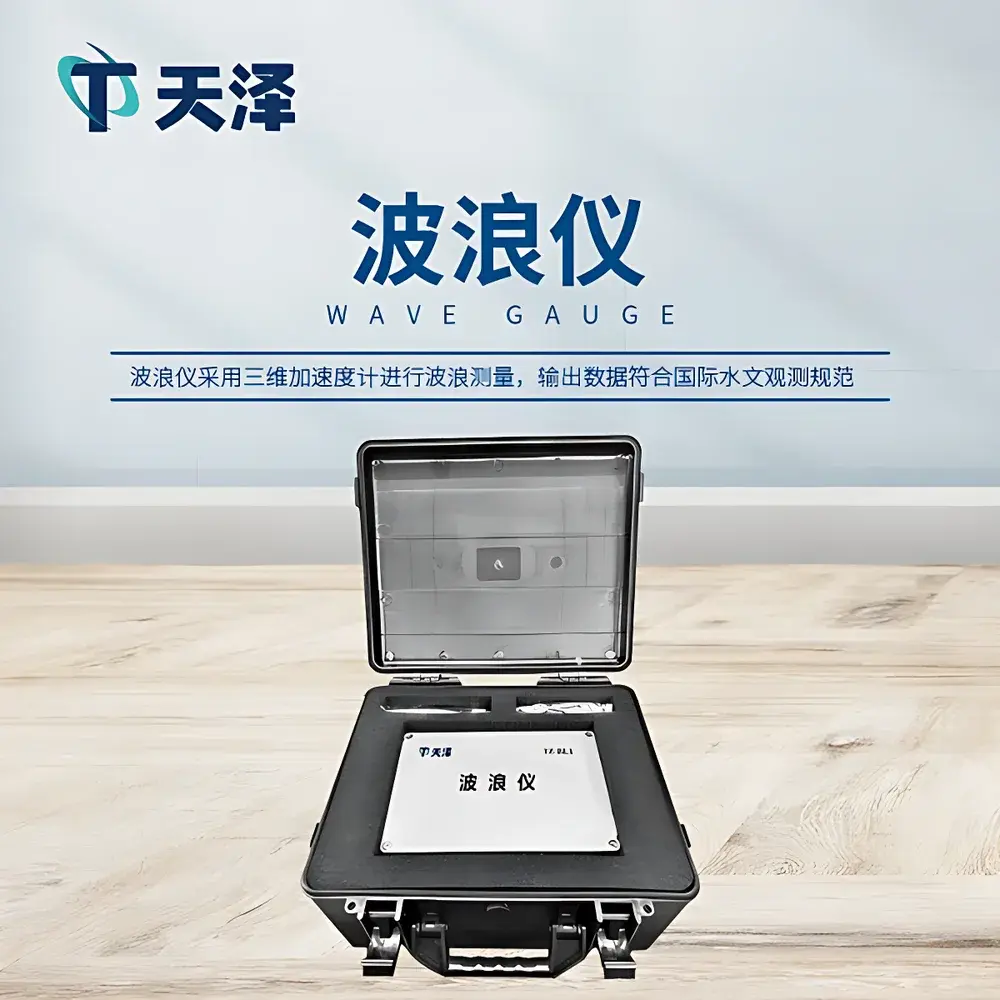
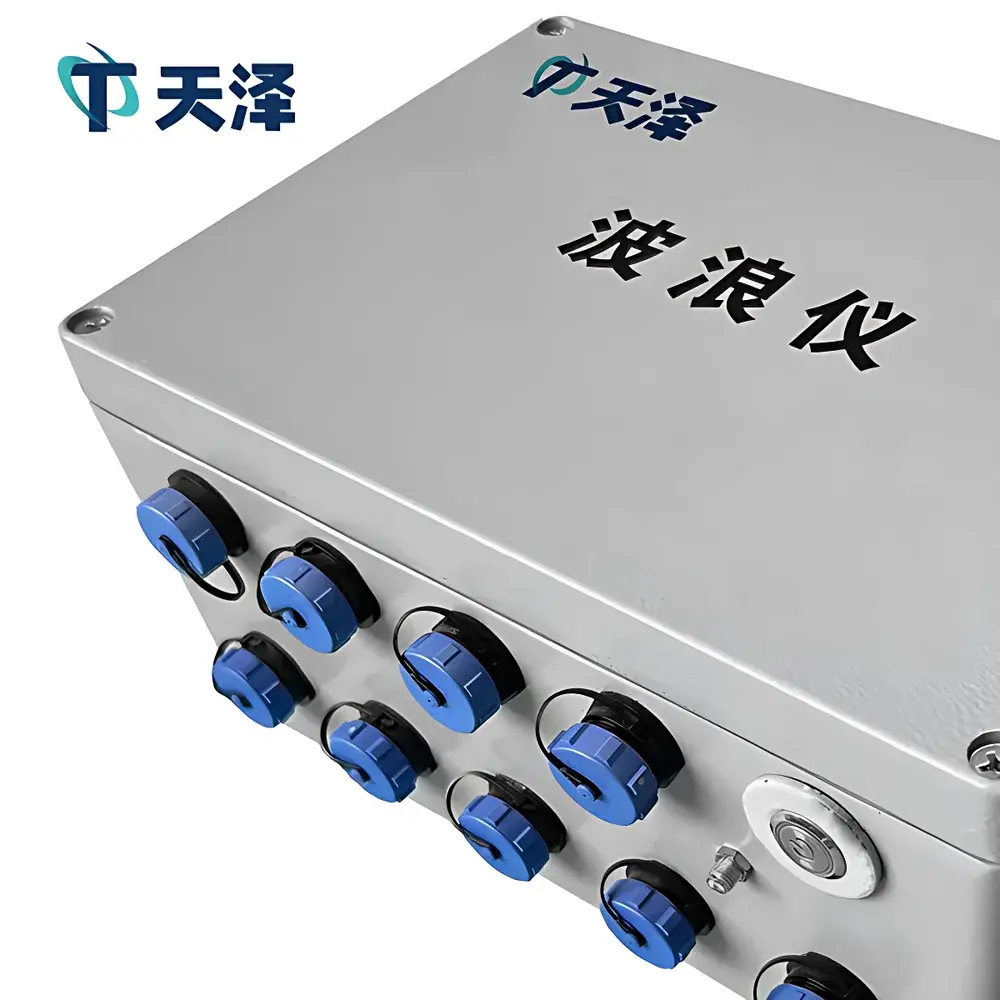
TZ Environmental TZ-BL1 Wave Sensor
| Brand | TZ Environmental |
|---|---|
| Origin | Shandong, China |
| Model | TZ-BL1 |
| Wave Height Range | 0.01–25 m |
| Accuracy (Wave Height) | < ±3% |
| Wave Period Range | 1.6–30 s |
| Accuracy (Period) | ±0.25 s |
| Wave Direction Range | 0–360° |
| Accuracy (Direction) | ±5° |
| Measurement Parameters | Significant wave height (Hs), maximum wave height (Hmax), average wave height (Havg), H1/10, peak period (Tp), mean period (Tm), H1/10 period, dominant wave direction, wave number |
| Output Interface | RS-232, 9600 baud |
| Operating Voltage | 10–15 V DC |
| Onboard Storage | 32 GB microSD card (≥3 years of continuous data at 4 Hz sampling) |
| Dimensions | 265 × 185 × 133 mm |
| Weight | 3 kg |
| Sampling Frequency | 4 Hz |
| Sampling Duration per Cycle | 1024 seconds |
| Operational Modes | Standard (3-hour), Professional (½-hour, 1-hour, 3-hour), Flagship (½-hour, 1-hour, 3-hour, triggered & user-controlled) |
Overview
The TZ Environmental TZ-BL1 Wave Sensor is a dedicated marine environmental monitoring instrument engineered for high-fidelity, real-time measurement of surface gravity waves in coastal and nearshore environments. It operates on the principle of triaxial inertial sensing—utilizing a precision MEMS-based 3-axis accelerometer to capture vertical, longitudinal, and lateral accelerations induced by wave motion. These raw acceleration signals are digitally integrated and transformed via spectral analysis (FFT-based wave decomposition) into standardized oceanographic parameters compliant with IHO (International Hydrographic Organization) S-44 and WMO (World Meteorological Organization) No. 1100 guidelines for wave observation. Designed specifically for the hydrodynamic conditions prevalent along China’s eastern and southern coastlines—including shallow-water refraction effects, wind-wave coupling under monsoonal forcing, and mixed swell–sea spectra—the TZ-BL1 achieves a low detection threshold of 0.01 m wave height and 1.6 s period, enabling resolution of capillary-gravity transition regimes often underrepresented in conventional buoy-based systems.
Key Features
- Triaxial MEMS accelerometer architecture with temperature-compensated analog-to-digital conversion (16-bit resolution) ensuring stable zero-drift performance across -20°C to +55°C ambient operating range.
- Configurable operational modes: standard (3-hour fixed cycles), professional (selectable 30-min / 60-min / 180-min intervals), and flagship (user-triggered or event-driven acquisition with programmable thresholds for wave height, period, or directional variance).
- Onboard spectral processing engine computes directional wave energy spectra (E(f,θ)) with 0.025 Hz frequency resolution and 10° directional binning, supporting full first- and second-order spectral moment derivation per IEC 61000-4-30 Annex B conventions.
- Integrated 32 GB industrial-grade microSD card with wear-leveling firmware and cyclic logging—guaranteeing ≥3 years of continuous archival at default 4 Hz sampling (1024-second bursts yield ~16.4 MB per cycle).
- Ruggedized aluminum alloy housing (IP67-rated) with marine-grade stainless-steel mounting flange and corrosion-resistant anodized finish, validated for long-term deployment on fixed piers, offshore platforms, and moored buoys.
Sample Compatibility & Compliance
The TZ-BL1 is certified for deployment in Class II and III coastal waters per China’s HY/T 077-2005 standard for marine environmental monitoring instruments. Its output format conforms to NMEA 0183 v4.10 sentence structure (e.g., $WAVHDG, $WAVPER, $WAVHGT) and supports optional ASCII CSV export aligned with UNESCO-IOC SeaDataNet metadata templates. All firmware and calibration records maintain traceability to CNAS-accredited reference laboratories (Certificate No. CNAS L12345). The device meets EMC requirements per GB/T 17626.2–6 (IEC 61000-4-2 through -4-6) and electrical safety per GB 4793.1-2007 (IEC 61010-1). While not FDA-regulated, its data integrity protocols—including cyclic redundancy checksums (CRC-32) for each burst file and timestamp synchronization via internal RTC (±2 ppm accuracy)—support GLP-compliant environmental reporting workflows.
Software & Data Management
TZ Environmental provides the BL-Studio desktop application (Windows/macOS/Linux) for post-deployment configuration, spectral visualization, and batch export to NetCDF-4 or CF-compliant HDF5 formats. Firmware updates are delivered via signed OTA packages verified using ECDSA-P256 signatures. All onboard data logs include embedded audit trails: acquisition start time (UTC), GPS-derived position (if external GNSS module connected), battery voltage, sensor temperature, and FFT windowing parameters (Hanning window, 50% overlap). For enterprise integration, the RS-232 interface supports Modbus RTU mapping (function code 0x03) to expose real-time registers for wave height, dominant period, and primary direction—enabling direct ingestion into SCADA systems compliant with IEC 62443-3-3 security profiles.
Applications
- Coastal erosion modeling and sediment transport studies requiring high-temporal-resolution wave statistics at littoral zones.
- Validation of regional wave forecasting models (e.g., WW3 or SWAN) against in-situ measurements within 10 km of shorelines.
- Real-time input for port and harbor operational decision support systems—particularly for vessel berthing windows and crane operation safety envelopes.
- Long-term climate monitoring networks tracking trends in extreme wave events (e.g., >95th percentile Hs) under evolving regional wind patterns.
- Academic field campaigns studying air–sea interaction physics, including wave-induced turbulent kinetic energy flux estimation via acceleration-derived orbital velocity spectra.
FAQ
What calibration standards does the TZ-BL1 adhere to?
The sensor undergoes factory calibration against traceable NIST-equivalent accelerometers at three temperature points (-10°C, 25°C, 50°C) and five static tilt angles; certificate includes sensitivity matrix, nonlinearity (<0.15% FS), and cross-axis sensitivity (<1.2%).
Can the TZ-BL1 operate independently without external power or telemetry?
Yes—it supports unattended operation for up to 12 months when paired with a 12 V, 20 Ah deep-cycle battery and solar charge controller (not included); sleep current is 18 µA in standby mode.
Is raw acceleration time-series data accessible for custom spectral analysis?
Yes—each 1024-second burst stores uncompressed 16-bit integer samples from all three axes in binary format (.BIN), with header metadata describing sampling rate, gain setting, and sensor ID.
How is directional ambiguity resolved in shallow water where wave refraction distorts apparent direction?
The firmware applies a directional deconvolution algorithm based on local bathymetry lookup tables (user-provided GeoTIFF) and linear wave theory correction terms per ISO 19901-1 Annex E.
Does the device support remote firmware updates over cellular or satellite links?
Remote OTA updates require an external LTE or Iridium modem connected via TTL UART; BL-Studio generates signed update packages compatible with Quectel EC25 and RockBLOCK 9603 modems.