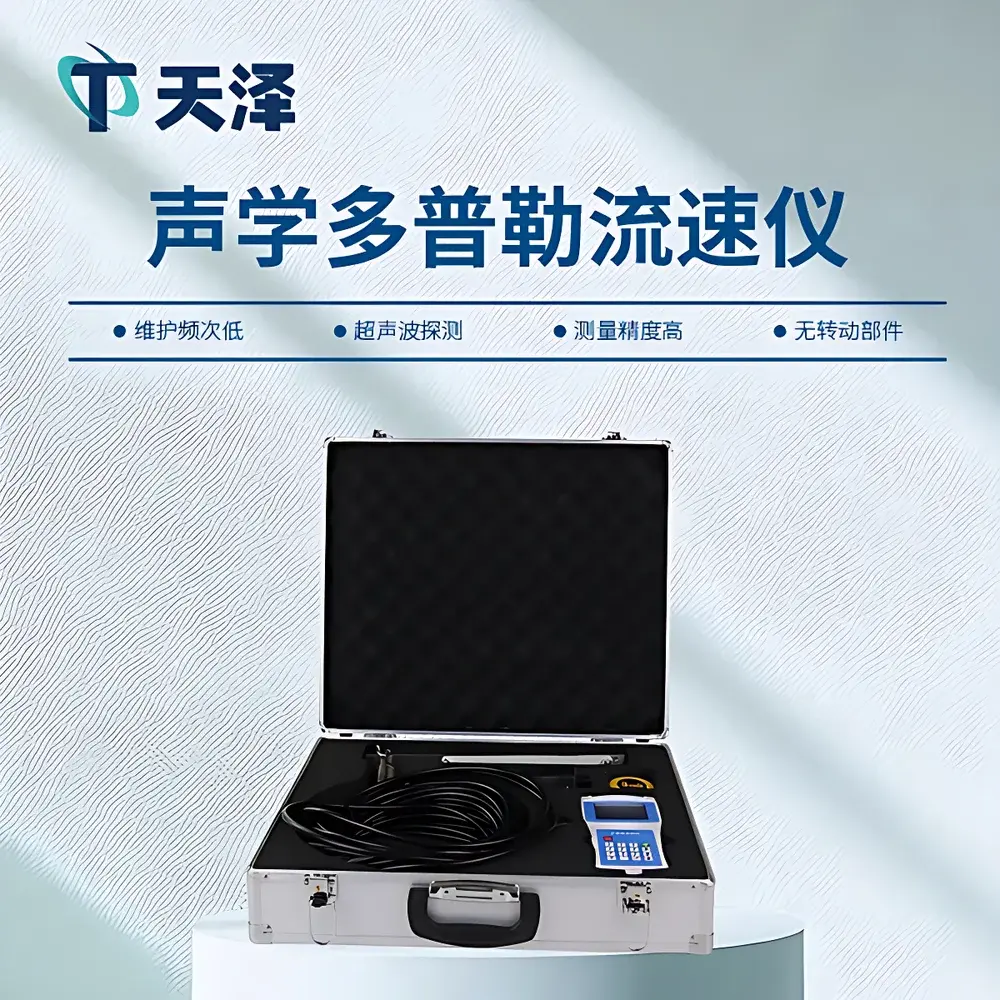
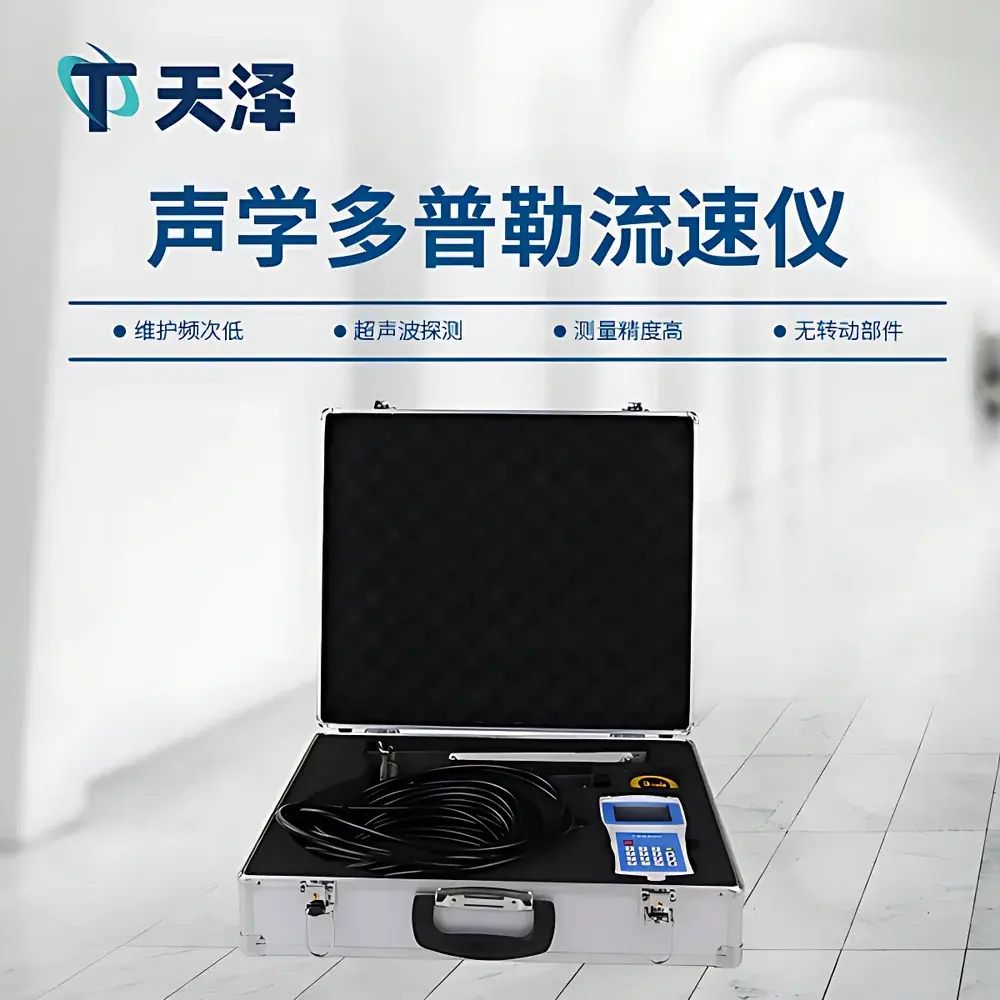
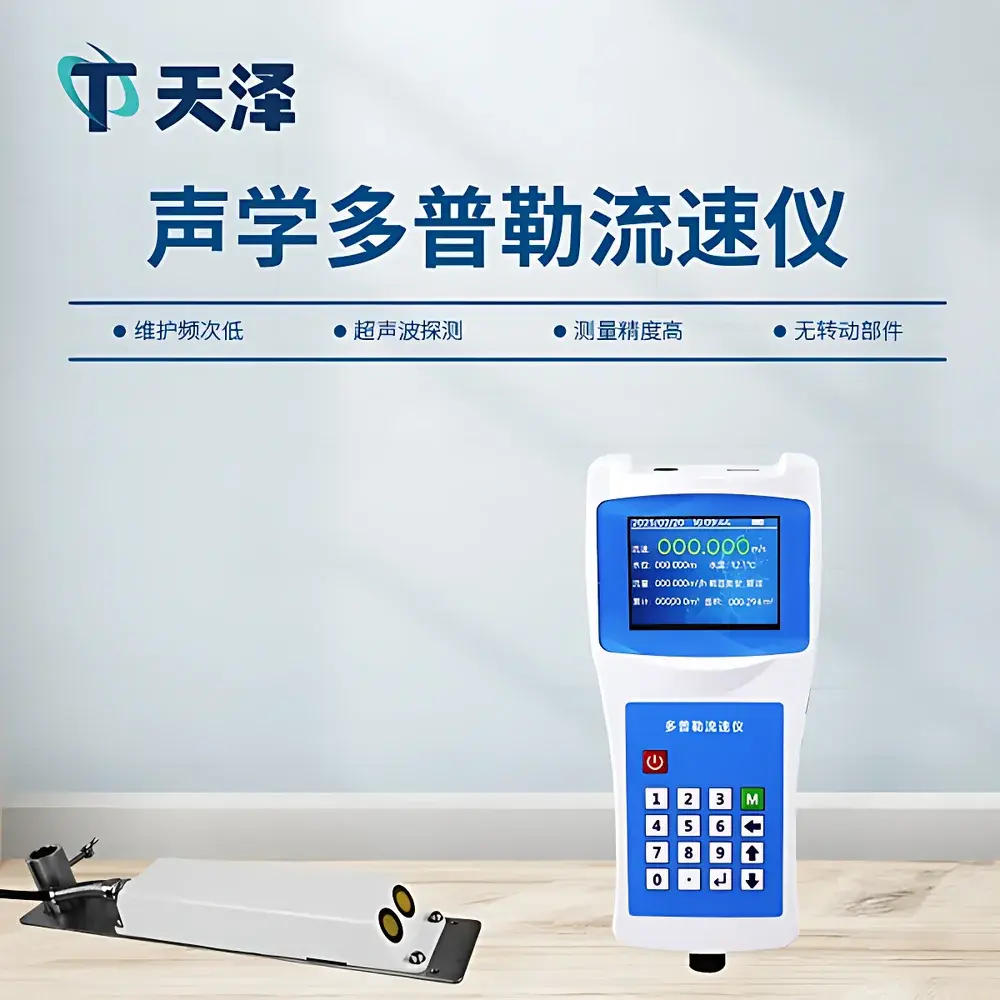
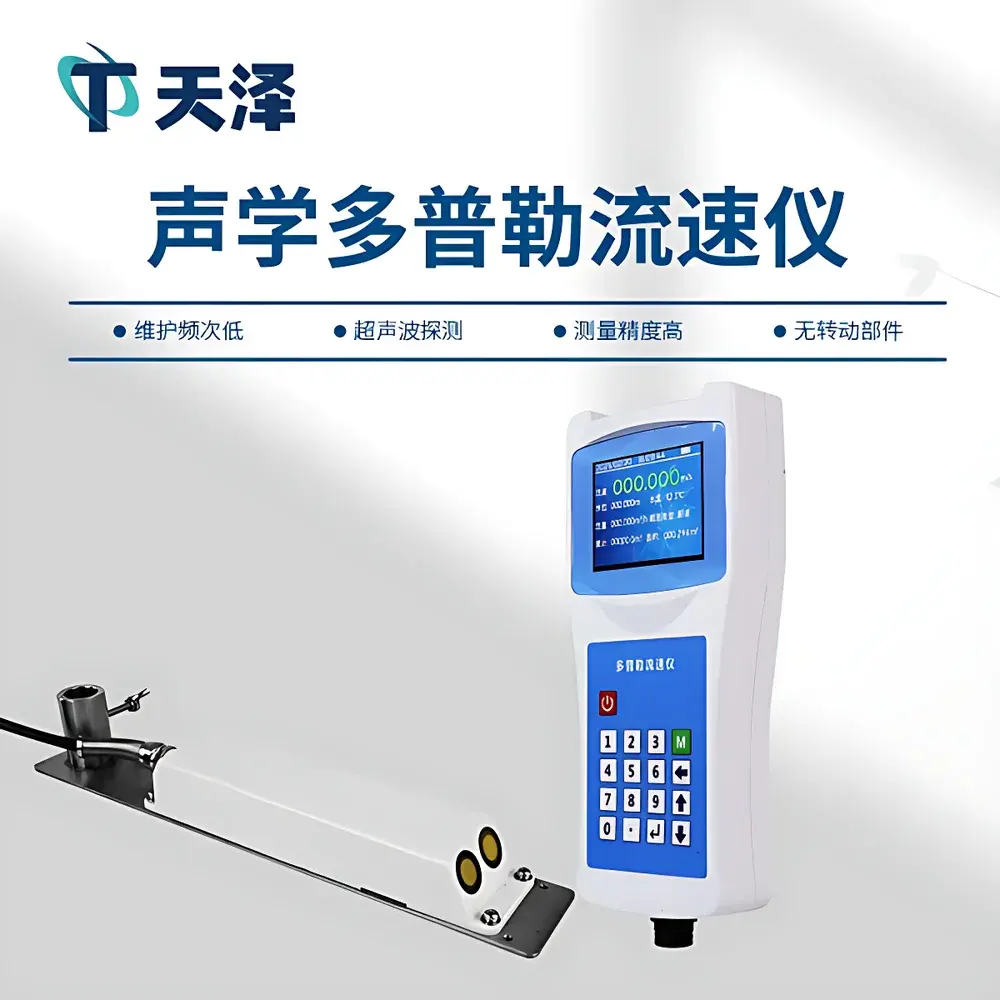
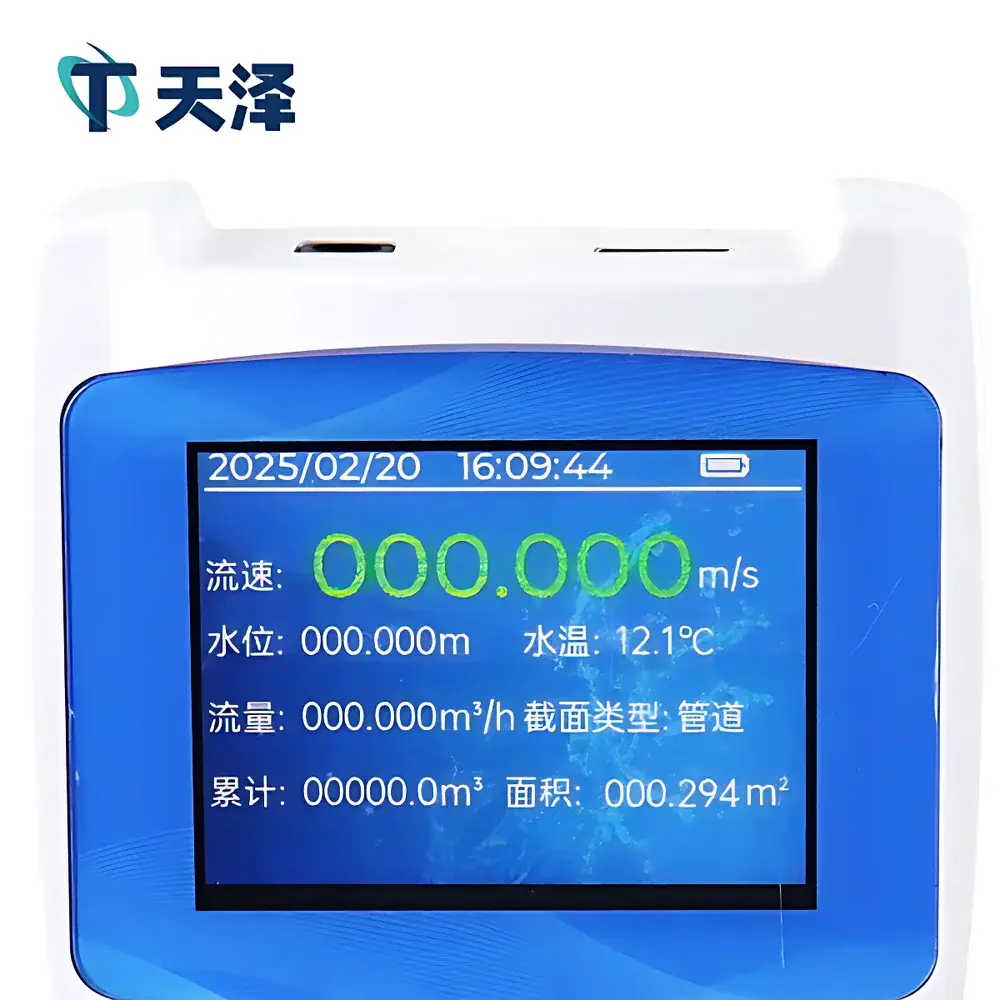
TZ-LS6+ Doppler Velocity Meter by Tianze Environmental
| Brand | Tianze Environmental |
|---|---|
| Origin | Shandong, China |
| Model | TZ-LS6+ |
| Measurement Principle | Acoustic Doppler Effect |
| Velocity Range | 0.020–6.00 m/s |
| Accuracy | ±1.0% of reading or ±1 mm/s (whichever is greater) |
| Resolution | 1 mm/s |
| Water Temperature Range | −10 to +60 °C |
| Temp. Accuracy | ±0.1 °C |
| Depth Range | 0.03–10 m |
| Depth Accuracy | ±0.3% FS or ±0.5 cm |
| Depth Resolution | 1 mm |
| Instantaneous Flow Range | 0.001–9999 m³/h |
| Flow Accuracy | ±3% of reading |
| Cumulative Flow Range | 0.001–9999 m³ |
| Flow Resolution | 0.001 m³ |
| Data Update Rate | 1 Hz |
| Power Supply | 10.0–12.6 V DC |
| Battery Capacity | 1800 mAh Li-ion |
| Operating Time | >8 h (on battery) |
| Cable Length | 20 m |
| Max. Submersion Depth | 10 m |
| Display | 2.8″ color LCD |
| Data Storage | 10,000 records |
| Interface | USB data export |
| Operating Language | English / Chinese toggle |
| Sensor Power Consumption | <0.8 W (during velocity measurement) |
| Total Unit Power Consumption | <2.4 W |
Overview
The TZ-LS6+ Doppler Velocity Meter, engineered by Tianze Environmental, is a field-deployable, non-intrusive acoustic Doppler instrument designed for continuous and portable velocity and flow monitoring in open channels, partially filled pipes, natural rivers, stormwater conduits, and wastewater outfalls. It operates on the fundamental principle of the acoustic Doppler effect: ultrasonic pulses transmitted into flowing water are scattered by suspended particles or micro-turbulence; the frequency shift between emitted and received signals is directly proportional to the axial component of water velocity relative to the sensor. Unlike mechanical propeller or electromagnetic meters, the TZ-LS6+ contains no moving parts, eliminating mechanical wear, bearing degradation, or calibration drift due to fouling—critical for long-term unattended operation in turbid, debris-laden, or biologically active environments.
Key Features
- Integrated dual-sensor architecture: co-located Doppler velocity transducer and pressure-based water level sensor enable simultaneous acquisition of velocity, depth, temperature, and derived flow metrics in real time.
- Low-power design optimized for extended battery operation: sensor module consumes <0.8 W during active measurement; full-system draw remains below 2.4 W, supporting over 8 hours of continuous logging on a rechargeable 1800 mAh Li-ion battery.
- 2.8-inch high-contrast color LCD with intuitive graphical interface—supports real-time velocity profile visualization, flow trend charts, and status diagnostics; language toggles seamlessly between English and Chinese via single-key input.
- Onboard storage capacity of 10,000 timestamped records—including instantaneous velocity, water temperature (−10 to +60 °C), pressure-derived depth (0.03–10 m), and computed flow values—with bulk export via standard USB flash drive (no proprietary software required).
- Ruggedized IP68-rated housing and 20-meter submersible cable rated for permanent deployment in municipal sewer lines, irrigation canals, tidal estuaries, and aquaculture discharge points—capable of operation under variable sediment load and biofilm accumulation.
Sample Compatibility & Compliance
The TZ-LS6+ is validated for use in heterogeneous hydraulic environments where traditional flow measurement methods face limitations: irregular channel geometry, low-flow conditions (down to 0.020 m/s), partial-fill pipes, and highly variable suspended solids concentration (e.g., stormwater runoff, combined sewer overflows, agricultural drainage). Its pressure-based depth sensing meets ISO 4064-2:2014 requirements for static liquid level accuracy (±0.5 cm or ±0.3% FS), while velocity measurement conforms to ASTM D5388-22 guidelines for acoustic Doppler velocimetry in open-channel applications. The device supports audit-ready data logging with embedded timestamps and does not require external calibration verification for routine municipal monitoring per EPA Guidance for Flow Monitoring in CSO/SSO Programs (2021). While not certified to IEC 61508 or SIL standards, its fail-safe behavior (auto-zeroing on signal loss, diagnostic self-check at power-on) aligns with GLP-aligned field data collection protocols.
Software & Data Management
Data retrieval is hardware-native: no driver installation or vendor-specific runtime environment is needed. Insert any FAT32-formatted USB 2.0 flash drive; the unit automatically writes comma-separated value (CSV) files containing columns for UTC timestamp, velocity (m/s), water temperature (°C), depth (m), instantaneous flow (m³/h), and cumulative volume (m³). Each file includes header metadata specifying firmware version, serial number, and sensor configuration. For integration into SCADA or cloud-based environmental monitoring platforms (e.g., ThingSpeak, AWS IoT Core), users may parse CSV outputs using Python/Pandas or MATLAB scripts—no API licensing or subscription fees apply. Firmware updates are delivered via same USB mechanism and preserve all stored historical data during upgrade cycles.
Applications
- Urban water infrastructure: real-time flow verification in combined sewer systems, wet weather overflow monitoring, and infiltration/inflow (I/I) assessment under EPA NPDES permit requirements.
- Smart watershed management: deployment in river gauging stations supporting “River Chief” governance frameworks, including automated alerting for flood-stage thresholds and baseflow recession analysis.
- Green infrastructure performance validation: quantifying runoff attenuation from bioswales, permeable pavements, and retention basins in compliance with SITES v2 or LEED v4.1 Low-Impact Development (LID) credit documentation.
- Aquaculture and irrigation: precision dosing control in recirculating aquaculture systems (RAS) and flow balancing across multi-outlet drip networks where electrical isolation and corrosion resistance are mandatory.
- Regulatory compliance reporting: generating auditable datasets for state water board submissions (e.g., California’s SWRCB Resolution No. 2022-0017), including traceable uncertainty budgets per ISO/IEC 17025 Annex A.3.
FAQ
Does the TZ-LS6+ require periodic factory recalibration?
No. The Doppler transducer and pressure sensor are factory-trimmed and thermally compensated. Field verification against a known reference (e.g., calibrated current meter or stilling well) is recommended annually—or after physical impact or prolonged exposure to temperatures exceeding 60 °C—but full recalibration is not necessary under normal operating conditions.
Can it measure reverse flow (negative velocity)?
Yes. The instrument resolves directional velocity along the acoustic beam axis and reports signed values (±m/s); this enables detection of backflow in tidal channels or pump station bypass scenarios.
Is the pressure-based depth sensor affected by water density changes?
Minimal impact. The sensor measures absolute pressure and applies a fixed freshwater density assumption (998.2 kg/m³ at 20 °C). For saline or high-TDS applications (>5,000 µS/cm), a manual density correction factor can be applied during post-processing using recorded temperature and conductivity (if measured externally).
What is the minimum detectable particle concentration for reliable Doppler signal?
Empirical validation confirms stable velocity tracking at suspended solids concentrations ≥20 mg/L—typical of urban runoff, agricultural return flows, and most treated wastewater effluents. Performance degrades only in optically clear alpine streams or distilled-water lab setups, where alternative measurement methods (e.g., magnetic or thermal dispersion) would also fail.
How is data integrity ensured during power interruption?
The device employs non-volatile FRAM memory for critical configuration and last-known-good measurement state. All logged records are written atomically; partial writes are rejected, preventing corrupted entries. Battery-backed real-time clock maintains accurate timestamps across power cycles.
Related Products