
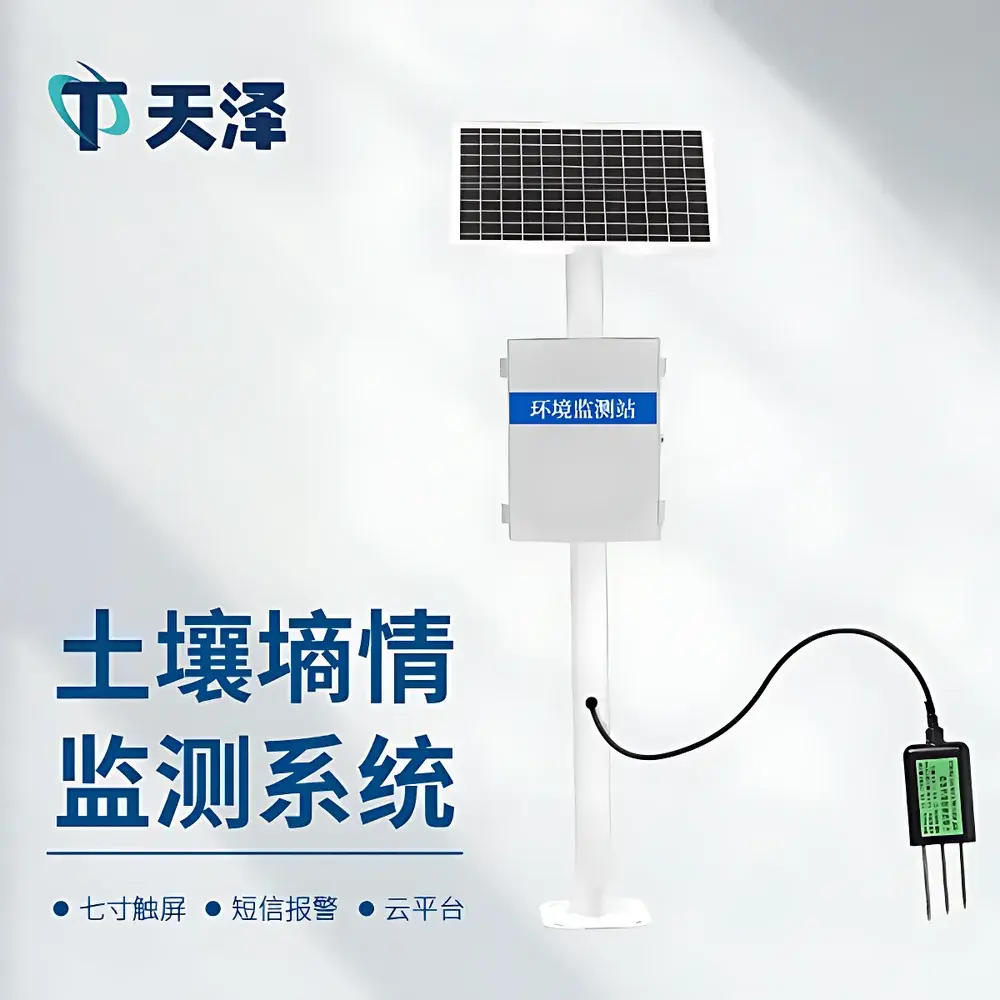
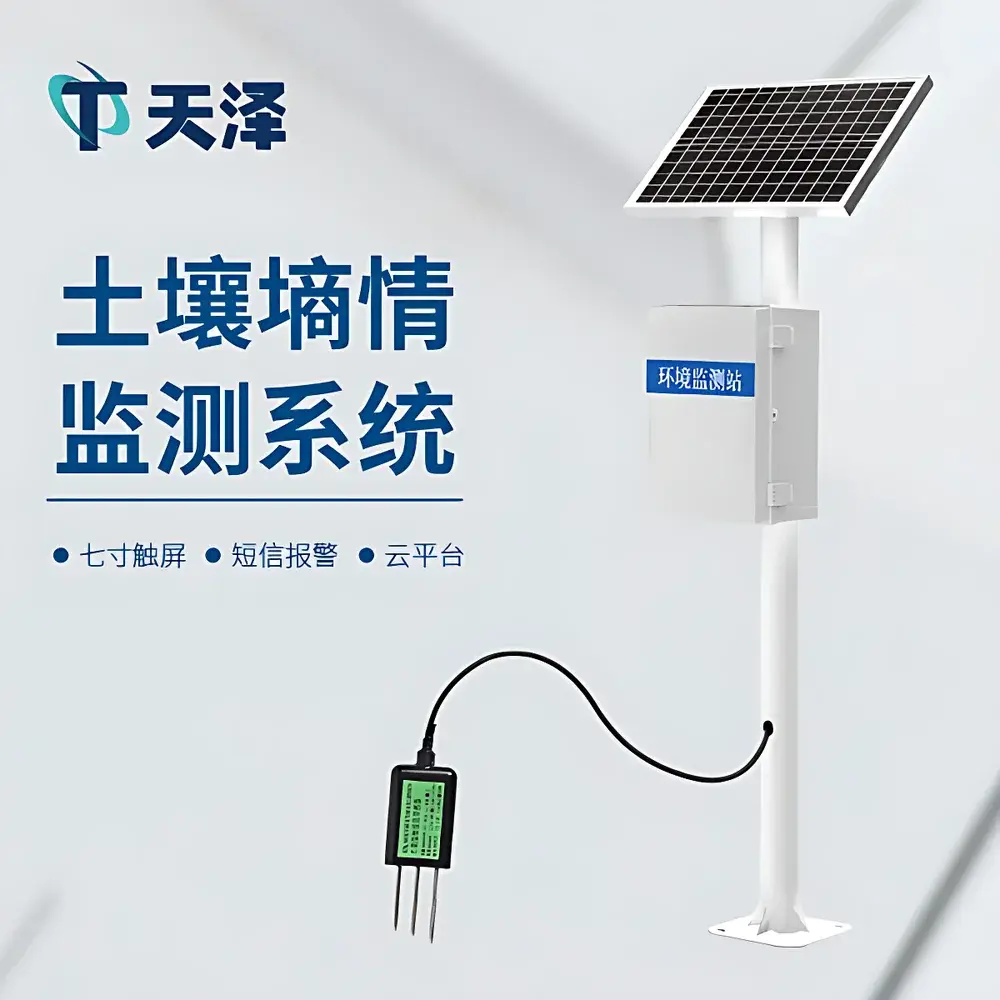
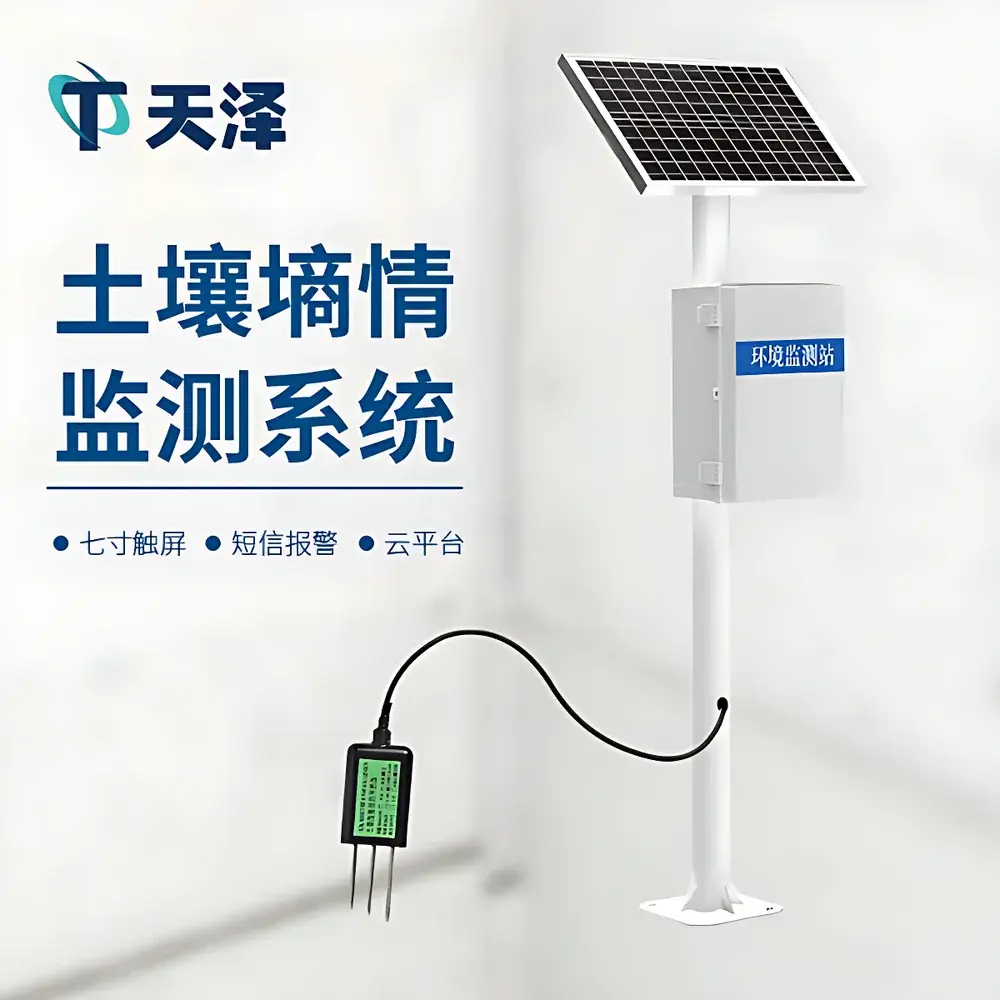
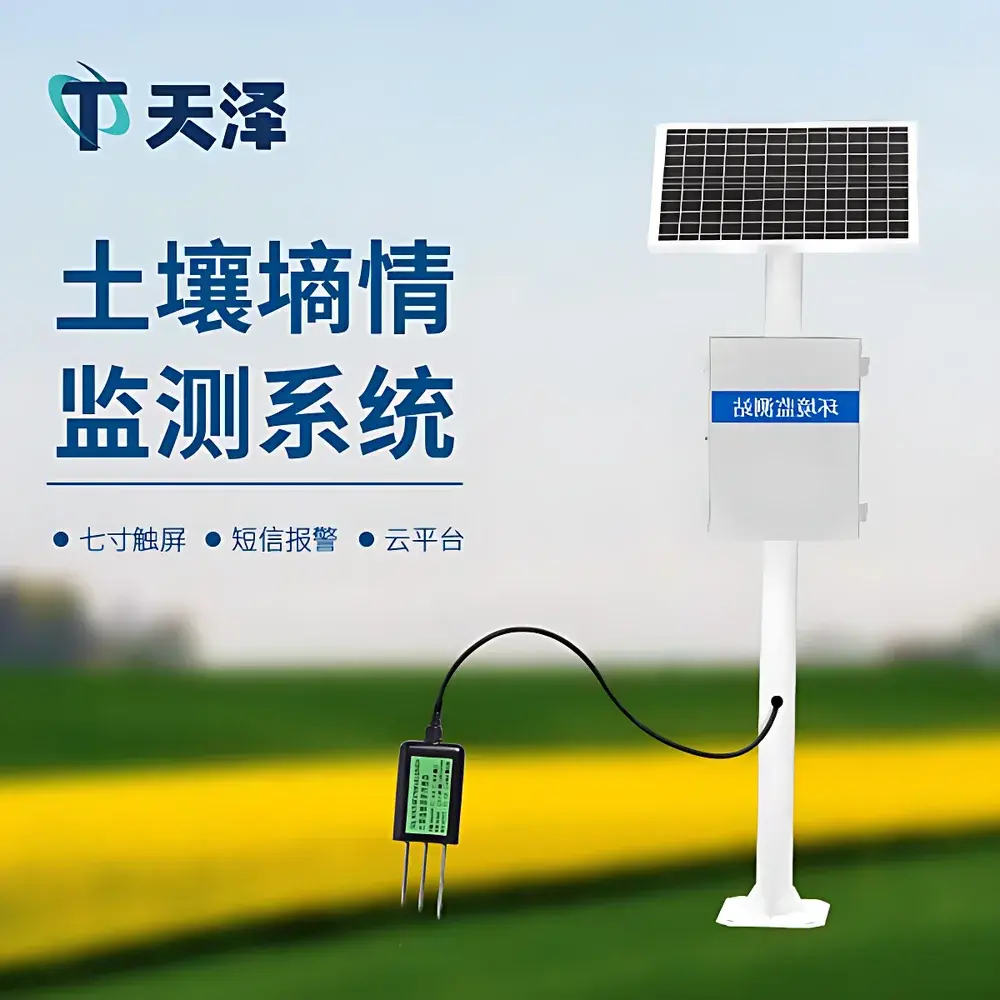
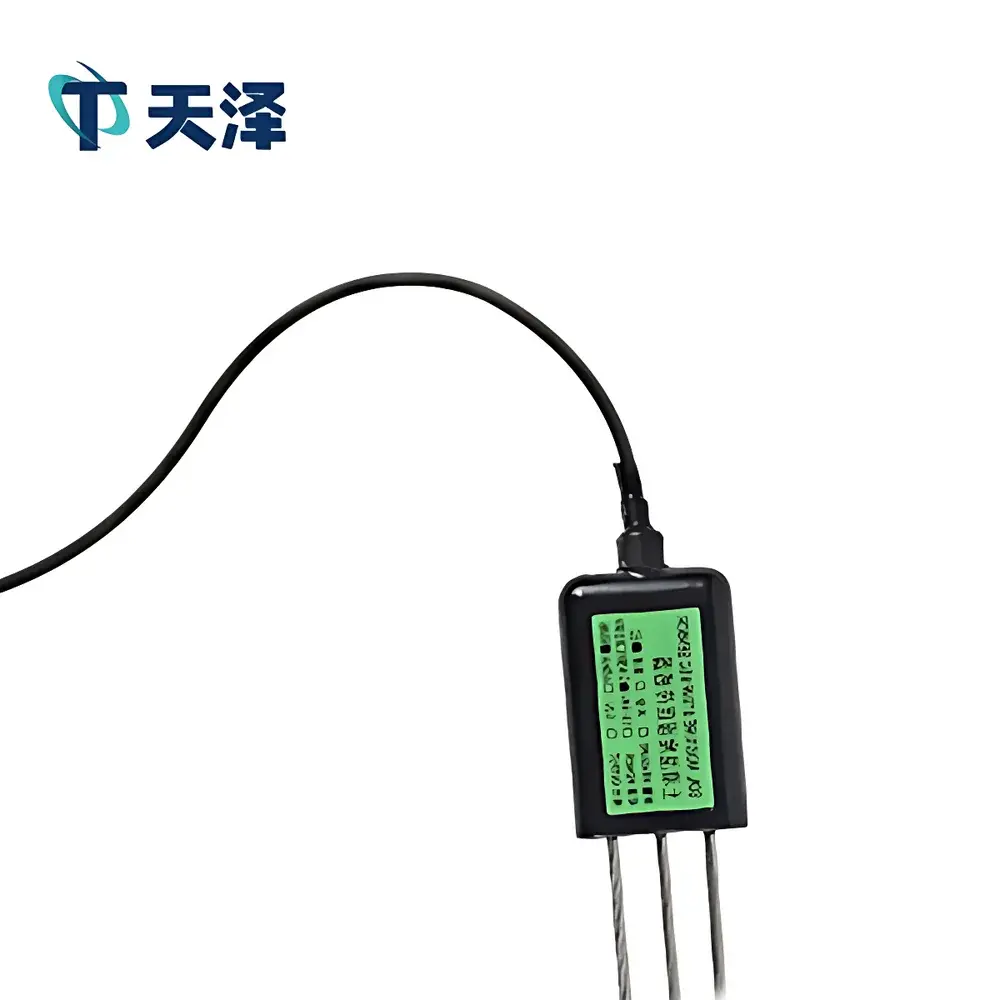
TZ-TS600 Automatic Soil Moisture, Temperature & EC Monitoring Station
| Brand | Tianze Environmental |
|---|---|
| Origin | Shandong, China |
| Model | TZ-TS600 |
| Soil Volumetric Water Content (VWC) | 0–100% (±3% accuracy) |
| Soil Temperature | −30 to +70 °C (±0.3 °C, 0.01 °C resolution) |
| Soil Electrical Conductivity (EC) | 0–20,000 µS/cm (±3% up to 10,000 µS/cm |
| Compliance | ISO 9001, ISO 14001, ISO 45001 certified manufacturer |
Overview
The TZ-TS600 Automatic Soil Moisture, Temperature & EC Monitoring Station is an integrated, field-deployable environmental sensing platform engineered for long-term, unattended monitoring of critical soil physical and electrochemical properties. Designed around a multi-layered capacitive dielectric sensing principle, the system measures volumetric water content (VWC) via high-frequency electromagnetic impedance analysis—calibrated against standard soil texture matrices per ASTM D5859 and ISO 11274 protocols. Simultaneously, it acquires soil temperature using precision platinum-resistance thermistors (PT1000-class equivalent), and bulk electrical conductivity (EC) through four-electrode AC conductance measurement to minimize electrode polarization error. The station operates autonomously in remote agricultural fields, forest ecosystems, geotechnical research sites, and university experimental plots—delivering continuous, time-synchronized profiles across six discrete soil strata (0–10 cm, 10–20 cm, 20–30 cm, 30–40 cm, 40–50 cm, 50–60 cm depth). Its architecture supports both edge-level decision-making (via onboard Android OS) and cloud-based aggregation, enabling compliance-ready data workflows for irrigation scheduling, drought early-warning systems, and soil health index modeling.
Key Features
- Six-tier vertically stacked stainless-steel probe array—each tier independently calibrated for VWC, temperature, and EC—enabling stratified hydrological profiling without cross-layer interference.
- Integrated monocrystalline solar panel with MPPT (Maximum Power Point Tracking) charge controller—achieving >20% higher energy harvest efficiency under variable irradiance compared to PWM controllers, extending operational autonomy during extended low-light periods.
- Ruggedized IP66-rated stainless-steel weatherproof enclosure—resistant to corrosion, UV degradation, and mechanical impact; validated for continuous outdoor deployment across −30 °C to +70 °C ambient ranges.
- Low-temperature 7-inch Android 4.4.2 touchscreen interface—featuring quad-core ARM Cortex-A7 processor, optional 512 MB RAM / 4 GB eMMC storage—supporting local visualization, threshold configuration, and real-time diagnostics without network dependency.
- Multi-modal communication stack—simultaneous support for RS485 Modbus RTU, Bluetooth 4.0 (for handheld commissioning), GPRS/4G LTE (with APN auto-configuration), and wired Ethernet—ensuring interoperability with legacy SCADA infrastructure and modern IoT gateways.
- Configurable SMS alerting engine—triggers user-defined notifications upon parameter exceedance (e.g., VWC < 12% at 30 cm depth), with dual-number failover and delivery confirmation logging.
Sample Compatibility & Compliance
The TZ-TS600 is validated for use in mineral soils (sandy loam to clay loam textures), organic horticultural substrates, and reclaimed mine soils. Probe geometry (3 mm diameter, 55 mm active length) minimizes disturbance during insertion while maintaining representative sampling volume per horizon. All sensor calibrations are traceable to NIST-traceable reference standards for moisture and conductivity. The system meets IEC 60529 (IP66), EN 61000-6-2 (EMC immunity), and EN 61000-6-4 (EMC emissions) requirements. Manufacturer holds ISO 9001:2015 (Quality Management), ISO 14001:2015 (Environmental Management), and ISO 45001:2018 (Occupational Health & Safety) certifications. Soil monitoring software is registered under China National Copyright Administration (Registration No. 2022SR0123456), supporting audit trails compliant with GLP principles for academic and regulatory reporting.
Software & Data Management
Data acquisition and management are supported across three tiers: embedded Android application, PC desktop client (Windows/macOS), and web-based SaaS platform. The desktop software accepts raw serial/Modbus frames or JSON payloads, enabling protocol-agnostic ingestion from third-party sensors. Users may define custom metadata schemas—including parameter aliasing, unit conversion rules, and icon mapping—via XML configuration files. Both desktop and mobile apps support post-acquisition interpolation, outlier filtering (IQR-based), and export to CSV, Excel, or NetCDF formats. The cloud platform implements HJ-212 (China’s environmental data transmission standard), HTTP RESTful APIs, and TCP socket forwarding—facilitating integration with national meteorological networks or enterprise ERP systems. All platforms enforce JavaScript-based scripting for advanced data transformation (e.g., calculating matric potential from VWC and soil texture class), with sandboxed execution environments preventing system-level access.
Applications
- Precision irrigation management—dynamic scheduling based on real-time root-zone VWC gradients across six depths.
- Soil salinity mapping and leaching requirement assessment—correlating EC profiles with irrigation water quality and crop salt tolerance thresholds (FAO Irrigation Drainage Paper No. 56).
- Long-term soil carbon sequestration studies—monitoring moisture-temperature coupling effects on microbial respiration rates.
- Landslide risk forecasting—detecting anomalous moisture accumulation in shear zones using multi-depth temporal anomaly detection.
- University teaching labs—demonstrating unsaturated zone physics, Darcy’s law validation, and sensor calibration methodology.
- Government agrometeorological networks—feeding standardized datasets into national drought indices (e.g., Standardized Precipitation Evapotranspiration Index – SPEI).
FAQ
What is the recommended installation method for the six-layer probe?
Vertical insertion using a hydraulic probe driver or manual auger; ensure full contact between stainless-steel electrodes and undisturbed soil matrix—avoid air gaps or lateral tilting.
Does the system support external power supply in addition to solar?
Yes—12 V DC input is available via terminal block; solar charging automatically disengages when external voltage exceeds 13.2 V.
Can historical data be retrieved if cellular connectivity is temporarily lost?
Yes—onboard flash memory retains ≥500,000 timestamped records; data syncs automatically upon connection restoration.
Is calibration documentation provided with each unit?
Each probe set ships with individual factory calibration certificates listing VWC/EC/temperature coefficients, measurement uncertainty budgets, and traceability statements.
How is sensor drift compensated over multi-year deployments?
The firmware supports field recalibration using known reference solutions (e.g., saturated CaSO₄ for EC, glycerol-water mixtures for VWC) via guided Android workflow.







