
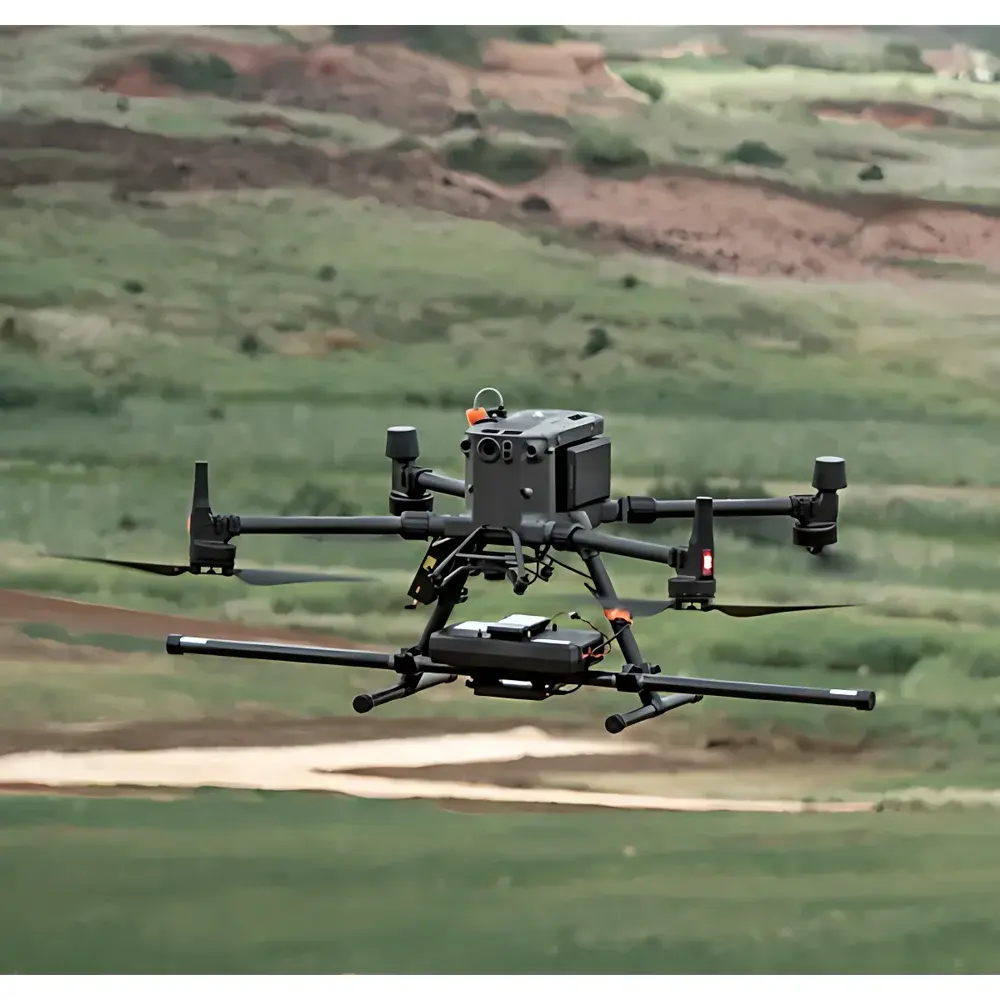
UgCS R4 Airborne Fluxgate Magnetometer System
| Brand | UgCS |
|---|---|
| Origin | Imported |
| Manufacturer Type | Authorized Distributor |
| Model | R4 |
| Measurement Principle | Pulsed-field fluxgate magnetometry |
| Magnet Type | Superconducting coil-based (auxiliary field generation) |
| Operating Temperature Range | −20 °C to +50 °C |
| Magnetic Field Range | ±75,000 nT (field-extensible) |
| Magnetic Moment Resolution | <150 pT |
| Temperature Ramp Rate | Up to 2 °C/min (within specified range) |
| Field Sweep Rate | Up to 200 Hz (programmable, field-extensible) |
| Sampling Rate | 200 Hz |
| Real-time Data Output Rate | 2 Hz |
| Onboard Storage | 2 GB SD card |
| Integrated Sensors | Triaxial fluxgate magnetometers, GPS receiver, 3-axis accelerometer |
| Weight | <1.2 kg (system-level, fully configured) |
Overview
The UgCS R4 Airborne Fluxgate Magnetometer System is a compact, high-stability, drone-integrated magnetic sensing platform engineered for geophysical surveying and tactical magnetic anomaly detection. Unlike scalar magnetometers (e.g., optically pumped or proton precession types), the R4 employs triaxial fluxgate sensor architecture operating under pulsed-field excitation, enabling vector magnetic field measurement with inherent directional sensitivity and high temporal fidelity. Its design centers on low-noise analog signal conditioning, synchronous demodulation, and real-time digital filtering—critical for suppressing platform-induced interference (e.g., from UAV motors, power electronics, and ferromagnetic components). The system’s pulse-driven operation enhances immunity to low-frequency drift and thermal hysteresis, supporting reliable measurements across dynamic flight profiles in variable ambient conditions (−20 °C to +50 °C). As a turnkey airborne solution, the R4 integrates inertial referencing (via onboard 3-axis accelerometer) and precise geolocation (GPS with sub-meter horizontal accuracy under open-sky conditions), ensuring spatially registered magnetic vector data suitable for gradiometric analysis and time-series anomaly tracking.
Key Features
- Triaxial fluxgate magnetometer array with factory-calibrated orthogonality and temperature-compensated offset/stability
- Programmable pulsed-field excitation architecture for enhanced signal-to-noise ratio and reduced 1/f noise contribution
- Integrated GPS module compliant with NMEA 0183 v4.10 and RTCM SC-104 standards; supports SBAS augmentation
- Onboard 2 GB industrial-grade SD card with cyclic buffering and power-fail-safe write protocols to prevent data loss during UAV landing or battery disconnect
- 200 Hz continuous sampling rate with hardware-level anti-aliasing filtering (cutoff at 80 Hz)
- Real-time telemetry output at 2 Hz via UART/RS-232 interface, compatible with common UAV flight controllers (e.g., Pixhawk, DJI SDK)
- Low-mass enclosure (<1.2 kg total system weight) optimized for Class II and III VTOL and fixed-wing UAV platforms
- Robust mechanical design meeting MIL-STD-810G for vibration, shock, and thermal cycling endurance
Sample Compatibility & Compliance
The R4 does not require physical sample contact or chamber loading; it operates as a passive remote-sensing instrument measuring ambient magnetic field vectors in free space. Its operational envelope complies with IEC 61000-6-2 (immunity) and IEC 61000-6-4 (emissions) for industrial environments. Magnetic calibration traceability follows ISO/IEC 17025–accredited procedures using Helmholtz coil systems referenced to NIST-traceable fluxgate standards. For regulated applications—including environmental site assessment under ASTM D6429 and UXO detection per DoD UXO-3.0 guidelines—the R4 supports audit-ready metadata logging (timestamp, GPS position, attitude quaternion, sensor temperature) required for QA/QC documentation and regulatory reporting.
Software & Data Management
Data acquisition and post-processing are supported by UgCS Ground Station Suite (v4.3+), a Windows/Linux-compatible application providing synchronized trajectory reconstruction, magnetic gradient computation (dBy/dx, dBz/dy), and noise spectral analysis (FFT-based). Raw binary logs (.ugc format) include embedded calibration coefficients and sensor health flags. Export options include GeoTIFF (gridded total field), CSV (time-series vectors), and SEG-Y (for interoperability with industry-standard geophysical interpretation tools such as Oasis montaj and Geosoft VOXI). The software enforces GLP-compliant audit trails: all processing steps, parameter changes, and user actions are timestamped and digitally signed. Optional integration with cloud-based dashboards enables automated alerting for magnetic threshold exceedances—relevant for perimeter monitoring and unexploded ordnance (UXO) surveillance workflows.
Applications
- High-resolution aeromagnetic mapping for mineral exploration (e.g., iron oxide-copper-gold systems, kimberlite indicator minerals)
- Shallow subsurface infrastructure detection: buried pipelines, reinforced concrete structures, and utility corridors in urban surveying
- Environmental magnetic screening: delineation of ferrous contamination plumes in soil and sediment, including landfill boundary verification
- Cultural resource management: non-invasive identification of buried foundations, kilns, ditches, and metallic artifacts in archaeological prospection
- Tactical counter-IED and UXO clearance operations—leveraging vector anomaly morphology (inclination, declination shifts) to discriminate between natural geology and anthropogenic ferrous objects
- Geothermal prospecting via mapping of Curie-point depth anomalies associated with shallow magmatic intrusions
FAQ
Is the R4 capable of absolute magnetic field calibration in-flight?
No—absolute calibration requires static, controlled-field conditions. However, the R4 supports in-situ relative calibration using GPS-referenced base station data and multi-pass survey redundancy to correct for diurnal variation and platform bias.
Can the R4 operate simultaneously with other electromagnetic sensors (e.g., EM-31, GPR)?
Yes, provided electromagnetic isolation is maintained per IEC 61000-4-3. UgCS provides EMI shielding recommendations and frequency coordination guidelines for co-deployed systems.
What level of positional accuracy is achievable in magnetic gradient mode?
When combined with RTK-GPS (horizontal accuracy ≤2 cm + 1 ppm) and pitch/yaw stabilization <0.1°, spatial resolution for first-order gradient estimation is ≤0.5 m at 30 m AGL.
Does the system comply with FAA Part 107 or EASA UAS regulations for commercial survey flights?
The R4 itself is not certified—but its form factor, EMC profile, and weight meet technical prerequisites for integration into FAA/EASA-certified UAV platforms. Integration validation remains the operator’s responsibility per AC 107-2B or EU 2019/947 Annex I.
Is firmware update support available beyond initial purchase?
Yes—UgCS provides quarterly firmware releases addressing sensor drift compensation algorithms, GPS constellation compatibility (GPS/Galileo/BeiDou), and extended temperature compensation models. Updates are delivered via secure OTA channel or offline SD card injection.



