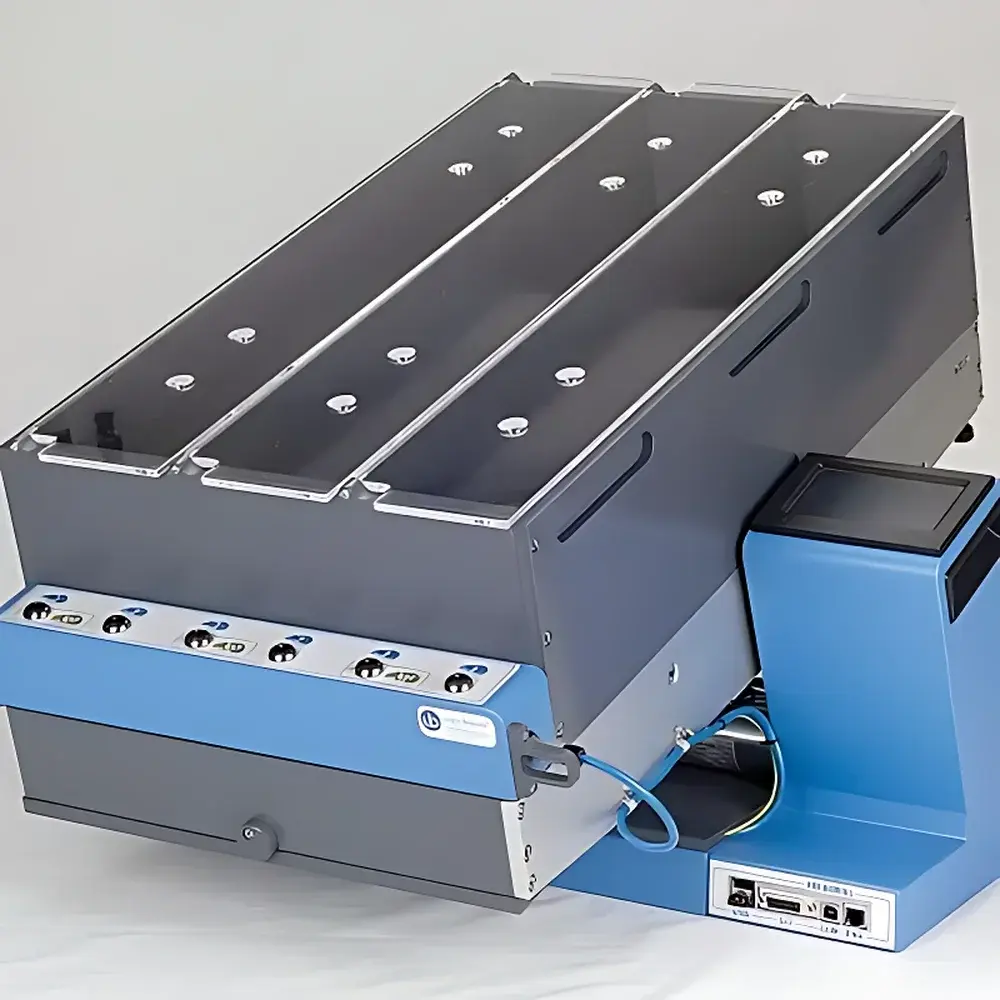
Ugo Basile 47302/47303 Dual-Mode Rodent Treadmill System (Rat & Mouse)
| Brand | Ugo Basile |
|---|---|
| Origin | Italy |
| Model | 47302 (Rat) / 47303 (Mouse) |
| Speed Range | 3–100 m/min (1 m/min increments) |
| Incline Range | −25° to +25° (5° steps) |
| Electric Stimulus | 0–2 mA (0.1 mA resolution) |
| Channel Configuration | 3 lanes (rat, 45 × 11 cm each) / 6 lanes (mouse, 45 × 5.5 cm each) |
| Frame Height | 15 cm (rat) / 7 cm (mouse) |
| Belt Material | Food-grade polymer with optimized traction |
| Data Output | USB export (TXT, Excel, PDF) |
| Control Interface | 4.3" capacitive touchscreen |
| Software | Integrated acquisition & analysis suite with audit-ready metadata tagging, hierarchical result tree, customizable layout, and GLP-compliant session annotation |
Overview
The Ugo Basile 47302/47303 Dual-Mode Rodent Treadmill System is an ISO 13485–certified, CE-marked instrument engineered for quantitative assessment of locomotor performance, exercise tolerance, neuromuscular fatigue, and behavioral response modulation in preclinical rodent models. Based on the validated principle of forced treadmill running—a cornerstone methodology in exercise physiology, metabolic phenotyping, neurodegenerative disease modeling, and analgesia research—the system delivers high reproducibility across longitudinal studies. Its dual-platform architecture enables seamless transition between rat- and mouse-specific protocols without hardware reconfiguration beyond lane module exchange, minimizing inter-subject variability and supporting standardized testing per NIH, OECD, and FELASA guidelines. The integrated electrophysiological stimulation module operates under precise current-controlled delivery, avoiding voltage drift or thermal artifact—critical for nociception threshold evaluation and aversive conditioning paradigms.
Key Features
- Modular dual-species design: Interchangeable 47302 (rat) and 47303 (mouse) lane assemblies—each with species-optimized dimensions, barrier height, and belt surface texture to ensure biomechanical fidelity and reduce stress-induced artifacts.
- Precise incline control: Motorized ±25° gradient adjustment in 5° increments, enabling controlled uphill/downhill locomotion for cardiopulmonary load modulation and gait kinematics analysis.
- Current-regulated electrostimulation: Programmable 0–2 mA foot-shock delivery (0.1 mA resolution), synchronized across all lanes; stimulus timing, duration, and inter-trial intervals are fully scriptable via touchscreen interface.
- Real-time biometric acquisition: Onboard speed/distance sensors with sub-second sampling resolution; automatic start/stop detection based on continuous position tracking and velocity thresholds.
- Hygienic, maintenance-optimized construction: Food-grade polymer running belt with non-slip micro-texture; removable waste collection tray; tool-free disassembly of base chassis for deep cleaning or sterilization compatibility.
- Embedded 4.3″ capacitive touchscreen: Standalone operation without external PC; intuitive icon-driven workflow navigation; real-time visualization of speed profile, cumulative distance, and stimulus event log.
Sample Compatibility & Compliance
The system supports C57BL/6, BALB/c, Sprague-Dawley, Wistar, and transgenic rodent strains (including aged and obese models) within standard IACUC-defined weight ranges (15–500 g). All mechanical and electrical components comply with IEC 61000-6-2 (EMC immunity) and IEC 61000-6-3 (EMC emission) standards. The electrophysiological module meets EN 60601-1 safety requirements for Class II medical devices. Software architecture supports ALCOA+ data integrity principles: each test session generates immutable metadata (operator ID, calibration timestamp, protocol version), and raw sensor logs are stored with SHA-256 hash verification. Audit trails meet FDA 21 CFR Part 11 requirements when used with optional networked server deployment.
Software & Data Management
The embedded firmware and companion desktop application (Windows/macOS) provide end-to-end experimental traceability. Users define protocols using parameter templates (constant speed, linear acceleration ramp, or user-defined velocity/time curves), assign animal IDs with custom annotations (e.g., treatment group, genotype, prior drug administration), and initiate runs with one-touch execution. Acquired data—including instantaneous speed, total distance, latency to first shock, number of shocks received, and time-to-exhaustion—are hierarchically organized in a collapsible tree view. Export options include timestamped CSV for statistical packages (R, Prism), Excel-compatible structured tables with embedded metadata, and publication-ready PDF reports featuring annotated speed profiles and session summaries. All exported files retain cryptographic hashes for regulatory submission validation.
Applications
- Exercise endurance phenotyping in metabolic syndrome, diabetes, and aging models
- Neuromuscular fatigue assessment in ALS, muscular dystrophy, and spinal cord injury studies
- Pharmacodynamic evaluation of ergogenic agents, myostatin inhibitors, and mitochondrial modulators
- Nociceptive threshold determination via shock-avoidance latency in inflammatory and neuropathic pain models
- Motor coordination and gait adaptation analysis during slope-based locomotion challenges
- Cardiovascular stress testing through graded incline protocols coupled with telemetry integration
FAQ
What regulatory certifications does this system hold?
The device carries CE marking under Directive 2014/32/EU (Measuring Instruments Directive) and complies with ISO 13485:2016 for quality management systems applicable to medical device manufacturers. Electrical safety conforms to EN 60601-1 and EMC compliance follows EN 61000-6-2/-3.
Can the treadmill be integrated with third-party physiological monitoring systems?
Yes—digital TTL trigger outputs (5 V logic) are provided for synchronization with EEG, EMG, ECG, or respiratory plethysmography platforms. Analog voltage outputs (0–5 V) mirror real-time speed and stimulus status for oscilloscope or DAQ system capture.
Is software validation documentation available for GxP environments?
Upon request, Ugo Basile provides IQ/OQ documentation packages, including installation checklists, operational test scripts, and performance verification reports aligned with ASTM E2500 and Annex 11 principles.
How often does the running belt require replacement?
Under typical usage (≤2 hrs/day, 5 days/week), the food-grade polymer belt maintains traction integrity for ≥18 months. Visual inspection for surface abrasion or tensile deformation is recommended quarterly.
Does the system support automated exhaustion endpoint detection?
Yes—exhaustion is defined programmatically as failure to maintain position on the belt for >3 consecutive seconds after stimulus onset, with configurable grace periods and adaptive shock escalation logic.