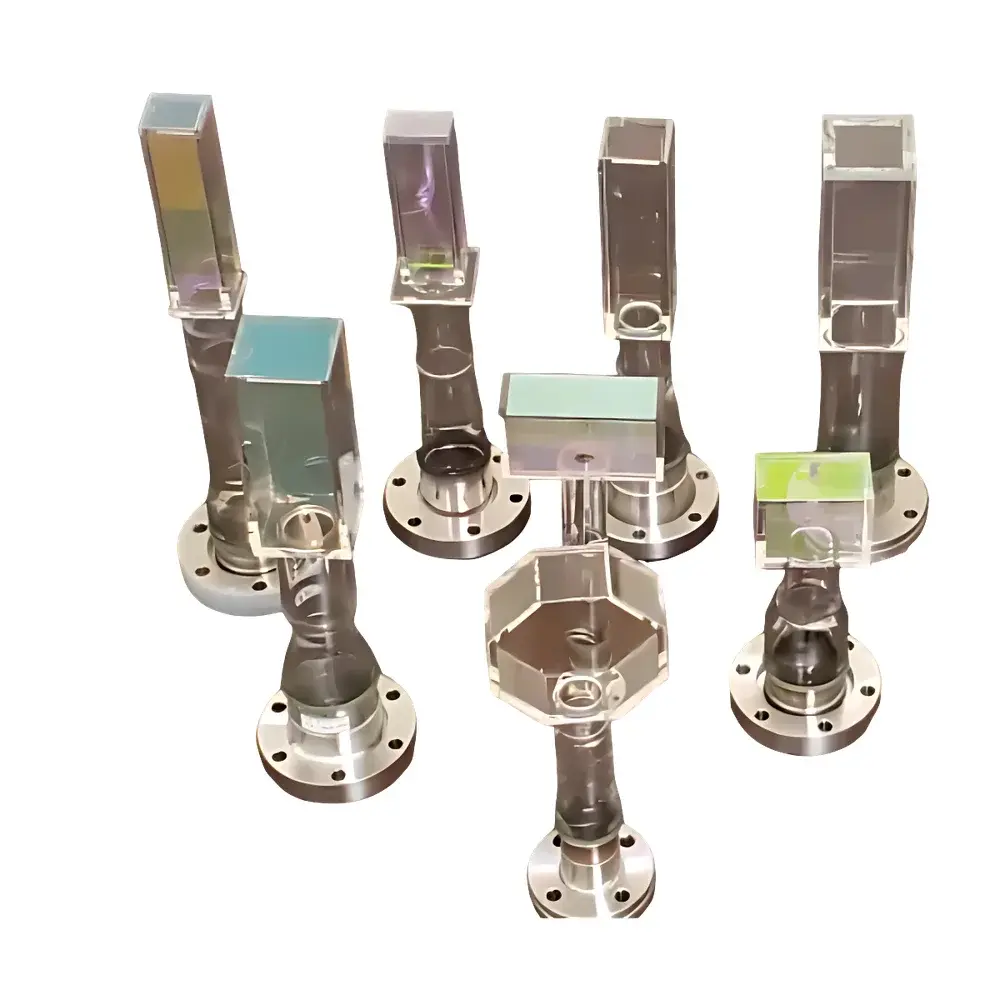
UHV Cell for Cold Atom Experiments
| Brand | Akatsuki Technology |
|---|---|
| Origin | Japan |
| Model | UHV Cold Atom Cell |
| Vacuum Performance | <1×10⁻¹⁰ mbar (after bake-out) |
| Optical Access | ≥6 viewports (4 × Ø25.4 mm, 2 × Ø50.8 mm) |
| Flange Standard | CF-40 & CF-63 (ISO-KF optional) |
| Material | OFHC Copper body with 316L stainless steel endplates |
| Surface Roughness | Ra ≤ 0.2 µm (mirror-polished internal surfaces) |
| Coating | Dual-side dielectric anti-reflection (AR) coating (R < 0.25% @ 780 nm & 1064 nm) |
| Bake-out Compatibility | 250 °C sustained for 24 h |
| Leak Rate | ≤1×10⁻¹² mbar·L/s (He) |
Overview
The Akatsuki Technology UHV Cold Atom Cell is an engineered ultra-high vacuum (UHV) chamber system specifically designed for laser-cooled atom experiments requiring extreme vacuum integrity, optical precision, and thermal-mechanical stability. Operating at base pressures below 1×10⁻¹⁰ mbar after standard 250 °C bake-out, the cell leverages a hybrid construction of oxygen-free high-conductivity (OFHC) copper body and electropolished 316L stainless steel endplates to achieve both rapid thermal equilibration and minimal outgassing. Its core function is to serve as the central vacuum envelope for magneto-optical traps (MOTs), atomic fountain clocks, atom interferometers, and quantum sensing platforms—where residual gas collisions, surface contamination, and optical wavefront distortion directly limit coherence time, trap lifetime, and measurement repeatability. The cell’s design adheres to fundamental UHV engineering principles: all internal surfaces are mirror-polished (Ra ≤ 0.2 µm), weld joints are orbital TIG-sealed under inert atmosphere, and material selection complies with ASTM F880-22 standards for ultra-clean metallic vacuum components.
Key Features
- Double-sided broadband anti-reflection (AR) coating applied in situ via ion-beam sputtering—optimized for 780 nm (D₂ line of ⁸⁷Rb) and 1064 nm (optical lattice/interferometry wavelengths), with reflectivity <0.25% per surface
- Integrated CF-40 and CF-63 conflat flanges with metal gasket grooves meeting ISO 3669:2021 dimensional tolerances; optional ISO-KF adapters available for auxiliary pumping or diagnostics
- Optical access configuration includes four Ø25.4 mm and two Ø50.8 mm fused silica viewports, all bonded using low-outgassing, helium-leak-tight epoxy (ASTM E1559-compliant)
- Internal geometry supports both vertical launch (toss-type atom interferometry) and horizontal MOT configurations, with precise alignment fiducials machined into mounting interfaces
- Compatible with standard UHV pumping stacks: NEG cartridges (SAES St707), titanium sublimation pumps (TSP), and ion pumps—electrical feedthroughs rated to 5 kV DC and 2 A continuous
Sample Compatibility & Compliance
The UHV Cold Atom Cell is validated for use with alkali atoms (⁸⁷Rb, ⁸⁵Rb, ⁴¹K, ²³Na) and alkaline-earth-like species (⁸⁸Sr, ¹⁷¹Yb) under typical MOT loading conditions (oven temperatures 50–120 °C, atomic beam flux ≤1×10¹¹ atoms/s). All wetted materials comply with ASTM E1559 mass loss testing and meet ESA PSS-01-702 requirements for outgassing rates (<1×10⁻¹² g/(cm²·s) total mass loss, <5×10⁻¹³ g/(cm²·s) collected volatile condensable material). The cell’s mechanical design satisfies ASME BPVC Section VIII, Division 1 pressure boundary criteria for external atmospheric loading. Documentation includes full material traceability (mill test reports), helium leak test certificates (per ISO 15848-1), and surface cleanliness verification (per ISO 14644-1 Class 5 cleanroom handling protocol).
Software & Data Management
While the UHV cell itself is a passive vacuum component, it integrates natively with industry-standard vacuum control ecosystems—including Keysight (formerly Agilent) VACUUBRAND DCP 3000 controllers, Pfeiffer HiCube Eco pumping stations, and MKS Instruments multigauge systems. Real-time pressure logging, interlock sequencing, and bake-out temperature ramp profiles can be synchronized via RS485/Modbus or Ethernet/IP protocols. For GLP/GMP-aligned quantum metrology labs, the cell’s serial-numbered build record—including batch-specific coating spectral data, leak test logs, and surface roughness maps—is archived in accordance with ISO/IEC 17025:2017 clause 7.5.3 on equipment records. Audit trails support FDA 21 CFR Part 11 compliance when paired with validated SCADA environments.
Applications
- Primary frequency standards: Atomic fountains and optical lattice clocks requiring >10 s free-fall interrogation times
- Quantum gravimetry: Toss-type atom interferometers measuring local gravitational acceleration with μGal-level resolution
- Fundamental physics tests: Matter-wave interferometry for equivalence principle verification and short-range gravity searches
- Quantum simulation platforms: 2D MOT arrays for Hubbard model emulation and spin-orbit-coupled degenerate gases
- Space-qualified cold atom sensors: Heritage-tested design basis for missions including STE-QUEST and CAL (Cold Atom Lab on ISS)
FAQ
What vacuum level can be achieved with this cell when paired with standard UHV pumping?
Typical base pressure after 24-hour bake-out at 250 °C is ≤5×10⁻¹¹ mbar, measured with a Bayard-Alpert gauge calibrated against a spinning rotor gauge.
Is custom viewport angular orientation supported?
Yes—custom azimuthal positioning (±0.1° tolerance) and tilt angles (up to ±15° from normal incidence) are available under engineering review and NDA.
Can the cell be retrofitted with RF or microwave feedthroughs?
Standard configurations include 2× SMA and 1× 1.0 mm coaxial feedthroughs; custom hermetic RF feedthroughs up to 18 GHz (WR-42) are offered with VSWR <1.25.
Does Akatsuki provide installation and commissioning support?
Remote technical guidance is included with purchase; on-site UHV commissioning and MOT alignment assistance is available under separate service agreement.
Are material certifications and coating spectral data provided with shipment?
Yes—each unit ships with a Certificate of Conformance (CoC), full spectral reflectance report (200–1200 nm), and certified surface roughness map (contact profilometry, 3-point average).