
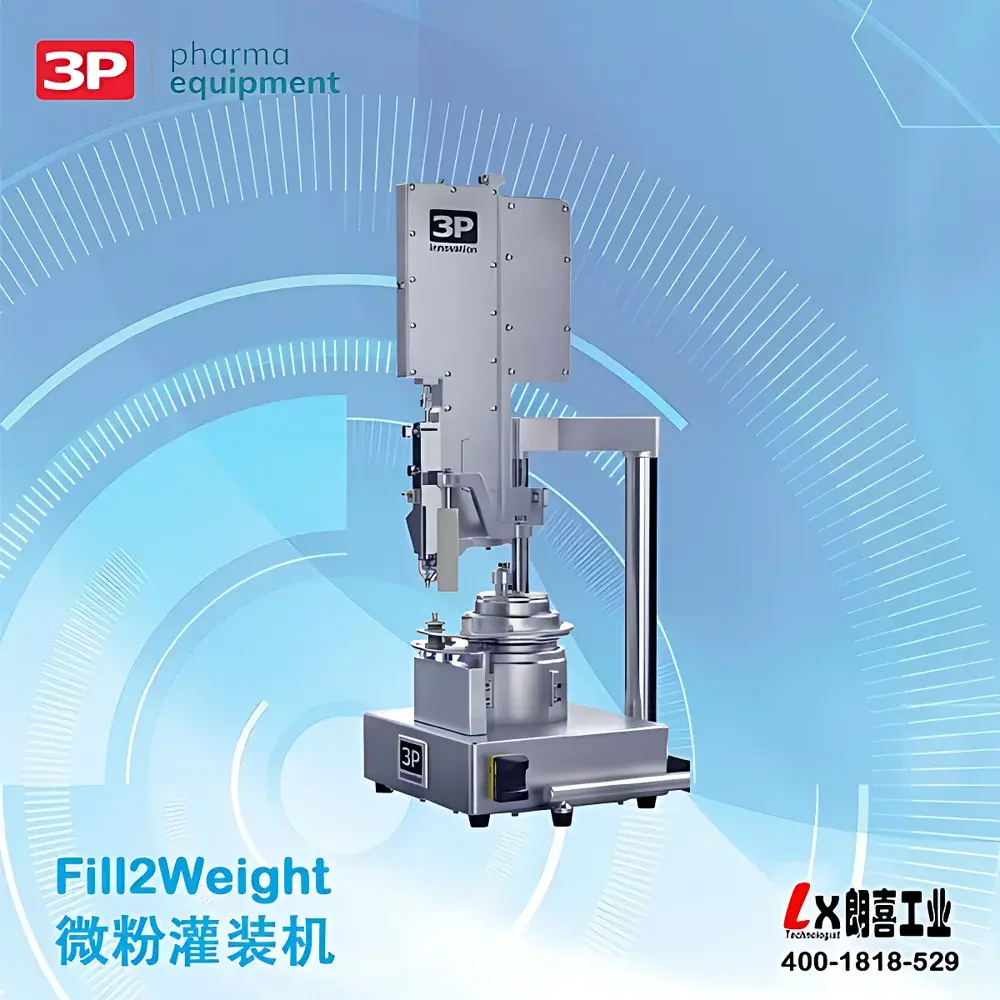
UK Fill2Weight Micro-Powder Gravimetric Filling System by 3P Innovation
| Brand | 3P Innovation (UK) |
|---|---|
| Origin | United Kingdom |
| Manufacturer Type | Authorized Distributor |
| Product Category | Imported Instrument |
| Model | Fill2Weight |
| Application Segment | Biopharmaceuticals |
| Compliance | FDA cGMP, EU GMP Annex 1, NMPA Sterile Manufacturing Guidelines |
| Material Construction | 316L Stainless Steel + Food-Grade Coating |
| Cleaning | CIP/SIP-Compatible |
| Particle Containment | <0.1 µg/m³ (OEL ≤1 µg/m³ compatible) |
| Dose Uniformity (CV) | ≤2.5% |
| Powder Size Range | 1–100 µm |
| Throughput (Commercial Mode) | >2000 units/min |
| Cleanroom Compatibility | ISO Class 5 (Grade A/B environments) |
Overview
The Fill2Weight Micro-Powder Gravimetric Filling System is a precision-engineered, fully integrated gravimetric dosing platform developed by 3P Innovation (UK) for the formulation and manufacturing of dry powder inhalers (DPIs). Unlike volumetric or auger-based fillers, Fill2Weight employs real-time mass feedback control—leveraging high-resolution load cells, closed-loop servo-driven micro-screw feeders, and dynamic pressure-compensated filling chambers—to deliver consistent, traceable, and repeatable micro-dose deposition across complex powder blends. Its design directly addresses the critical challenges in DPI development: poor flowability of magnesium stearate-lubricated formulations, segregation of API–lactose carrier mixtures, and handling of high-potency active pharmaceutical ingredients (HPAPIs) with occupational exposure limits (OEL) as low as 1 µg/m³. Built upon 23 years of legacy expertise—including core engineering contributions to the original GlaxoSmithKline Diskus® and Ellipta® filling platforms—the system bridges laboratory-scale formulation work with clinical and commercial manufacturing under unified process control architecture.
Key Features
- Gravimetric closed-loop dosing with continuous mass feedback (±0.1 mg resolution) and adaptive algorithmic compensation for powder compressibility and electrostatic effects.
- Modular tri-stage platform architecture: DISCOVER (R&D), EXPLORE (clinical batch production), and EVOLVE (commercial high-speed line integration).
- Vibration-assisted screening and pressure-balanced micro-screw feeding enabling stable handling of cohesive, aerated, and ultrafine powders (1–100 µm).
- Integrated negative-pressure isolation chamber with HEPA-filtered recirculation and real-time airborne particle monitoring (<0.1 µg/m³ leakage limit).
- Full CIP/SIP compatibility using 316L stainless steel wetted parts and certified food-grade internal coatings compliant with USP Class VI and EC 1935/2004.
- Robust mechanical design validated for operation in ISO Class 5 (Grade A) environments; supports glove-port integration and isolator docking.
Sample Compatibility & Compliance
Fill2Weight accommodates heterogeneous powder systems including multi-component blends containing APIs, lactose carriers, magnesium stearate lubricants, and functional excipients such as leucine or mannitol. Its adaptive feeding logic mitigates segregation during transfer and ensures CV ≤2.5% across dose ranges from 10 µg to 50 mg per actuation. The system meets regulatory expectations for data integrity and process validation under FDA 21 CFR Part 11, EU Annex 11, and ICH Q5A/Q5C guidelines. All electronic records include full audit trail functionality, user access controls, and electronic signatures. It is pre-qualified for use in IND-enabling clinical manufacturing and supports qualification protocols aligned with ASTM E2500-13 and ISPE GAMP 5.
Software & Data Management
The Fill2Weight Control Suite runs on a deterministic Windows OS platform with deterministic timing loops and deterministic I/O polling. Process parameters—including screw speed, vibration frequency, chamber pressure differential, fill time, and final weight—are logged at ≥100 Hz with timestamped metadata. Raw data exports comply with ASAM ATX and SDTM standards for regulatory submission. Batch reports include statistical summaries (mean, SD, CV, min/max), trend charts, and deviation flags linked to root cause tags (e.g., “powder bridging,” “electrostatic charge build-up”). Software architecture supports integration with MES (Manufacturing Execution Systems) via OPC UA and supports FDA 21 CFR Part 11-compliant electronic record retention for ≥15 years.
Applications
- Formulation screening of DPI candidates under R&D conditions (mg-scale, single-actuator testing).
- Clinical trial material production (Phase I–III) requiring full traceability, environmental containment, and weight-based release testing.
- Commercial manufacturing of generic and novel DPI products compatible with Diskus®, Ellipta®, Genuair®, and Respimat®-type devices.
- High-potency drug product manufacturing where OEL compliance and cross-contamination prevention are non-negotiable.
- Process characterization studies supporting Quality-by-Design (QbD) frameworks and Design Space definition per ICH Q8(R2).
FAQ
Is Fill2Weight suitable for handling highly potent compounds (HPAPIs)?
Yes. The system incorporates dual-stage HEPA filtration, negative-pressure containment, and real-time particle monitoring calibrated to detect sub-microgram airborne concentrations—ensuring operator safety and compliance with OEL ≤1 µg/m³ requirements.
Can it be integrated into an existing cleanroom or isolator?
Absolutely. Fill2Weight modules are designed with standardized ISO-KF flange interfaces, glove-port alignment fixtures, and modular footprint options to support retrofitting into Grade A/B environments and rigid-wall isolators.
Does the system support regulatory submissions for FDA or EMA approval?
Yes. Full IQ/OQ/PQ documentation packages are provided, including risk assessments (FMEA), calibration certificates traceable to NIST, and validation protocols aligned with ASTM E2500 and EU Annex 15.
What level of software validation is included?
The Fill2Weight Control Suite is delivered with vendor-supplied CSV (Computerized System Validation) documentation, including URS, FS, DS, IQ/OQ test scripts, and Part 11 compliance evidence.
How does Fill2Weight differ from traditional volumetric fillers?
It replaces volume-based assumptions with direct mass measurement and adaptive feed control—eliminating errors caused by powder density variation, moisture content, or electrostatic charge—thus delivering superior dose uniformity and process robustness.
Related Products





