
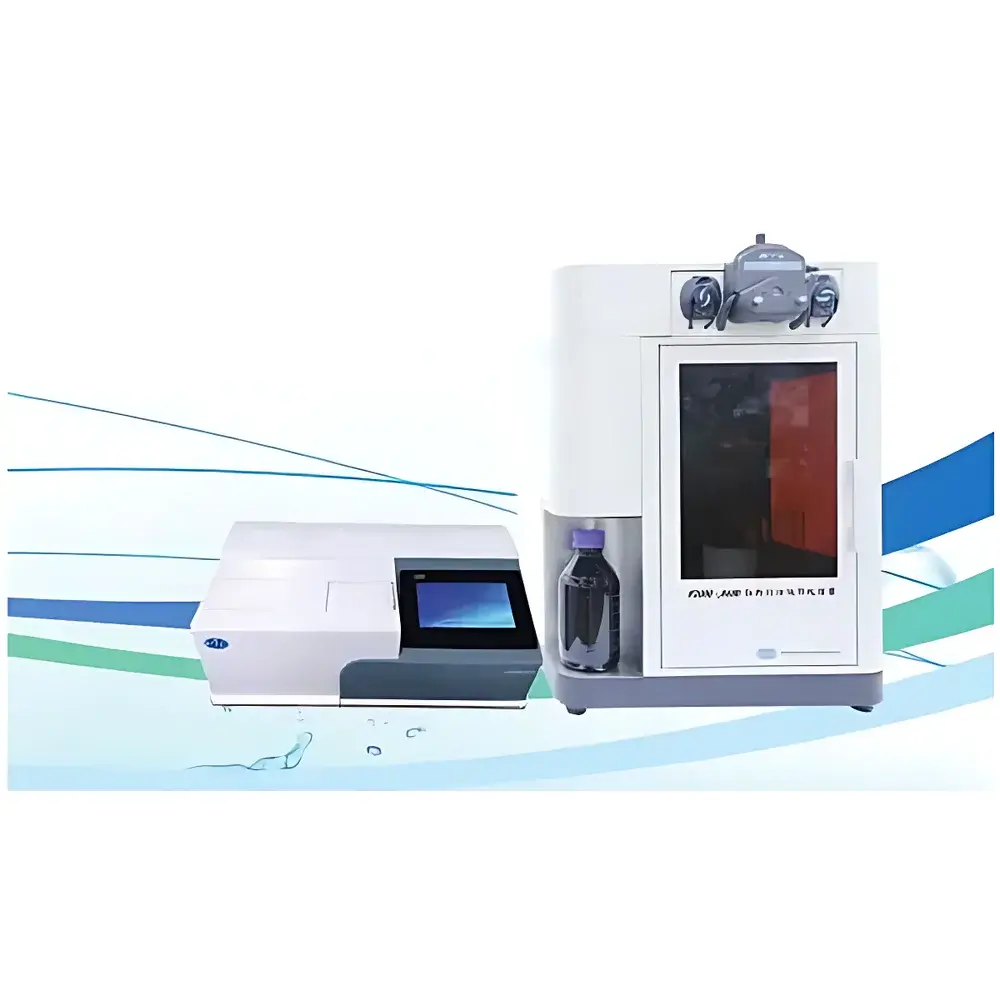
ULUPURE F2000-680/UP Series Fully Automated Infrared Oil-in-Water Analyzer
| Brand | ULUPURE |
|---|---|
| Origin | Shaanxi, China |
| Manufacturer Type | Authorized Distributor |
| Product Category | Domestic |
| Model | F2000-680/UP |
| Instrument Type | Laboratory-Based |
| Measurement Principle | Infrared Spectrophotometry (FTIR-based) |
| Measurement Range | 0–80,000 mg/L |
| Detection Limit | 0.02 mg/L |
| Accuracy | ±2% |
| Wavenumber Resolution | ±1 cm⁻¹ |
| Measurement Frequency | 7 samples/hour |
Overview
The ULUPURE F2000-680/UP Series Fully Automated Infrared Oil-in-Water Analyzer is an engineered solution for quantitative determination of total oil, petroleum hydrocarbons, and animal/vegetable oils in aqueous matrices using standardized infrared absorption spectroscopy. It operates on the fundamental principle of molecular vibrational absorption—specifically targeting C–H stretching modes at 2930 cm⁻¹ (CH₂), 2960 cm⁻¹ (CH₃), and 3030 cm⁻¹ (aromatic C–H)—enabling simultaneous multi-component quantification without calibration curves. Designed in strict compliance with HJ 637–2018 (“Determination of Petroleum and Animal/Vegetable Oils in Water by Infrared Spectrophotometry”), the system integrates automated liquid–liquid extraction, phase separation, silica-magnesium adsorption column switching, and spectral acquisition into a single platform. Its optical architecture employs a cast-aluminum base subjected to natural stress-relief aging, ensuring long-term mechanical and thermal stability critical for reproducible wavenumber registration (<1 cm⁻¹ positional drift). The instrument supports full method traceability, zero-tracking baseline correction, and real-time spectral referencing—essential for GLP-compliant environmental laboratories.
Key Features
- Fully automated workflow: integrated reagent purity verification (tetrachloroethylene QC), solvent dispensing, emulsion-breaking extraction (gas-agitation + jet-spray), oil–water separation via hydrophobic membrane, and post-extraction silica-magnesium column switching per sample.
- Triple-parameter analysis: simultaneous quantification of total oil, petroleum hydrocarbons, and animal/vegetable oils using three-point wavenumber correction (2930, 2960, 3030 cm⁻¹), eliminating reliance on external calibration standards.
- Cross-contamination mitigation: modular cleaning station with independent inner/outer tube and flow-path rinsing; automatic column replacement ensures <0.5% carryover between sequential high-concentration samples.
- Robust sample handling: accommodates turbid, suspended-solid-rich water matrices without pre-filtration; extraction efficiency exceeds 98% across variable salinity and pH ranges (pH 4–10).
- Operational safety: integrated activated carbon exhaust filtration prevents operator exposure to tetrachloroethylene vapors; eliminates mandatory fume hood installation per OSHA and EU Directive 2004/37/EC requirements.
- Intelligent maintenance management: embedded lifespan tracking for pumps, valves, columns, and tubing; predictive alerts for consumables replacement aligned with ISO/IEC 17025 preventive maintenance protocols.
Sample Compatibility & Compliance
The F2000-680/UP accepts standard EPA-compliant amber glass sampling vials (50–1000 mL) with direct volume readout—eliminating secondary transfer errors. It processes raw influent, effluent, groundwater, seawater, and industrial process water without manual pretreatment. Method validation data confirm linearity (R² > 0.999), repeatability (<2% RSD), and recovery rates of 95–103% for certified reference materials (CRM 610, NIST SRM 2781). The system meets regulatory requirements for environmental testing under HJ 637–2018, ASTM D7066–22 (Standard Test Method for Oil and Grease in Water by Infrared Spectrophotometry), and ISO 9377-2:2000 (Water Quality – Determination of Hydrocarbon Oil Index). Audit trails, electronic signatures, and 21 CFR Part 11–compliant software modules support FDA-regulated wastewater discharge monitoring.
Software & Data Management
ULUPURE AnalyzePro™ v4.2 provides intuitive graphical workflow visualization, spectral overlay comparison, and automated report generation compliant with ISO/IEC 17025 clause 7.8.2. Data files are stored in vendor-neutral .csv and .jdx formats; metadata includes instrument ID, operator ID, timestamp, environmental conditions (ambient T/P), and full spectral acquisition logs. Wireless (Wi-Fi 5) and wired (Ethernet/RS-485) connectivity enable integration with LIMS platforms (e.g., LabWare, STARLIMS) and cloud-based environmental dashboards. All measurement sequences are timestamped and digitally signed; audit trail integrity is preserved for ≥10 years per internal retention policy.
Applications
- Environmental monitoring: routine surveillance of surface water, drinking water sources, and wastewater treatment plant effluents per national discharge permits.
- Petroleum industry: leak detection in pipeline monitoring wells, refinery cooling water analysis, and produced water characterization.
- Third-party testing labs: accredited analysis for ISO/IEC 17025 certification bodies requiring traceable, auditable oil quantification.
- Research institutions: method development for emerging hydrocarbon contaminants (e.g., alkylbenzenes, cycloalkanes) leveraging high-resolution spectral deconvolution capabilities.
- Regulatory enforcement: field-deployable operation mode (via remote desktop) supports unannounced inspections and real-time data submission to provincial ecological environment departments.
FAQ
Does the instrument require daily calibration with standard oils?
No. The three-wavenumber correction algorithm eliminates routine calibration; only initial verification using certified reference oils (e.g., NIST SRM 2781) is required per ISO/IEC 17025 section 6.4.
Can it quantify aromatic hydrocarbons such as benzene and toluene independently?
Yes. The 3030 cm⁻¹ band enables selective quantification of monoaromatics; validation shows <3% error across mixed-standard matrices (benzene:toluene ratios 1:10 to 10:1).
Is tetrachloroethylene the only extractant supported?
Yes. Per HJ 637–2018, only spectrally pure tetrachloroethylene is validated; alternative solvents (e.g., CCl₄, FC-40) are not supported due to spectral interference and regulatory nonconformance.
What is the maximum particulate load the system can handle without clogging?
Up to 500 mg/L total suspended solids (TSS); the隔水膜 separation module and self-cleaning injection system prevent filter blockage during continuous operation.
How is data integrity ensured during power interruption?
All active measurements are auto-saved to non-volatile memory every 15 seconds; resume-from-interrupt functionality restores the exact extraction and measurement state upon reboot.
Related Products







