
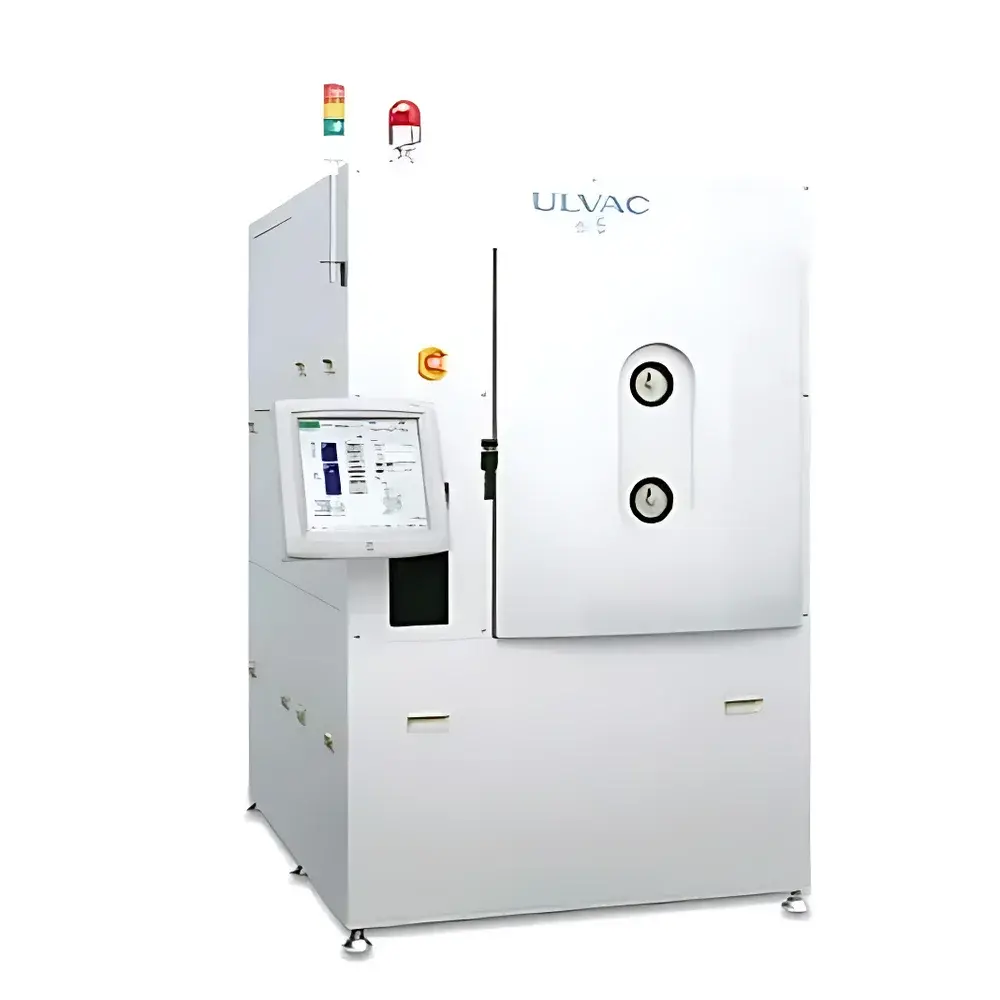
ULVAC EI-5Z Series Electron Beam Vacuum Evaporator for Gold Coating
| Brand | ULVAC |
|---|---|
| Model | EI-5Z |
| Evaporation Sources | Dual-mode (Electron Beam + Resistive Thermal) |
| Substrate Compatibility | 2–8 inch wafers (Si, GaAs, glass, ceramics) |
| Base Pressure | ≤3.0 × 10⁻⁵ Pa |
| Pumping Speed | Achieves 3.0 × 10⁻⁴ Pa in ≤20 min |
| Thickness Uniformity | ±5% across substrate |
| Control System | Fully Automated PLC-Based Interface |
| Chamber Configuration | Vertical-Incidence Deposition |
| Optional Integration | Wall-Through (Penetrating) Design |
| Material Compatibility | Au, Ag, Al, Cr, Ni, Ti, ITO, SiO₂, Al₂O₃, and other conductive/insulating evaporants |
Overview
The ULVAC EI-5Z Series Electron Beam Vacuum Evaporator is a precision thin-film deposition system engineered for reproducible, high-purity metallization and dielectric coating in academic research laboratories, semiconductor process development, and microfabrication cleanrooms. It operates on the principle of physical vapor deposition (PVD) via electron beam (e-beam) heating—where a focused high-energy electron beam impinges on a solid source material within a water-cooled crucible, inducing localized melting and vaporization under high vacuum. Complementing this, the system integrates a resistive thermal evaporation source, enabling dual-mode operation without hardware reconfiguration. This architecture supports both high-melting-point metals (e.g., tungsten, molybdenum, gold) and low-volatility oxides (e.g., SiO₂, Al₂O₃), while maintaining stoichiometric fidelity and minimal contamination. The vertical-incidence geometry ensures direct-line-of-sight deposition onto horizontally mounted substrates, minimizing shadowing effects and enhancing step coverage control—critical for mask-based lithography and TEM grid preparation.
Key Features
- Dual-source compatibility: Simultaneous integration of e-beam and resistive thermal evaporation sources with shared shutter mechanism and real-time source monitoring.
- High-vacuum performance: Equipped with a turbomolecular pump backed by a dry scroll pump (low-oil/no-oil configuration), achieving base pressure ≤3.0 × 10⁻⁵ Pa and operational pressure ≤3.0 × 10⁻⁴ Pa within 20 minutes—ensuring low residual gas partial pressures (<10⁻⁷ Torr O₂/H₂O equivalent) essential for oxidation-sensitive films such as Ti, Cr, or Fe.
- Precision substrate handling: Motorized XYZ stage with tilt capability (±5°) and optional rotation (0–30 rpm), accommodating substrates from 2-inch to 8-inch diameter—including irregular shapes (square, rectangular, or custom-cut wafers) made of Si, GaAs, fused silica, alumina, or LTCC ceramics.
- Automated process control: PLC-driven interface with programmable deposition sequences, real-time quartz crystal microbalance (QCM) feedback, and integrated pressure, temperature, and current logging compliant with GLP audit requirements.
- Modular chamber design: Stainless steel UHV-compatible main chamber (CF-flanged), optional wall-through feedthroughs for external source access or in-situ diagnostics (e.g., RHEED, optical emission spectroscopy), and quick-change shield/liner kits for cross-material compatibility.
Sample Compatibility & Compliance
The EI-5Z accommodates a broad spectrum of substrate materials and geometries without requiring tooling modification. Standard configurations support flat, rigid substrates up to 200 mm in diameter; custom fixtures enable clamping of flexible foils or small particulates (e.g., TEM grids, fiber tips). Film composition integrity is maintained through strict vacuum integrity protocols aligned with ISO 14644-1 Class 5 cleanroom integration standards. All electronic controls meet IEC 61000-6-2/6-4 EMC specifications. Data acquisition and recipe storage comply with FDA 21 CFR Part 11 requirements when paired with ULVAC’s optional validated software package (EI-5Z-SPS v3.2), including electronic signatures, audit trails, and role-based access control.
Software & Data Management
The system ships with ULVAC’s proprietary EI-5Z Control Suite—a Windows-based application supporting multi-step deposition recipes, live QCM thickness rate monitoring (0.01 Å/s resolution), and synchronized log export in CSV and HDF5 formats. Raw sensor data (pressure, e-beam current/voltage, heater power, shutter position) are timestamped and stored with nanosecond-level synchronization. Exported datasets include metadata headers referencing ASTM F1529-22 (Standard Guide for Thin-Film Thickness Measurement by Quartz Crystal Microbalance) and ISO 14644-1 environmental context tags. Optional cloud-enabled remote diagnostics provide predictive maintenance alerts based on pump vibration spectra and thermal cycling history.
Applications
- Preparation of conductive top contacts for organic photovoltaics (OPV) and perovskite solar cells (Au, Ag, Al).
- Fabrication of electron-transparent windows and fiducial markers for transmission electron microscopy (TEM) using ultra-thin Au/Cr bilayers.
- Deposition of adhesion-promoting interlayers (e.g., 2 nm Ti or Cr) prior to noble metal sputtering in MEMS packaging.
- Research-scale fabrication of plasmonic nanostructures via lift-off processes requiring sub-10 nm uniformity control.
- Low-volume prototyping of transparent conductive oxides (ITO, AZO) for flexible display test structures.
FAQ
What vacuum level is required for high-quality gold film deposition?
For pinhole-free, low-resistivity gold films (≥99.99% purity), a base pressure ≤5.0 × 10⁻⁵ Pa is recommended to suppress oxide incorporation and carbon contamination from residual hydrocarbons.
Can the EI-5Z be upgraded to include in-situ ellipsometry?
Yes—ULVAC offers factory-integrated rotating analyzer ellipsometer (RAE) modules with Brewster-angle optical feedthroughs compatible with the EI-5Z chamber flange layout (CF-100 or CF-150).
Is thermal evaporation suitable for depositing ITO?
Resistive thermal evaporation of ITO is feasible but requires precise stoichiometric control; e-beam evaporation is preferred for higher density and lower oxygen deficiency—both modes are supported on the EI-5Z with appropriate source crucible selection.
How is film thickness calibrated and verified?
Calibration uses NIST-traceable quartz crystal monitors (QCMs) with pre-deposition sensitivity factors; post-deposition verification is performed via cross-sectional SEM with certified reference standards (e.g., NIST SRM 2053).



