
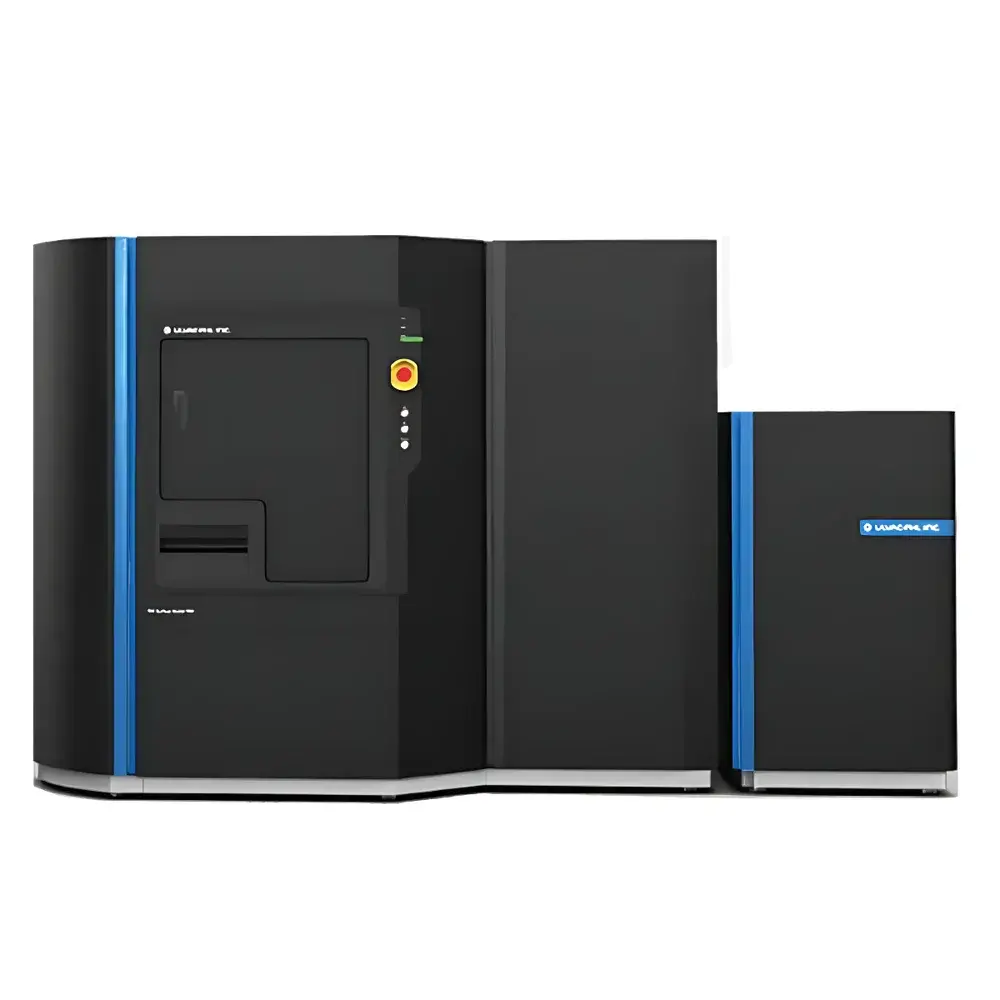
ULVAC-PHI PHI GENESIS 900 Hard X-ray Photoelectron Spectrometer (HAXPES)
| Brand | ULVAC-PHI |
|---|---|
| Origin | Japan |
| Model | PHI GENESIS 900 |
| Excitation Source | Cr Kα (5414.7 eV) |
| Probe Depth | ~30 nm |
| Spatial Resolution | <10 µm (focused beam mode) |
| Energy Resolution | <0.3 eV (at Fermi edge, pass energy 20 eV) |
| Analyzer Type | Hemispherical Deflector Analyzer (HDA) with 180° double-pass optics |
| Vacuum System | UHV base pressure <5×10⁻¹⁰ Torr |
| Automation | Fully motorized sample stage, multi-axis tilt/rotation, in-situ transfer capability |
Overview
The ULVAC-PHI PHI GENESIS 900 Hard X-ray Photoelectron Spectrometer (HAXPES) is a high-performance surface and near-surface analytical instrument engineered for non-destructive, depth-resolved electronic and chemical characterization of solid-state materials. Unlike conventional XPS systems utilizing Al Kα (1486.6 eV) or Mg Kα (1253.6 eV) sources, the PHI GENESIS 900 integrates a high-brilliance Cr Kα X-ray source (5414.7 eV), enabling photoelectron emission from deeper core levels (e.g., 2p, 3p, 3d of heavier elements) with significantly increased inelastic mean free path (IMFP). This extends the effective analysis depth to approximately 30 nm—more than twice that of standard XPS—while maintaining quantitative chemical state sensitivity and elemental specificity. The system operates under ultra-high vacuum (UHV) conditions (<5×10⁻¹⁰ Torr), ensuring surface integrity during acquisition and minimizing hydrocarbon contamination. Its hemispherical deflector analyzer (HDA) features double-pass 180° optics and variable pass energy control, delivering high energy resolution (<0.3 eV at Fermi edge, PE = 20 eV) and excellent signal-to-noise ratio even for low-cross-section transitions.
Key Features
- Fully automated PHI GENESIS platform with motorized XYZ stage, ±90° tilt, and 360° rotation for precise angular-resolved measurements and multi-point mapping.
- Integrated Cr Kα monochromated X-ray source with stable output and long-term intensity reproducibility—critical for quantitative depth profiling without sputter damage.
- High-transmission HDA with dual-stage detection and multi-channel delay-line detector for parallel kinetic energy acquisition and rapid survey scanning.
- In-situ transfer vessel compatibility for air-sensitive samples (e.g., Li-based battery cathodes, perovskite thin films, organometallics), supporting seamless integration with glovebox-connected load locks.
- Multi-technique co-localization: simultaneous or sequential acquisition of HAXPES, conventional XPS, UPS, LEIPS, AES, and Ar-GCIB depth profiling on the same analysis location.
- Advanced charge compensation via low-energy electron flood gun and adjustable ion flood source—optimized for insulating oxides, polymers, and ceramic multilayers.
Sample Compatibility & Compliance
The PHI GENESIS 900 accommodates conductive, semi-conductive, and insulating solid samples up to 25 mm in diameter and 10 mm in thickness—including wafers, cross-sectional TEM lamellae, catalyst-coated foils, QD-embedded polymer films, and all-solid-state battery stack interfaces. Its UHV architecture complies with ISO 14644-1 Class 4 cleanroom requirements for chamber integrity and particulate control. All data acquisition and processing workflows adhere to GLP/GMP principles, with full audit trail support for FDA 21 CFR Part 11–compliant environments. Instrument calibration follows ASTM E1521 (Standard Practice for Calibration of Surface Analytical Instruments) and ISO 18118 (XPS terminology and reporting guidelines), ensuring traceable quantification across laboratories.
Software & Data Management
Acquisition and analysis are managed through PHI’s proprietary MultiPak v10 software suite, which supports scripting (Python API), batch processing, spectral deconvolution using Shirley/Tougaard background models, and constrained least-squares fitting with built-in chemical shift databases (NIST XPS Database, PHI Reference Library). Raw spectra are stored in vendor-neutral VAMAS format (ISO 14976), enabling third-party interoperability with CasaXPS, IGOR Pro, and MATLAB-based analysis pipelines. The system logs full metadata—including beam parameters, analyzer settings, sample position, vacuum history, and operator ID—for full experimental reproducibility. Optional secure network deployment enables remote monitoring and centralized data archiving compliant with institutional digital lab notebook standards.
Applications
The PHI GENESIS 900 addresses critical challenges in advanced materials R&D where interface chemistry governs device performance. In solid-state batteries, it quantifies interphase evolution (e.g., LiPON/LiCoO₂) without beam-induced reduction artifacts. For GaN-on-Si power devices, HAXPES resolves buried gate oxide stoichiometry and interfacial Cr/Ni oxidation states at depths inaccessible to Al Kα. In quantum dot optoelectronics, combined XPS/HAXPES line scans across single QDs (10–50 nm) yield depth-resolved maps of Zn/S/O/C bonding gradients—enabling correlation of shell composition with photoluminescence quantum yield. Catalyst studies benefit from Cr Kα access to 3p signals of Pt, Pd, and Ru, revealing metal-support electron transfer beyond the topmost monolayer. Additional validated use cases include organic semiconductor energy-level alignment (via UPS/HAXPES cross-correlation), thermal barrier coating adhesion layer oxidation, and corrosion product stratification in aerospace alloys.
FAQ
What is the primary advantage of HAXPES over conventional XPS?
HAXPES achieves greater probing depth (~30 nm vs. ~5–10 nm for Al Kα XPS) due to higher photoelectron kinetic energy and longer inelastic mean free path—enabling non-destructive analysis of buried interfaces and multilayer stacks without ion-beam sputtering.
Can the PHI GENESIS 900 perform angle-resolved measurements?
Yes—it supports precise take-off angle variation (30° to 90°) via motorized sample tilt, facilitating escape-depth modulation for qualitative depth distribution analysis and surface sensitivity tuning.
Is the system compatible with air-sensitive battery materials?
Yes—equipped with a UHV-compatible transfer vessel and optional glovebox-integrated load lock, enabling inert-atmosphere sample loading and preservation of native SEI/CEI layers.
Does the instrument support quantitative chemical state analysis?
Yes—multi-peak fitting with reference spectra, matrix correction algorithms, and certified reference materials (e.g., NIST SRM 2051, 2052) ensure traceable quantification of oxidation states and bonding environments.
How is data integrity ensured for regulated environments?
Multi-layered security includes user authentication, electronic signatures, immutable audit trails, and 21 CFR Part 11–compliant electronic record management within MultiPak software.






