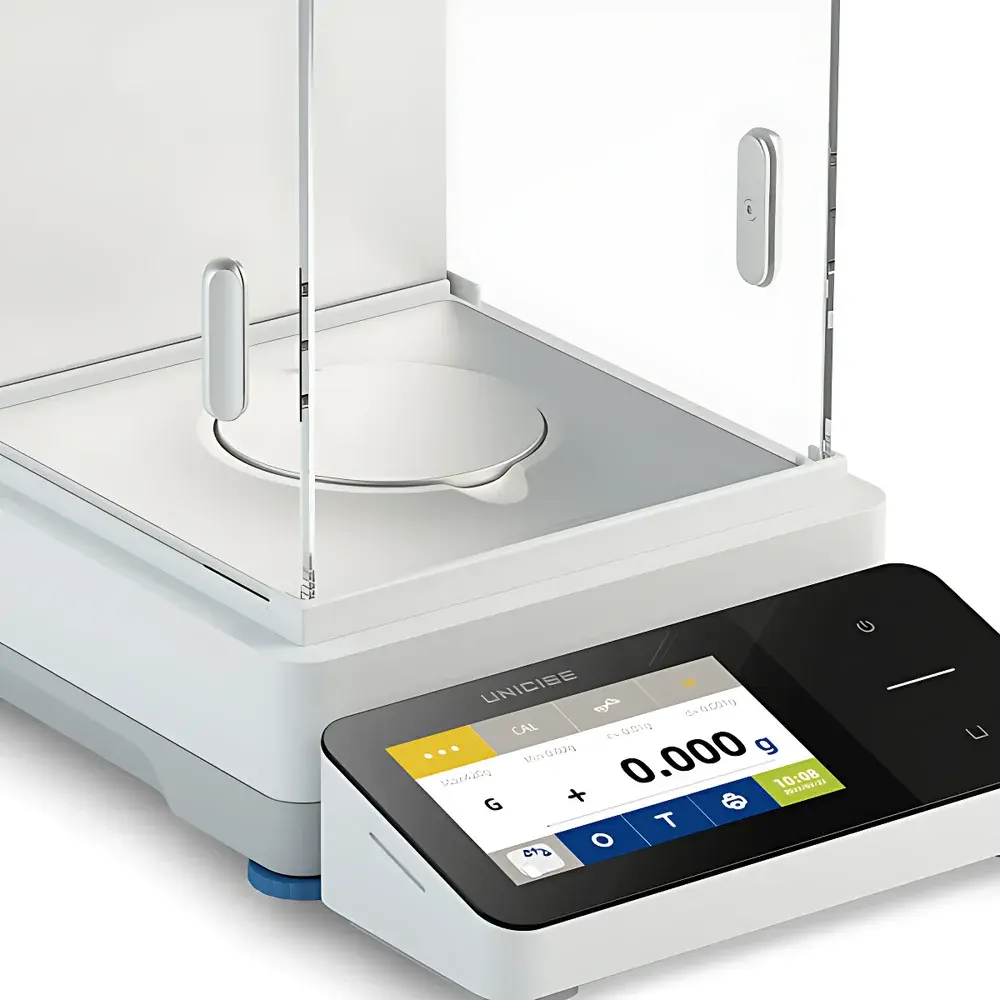
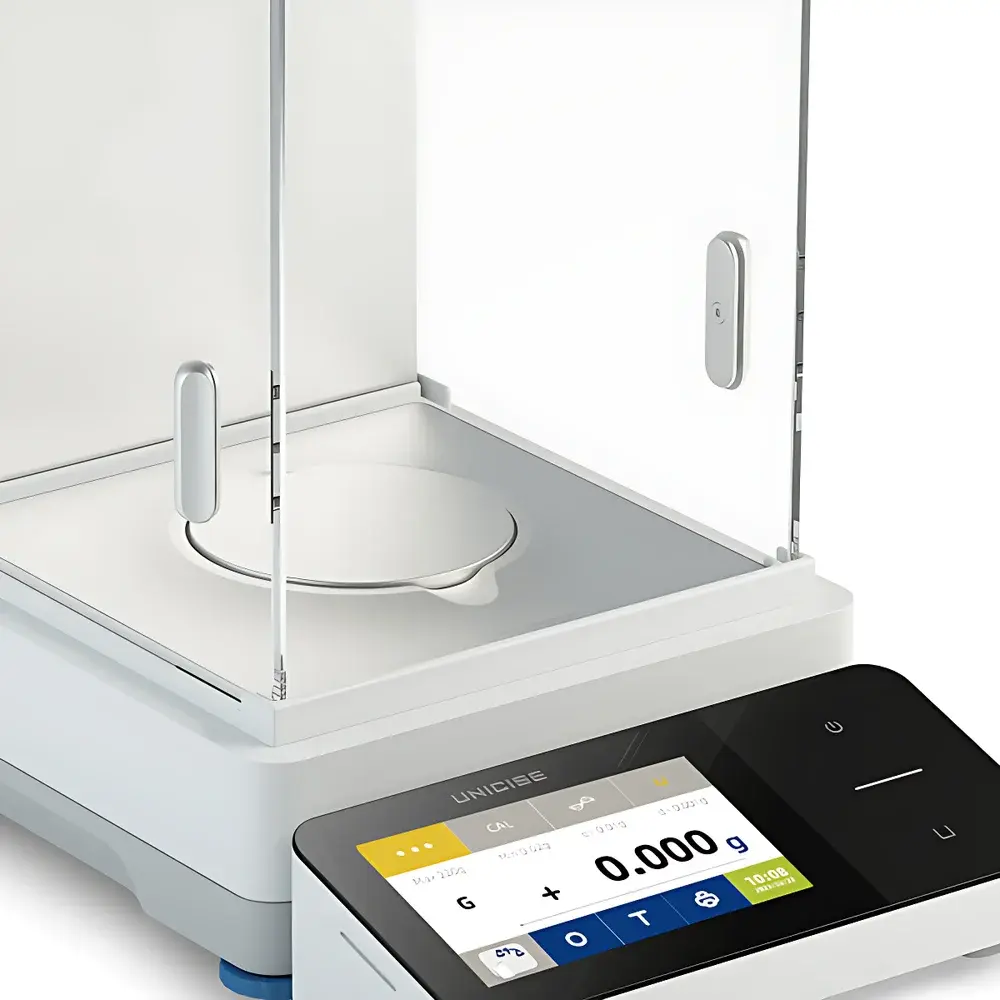
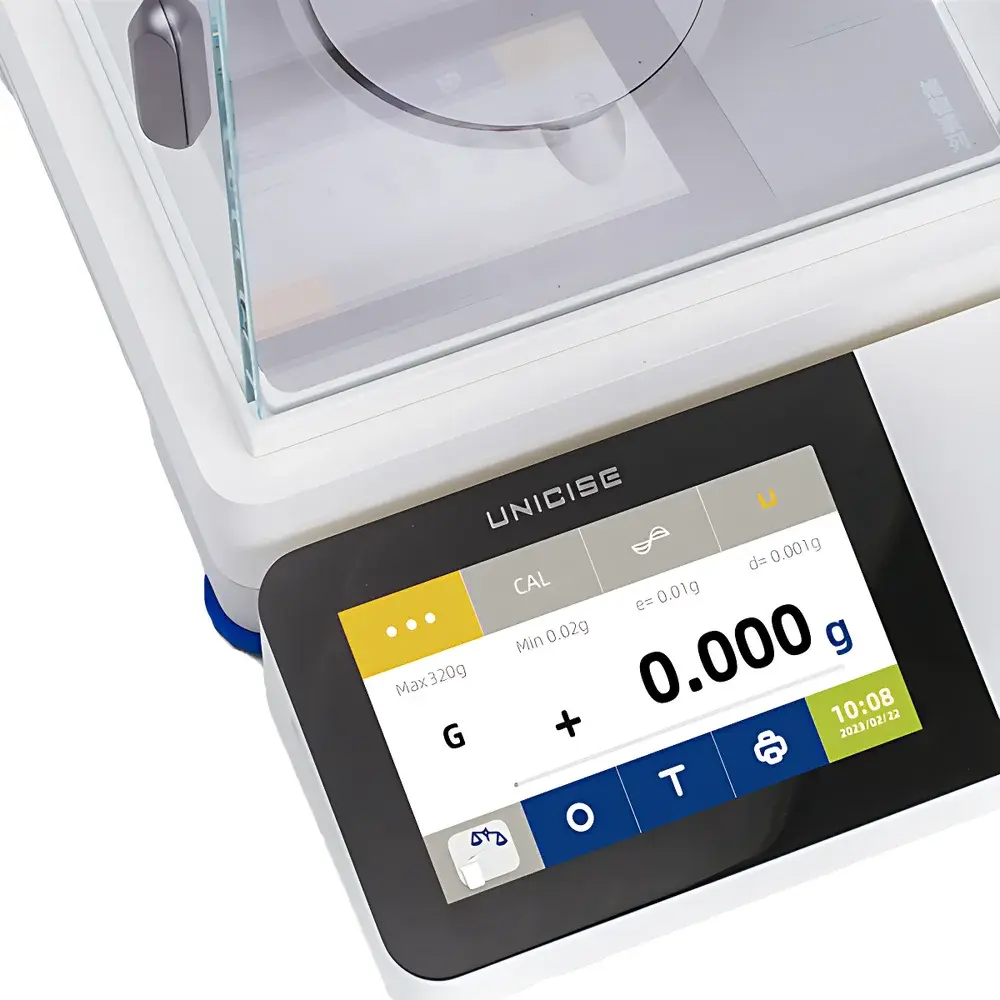
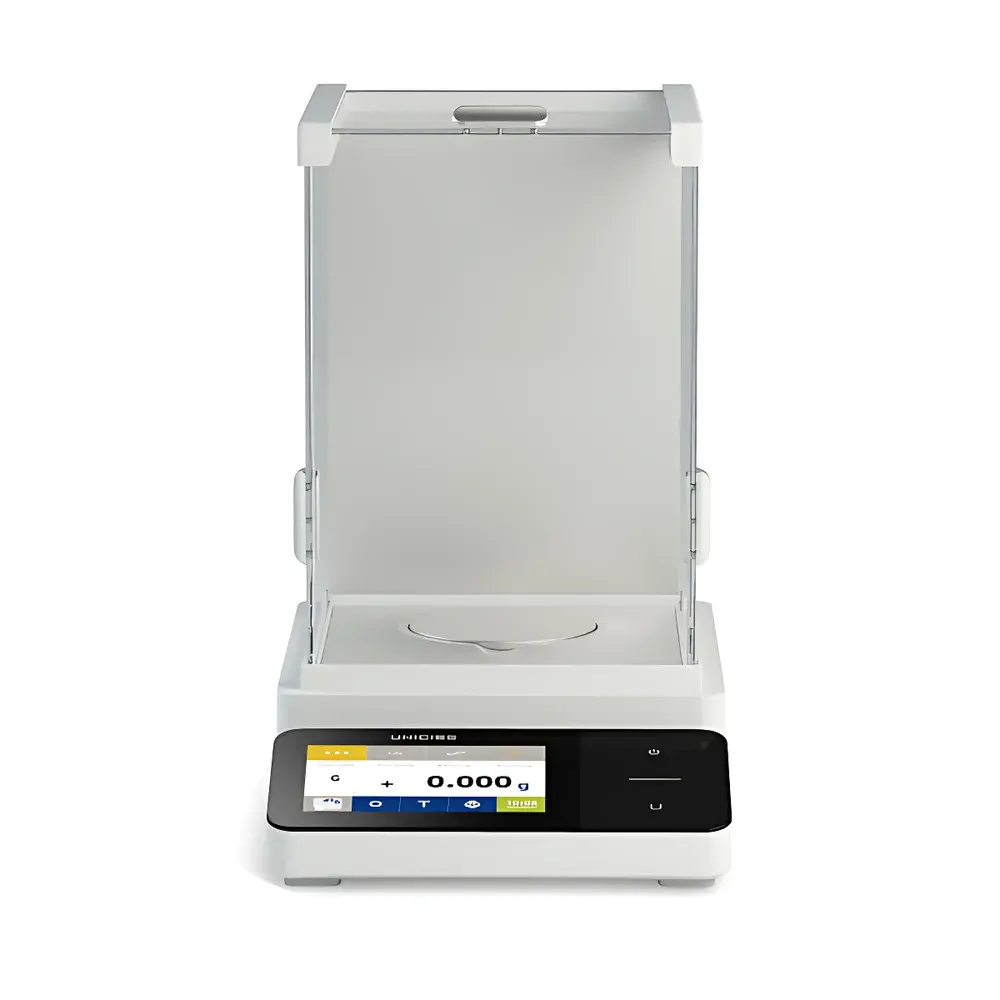
Unicise UBP Series 1 mg Precision Analytical Balance
| Brand | Unicise |
|---|---|
| Origin | Jiangsu, China |
| Manufacturer Type | Authorized Distributor |
| Product Category | Domestic |
| Models | UBP223 / UBP223-I / UBP323 / UBP323-I / UBP423 / UBP423-I / UBP523 / UBP523-I / UBP623 / UBP623-I |
| Balance Type | Precision Analytical Balance |
| Capacity Range | 220 g – 620 g |
| Readability | 1 mg |
| Repeatability (5% load) | 0.5 mg |
| Repeatability (full load) | 1 mg |
| Linearity | ±0.6 mg |
| Stabilization Time | ≤1.0 s |
| Temperature Drift Sensitivity | ±2 ppm/K (+10 °C to +30 °C) |
| Calibration | External calibration (UBP-x23) |
| Compliance | GLP/GMP-compliant data output (Device ID, Sample ID, Batch ID), audit trail (3000 entries, immutable export), user management (3-tier, up to 11 users), minimum weight warning, SBI (RS-232) and SICS protocol support |
| Connectivity | DB9 serial port + USB Type-C |
| Power | AC adapter or external power bank (5 V DC) |
| Display | Full-color capacitive touchscreen with customizable hotkeys and LED key illumination |
| Construction | 316L stainless steel pan and baseplate |
| Built-in Applications | 12 functions including weighing, formulation, statistics, component analysis, density, percentage, unit conversion, animal weighing, checkweighing, peak hold, counting, and comparative mass analysis |
Overview
The Unicise UBP Series 1 mg Precision Analytical Balance is engineered for laboratories requiring high-resolution mass measurement under variable environmental conditions. Utilizing a proprietary Uni-block electromagnetic force restoration sensor architecture, the UBP platform delivers stable 1 mg readability across capacities from 220 g to 620 g. Its core metrological performance—characterized by ≤1.0 s stabilization time, ±0.6 mg linearity, and 0.5 mg repeatability at 5% of capacity—is maintained through an integrated dynamic temperature compensation system calibrated to ±2 ppm/K over the operational range of +10 °C to +30 °C. Unlike conventional strain-gauge-based balances, the electromagnetic force restoration principle ensures inherent long-term stability, minimal hysteresis, and immunity to mechanical creep. The balance conforms to ISO/IEC 17025 metrological traceability requirements when used with NIST-traceable calibration weights and follows fundamental principles outlined in USP <41> and ASTM E898 for analytical balance qualification.
Key Features
- Uni-block monolithic electromagnetic sensor with real-time thermal drift compensation
- Modular design with detachable full-color capacitive touchscreen display and illuminated hotkey interface
- Removable ultra-clear draft shield featuring anti-static coating and volcano-profile base for optimal airflow control and particulate containment
- Electrostatic-dissipative polymer housing (surface resistivity <10⁹ Ω/sq) compliant with ANSI/ESD S20.20
- 316L stainless steel weighing pan and baseplate—certified food-grade, corrosion-resistant, and non-reactive with organic solvents and aqueous reagents
- Dual-mode calibration: guided external calibration (SBI/RS-232 protocol) or fully automated internal calibration (UBP-x23-I models), triggered by time interval or ambient temperature shift ≥0.5 °C
- Integrated battery-ready power architecture supporting 5 V DC input—enabling portable operation via certified power banks without compromising calibration integrity
Sample Compatibility & Compliance
The UBP Series accommodates diverse sample forms—including powders, granules, liquids in tared vessels, and small solid components—within standard laboratory glassware (e.g., weighing boats, vials, crucibles). Draft shield geometry minimizes convection-induced error while permitting unobstructed access during handling. All models meet GLP and GMP documentation requirements: device identity, operator ID, sample ID, batch number, timestamp, and net/gross/tare values are embeddable in every data record. The UBP-x23-I variants provide full 21 CFR Part 11 readiness through cryptographic audit trail logging (3000 entries, FIFO overwrite, CSV export with SHA-256 hash verification), three-level role-based access control (Administrator, Supervisor, User), and mandatory password enforcement for critical operations including calibration and parameter reset.
Software & Data Management
- Direct PC data transmission via RS-232 or USB virtual COM port—compatible with Microsoft Excel, LabWare LIMS, and Thermo Fisher SampleManager
- SICS and SBI protocol compliance enables seamless integration into centralized lab instrument networks without middleware
- Configurable data output format: ASCII-delimited fields with header metadata (e.g., “DEV:UBP523-I|USR:LAB-07|SAM:STD-2024-089|WT:124.5678 g|TS:2024-06-15T14:22:08Z”)
- Minimum weight alert function calculates and displays the smallest sample mass meeting required uncertainty thresholds per USP <41>, based on user-defined confidence level (k=2) and process tolerance
- On-device data review with scrollable history, statistical summary (n, mean, SD, RSD, min/max), and export-ready filtering by date range or operator ID
Applications
The UBP Series supports routine and regulated workflows across pharmaceutical QC labs (e.g., active pharmaceutical ingredient (API) assay, excipient blending verification), academic research (gravimetric synthesis, catalyst loading, stoichiometric ratio validation), environmental testing (filter weighing for PM₂.₅ analysis), and materials science (coating thickness calculation via mass loss, density determination of composites). Its 12 built-in applications—such as formulation-by-loss-on-drying, dynamic checkweighing with pass/fail limits, and multi-component mass allocation—reduce reliance on external software and minimize transcription errors. The peak-hold function captures transient mass changes during volatile solvent evaporation or reactive gas absorption experiments, while animal weighing mode compensates for low-frequency motion artifacts using adaptive digital filtering.
FAQ
What is the difference between UBP-x23 and UBP-x23-I models?
The “-I” suffix denotes internal motorized calibration capability with programmable triggers (time-based or temperature-driven), whereas standard UBP-x23 models require manual external calibration using certified weights.
Is the balance compliant with ISO/IEC 17025 for accredited testing labs?
Yes—when operated within specified environmental conditions (+10–30 °C, ≤80% RH non-condensing), calibrated using traceable standards, and documented per clause 7.8.2 of ISO/IEC 17025:2017, the UBP Series satisfies metrological traceability and uncertainty reporting requirements.
Can audit trail data be exported in a tamper-evident format?
Yes—the UBP-x23-I stores all audit events (calibration, weighing, login, configuration change) with timestamps, operator IDs, and action parameters. Exported CSV files include SHA-256 checksums and cannot be altered without detection.
Does the balance support density determination of solids?
Yes—using the built-in density application with optional density kit (not included), users can perform buoyancy-corrected measurements per ISO 1183-1, calculating density from air-weight and immersed-weight readings.
What is the recommended recalibration frequency under GxP conditions?
Per FDA guidance and internal risk assessment, daily zero-check and weekly full-range calibration are advised; however, the UBP-x23-I’s auto-calibration function may reduce manual intervention frequency if environmental stability is verified and documented.