
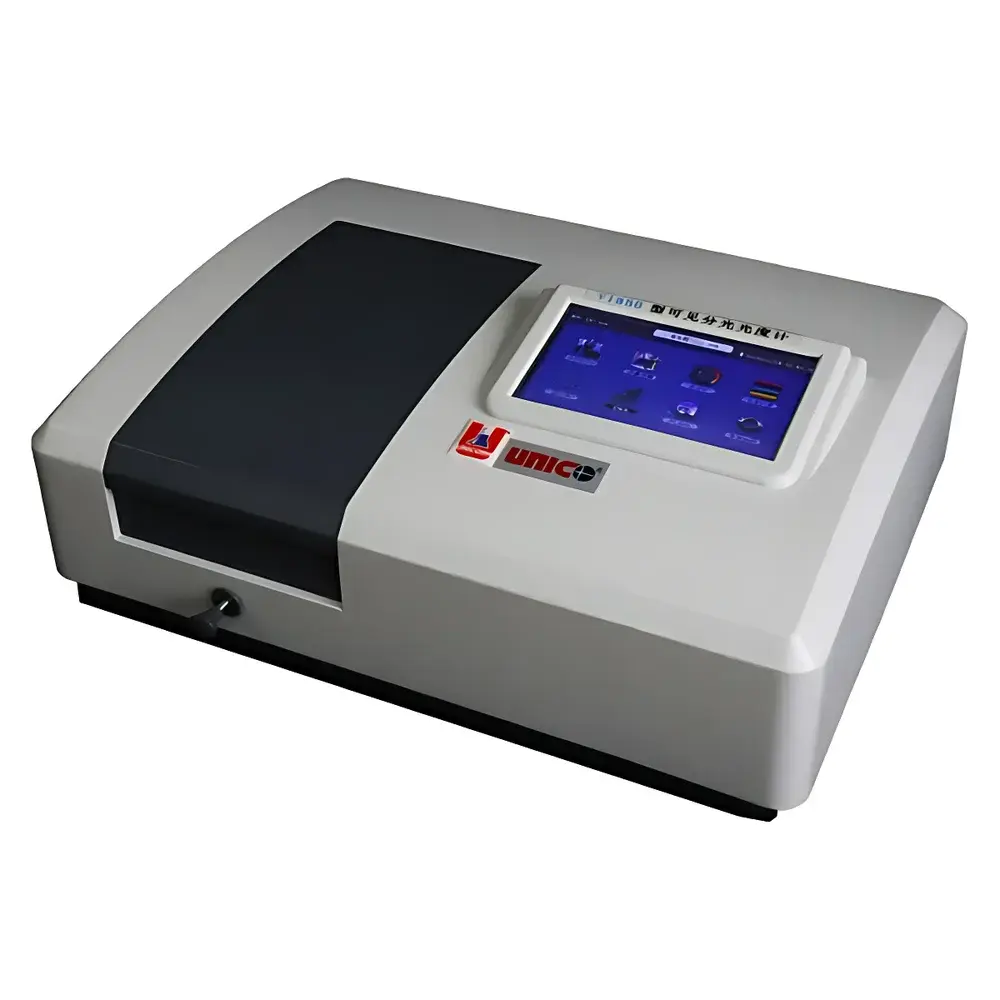
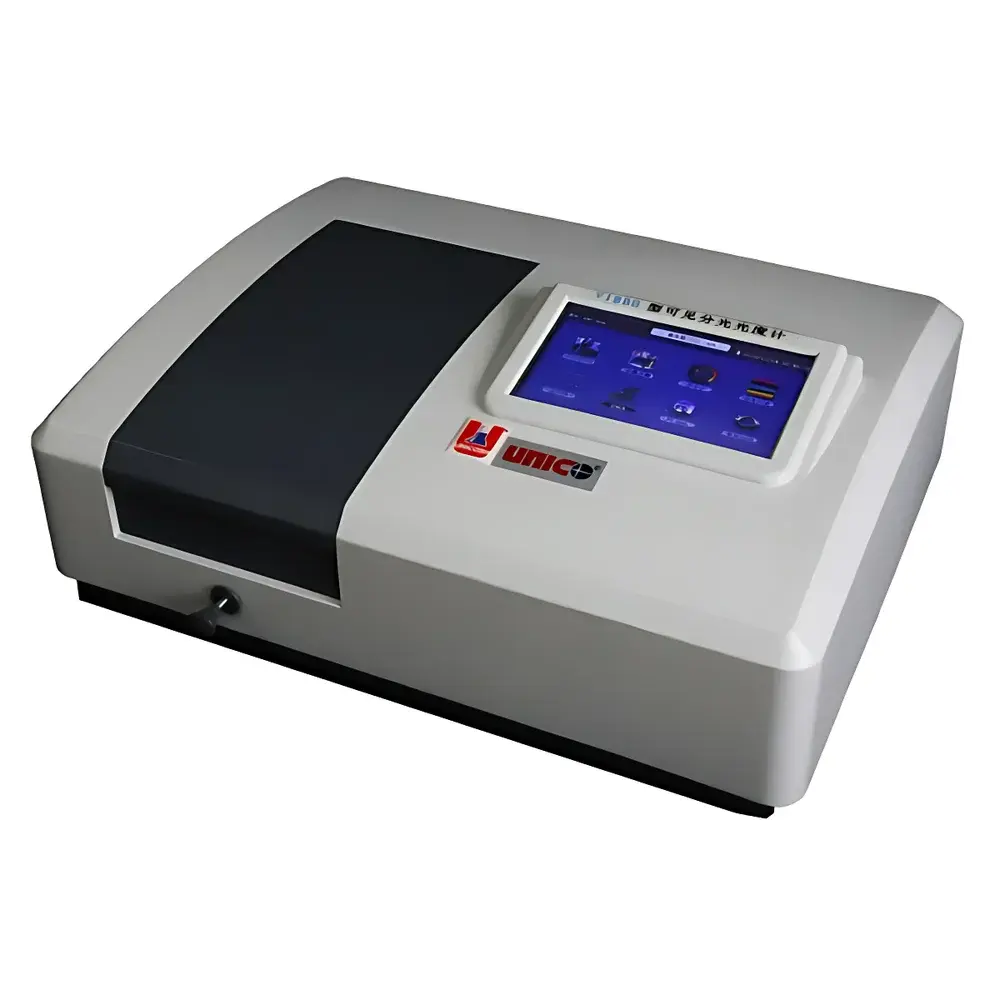
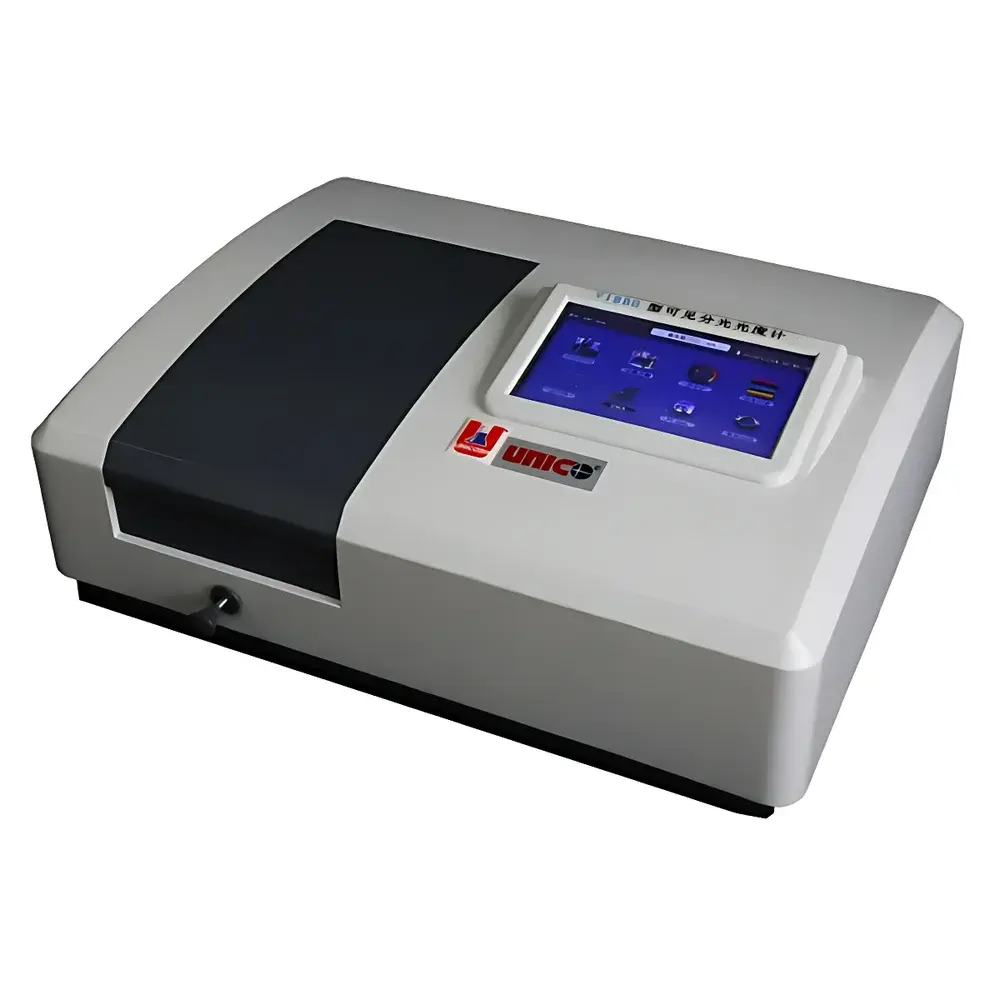
UniCo V-1860 Scanning Visible Spectrophotometer
| Brand | UniCo |
|---|---|
| Origin | Shanghai, China |
| Model | V-1860 |
| Optical System | Single-beam |
| Detector | Photodiode Array (PDA) |
| Wavelength Range | 315–1050 nm |
| Spectral Bandwidth | 2 nm |
| Wavelength Accuracy | ±0.5 nm |
| Wavelength Repeatability | ≤1 nm |
| Stray Light | ≤0.05% T |
| Wavelength Display Resolution | 0.1 nm |
| Auto-wavelength Setting | Yes |
| Data Storage | USB flash drive support |
| Connectivity | Bluetooth printing, mobile app (iOS/Android), email/QQ/WeChat sharing |
| Touch Interface | 7-inch capacitive touchscreen |
| Scan Speed | Up to 3000 nm/min (high mode) |
| Scan Interval | Adjustable from 0.1 to 5 nm |
| Kinetic Sampling Interval | Minimum 0.5 s |
| Max Duration | 9 h |
| Calibration Modes | Auto-zero (0% T) and auto-reference (100% T) |
| Curve Fitting | Linear (zero/non-zero intercept), quadratic, cubic regression |
| Data Capacity | 100 test records per method |
| Grating | 1200 lines/mm holographic diffraction grating |
Overview
The UniCo V-1860 Scanning Visible Spectrophotometer is a precision single-beam optical instrument engineered for quantitative and qualitative analysis of liquid samples in the visible and near-UV spectral region. It operates on the principle of absorbance measurement via Beer–Lambert law, utilizing a high-line-density holographic diffraction grating (1200 lines/mm) to disperse incident light and a photodiode array (PDA) detector for simultaneous multi-wavelength signal acquisition. With a wavelength coverage of 315–1050 nm and a fixed spectral bandwidth of 2 nm, the V-1860 delivers consistent resolution suitable for routine colorimetric assays, concentration determinations, and spectral profiling in regulated and research environments. Its optical architecture—optimized for stability and low stray light (<0.05% T)—ensures high photometric accuracy and reproducibility across repeated measurements.
Key Features
- Single-beam optical design with 1200 lines/mm holographic grating for enhanced spectral fidelity and long-term wavelength stability
- Photodiode array (PDA) detection system enabling rapid, noise-resistant spectral acquisition without mechanical scanning of the detector
- 7-inch capacitive touchscreen interface supporting intuitive navigation, real-time spectrum visualization, and on-device parameter configuration
- Automated optical calibration routines including automatic 0% T (dark current) and 100% T (reference beam) setting to minimize operator-induced variability
- Flexible scan control: adjustable scan interval (0.1–5 nm), three scan speed modes (low/medium/high), and programmable start/stop wavelengths
- Comprehensive kinetic mode: sampling intervals as short as 0.5 seconds over durations up to 9 hours, ideal for enzyme kinetics or reaction monitoring
- Onboard data management: internal storage for up to 100 test records per method, plus direct export via USB flash drive
- Wireless connectivity suite: Bluetooth-enabled thermal printing, cloud-agnostic data sharing via email, WeChat, and QQ, and companion iOS/Android application for remote data retrieval and instrument status monitoring
Sample Compatibility & Compliance
The V-1860 accepts standard 10 mm pathlength cuvettes (glass, quartz, or plastic) and supports both transmission and absorbance measurements in solution-phase applications. It complies with core performance benchmarks defined in ISO 6223 (spectrophotometers — terminology and general requirements) and aligns with functional expectations outlined in ASTM E275 (standard practices for describing and measuring performance of ultraviolet, visible, and near-infrared spectrophotometers). While not validated for GMP or FDA 21 CFR Part 11 environments out-of-the-box, its audit-ready data logging (timestamped records, user ID tagging via optional login extension), traceable calibration protocols, and deterministic firmware behavior make it suitable for GLP-compliant laboratories conducting environmental testing, food safety screening, pharmaceutical excipient analysis, and academic life science research.
Software & Data Management
Instrument control and data processing are fully integrated into the embedded Linux-based operating system. The touch interface hosts native applications for spectral scanning, multi-wavelength quantitation (up to 10 wavelengths per run), fixed-wavelength absorbance tracking, and time-resolved kinetic studies. Quantitative analysis includes single-point, two-point, and multi-point calibration using linear (with or without forced zero-intercept), quadratic, and cubic regression models. All curve-fitting parameters—including correlation coefficient (r²), slope, intercept, and residual plots—are displayed and stored with each dataset. Export formats include CSV and PDF; no proprietary software license or PC dependency is required for basic operation or report generation. Optional PC-based software (UniCo SpectraLink) provides advanced spectral overlay, derivative analysis, and batch report compilation for laboratory information management system (LIMS) integration.
Applications
The V-1860 serves as a foundational analytical tool across diverse sectors requiring reliable UV-Vis absorbance data. In clinical and public health laboratories, it supports hemoglobin assay standardization, bilirubin quantification, and water quality parameter testing (e.g., nitrate, phosphate, COD). Environmental labs employ it for heavy metal speciation (via complexometric colorimetry), chlorophyll-a estimation in aquatic samples, and turbidity correction. Food and beverage QA/QC teams use it for pigment concentration verification (e.g., anthocyanins, carotenoids), preservative level validation, and shelf-life stability studies. In biotechnology and academia, the instrument facilitates protein quantification (Bradford/Lowry), nucleic acid purity assessment (A260/A280), and enzyme activity profiling under controlled kinetic conditions.
FAQ
What is the minimum detectable absorbance change supported by the V-1860?
The instrument achieves an absorbance repeatability of ±0.002 A at 1.0 A (measured at 546 nm with neutral density filters), enabling precise detection of small concentration variations in optimized assay conditions.
Does the V-1860 support wavelength calibration verification with NIST-traceable standards?
Yes—users may perform wavelength accuracy verification using certified holmium oxide or didymium glass filters; the onboard calibration verification function compares measured peak positions against reference values and logs deviations.
Can the V-1860 operate without a connected computer?
Yes—the full measurement workflow—including method setup, sample analysis, calibration, curve fitting, and report export—is executable independently using the built-in touchscreen interface and internal memory.
Is the photodiode array detector cooled or thermally stabilized?
No—the PDA operates at ambient temperature; however, its low-noise analog front-end and digital signal averaging algorithms ensure stable baseline performance during extended scans.
What maintenance is recommended to preserve optical alignment and wavelength accuracy?
UniCo recommends annual verification of wavelength accuracy and photometric linearity using reference standards, along with periodic cleaning of the sample compartment optics using lint-free wipes and spectroscopic-grade methanol—no user-accessible optical realignment is required under normal operating conditions.





