
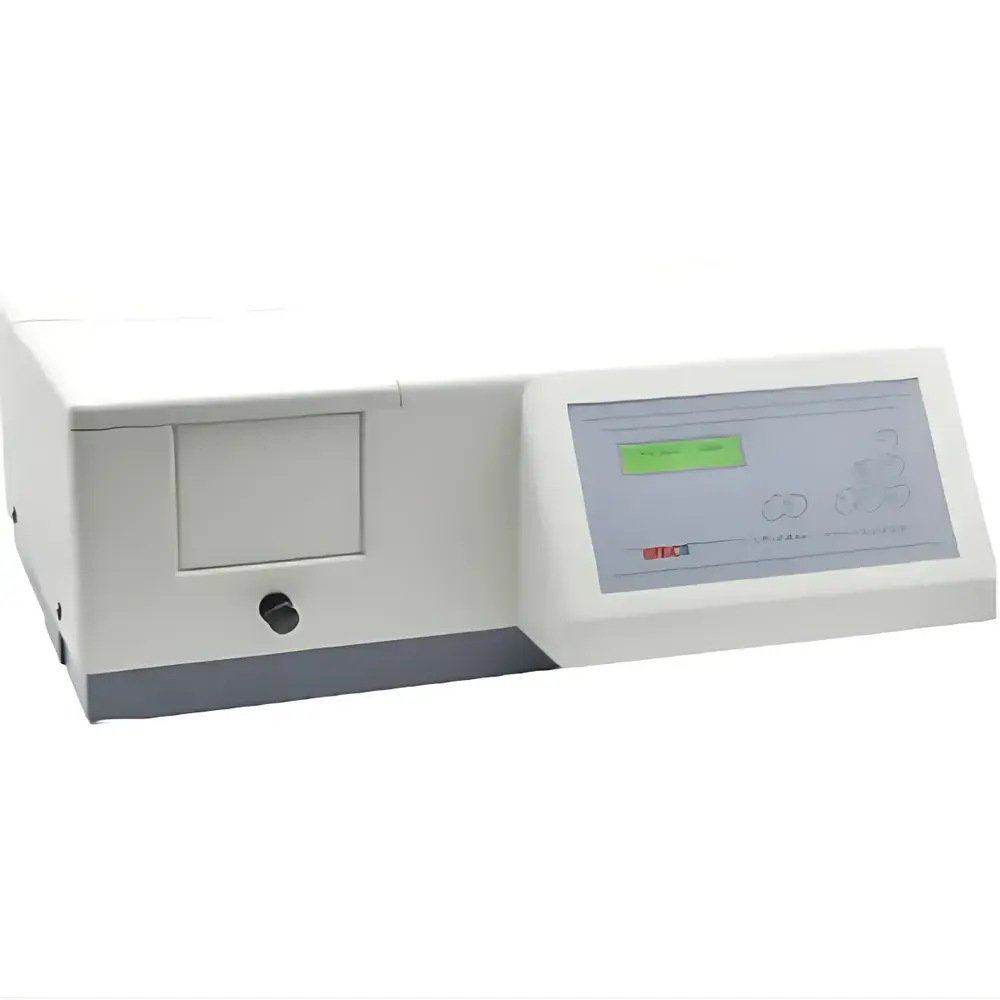
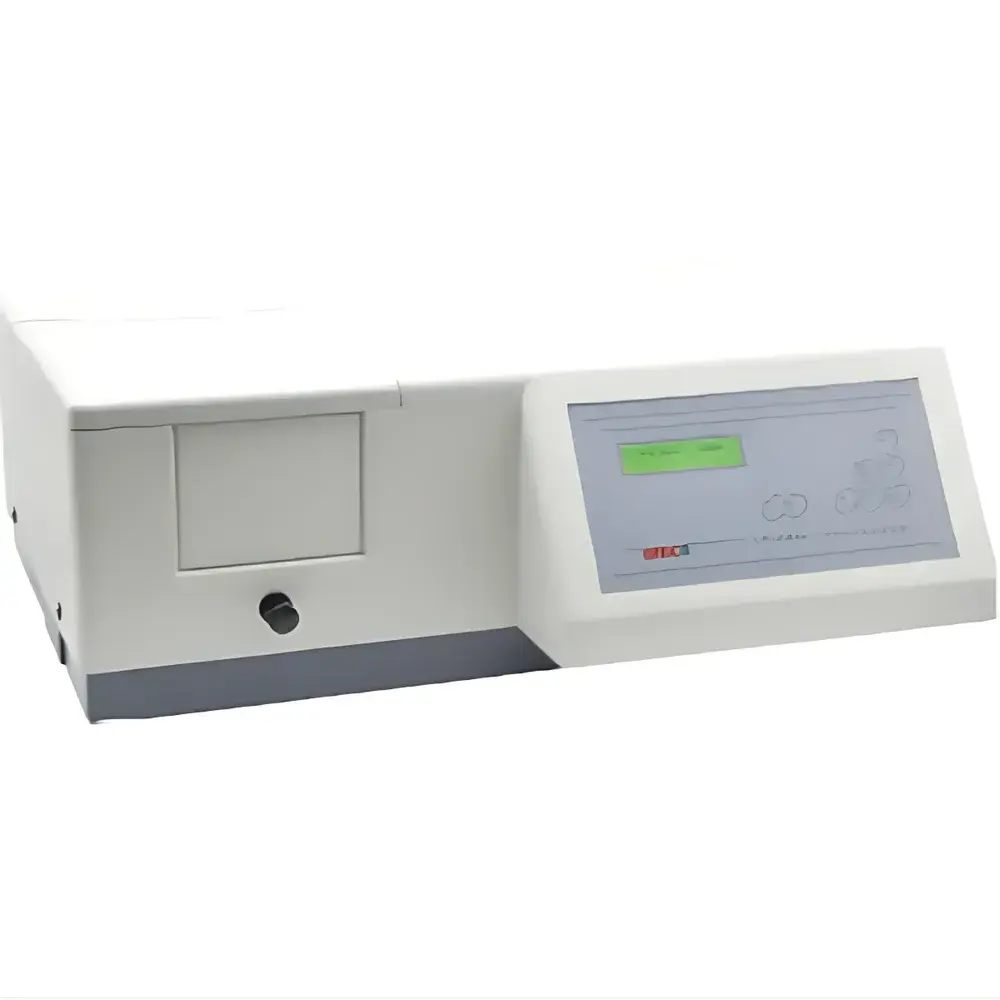
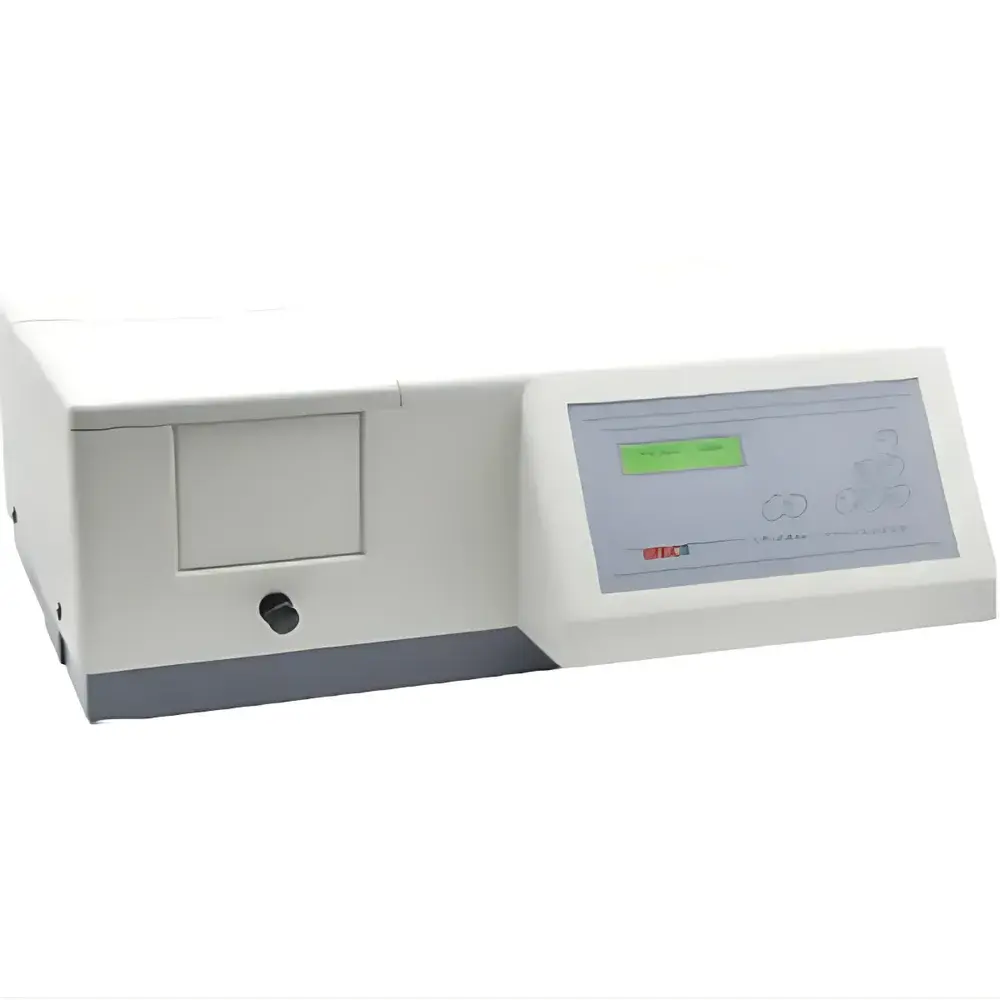
UniCo UV-2102C Single-Beam Ultraviolet-Visible Spectrophotometer
| Brand | UniCo |
|---|---|
| Origin | Shanghai, China |
| Model | UV-2102C |
| Optical System | Single-beam with 1200 lines/mm holographic grating |
| Wavelength Range | 190–1000 nm |
| Wavelength Accuracy | ±0.3 nm |
| Wavelength Repeatability | ≤0.4 nm |
| Spectral Bandwidth | 2 nm |
| Stray Light | <0.1% T at 220 nm and 340 nm |
| Photometric Range | 0–125% T, –0.097–1.999 A, 0–1999 C (0–1999 F) |
| Photometric Accuracy | ±0.3% T |
| Photometric Repeatability | ±0.3% T |
| Baseline Stability | ±0.002 A/h at 220 nm and 340 nm |
| Detector Type | Silicon photodiode |
| Wavelength Scanning Mode | Motorized automatic wavelength drive |
| Data Interface | USB port + Parallel printer port |
| Dimensions (W×D×H) | 580 × 450 × 200 mm |
| Weight | 23 kg |
Overview
The UniCo UV-2102C is a precision-engineered single-beam ultraviolet-visible (UV-Vis) spectrophotometer designed for routine quantitative and qualitative analysis in academic laboratories, quality control environments, and industrial R&D settings. Based on the principle of Beer-Lambert law absorption spectroscopy, the instrument measures sample absorbance, transmittance, or concentration across a broad spectral range from 190 nm to 1000 nm — covering deep UV, near-UV, visible, and near-infrared regions. Its optical architecture employs a high-efficiency 1200 lines/mm holographic diffraction grating and a silicon photodiode detector, ensuring stable signal acquisition and high photometric fidelity. The motor-driven automatic wavelength scanning mechanism enables reproducible spectral acquisition without manual adjustment, supporting both fixed-wavelength measurements and full-spectrum scans.
Key Features
- Single-beam optical design optimized for cost-effective, high-reliability operation in standardized analytical workflows
- Fixed 2 nm spectral bandwidth, balancing resolution and signal-to-noise ratio for general-purpose UV-Vis applications
- Wavelength accuracy of ±0.3 nm and repeatability better than 0.4 nm — compliant with ASTM E275 and ISO 6223 performance benchmarks for routine spectrophotometers
- Low stray light (<0.1% T at 220 nm and 340 nm), critical for accurate measurement of highly absorbing samples and dilute analytes in UV region
- Photometric accuracy and repeatability of ±0.3% T — suitable for pharmacopeial assays requiring trace-level quantitation (e.g., USP )
- Thermally stabilized optical bench and low-drift electronics ensure baseline stability of ±0.002 A/h, minimizing recalibration frequency during extended kinetics experiments
- Dual data output: native USB interface for direct PC connectivity and parallel port for legacy thermal printers used in regulated environments
Sample Compatibility & Compliance
The UV-2102C accommodates standard 10 mm pathlength cuvettes, including quartz (for UV measurements below 220 nm), optical glass (for visible-range work), and disposable plastic cells. It supports common solvent systems (water, methanol, ethanol, buffer solutions) and is routinely deployed in compliance-sensitive applications such as raw material identification, dissolution testing, and purity verification. While not pre-certified for 21 CFR Part 11, its hardware architecture allows integration into validated laboratory information management systems (LIMS) when paired with audit-trail-enabled third-party software. Instrument documentation and calibration records align with GLP and GMP documentation expectations for non-automated analytical instruments.
Software & Data Management
The UV-2102C operates via embedded firmware with intuitive front-panel navigation and real-time display of absorbance, transmittance, and concentration values. Optional PC-based software (sold separately) provides advanced functionality including kinetic time-scan profiling, multi-point standard curve generation (linear, quadratic, and polynomial regression), and export of spectral data in CSV or ASCII format for downstream statistical analysis in tools such as OriginLab or JMP. All measurement parameters — date/time stamp, operator ID (manually entered), wavelength setting, and cell position — are logged locally and transferable via USB mass storage mode, facilitating traceability in ISO/IEC 17025-accredited laboratories.
Applications
- Quantitative determination of nucleic acids and proteins using A260/A280 ratios
- Colorimetric enzyme assays (e.g., ELISA, LDH, ALP) requiring precise endpoint or kinetic absorbance monitoring
- Pharmaceutical content uniformity testing per USP general chapters and
- Water quality analysis (e.g., nitrate, phosphate, COD estimation via colorimetric methods)
- Quality assurance of dyes, pigments, and food additives through spectral fingerprinting and concentration verification
- Teaching laboratories for fundamental spectroscopy principles, including Beer’s law validation and spectral deconvolution exercises
FAQ
What cuvette types are supported?
Standard 10 mm square cuvettes made of quartz (for UV), optical glass (for visible), or polystyrene (for non-UV applications) are compatible. Quartz cuvettes are required for measurements below 220 nm.
Does the UV-2102C support GLP-compliant data archiving?
The instrument itself does not include electronic signature or audit trail features; however, its USB data export and timestamped measurement logs enable integration into externally validated GLP/GMP workflows when combined with compliant LIMS or spreadsheet-based tracking protocols.
Can it perform kinetic measurements over time?
Yes — the built-in time-scan function allows continuous absorbance monitoring at a fixed wavelength for up to 9999 seconds, with programmable sampling intervals from 0.1 s to 60 s.
Is wavelength calibration traceable to NIST standards?
Factory calibration uses holmium oxide and didymium filters traceable to national metrology institutes. Users may perform periodic verification using certified reference materials such as NIST SRM 2034 (UV-Vis transmission standard).
What maintenance is required for long-term photometric stability?
Annual optical alignment verification and detector dark-current calibration are recommended. The lamp (deuterium for UV, tungsten-halogen for visible) has a typical lifetime of 1000–2000 hours and should be replaced based on intensity decay monitoring.




