
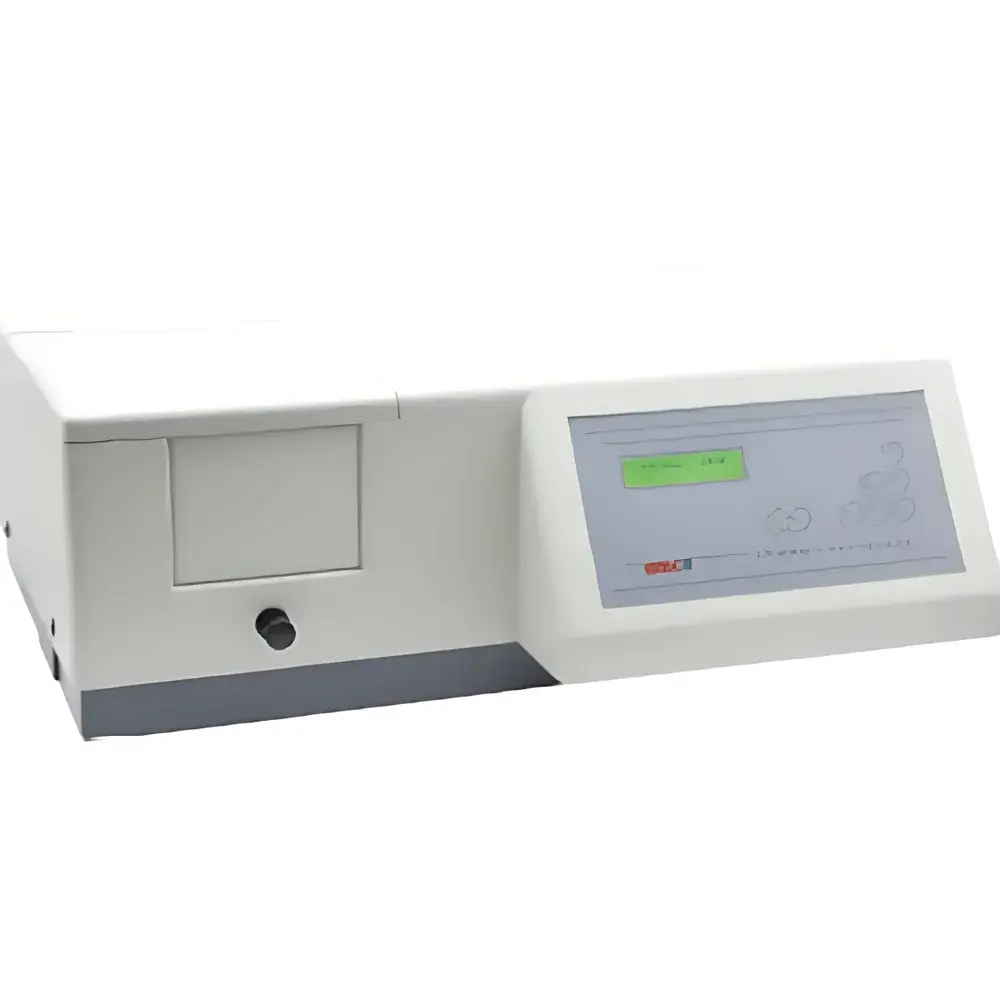
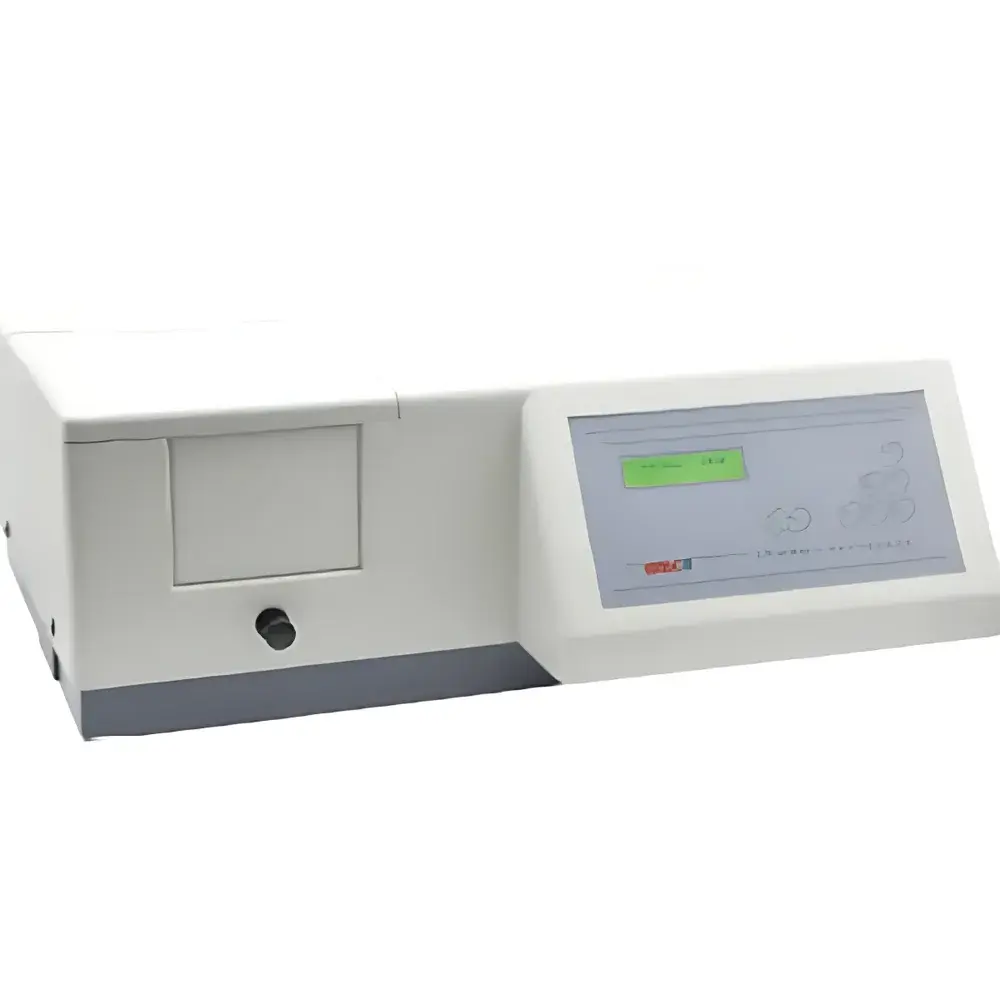
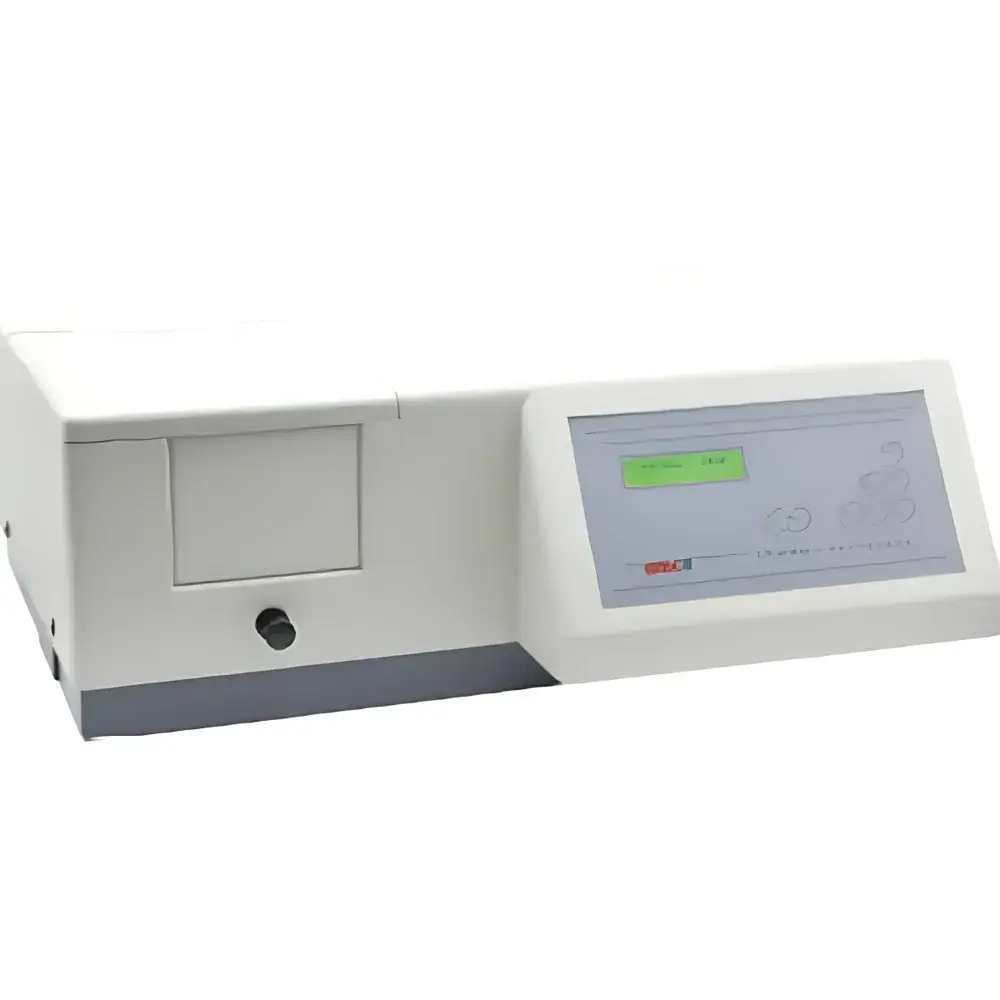
UniCo UV-2102PCS Single-Beam Ultraviolet-Visible Spectrophotometer
| Brand | UniCo |
|---|---|
| Origin | Shanghai, China |
| Model | UV-2102PCS |
| Optical System | Single-beam with 1200 lines/mm holographic grating |
| Wavelength Range | 190–1000 nm |
| Wavelength Accuracy | ±0.3 nm |
| Wavelength Repeatability | ≤0.2 nm |
| Spectral Bandwidth | 0.5, 1, 2, and 4 nm (selectable) |
| Stray Light | <0.1% T at 220 nm and 340 nm |
| Photometric Range | 0–125% T, –0.097–1.999 A, 0–1999 C (or F) |
| Photometric Accuracy | ±0.3% T |
| Photometric Repeatability | ±0.3% T |
| Baseline Flatness | ±0.005 A |
| Drift | ±0.002 A/h at 220 nm and 340 nm |
| Detector Type | Silicon photodiode |
| Wavelength Scanning Mode | Automatic |
| Interface | USB port for PC connectivity |
| Dimensions (W×D×H) | 580 × 450 × 200 mm |
| Weight | 24 kg |
Overview
The UniCo UV-2102PCS is a precision-engineered single-beam ultraviolet-visible (UV-Vis) spectrophotometer designed for routine and research-grade quantitative and qualitative analysis in academic, pharmaceutical, environmental, and industrial laboratories. It operates on the principle of Beer-Lambert law-based absorbance measurement, utilizing a holographic grating monochromator (1200 lines/mm) to resolve spectral features across a broad optical range from 190 nm to 1000 nm—encompassing deep UV, near-UV, visible, and near-infrared regions. Its single-beam architecture ensures mechanical simplicity and thermal stability, while programmable wavelength scanning and automated calibration routines support reproducible data acquisition under controlled conditions. The instrument meets foundational performance criteria aligned with ISO 9022-10 (optical instruments — environmental testing) and supports method validation workflows consistent with USP and ASTM E275 for spectrophotometric instrumentation.
Key Features
- Four selectable spectral bandwidths (0.5, 1, 2, and 4 nm) to balance resolution and signal-to-noise ratio based on sample matrix complexity and analyte absorption profile.
- High-wavelength accuracy (±0.3 nm) and exceptional repeatability (≤0.2 nm), verified via traceable holmium oxide and didymium glass filters per NIST SRM protocols.
- Low stray light (<0.1% T at 220 nm and 340 nm), critical for accurate quantitation of highly absorbing samples and high-dynamic-range assays such as nucleic acid purity assessment (A260/A280).
- Stable photometric baseline (±0.005 A) and low drift (±0.002 A/h), enabling extended kinetic measurements and multi-hour batch analyses without recalibration.
- Integrated silicon photodiode detector with linear response across the full photometric scale (–0.097 to 1.999 A), supporting both transmission (0–125% T) and concentration (0–1999 C/F) readouts.
- USB and parallel interfaces facilitate seamless integration into laboratory networks, supporting audit-ready data export and peripheral device control (e.g., thermal printers, autosamplers).
Sample Compatibility & Compliance
The UV-2102PCS accommodates standard 10-mm pathlength cuvettes—including quartz (for UV transparency down to 190 nm), optical glass (visible range only), and optional plastic or disposable variants—via its fixed cuvette holder. It complies with general safety and electromagnetic compatibility requirements outlined in IEC 61010-1 for electrical equipment used in laboratory environments. While not pre-certified for GMP or GLP environments, its software architecture supports user-defined method templates, electronic signature-capable operation (when paired with compliant PC-based software), and full audit trail generation—enabling alignment with FDA 21 CFR Part 11 requirements when deployed with validated third-party LIMS or ELN platforms.
Software & Data Management
Bundled application software provides intuitive graphical interface control for all core functions: spectrum scanning, time-based kinetics, multi-wavelength quantitation, standard curve generation (linear, quadratic, cubic, and non-linear fitting), and DNA/RNA analysis (A260/A280, A260/A230 ratios). Raw spectral data are exported in CSV and ASCII formats compatible with Origin, MATLAB, and Excel. The software logs operator ID, timestamp, instrument parameters, and measurement metadata—supporting traceability and retrospective review. Firmware updates are delivered via USB drive, ensuring long-term maintainability without hardware modification.
Applications
- Quantitative determination of organic and inorganic compounds in water, wastewater, and process streams per EPA Method 4500-NO₂⁻ and ISO 10566.
- Enzyme kinetics and protein-ligand binding studies using time-scan mode with configurable sampling intervals (0.1–60 s).
- Pharmaceutical assay validation and excipient interference screening in accordance with ICH Q2(R2) guidelines.
- Nucleic acid quantification and purity assessment (e.g., dsDNA, ssDNA, RNA) using built-in DNA calculation modules calibrated against λ-DNA standards.
- Educational laboratory instruction for fundamental spectroscopy principles, including Lambert-Beer law verification, bandgap estimation of semiconductors, and colorimetric ion detection.
FAQ
What cuvette types are supported?
Standard 10-mm square cuvettes made of quartz (UV-compatible), optical glass (≥340 nm), or polystyrene (visible-only applications) can be used. Quartz cuvettes are required for measurements below 340 nm.
Is the instrument compliant with FDA 21 CFR Part 11?
The hardware and bundled software do not include built-in electronic signatures or audit trail encryption; however, full compliance is achievable when integrated with validated third-party laboratory information management systems (LIMS) or electronic lab notebooks (ELN) that enforce user authentication, change control, and data integrity protocols.
Can the UV-2102PCS perform kinetic measurements over extended durations?
Yes—its thermal stabilization design and low baseline drift (±0.002 A/h) enable reliable time-scan experiments lasting up to 2 hours without manual intervention or recalibration.
How is wavelength accuracy verified during routine use?
Users may validate wavelength accuracy using NIST-traceable reference standards such as holmium oxide solution (peaks at 241.5, 279.4, 287.5, 333.7, 360.9, 418.5, 460.0, 485.8, 536.2 nm) or didymium glass filters, following procedures described in ASTM E275.
What maintenance is required for long-term photometric stability?
Annual verification of lamp output intensity, grating alignment, and detector linearity is recommended. Cleaning of optical surfaces with spectroscopic-grade methanol and lint-free wipes should be performed only when contamination is visually confirmed or signal noise increases significantly.





