
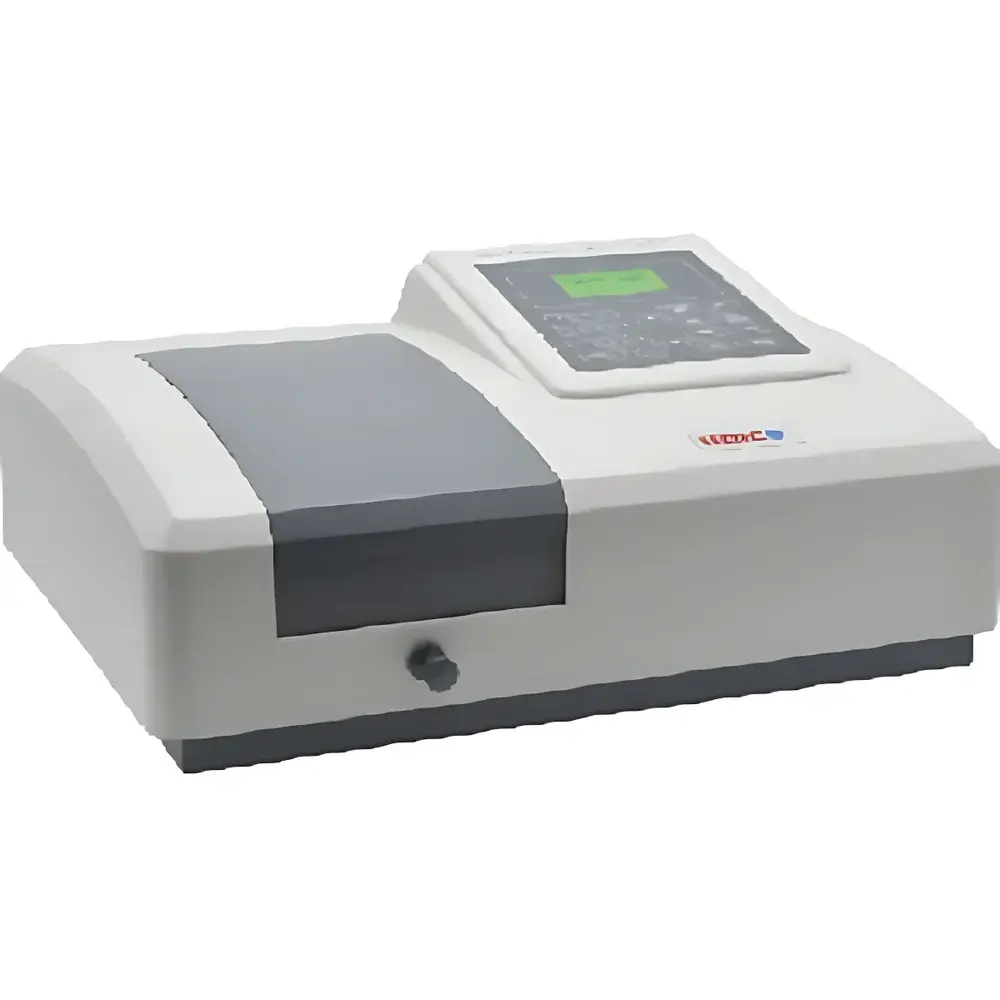
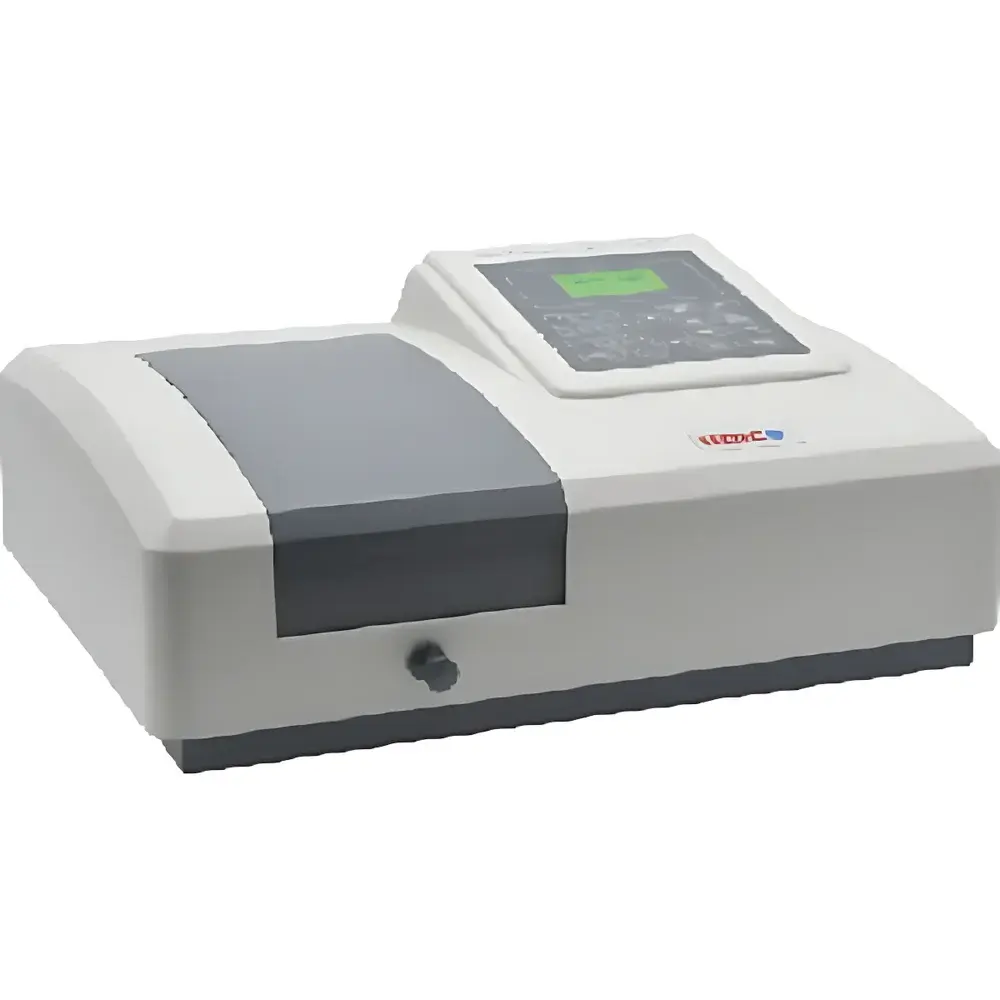
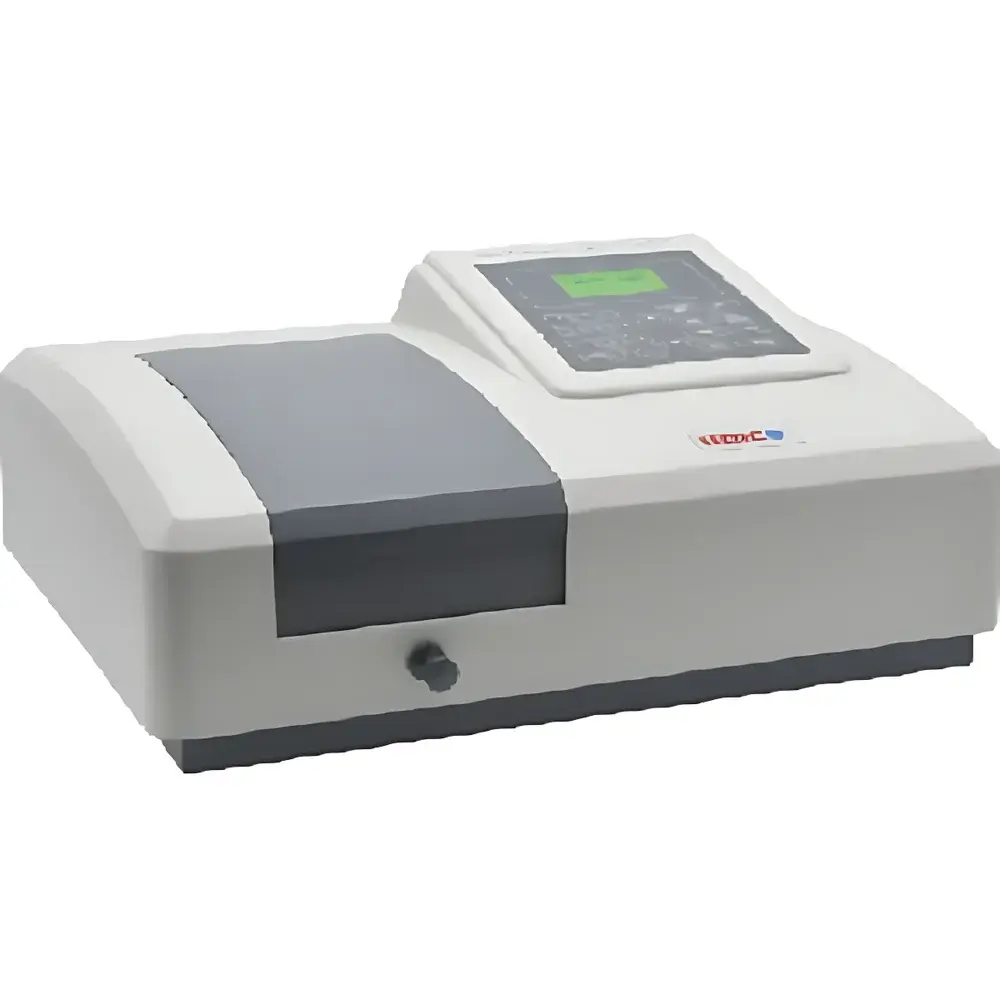
UniCo UV-2150 Single-Beam Ultraviolet-Visible Spectrophotometer
| Brand | UniCo |
|---|---|
| Origin | Shanghai, China |
| Model | UV-2150 |
| Optical System | Single-beam with 1200 lines/mm diffraction grating |
| Wavelength Range | 190–1100 nm |
| Spectral Bandwidth | 2 nm |
| Wavelength Accuracy | ±2 nm |
| Wavelength Repeatability | ±1 nm |
| Stray Light | ≤0.2% T at 360 nm |
| Photometric Accuracy | ±0.002 Abs (0–0.5 Abs), ±0.005 Abs (0.5–1.0 Abs), ±0.3% T |
| Photometric Repeatability | ±0.001 Abs (0–0.5 Abs), ±0.002 Abs (0.5–1.0 Abs), ±0.2% T |
| Photometric Range | 0–200% T, –0.3 to 3.0 A, 0–9999 C (or F) |
| Baseline Stability | ±0.002 A/h at 500 nm (after warm-up) |
| Display | 126 × 64 dot-matrix graphical LCD |
| Wavelength Resolution | 1 nm |
| Detector Type | Silicon photodiode |
| Interface | USB and Centronics parallel port |
| Dimensions (W×D×H) | 485 × 365 × 220 mm |
| Weight | 14 kg |
Overview
The UniCo UV-2150 is a single-beam ultraviolet-visible (UV-Vis) spectrophotometer engineered for routine quantitative analysis in academic laboratories, quality control environments, and industrial R&D settings. It operates on the principle of Beer–Lambert law-based absorbance measurement, utilizing a fixed 1200 lines/mm diffraction grating monochromator to isolate discrete wavelengths across a broad spectral range from 190 nm to 1100 nm. Its optical architecture—comprising a tungsten-halogen lamp for visible/NIR and a deuterium lamp for UV emission—ensures stable, continuous spectral coverage without manual lamp switching. The instrument employs a silicon photodiode detector, offering high signal-to-noise ratio and long-term responsivity stability. Designed for reproducibility in regulated workflows, the UV-2150 delivers calibrated photometric accuracy compliant with ISO 9001-aligned manufacturing practices and supports traceable operation under GLP and basic GMP documentation requirements.
Key Features
- Single-beam optical path with optimized stray light suppression (≤0.2% T at 360 nm), ensuring reliable baseline integrity for low-absorbance measurements.
- Automated wavelength scanning and zero/100% transmittance calibration—reducing operator-induced variability and accelerating method setup.
- High-resolution 126 × 64 dot-matrix graphical LCD display with intuitive menu navigation and real-time spectral preview.
- Onboard memory capable of storing up to 200 user-defined methods—including standard curve templates, concentration calculations (C mode), and kinetic protocols.
- Integrated USB and Centronics parallel interfaces for direct data export to external PCs or thermal printers—enabling seamless integration into laboratory information management systems (LIMS).
- Robust mechanical design (14 kg mass, vibration-damped chassis) suitable for shared lab spaces and production-floor deployment.
Sample Compatibility & Compliance
The UV-2150 accommodates standard 10 mm pathlength cuvettes—including supplied glass (for visible-range work) and quartz (for UV applications down to 190 nm). Its sample compartment is compatible with optional accessories such as variable-pathlength cells, micro-volume adapters, and temperature-controlled holders (sold separately). While not certified to ASTM E275 or ISO 6223-1 as a Class I reference instrument, its performance specifications align with typical acceptance criteria for routine UV-Vis instrumentation used in pharmaceutical excipient testing (USP <857>), water quality analysis (APHA Standard Methods 4500-UV), and dye concentration validation per ISO 105-X12. All firmware and hardware configurations support audit-ready operation, including timestamped method logs and non-editable raw data storage.
Software & Data Management
The UV-2150 operates autonomously via embedded firmware but also supports PC-based control through optional UniCo SpectraLink software (Windows-compatible). This application enables advanced spectral processing—including peak identification, derivative spectroscopy, multi-component analysis using simultaneous equations, and compliance reporting with customizable metadata fields. Data files are exported in CSV and ASCII formats, preserving wavelength-absorbance pairs with full precision. Instrument logs retain calibration history, lamp usage hours, and error codes—facilitating preventive maintenance scheduling and FDA 21 CFR Part 11 readiness when paired with institutional electronic signature policies and secure network storage.
Applications
- Quantitative determination of nucleic acid and protein concentrations (e.g., A260/A280 ratios) in molecular biology labs.
- Colorimetric assays in clinical chemistry, including glucose, cholesterol, and creatinine using standardized reagent kits.
- Quality assurance of dyes, pigments, and UV absorbers in polymer and cosmetic formulations.
- Monitoring reaction kinetics in catalysis studies and enzyme activity assays (e.g., NADH oxidation at 340 nm).
- Verification of solvent purity and detection of organic contaminants in HPLC mobile phase preparation.
- Educational instruction in analytical chemistry curricula—leveraging its tactile interface and transparent parameter mapping for pedagogical clarity.
FAQ
Does the UV-2150 support dual-beam functionality?
No. The UV-2150 uses a single-beam optical design. Reference measurements require sequential acquisition—first blank, then sample—making it suitable for stable samples but less ideal for time-sensitive or thermally unstable systems.
Can quartz cuvettes be used below 200 nm?
Yes. The supplied quartz cuvette enables transmission measurements from 190 nm onward, provided the cell windows are free of scratches and solvent residues.
Is wavelength calibration traceable to NIST standards?
The factory calibration is performed using holmium oxide and didymium filters. Users may perform verification checks against NIST-traceable standards; however, field recalibration requires authorized service personnel.
What is the warm-up time required before photometric stability is achieved?
A minimum 30-minute warm-up period is recommended prior to critical measurements. Baseline drift is specified at ±0.002 A/h at 500 nm after stabilization.
Is the instrument compatible with LIMS integration?
Yes—via USB or Centronics output. Raw absorbance and transmittance values can be streamed directly to third-party LIMS platforms supporting ASCII ingestion protocols, with optional SpectraLink middleware for enhanced metadata tagging.



