
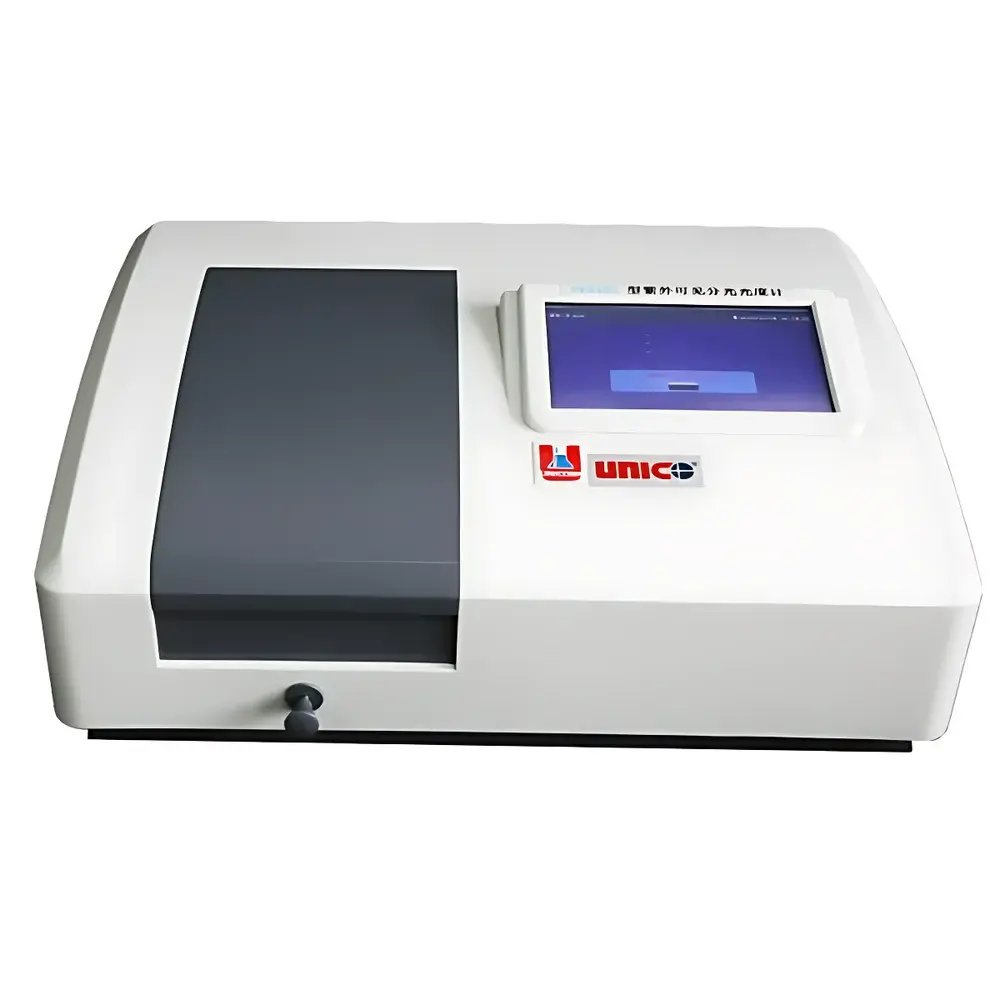
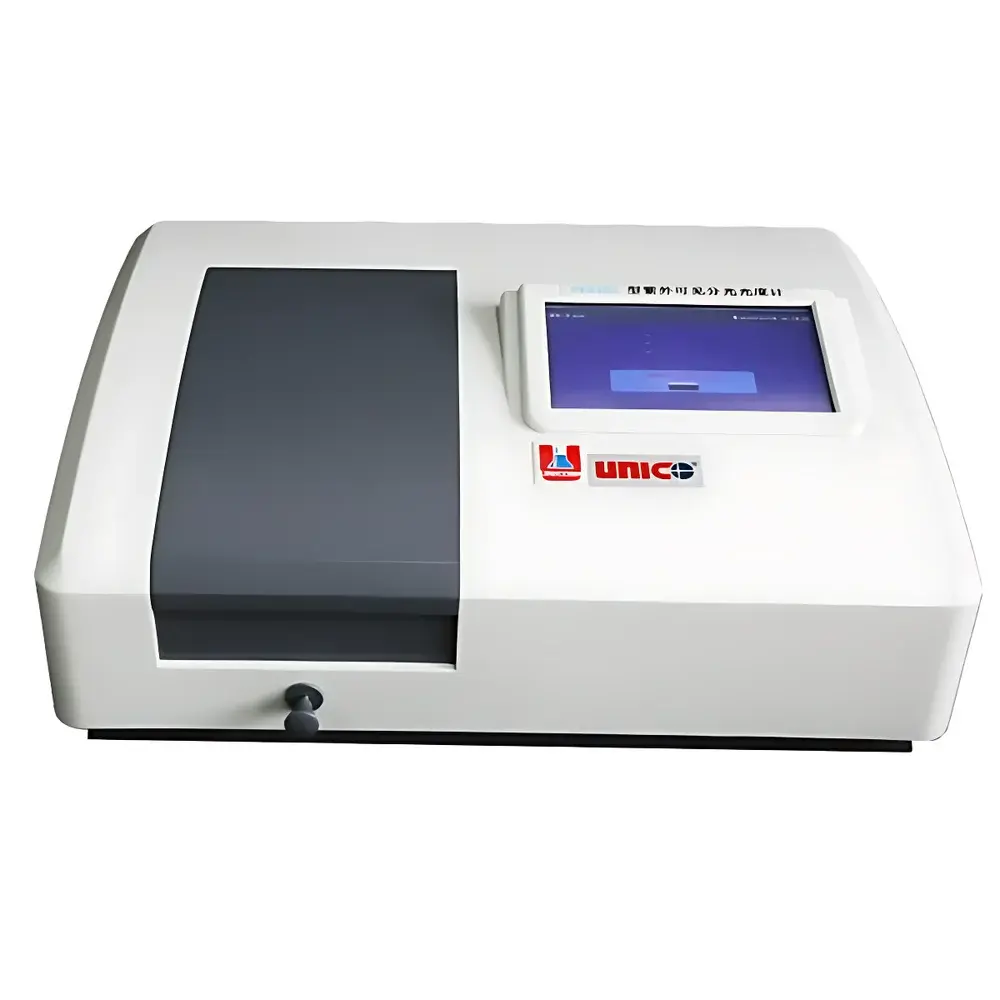
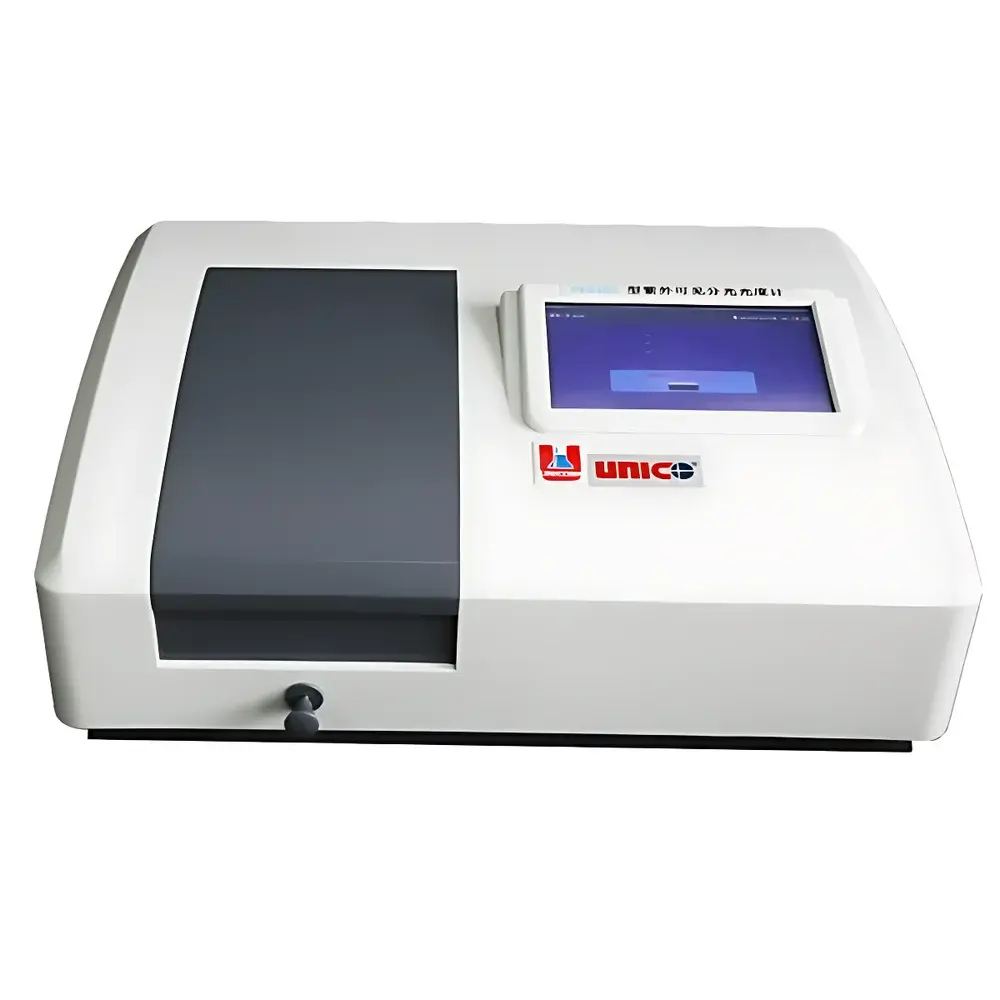
UniCo UV-2355 Ultraviolet-Visible Spectrophotometer
| Brand | UniCo |
|---|---|
| Origin | Shanghai, China |
| Instrument Type | Single-Beam |
| Detector | Silicon Photocell |
| Wavelength Range | 190–1100 nm |
| Wavelength Accuracy | ±0.8 nm |
| Wavelength Repeatability | ±0.2 nm |
| Spectral Bandwidth | 2 nm |
| Stray Light | ≤0.05% T |
| Display | 7-inch capacitive touchscreen (0.1 nm wavelength resolution) |
| Dimensions | 485 × 365 × 220 mm |
| Weight | 14 kg |
| Data Storage | Internal memory for up to 100 measurement files per method and 200 user-defined methods |
| Connectivity | USB port, Bluetooth printing support, mobile app integration (iOS/Android), cloud-ready data export via email/QQ/WeChat |
Overview
The UniCo UV-2355 is a single-beam ultraviolet-visible (UV-Vis) spectrophotometer engineered for precision routine analysis in academic, industrial, and quality control laboratories. It operates on the principle of absorbance measurement based on the Beer–Lambert law, utilizing a 1200-line/mm holographic diffraction grating optical system to deliver high-resolution spectral data across a broad wavelength range from 190 nm to 1100 nm. Designed for robustness and operational simplicity, the instrument integrates a 7-inch high-resolution capacitive touchscreen interface—eliminating dependency on external PCs for basic operation—and supports full-spectrum scanning, quantitative analysis, kinetics studies, and multi-wavelength measurements without hardware modification. Its optical architecture ensures stable baseline performance (±0.002 A), wide photometric range (–4.000 to +4.000 A), and low stray light (<0.05% T at 220 nm and 340 nm), meeting essential requirements for regulatory-compliant assays in environmental monitoring, food safety, pharmaceutical QC, and life sciences applications.
Key Features
- Single-beam optical design with optimized thermal and mechanical stability for consistent long-term performance
- 1200 lines/mm holographic grating delivering 2 nm spectral bandwidth and <0.05% T stray light specification
- Wavelength accuracy of ±0.8 nm and repeatability of ±0.2 nm—validated per ISO 8579-1 and ASTM E275 guidelines
- 7-inch full-color capacitive touchscreen with intuitive graphical UI; real-time spectrum display, peak/valley detection, and on-device curve fitting (1st–3rd order)
- Flexible scanning modes: adjustable scan step (0.1–5.0 nm), three scan speeds (up to 3000 nm/min), and automatic peak search with wavelength labeling
- Kinetic mode with minimum sampling interval of 0.5 seconds and maximum duration of 9 hours—suitable for enzyme activity or reaction rate profiling
- Multi-wavelength mode supporting up to 10 user-defined wavelengths per assay sequence
- Integrated sample compartment with built-in cuvette storage slot—reducing bench clutter and minimizing handling errors
Sample Compatibility & Compliance
The UV-2355 accommodates standard 10 mm pathlength quartz, glass, or plastic cuvettes (including semi-micro and micro-volume variants with optional adapters). It supports aqueous, organic, and buffered solutions across pH 2–12 and common solvents including ethanol, methanol, acetone, and hexane—provided compatibility with cuvette material is verified. The instrument conforms to fundamental optical safety standards (IEC 61010-1) and electromagnetic compatibility (IEC 61326-1). While not certified under FDA 21 CFR Part 11 out-of-the-box, its audit-trail-capable firmware (v3.2+) enables traceable method execution and data export suitable for GLP/GMP-aligned workflows when paired with validated SOPs and controlled access protocols.
Software & Data Management
All core operations—including method creation, calibration, scanning, and quantitation—are fully executable via the embedded touchscreen OS. Data can be exported in CSV, TXT, or PNG formats directly to USB flash drives. Bluetooth-enabled thermal printers allow immediate hardcopy output without driver installation. Mobile integration is supported through the official UniCo LabLink app (iOS/Android), enabling remote parameter configuration, real-time result viewing, and push notifications for assay completion. Internal memory retains up to 100 measurement records per method and stores 200 customizable test templates. Exported datasets include timestamp, operator ID (if configured), wavelength metadata, and raw absorbance/transmittance values—facilitating downstream analysis in third-party tools such as OriginLab, GraphPad Prism, or MATLAB.
Applications
- Environmental analysis: COD, nitrate, phosphate, and heavy metal ion quantification (e.g., Cr(VI), Fe²⁺) using standardized colorimetric methods (APHA 3111B, ISO 6060)
- Food & beverage QC: Determination of total phenolics, anthocyanins, caffeine, preservatives (e.g., benzoic acid), and protein concentration (Bradford/Lowry assays)
- Pharmaceutical testing: Assay of active pharmaceutical ingredients (APIs), dissolution profile monitoring, and excipient interference screening per USP
- Life sciences: DNA/RNA purity assessment (A260/A280 ratio), protein quantitation (BCA, Bradford), and enzyme kinetics (e.g., LDH, ALP)
- Materials science: Characterization of dye concentrations, nanoparticle dispersion stability, and thin-film transmittance profiles
FAQ
Is the UV-2355 compliant with ISO/IEC 17025 requirements for accredited testing laboratories?
Yes—the instrument’s wavelength accuracy, photometric linearity, and stray light performance are verifiable using NIST-traceable reference standards (e.g., Holmium oxide filter, potassium dichromate solution), enabling documented metrological validation per ISO/IEC 17025 Clause 6.4.
Can the UV-2355 perform DNA/RNA quantification with integrated purity ratio calculation?
Yes—it includes pre-programmed nucleic acid analysis modes that automatically compute A260/A280 and A260/A230 ratios, flagging potential contamination from proteins or chaotropic salts based on user-defined thresholds.
What is the recommended calibration frequency for routine use?
Daily verification using a holmium oxide filter at 241.1 nm, 279.4 nm, and 361.5 nm is advised; full wavelength and photometric calibration should be performed quarterly or after any optical maintenance.
Does the instrument support external PC control via RS232 or Ethernet?
No—USB host and Bluetooth are the only physical interfaces; however, the UniCo LabLink app provides secure wireless command-and-control functionality compatible with Windows/macOS environments via local network pairing.
Is service documentation available in English?
Yes—full English-language user manual, maintenance guide, and calibration certificate templates are provided with each unit and accessible via UniCo’s global support portal.




