
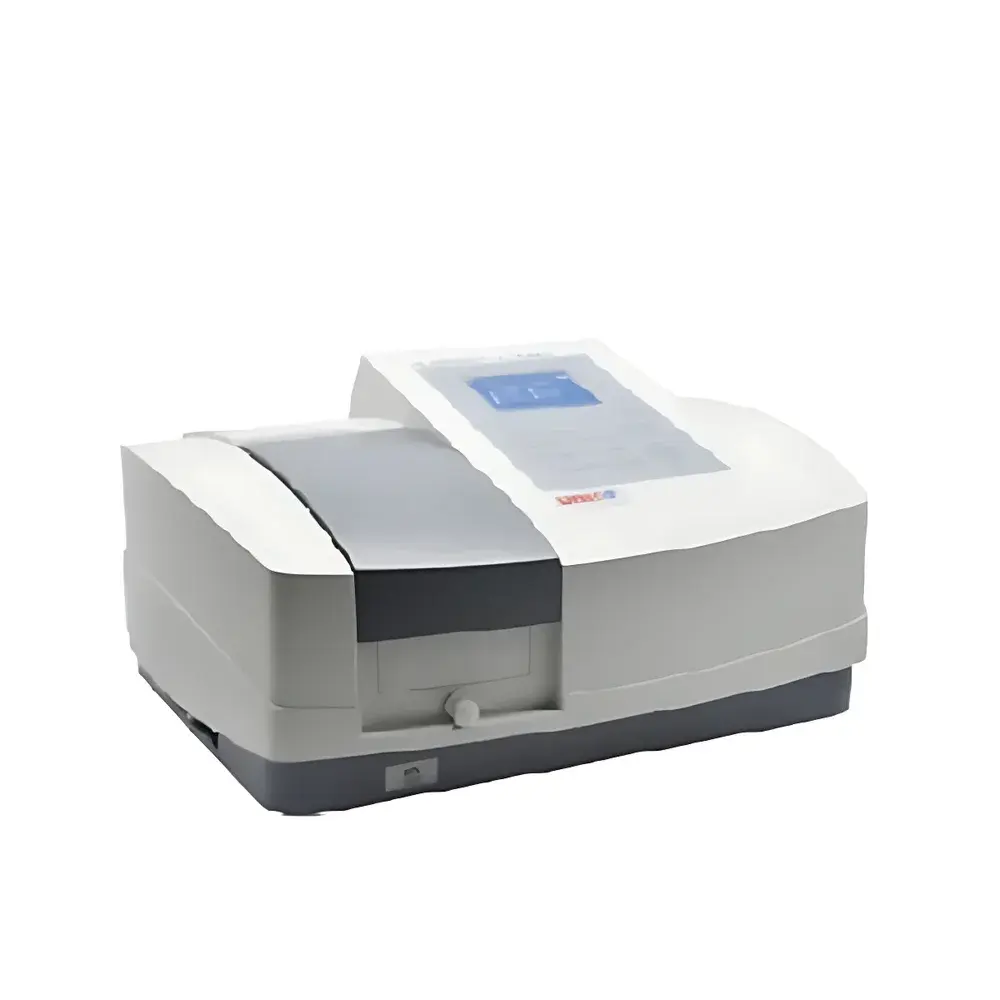
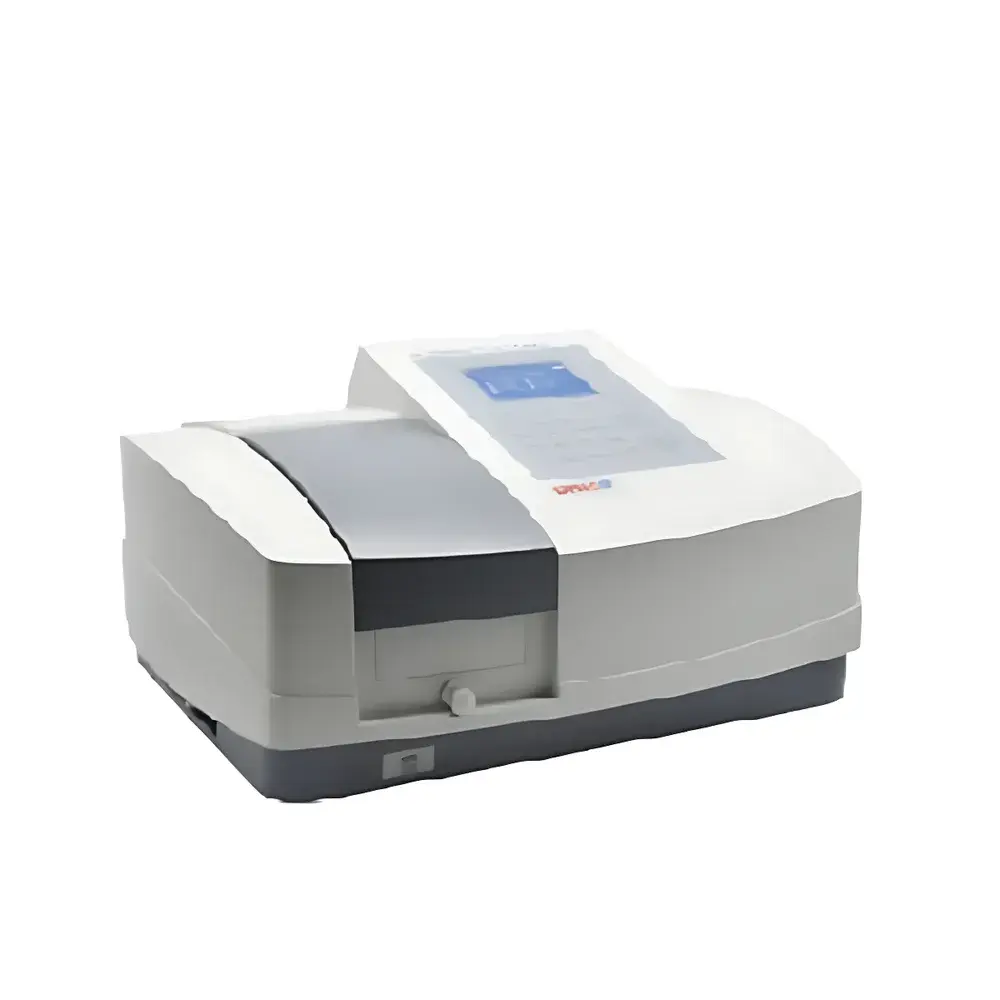
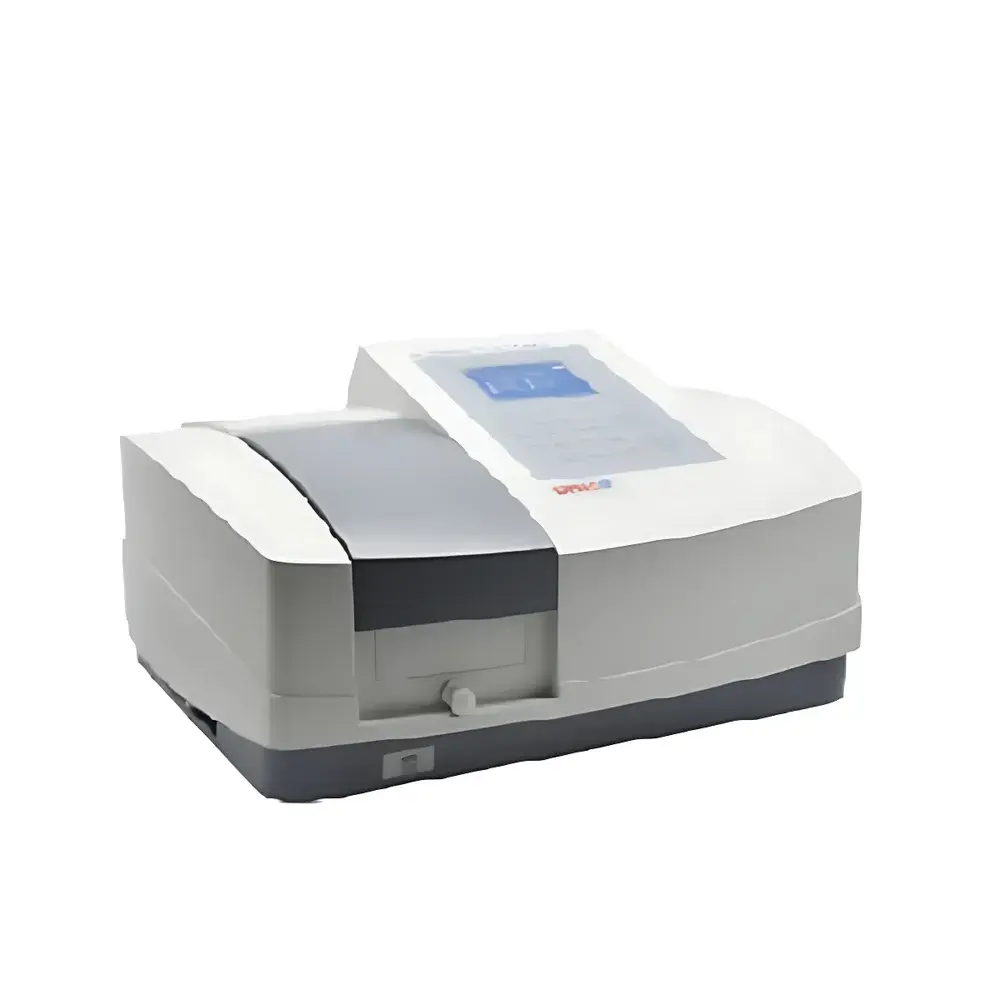
UniCo UV-2600A Single-Beam Ultraviolet-Visible Spectrophotometer
| Brand | UniCo |
|---|---|
| Origin | Shanghai, China |
| Model | UV-2600A |
| Optical System | Single-beam with 1200 lines/mm holographic grating |
| Wavelength Range | 190–1000 nm |
| Spectral Bandwidth | 1.8 nm |
| Wavelength Accuracy | ±0.8 nm |
| Wavelength Repeatability | ≤1 nm |
| Stray Light | ≤0.05% T |
| Detector Type | Silicon Photocell |
| Wavelength Scanning Mode | Motorized Automatic |
| Display | 320 × 240 Graphic LCD |
| Data Interface | USB |
| Dimensions (W×D×H) | 545 × 245 × 260 mm |
| Weight | 20 kg |
Overview
The UniCo UV-2600A is a precision-engineered single-beam ultraviolet-visible (UV-Vis) spectrophotometer designed for routine quantitative and qualitative analysis in academic laboratories, quality control environments, and industrial R&D settings. It operates on the principle of Beer-Lambert absorption spectroscopy, measuring the attenuation of monochromatic light as it passes through a sample solution across the spectral range of 190–1000 nm. Its optical architecture employs a high-efficiency 1200 lines/mm holographic grating and a silicon photocell detector, ensuring stable baseline performance and reliable photometric response under standard ambient conditions. The instrument is optimized for reproducible absorbance (A), transmittance (%T), and concentration (C) measurements—supporting compliance with foundational analytical standards including ASTM E275, ISO 6425, and USP for spectrophotometric system suitability.
Key Features
- Single-beam optical design with motorized automatic wavelength scanning, enabling rapid and repeatable positioning across the full UV-Vis spectrum
- Fixed spectral bandwidth of 1.8 nm—engineered to balance resolution and signal-to-noise ratio for general-purpose applications
- High-contrast 320 × 240 graphic LCD display with intuitive menu navigation and real-time spectral visualization
- Tactile membrane keypad interface for ergonomic operation and reduced mechanical wear over extended use cycles
- USB data port for direct connection to Windows-based PCs; compatible with UniCo’s native acquisition and analysis software for method storage, calibration, and report generation
- Thermally stabilized optical bench and pre-aligned optical path minimize drift; achieves photometric stability of ±0.002 A/h at 500 nm after warm-up
- Comprehensive photometric range: 0–200% T, –0.3 to 3.0 A, and 0–9999 C (concentration units), supporting both fixed-wavelength and multi-point assays
Sample Compatibility & Compliance
The UV-2600A accommodates standard 10-mm-pathlength cuvettes—including supplied glass and quartz cells—enabling measurement of aqueous, organic, and mildly corrosive solutions. Its 190 nm lower limit permits detection of key chromophores such as peptide bonds, nucleic acids, and aromatic compounds. The system meets essential requirements for GLP-compliant workflows when paired with audit-trail-enabled software (optional upgrade). While not inherently 21 CFR Part 11 compliant out-of-the-box, its deterministic data output format and timestamped measurement logs support integration into validated laboratory information management systems (LIMS). All specifications adhere to internationally recognized tolerances for educational and mid-tier industrial instrumentation per ICH Q2(R2) guidance on analytical procedure validation.
Software & Data Management
The UV-2600A interfaces with UniCo’s PC-based control software via USB, offering four core operational modes: photometric measurement, multi-wavelength analysis, standard curve construction (with linear, quadratic, or polynomial regression), and optional firmware-upgradable modules for kinetic and full-spectrum scanning. Raw data are exported in CSV format for downstream statistical analysis in Excel, MATLAB, or Python-based tools. Software-generated reports include instrument ID, date/time stamps, operator ID (user-defined), method parameters, and measured values—with configurable pass/fail criteria based on user-set tolerance bands. All calibration events and parameter changes are logged locally within the host PC application, facilitating traceability during internal audits.
Applications
- Quantitative determination of analytes in pharmaceutical formulations (e.g., assay of paracetamol, ibuprofen, or vitamin B12 using reference standards)
- Enzyme kinetics monitoring via NADH/NADPH absorbance at 340 nm
- Water quality assessment—including nitrate (220 nm/275 nm dual-wavelength correction), phosphate (880 nm molybdenum blue method), and COD estimation
- Protein concentration estimation using Bradford or Lowry assays (595 nm or 750 nm endpoints)
- Validation of cleaning efficacy in biomanufacturing through residual protein or detergent quantification
- Teaching laboratory exercises covering Beer’s law verification, λmax determination, and interference studies
FAQ
Is the UV-2600A compliant with FDA 21 CFR Part 11?
No—the base configuration does not include electronic signature capability, role-based access control, or immutable audit trails required for Part 11 compliance. However, raw data export and manual record-keeping align with ALCOA+ principles when implemented within a documented QC process.
What is the minimum detectable absorbance change?
Photometric repeatability is specified as ±0.001 A (0–0.5 A range), corresponding to a practical resolution limit of approximately 0.002 A under controlled conditions.
Can quartz cuvettes be used below 220 nm?
Yes—the included fused-silica quartz cells transmit effectively down to 190 nm, enabling accurate measurements in the far-UV region for nucleic acid and peptide analysis.
Does the instrument support GMP/GLP documentation requirements?
While the hardware itself lacks built-in electronic records, its deterministic output, consistent serial communication protocol, and compatibility with third-party LIMS integrations allow deployment in regulated environments when supported by procedural controls and validation protocols.
Is wavelength calibration traceable to NIST standards?
Factory calibration uses certified holmium oxide and didymium filters; users may perform periodic verification using NIST-traceable reference materials (e.g., SRM 2034 or 930e) in accordance with ISO/IEC 17025 guidelines.





