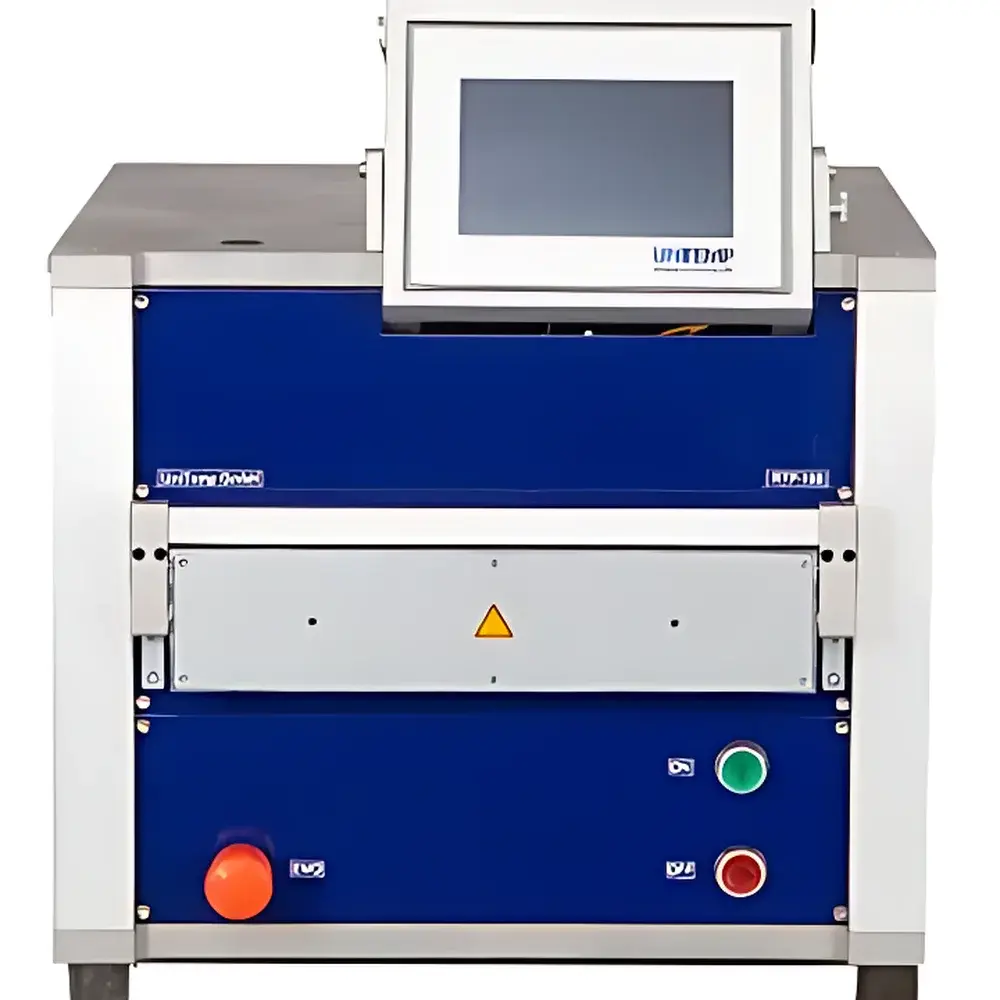
UniTemp RTP-200-HV High-Vacuum Rapid Thermal Processing Furnace
| Brand | UniTemp |
|---|---|
| Origin | Germany |
| Model | RTP-200-HV |
| Instrument Type | High-Vacuum Rapid Thermal Annealing Furnace |
| Sample Size | 200 mm (8-inch wafer) |
| Temperature Range | 0–1200 °C |
| Max. Ramp Rate | 150 °C/s |
| Max. Cool-down Rate | 200 °C/min (from 1000 °C to 400 °C) |
| Temperature Accuracy | < ±1% of setpoint |
| Temperature Uniformity | < ±1% across wafer surface |
| Vacuum Level | ≤1×10⁻⁶ hPa (high-vacuum configuration) |
| Heating Source | Dual-zone halogen lamp array (top & bottom) |
| Cooling Method | Water-cooled chamber + N₂ purge for substrate |
| Gas Control | Up to 4 MFC-controlled lines (N₂, Ar, O₂, H₂/N₂ mix) |
| Control System | SIMATIC S7-based PLC with 7″ HMI touchscreen |
| Program Storage | 50 multi-segment recipes (up to 50 steps each) |
| Dimensions (W×D×H) | 505 × 504 × 420 mm |
| Weight | ~55 kg |
Overview
The UniTemp RTP-200-HV is a high-vacuum rapid thermal processing furnace engineered for precision semiconductor fabrication and advanced materials research. It operates on the principle of radiant heating via high-intensity, spectrally optimized halogen lamps—providing non-contact, spatially controlled thermal energy delivery to silicon, compound semiconductor, and thin-film substrates. Unlike conventional tube or box furnaces, the RTP-200-HV achieves sub-second thermal response through direct infrared absorption, enabling process times measured in seconds rather than minutes. Its design targets critical post-implantation and metallization steps—including contact annealing, silicide formation, dopant activation, oxide/nitride growth (RTO/RTN), and wafer-level bonding—under tightly regulated vacuum or reactive/inert atmospheres. The system’s architecture supports both R&D scalability and pilot-line integration, meeting stringent requirements for thermal budget control, inter-run reproducibility, and process traceability.
Key Features
- Dual-zone infrared heating system with 24 halogen lamps (21 kW total power) ensuring symmetric radiant flux distribution above and below the 200 mm (8-inch) wafer.
- High-vacuum capability down to 1×10⁻⁶ hPa, achieved via integrated turbomolecular pumping and leak-tight stainless-steel chamber construction compliant with UHV-compatible material standards.
- Dynamic thermal control: programmable ramp rates up to 150 °C/s and controlled cool-down at 200 °C/min (1000 °C → 400 °C), enabled by real-time PID feedback from multiple calibrated thermocouples and pyrometric sensors.
- Substrate cooling via high-purity nitrogen purge, minimizing thermal lag and preventing backside contamination during rapid quench cycles.
- Four-channel mass flow controller (MFC) gas delivery system supporting N₂, Ar, O₂, and forming gas (H₂/N₂), with automated pressure regulation and leak-check protocols.
- Water-cooled chamber housing with integrated coolant flow monitoring and interlock circuitry to maintain structural integrity under repeated thermal cycling.
- SIMATIC S7-1200 PLC-based control platform with 7-inch resistive touchscreen HMI, supporting recipe-driven operation, event logging, and password-protected user access levels.
Sample Compatibility & Compliance
The RTP-200-HV accommodates standard 200 mm (8-inch) wafers with optional adaptors for smaller formats (100 mm, 150 mm). It supports bare Si, SOI, GaAs, SiC, and thin-film stacks including metal oxides, nitrides, and low-k dielectrics. All wetted surfaces are electropolished stainless steel or ceramic-coated; no internal elastomers or organic seals are used in the high-vacuum path. The system complies with CE machinery directives (2006/42/EC), EMC directive (2014/30/EU), and RoHS 2011/65/EU. For regulated environments, it supports audit-ready data logging aligned with GLP and GMP principles—including timestamped parameter records, operator ID tagging, and electronic signature options compatible with FDA 21 CFR Part 11–compliant software extensions.
Software & Data Management
Control firmware includes embedded data acquisition at 10 Hz resolution for temperature, pressure, gas flows, and lamp power. Raw logs are stored in CSV format with ISO 8601 timestamps and include checksum validation. Optional Ethernet/IP interface enables integration into factory MES systems via OPC UA or Modbus TCP. Recipe management allows hierarchical organization (project → process → step), version control, and change history tracking. All operational events—including vacuum pump status, safety interlocks, and thermal deviation alerts—are archived with configurable retention policies. Remote diagnostics and firmware updates are supported via secure SSH tunneling.
Applications
- Ion implant activation and damage recovery in CMOS and FinFET node development.
- Formation of NiSi, CoSi₂, and TiSi₂ contacts on advanced logic and memory devices.
- Rapid thermal oxidation (RTO) of ultra-thin gate oxides (<2 nm) and interfacial layer engineering.
- Low-temperature crystallization of amorphous silicon, IGZO, and perovskite precursors for display and photovoltaic applications.
- Wafer-level eutectic bonding (e.g., Si–Au, Si–Al, Si–Mo) with precise thermal gradient control to suppress void formation.
- Densification and stress modulation of plasma-enhanced CVD low-dielectric constant films (e.g., SiCOH).
- Thermal treatment of MEMS structures requiring minimal warpage and residual stress.
FAQ
What vacuum level does the RTP-200-HV achieve, and how is it maintained?
The system reaches ≤1×10⁻⁶ hPa using a turbomolecular pump backed by a dry scroll pump; vacuum integrity is verified via built-in Pirani and cold cathode gauges with automatic bake-out support.
Can the furnace operate under oxidizing or reducing atmospheres?
Yes—it supports fully programmable gas sequences with up to four MFC-controlled lines, including O₂ for oxidation and H₂/N₂ mixtures for reduction or passivation.
Is the temperature uniformity validated per industry standards?
Uniformity is characterized per SEMI F47-0218 using a 200 mm thermal mapping wafer; results are provided in the factory acceptance test (FAT) report.
How is process repeatability ensured across multiple runs?
Each run logs full parameter history with millisecond time stamps; deviation thresholds trigger automatic hold-and-alert, and inter-run drift is corrected via closed-loop pyrometer calibration routines.
Does the system support integration with external automation or SECS/GEM?
Yes—via optional RS-485, Ethernet/IP, or SECS/GEM-compliant communication modules with configurable equipment handler (EH) profiles.
Related Products