UniTemp VSS-300 Reflow Soldering System
| Brand | UniTemp |
|---|---|
| Model | VSS-300 |
| Origin | Germany |
| Chamber Dimensions | 350 × 350 × 75 mm (expandable to 300 mm height) |
| Max Ramp-Up Rate | 150 K/min |
| Max Ramp-Down Rate | 120 K/min |
| Bottom Heating Power | 2 × 12-lamp arrays, 18 kW total |
| Cooling | Water-cooled graphite plate (310 × 310 mm) |
| Control System | SIMATIC PLC with 7" touchscreen HMI |
| Programmable Steps | 50 programs × 50 steps each |
| Process Gas Flow | Standard 1.5 sL/min MFC (up to 4 gas lines optional) |
| Vacuum Options | MPC (10 hPa) or RVP (10⁻³ hPa) |
| Power Supply | 3-phase + N + PE, 230 V, CEE 3×32 A |
| Weight | ~140 kg |
| Compliance | Designed for ISO 9001-compliant SMT manufacturing environments |
| Enclosure Material | Polished aluminum chamber walls (stainless steel optional) |
Overview
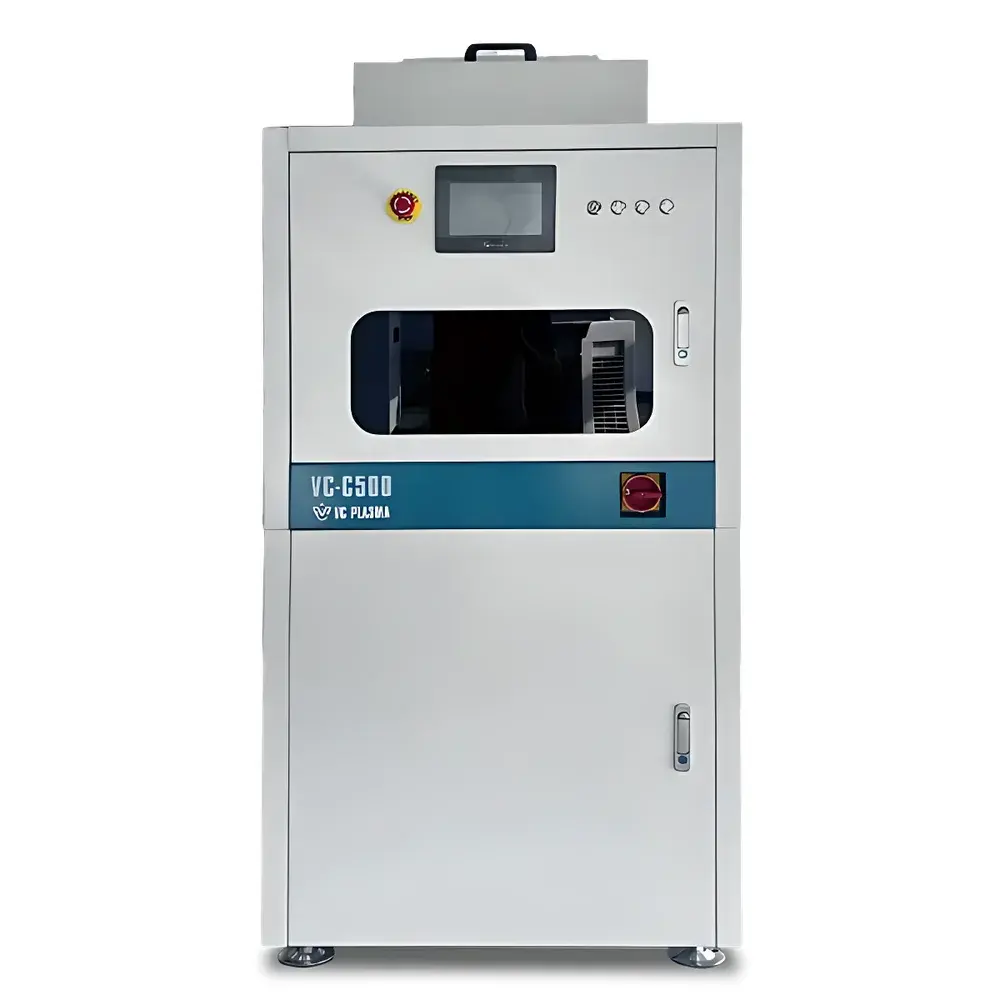
The UniTemp VSS-300 Reflow Soldering System is a precision-engineered thermal processing platform designed specifically for high-reliability surface mount technology (SMT) assembly in semiconductor packaging and advanced electronics manufacturing. Unlike conventional convection-based reflow ovens, the VSS-300 employs a high-intensity infrared (IR) lamp array architecture—comprising two independent 12-lamp cross-arranged modules delivering 18 kW of controllable bottom heating—to achieve rapid, repeatable, and spatially uniform thermal profiles across printed circuit board assemblies (PCBAs). Its closed-chamber design supports both atmospheric and controlled-atmosphere processing, including inert (N₂, forming gas) and vacuum-assisted soldering sequences. The system is engineered to meet the stringent thermal ramp rate requirements of modern lead-free (e.g., SAC305, SN100C) and low-temperature solder pastes (e.g., Bi-based, indium alloys), as well as advanced interconnect materials used in power modules, RF packages, and heterogeneous integration substrates.
Key Features
- Ultra-fast thermal response: Programmable ramp rates up to 150 K/min (heating) and 120 K/min (cooling), enabling precise replication of JEDEC J-STD-020 and IPC-7530-compliant profiles.
- Modular chamber architecture: Standard 350 × 350 × 75 mm internal volume, expandable to 300 mm vertical clearance; polished aluminum chamber walls ensure thermal stability and ease of residue removal (stainless steel variant available for corrosive process gases).
- Dual-zone IR heating control: Independent top and bottom lamp banks (top heating optional) allow asymmetric profile shaping—critical for thermally imbalanced boards or stacked-die packages.
- Integrated water-cooled graphite heat sink plate (310 × 310 mm): Provides rapid, non-contact quenching and minimizes thermal lag between cycles.
- Industrial-grade automation interface: Native support for PLC-level integration (SIMATIC S7-compatible I/O), robotic arm handshaking (via digital I/O or EtherNet/IP), and seamless linkage with MES/SCADA systems.
- Full-process environmental control: Standard mass flow controller (1.5 sL/min, N₂ or forming gas); optional multi-gas manifold (up to 4 lines) and dual-vacuum capability (MPC for coarse vacuum down to 10 hPa; RVP for high vacuum down to 10⁻³ hPa).
Sample Compatibility & Compliance
The VSS-300 accommodates standard SMT carrier formats—including bare PCBs (up to 300 × 300 mm), tray-loaded QFN/WLCSP packages, and substrate panels—via top-loading vertical access with motorized lid actuation. Its chamber geometry and thermal field homogeneity (±2.5 °C across zone at 250 °C, per ASTM E220 calibration protocol) comply with IPC-A-610 Class 3 and IPC-J-STD-001G requirements for high-reliability solder joints. The system’s data logging and audit trail functionality—supporting timestamped parameter records, recipe versioning, and user-access logs—align with FDA 21 CFR Part 11 and ISO 13485 documentation integrity standards when deployed in regulated medical device or automotive electronics production lines.
Software & Data Management
Control and monitoring are executed through an embedded SIMATIC S7-1200 PLC interfaced with a 7-inch industrial touchscreen HMI. The proprietary firmware supports up to 50 stored thermal recipes, each containing 50 definable process steps (ramp, soak, peak, cooling) with independent setpoint, dwell time, and gas/vacuum sequencing logic. All process executions generate .CSV-formatted log files (temperature, power, gas flow, vacuum level, time stamp) compliant with GLP/GMP electronic record retention protocols. Optional OPC UA server module enables real-time data export to centralized manufacturing execution systems (MES) and statistical process control (SPC) platforms.
Applications
- Lead-free and low-temperature solder reflow for fine-pitch BGAs (≤0.4 mm pitch), 01005 passives, and ultra-thin flex circuits.
- Vacuum-assisted void reduction in power semiconductor die-attach processes (e.g., SiC MOSFETs, GaN HEMTs).
- Reflow of copper-copper thermocompression bonds in 2.5D/3D IC stacking.
- Process development and qualification of novel solder pastes, underfill materials, and conductive adhesives.
- Failure analysis lab use: Controlled rework of populated PCBAs without thermal damage to adjacent components.
FAQ
What types of solder pastes are compatible with the VSS-300?
The system supports all commercial solder paste chemistries—including SAC305, SN100C, Bi57Sn42Ag1, and low-temp indium alloys—provided their recommended peak temperature, time-above-liquidus (TAL), and cooling rate specifications fall within the VSS-300’s operational envelope.
Can the VSS-300 be integrated into an automated SMT line?
Yes. It features standardized digital I/O (24 V DC), Ethernet port for Modbus TCP or EtherNet/IP, and mechanical interfaces for robotic end-effector docking—enabling direct integration with pick-and-place machines and conveyor-based handling systems.
Is vacuum capability required for standard reflow applications?
No. Vacuum is optional and primarily used for specialized applications such as void-sensitive power module assembly or high-reliability aerospace PCBAs where nitrogen-only atmospheres are insufficient.
How is temperature uniformity validated and maintained?
Chamber uniformity is verified using a 9-point thermocouple mapping procedure per ASTM E220 prior to commissioning. Real-time uniformity is monitored via embedded thermopile sensors and compensated dynamically via closed-loop lamp power modulation.
Does the system support remote diagnostics and software updates?
Yes. With optional secure VPN configuration, authorized service engineers can perform remote firmware updates, parameter diagnostics, and historical log analysis without on-site intervention.
Related Products