
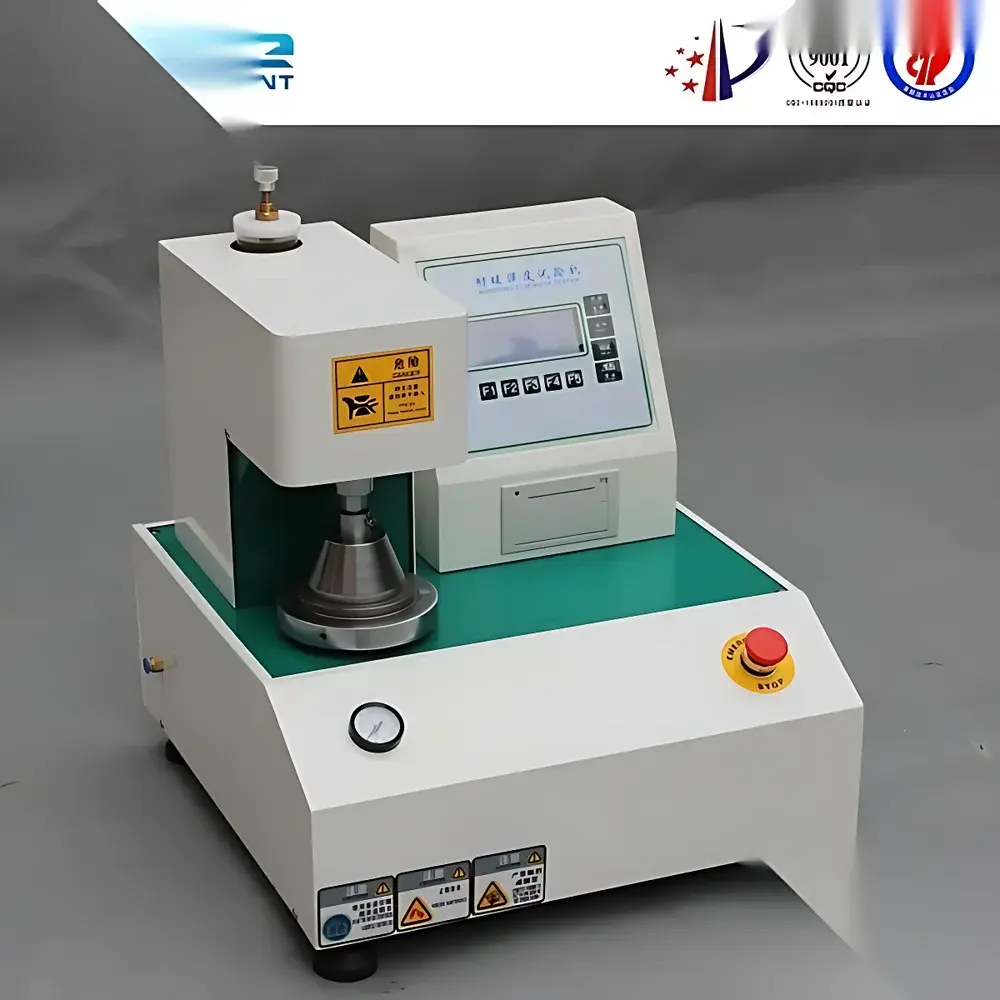
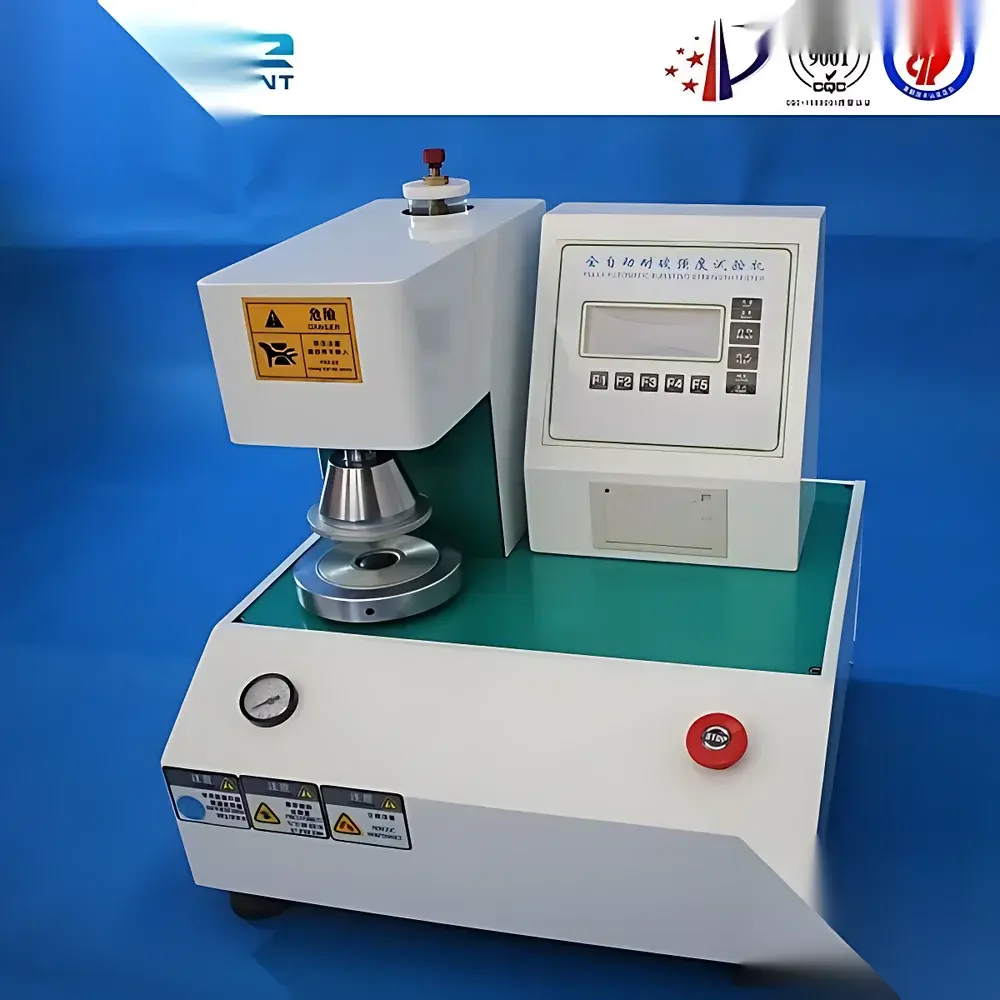
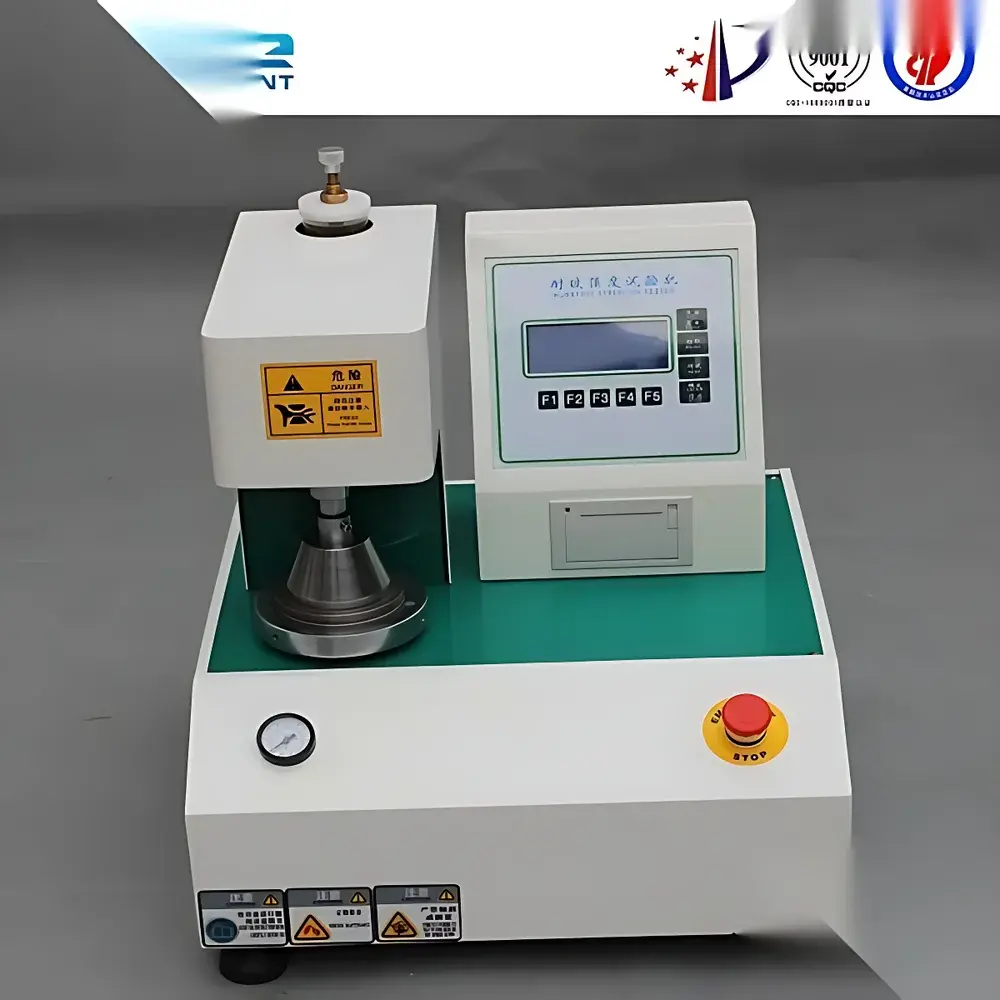
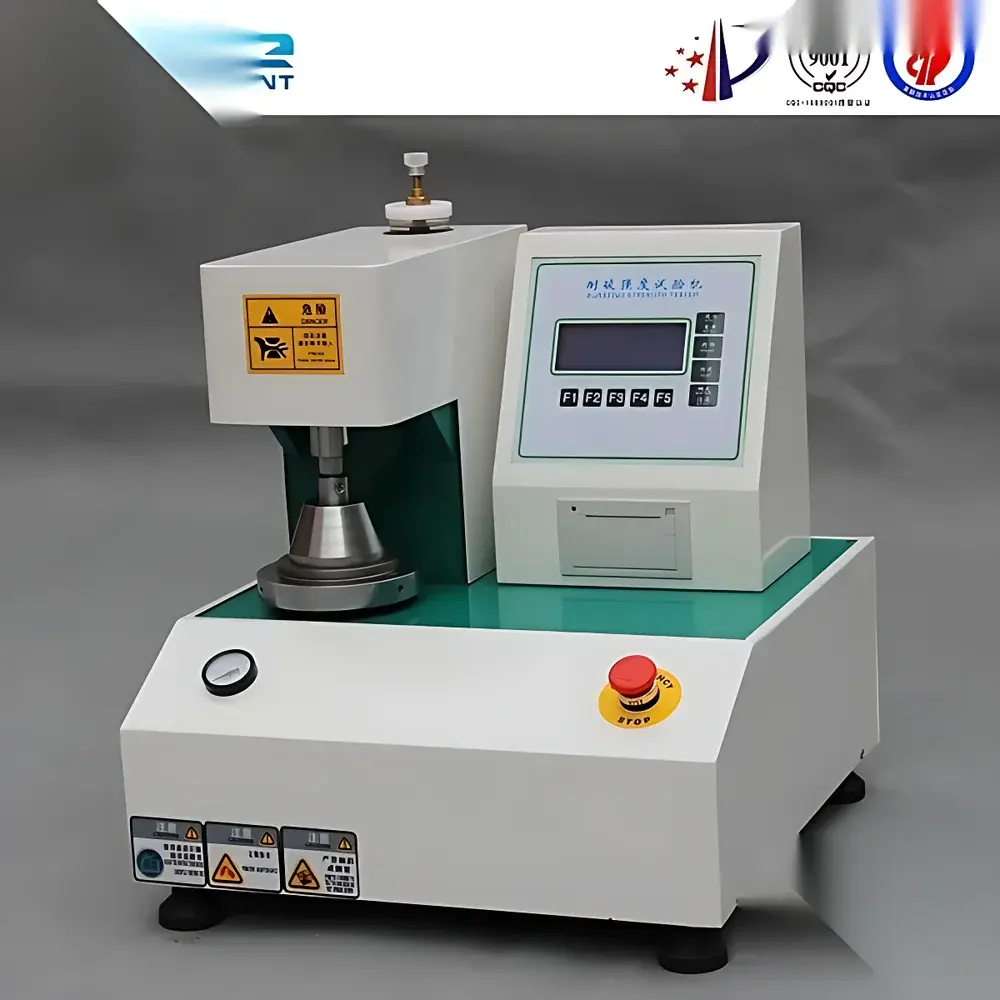
Universal Bursting Strength Tester for Corrugated Board and Flexible Materials
| Brand | OEM / Private Label |
|---|---|
| Origin | Imported |
| Supplier Type | Authorized Distributor |
| Price | USD 650 (FOB) |
| Compliance | ASTM D2210, TAPPI T403, ISO 2759, GB/T 6545, JIS L1004/L1018/L1031, K6328, P8131/P8112 |
Overview
The Universal Bursting Strength Tester is a precision electromechanical instrument engineered for the quantitative determination of bursting strength—the maximum uniform hydraulic or pneumatic pressure a sheet material can withstand before rupture—under controlled, standardized loading conditions. Based on the Mullen-type principle, it applies a steadily increasing, radially symmetric force via an elastomeric diaphragm against a clamped specimen until failure occurs. This method is universally recognized for evaluating the structural integrity of corrugated fiberboard, solid fiberboard, kraft paper, coated board, synthetic leather, woven and nonwoven textiles, and other flexible sheet materials used in packaging, transportation, and protective applications. Designed to meet stringent repeatability requirements (±1.5% full-scale per ISO 2759 Annex B), the system delivers traceable, reproducible results essential for QC/QA laboratories operating under GLP, ISO/IEC 17025, or IATF 16949 frameworks. Its rigid cast-iron frame, dual-clamp pneumatic actuation, and digital load-cell feedback loop ensure minimal mechanical hysteresis and long-term calibration stability.
Key Features
- High-precision digital load cell with 0.5% FS accuracy and automatic zero-tracking compensation
- Pneumatically actuated clamping system (adjustable clamping pressure: 0.4–0.6 MPa) ensuring consistent specimen confinement without edge deformation
- Integrated burst pressure measurement range: 0–1.6 MPa (0–232 psi), resolution: 0.001 MPa
- Real-time analog-to-digital conversion at 1 kHz sampling rate, capturing peak rupture force with sub-millisecond timing fidelity
- Compliance-ready firmware supporting audit trails, user-level access control (admin/operator modes), and data export in CSV and PDF formats
- Modular design enabling rapid field recalibration using NIST-traceable reference standards (certified burst pressure discs)
- CE-marked electrical architecture with reinforced insulation, overpressure cutoff, and emergency stop circuitry per EN 61000-6-2/6-4
Sample Compatibility & Compliance
The tester accommodates standard circular specimens of 100 mm diameter (per ISO 2759, ASTM D2210, and GB/T 6545), with optional adapters for 150 mm or rectangular formats upon request. It supports materials ranging from 0.1 mm thick tissue paper to 12 mm thick double-wall corrugated board, provided surface flatness deviation remains within ±0.05 mm across the clamping area. All test protocols align with mandatory regulatory benchmarks: ASTM D2210 for packaging board qualification; TAPPI T403 for pulp and paper mills; ISO 2759 for international shipment compliance; and GB/T 6545 as the national standard for Chinese packaging certification. The instrument’s measurement uncertainty budget has been validated per GUM (JCGM 100:2008) and satisfies FDA 21 CFR Part 11 requirements when paired with compliant software modules.
Software & Data Management
The embedded microcontroller runs deterministic real-time firmware (RTOS-based) with no external OS dependencies. Optional PC-connected software (Windows 10/11 compatible) provides full GLP-compliant data handling: electronic signatures, version-controlled method templates, automated pass/fail flagging against user-defined limits, and integrated statistical process control (SPC) charts (X̄-R, Cpk). All raw burst curves—including time-pressure and displacement-force profiles—are stored with metadata (operator ID, timestamp, environmental temperature/humidity, calibration certificate ID). Exported datasets include ISO-standardized XML headers for seamless ingestion into LIMS platforms such as LabWare, Thermo Fisher SampleManager, or Siemens Opcenter Quality.
Applications
This tester serves critical roles across supply chain quality assurance: validating inbound corrugated container strength prior to warehouse receipt; certifying export-grade packaging for ISTA 3A/3E compliance; verifying synthetic leather burst resistance in footwear R&D labs; monitoring batch-to-batch consistency of coated paper in printing substrate qualification; and supporting root-cause analysis during packaging failure investigations (e.g., pallet collapse, transit damage). It is routinely deployed in third-party testing labs accredited to CNAS (China), UKAS (UK), or A2LA (USA), as well as internal QC labs of Tier-1 automotive suppliers, medical device contract manufacturers, and global e-commerce logistics providers.
FAQ
What standards does this instrument fully support out-of-the-box?
ASTM D2210, ISO 2759, TAPPI T403, GB/T 6545, JIS L1004, and EN 13862—all preloaded in method library with auto-configured test parameters.
Can the system be integrated into an existing MES or SAP QM module?
Yes, via OPC UA server interface (optional add-on) or direct CSV/ODBC export; configuration assistance available for SAP QM customizing tables (QPMK, QPMP).
Is on-site calibration and IQ/OQ documentation provided?
Factory calibration certificate included; IQ/OQ protocol templates and witnessed on-site validation services available upon request (ISO 17025-accredited partner network).
What maintenance intervals are recommended for long-term accuracy?
Diaphragm replacement every 12 months or 5,000 cycles; annual load-cell verification using certified deadweight standards; quarterly clamp seal inspection.



