
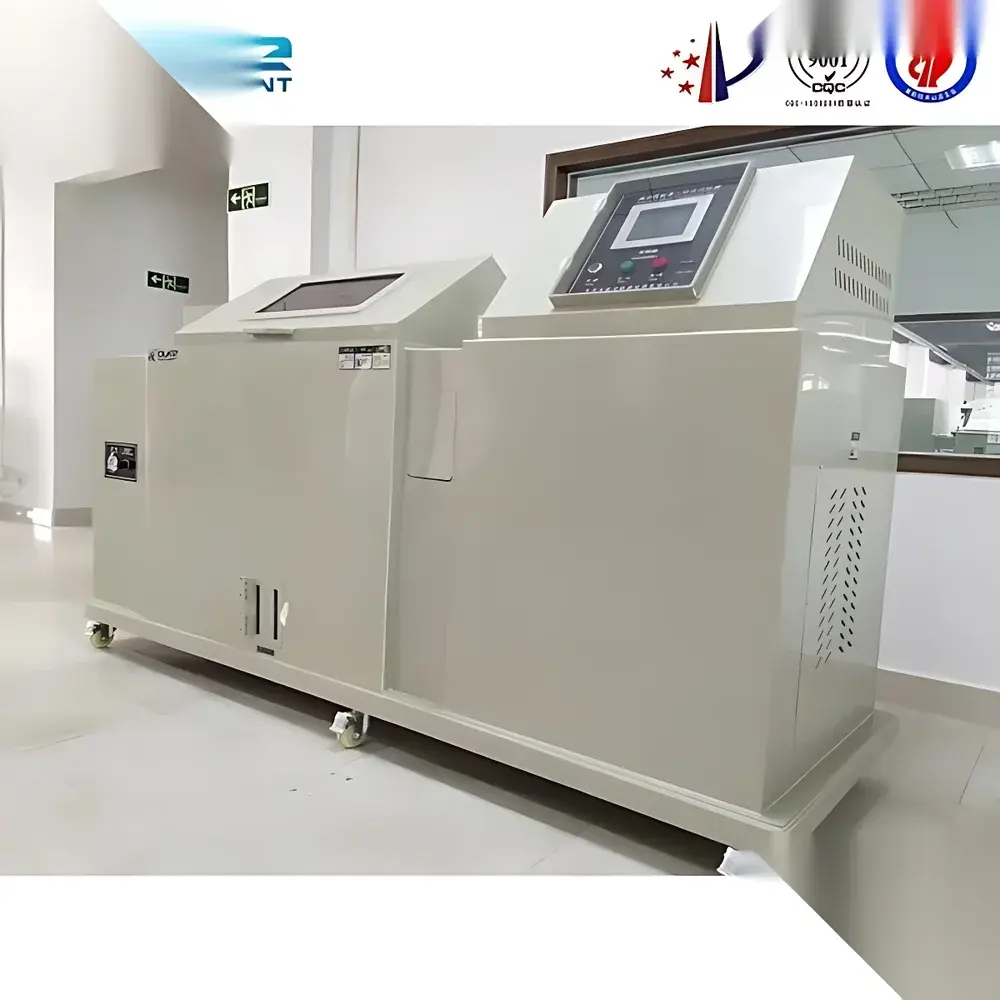
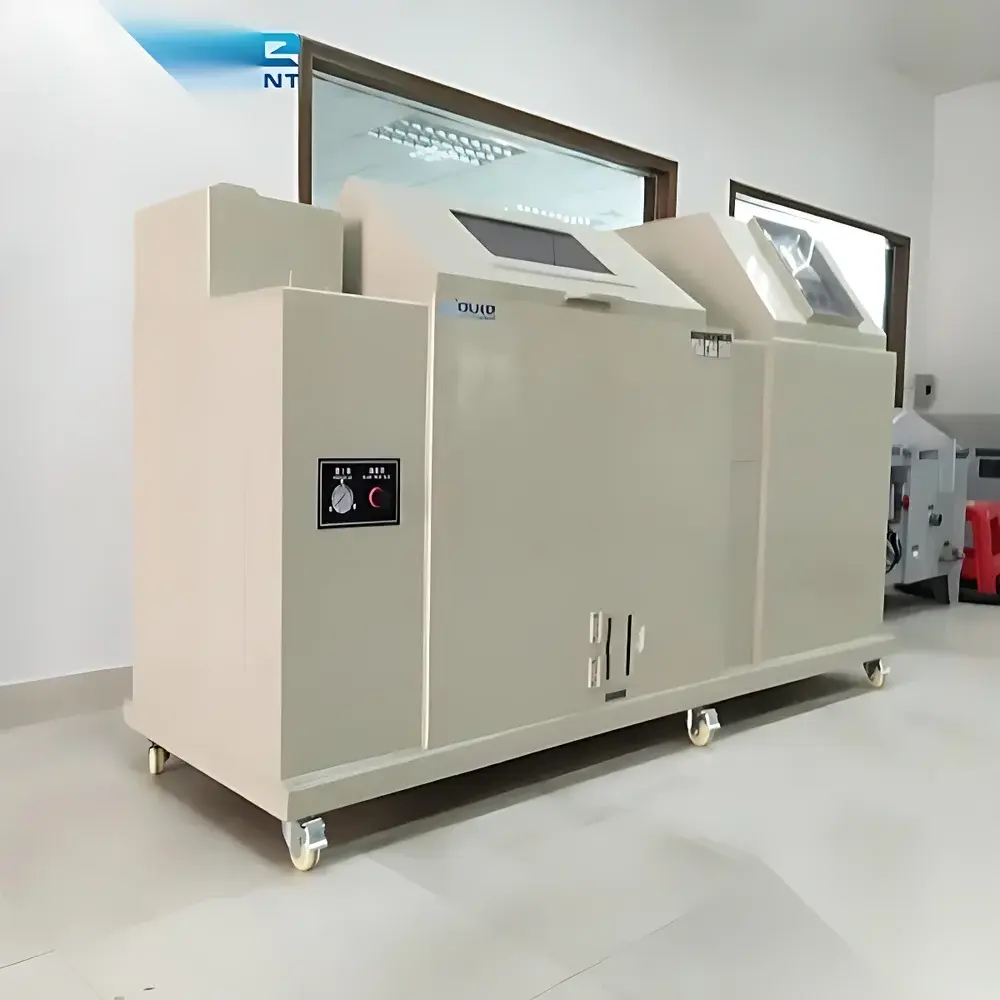
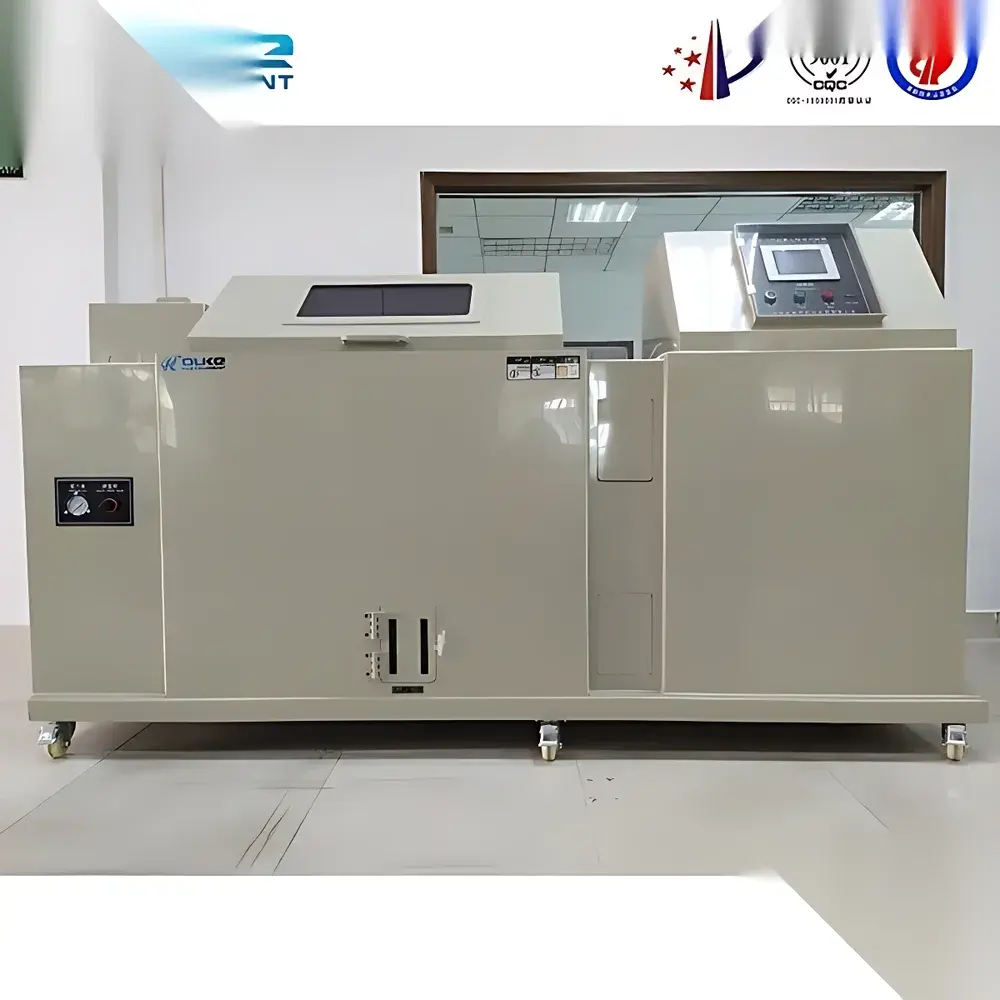
Universal Climate Corrosion Test Chamber with Salt Spray, Temperature & Humidity Control
| Brand | OEM / Custom Brand |
|---|---|
| Origin | Imported |
| Manufacturer Type | Authorized Distributor |
| Temperature Range | +5°C to 60°C |
| Internal Chamber Dimensions | W120 × H50 × D100 cm |
| Temperature Uniformity | ±2°C |
| Temperature Fluctuation | ±0.5°C |
| Salt Spray Deposition Rate | 1–2 mL / 80 cm²·h |
| Spray Mode | Continuous or Cyclic |
| Chamber Material | High-Purity Grey PVC (Acid- and Alkali-Resistant) |
| Heating System | Independent Ni-Cr Alloy Heaters |
| Temperature Sensor | PT100 Platinum Resistance Thermometer |
| Control System | LED Digital PID Controller with Dual-Channel Display |
| Safety Features | Circuit Breakers, Dual Overheat Protection (Electronic & Mechanical), Integrated Water Filtration, Preheated Salt Solution System |
Overview
The Universal Climate Corrosion Test Chamber is an engineered environmental simulation system designed for accelerated corrosion testing under controlled combinations of temperature, relative humidity, and salt spray exposure. It operates on the principle of standardized electrochemical degradation acceleration—reproducing field-relevant corrosive environments in a reproducible, time-compressed laboratory setting. This chamber complies with core international test standards including ASTM B117 (Salt Spray Testing), ISO 9227 (Corrosion Tests in Artificial Atmospheres), JIS Z2371, and GB/T 2423.17. Its integrated tri-variable control architecture enables precise orchestration of dry, humid, salt-laden, and wet-dry cyclic conditions—essential for evaluating coating integrity, metallic component durability, electronic enclosure sealing, and material passivation performance across automotive, aerospace, marine, and electronics manufacturing sectors.
Key Features
- Robust chamber construction using high-purity grey PVC板材 (polyvinyl chloride) with reinforced 3D circumferential welding—ensuring long-term resistance to HCl, NaCl, acetic acid, and CuCl₂ solutions without warping, cracking, or leakage.
- Independent dual-zone thermal management: separate heating circuitry (Ni-Cr alloy heaters) and calibrated PT100 sensors maintain stable setpoints within ±0.5°C fluctuation and ±2°C uniformity across the full working volume (W120 × H50 × D100 cm).
- Tower-type atomization system with non-crystallizing nozzles delivers consistent, adjustable salt fog deposition (1–2 mL/80 cm²·h) per ASTM B117 requirements; spray mode is user-selectable between continuous and programmable cyclic operation.
- Integrated salt solution preheating subsystem ensures thermal equilibrium between brine feed and chamber ambient—eliminating condensation-induced test artifacts and improving repeatability.
- Comprehensive safety architecture: individual circuit breakers per subsystem, redundant overheat protection (both electronic cutoff and mechanical thermal fuses), and inline water filtration at the suction line prevent nozzle clogging and ensure solution purity.
Sample Compatibility & Compliance
This chamber accommodates flat panels, fasteners, printed circuit boards (PCBs), coated substrates, and small assemblies up to 120 cm wide. All internal surfaces are non-metallic and chemically inert—preventing cross-contamination during multi-specimen runs. The design conforms to GLP-aligned operational traceability: digital PID controller logs timestamped temperature/humidity/spray status, and optional data export supports audit-ready documentation per ISO/IEC 17025 and FDA 21 CFR Part 11 requirements when paired with validated software modules. Calibration certificates for PT100 sensors and deposition rate verification kits are available upon request.
Software & Data Management
The embedded LED PID controller provides real-time dual-channel display (chamber temperature and saturation temperature) with manual or auto-tuning PID parameters. While the base unit operates via front-panel interface, optional RS485/Modbus RTU connectivity enables integration into centralized lab monitoring systems (e.g., LabVIEW, SCADA). Logged data—including start/stop timestamps, setpoint deviations, and spray cycle history—can be exported as CSV for statistical process control (SPC) analysis. Firmware supports password-protected parameter locking to enforce SOP compliance during routine QC testing.
Applications
- Evaluation of anti-corrosion coatings (epoxy, zinc-rich primers, chromate conversion layers) per ASTM D1654 and ISO 12944.
- Qualification of automotive under-hood components exposed to road-salt aerosols and thermal cycling.
- Reliability screening of conformal-coated PCBs and hermetic seals in consumer electronics per IPC-J-STD-006 and IEC 60068-2-52.
- Accelerated aging of stainless steel grades, aluminum alloys, and galvanized steels per ASTM G85 Annex A5 (Acetic Acid Salt Spray).
- Validation of packaging barrier performance for medical device sterilization trays subjected to coastal storage conditions.
FAQ
What standards does this chamber support out-of-the-box?
It natively meets ASTM B117, ISO 9227, JIS Z2371, and GB/T 2423.17 specifications. Optional calibration packages extend traceability to national metrology institutes (NMI).
Can humidity be controlled independently of salt spray?
Yes—the chamber supports standalone high-humidity soak (up to 98% RH) and dry-heat conditioning modes without activation of the spray system.
Is the PVC chamber compatible with acetic acid salt spray (AASS) or copper-accelerated acetate spray (CASS)?
Yes—grey PVC exhibits full chemical compatibility with CH₃COOH and CuCl₂ solutions at elevated temperatures; no liner replacement is required.
How is salt solution concentration verified and maintained?
Standard漏斗 (funnel) and calibrated measuring cylinder enable gravimetric verification per ASTM B117; integrated water filtration and preheating minimize crystallization and concentration drift.
What maintenance intervals are recommended for long-term reliability?
Daily visual inspection of nozzles and collection funnels; monthly cleaning of PVC weld seams with pH-neutral detergent; annual recalibration of PT100 sensors and deposition rate validation using NIST-traceable volumetric standards.



