
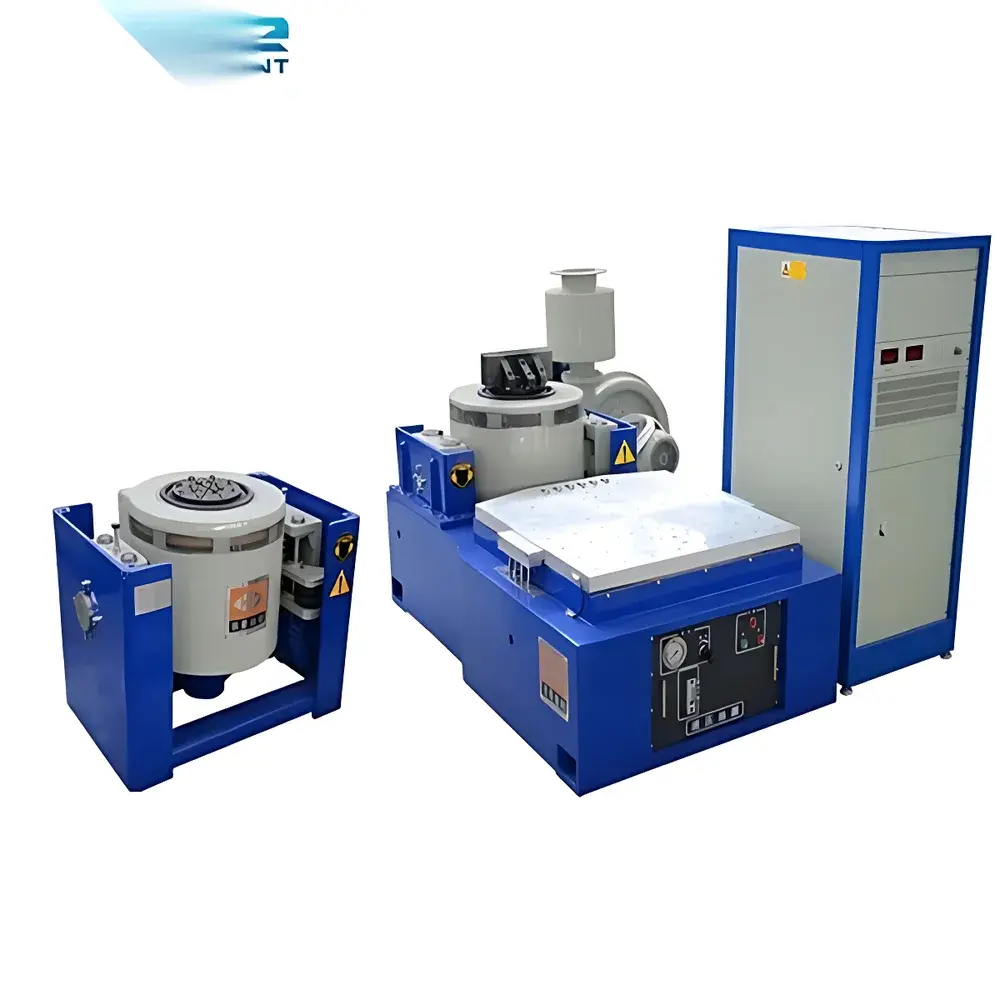
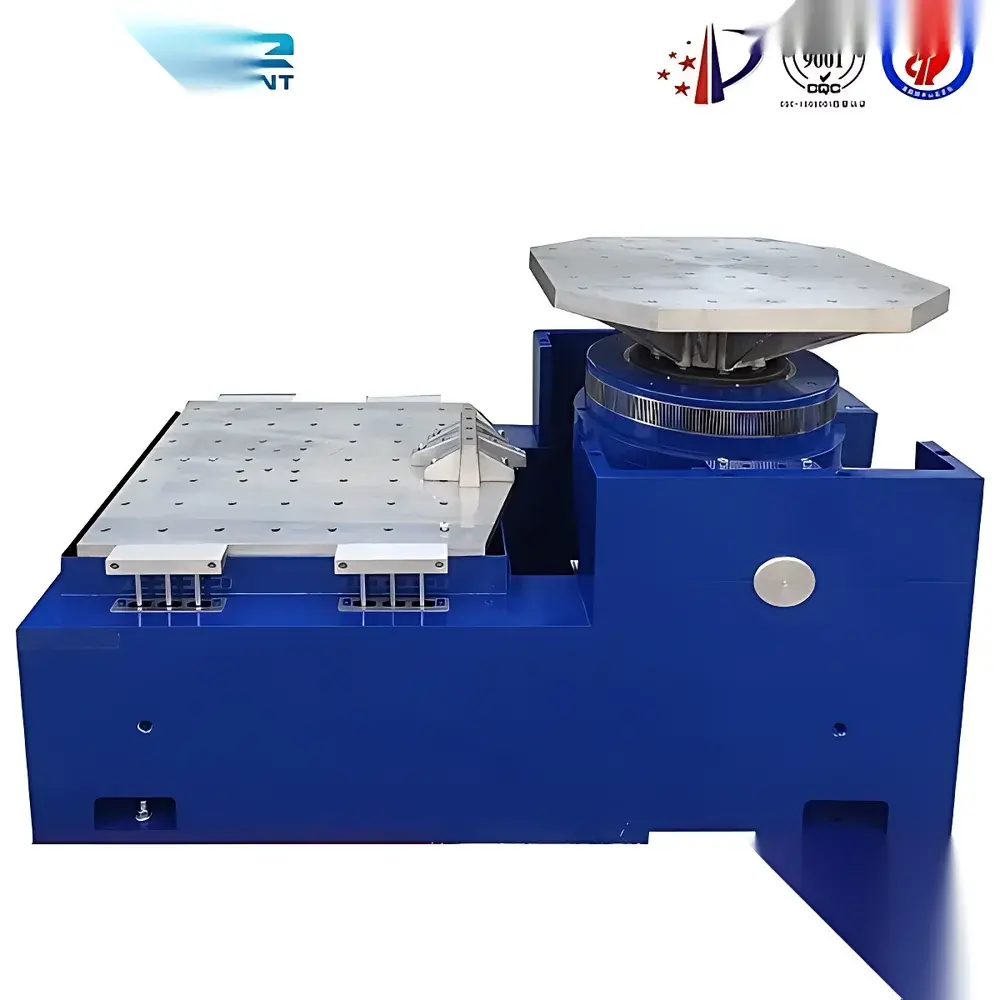
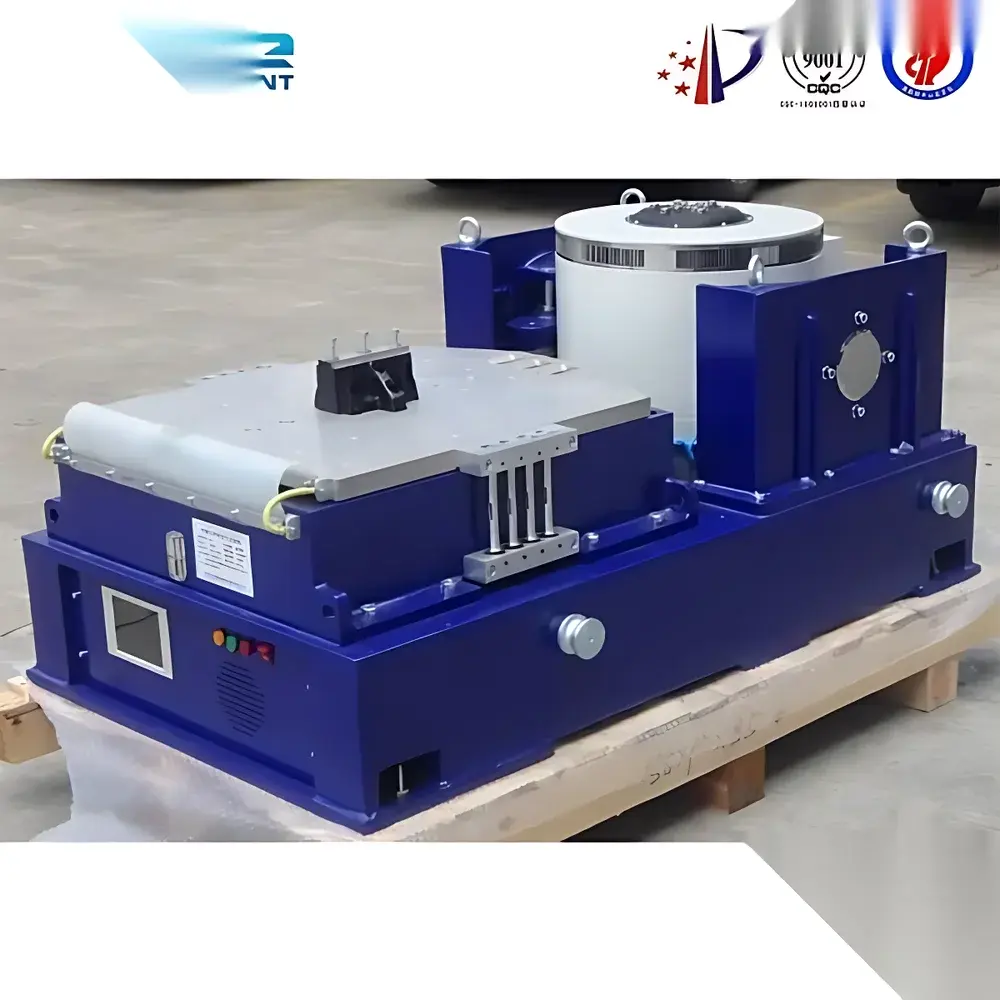
Universal Dual-Axis Vibration & Shock Tester for Luggage and Consumer Goods
| Brand | OEM / Custom Brand |
|---|---|
| Origin | Imported |
| Manufacturer Type | Authorized Distributor |
| Load Capacity | 60 kg / 150 kg (max) |
| Frequency Range (Manual) | 5–50 Hz |
| Sweep Frequency Range | 5–50 Hz |
| Table Dimensions | 1100 × 800 × 60 mm |
| Overall Unit Dimensions | 1100 × 800 × 900 mm |
| Displacement Amplitude (No-Load) | 0–3.5 mm |
| Timing Range | 0.01 s – 99.99 h |
| Waveform | Sinusoidal |
| Control Mode | Programmable Multi-Stage Sweep (up to 30 segments), Fixed-Frequency, Logarithmic/Linear/Multi-Octave Sweep |
| Power Supply | 3-phase 380 VAC ±5%, 50/60 Hz |
| Power Consumption | 4.2 kVA |
| Cooling Method | Air-Cooled |
| Compliance Standard | GB/T 2423.10 |
| Vibration Axes | Vertical + Horizontal (Simultaneous Dual-Axis Excitation) |
| Drive System | Four-Point Synchronized Electromagnetic Shaker |
| Control Interface | Digital PID Controller with Real-Time Parameter Display and Preview Curve Function |
| Structural Design | Integrated Rigid Base with Passive Vibration Isolation Mounts |
| Optional Features | Time-Based Test Termination, Amplitude Prediction Algorithm, EMI-Resistant Circuitry |
Overview
The Universal Dual-Axis Vibration & Shock Tester for Luggage and Consumer Goods is an electromechanical shaker system engineered for reliability and repeatability in mechanical stress evaluation of finished products and subassemblies. It operates on the principle of electromagnetic force generation, delivering controlled sinusoidal excitation across two orthogonal axes—vertical and horizontal—simultaneously. Unlike single-axis systems, this dual-direction capability replicates real-world transport and handling conditions more accurately, particularly for bulky or asymmetric items such as travel luggage, wheeled cases, backpacks, and large consumer electronics enclosures. The system conforms to the environmental test methodology defined in GB/T 2423.10 (equivalent to IEC 60068-2-6), enabling standardized assessment of mechanical robustness under vibratory loading. Its modular architecture supports both laboratory validation and production-line quality assurance workflows, with emphasis on long-term operational stability and minimal operator intervention.
Key Features
- Integrated dual-axis excitation platform with four-point synchronized electromagnetic shakers ensuring uniform table acceleration distribution and minimized torsional coupling.
- Programmable multi-segment sweep control—up to 30 independent frequency-time-amplitude steps per test profile—with logarithmic, linear, and octave-based sweep modes.
- Digital PID-controlled frequency regulation with real-time display of setpoint, actual frequency, displacement amplitude, and elapsed time; preview curve function enables pre-execution visualization of vibration profiles.
- Passive vibration isolation base eliminates requirement for floor anchoring; unit achieves stable operation on standard concrete laboratory flooring without structural reinforcement.
- Amplitude prediction algorithm embedded in controller firmware facilitates rapid setup and repeatable calibration across load variations (60 kg / 150 kg max capacity).
- EMI-hardened control circuitry with shielded signal paths and filtered power inputs ensures immunity against electromagnetic interference from adjacent industrial equipment.
- Configurable timing logic—including countdown timers, dwell periods, and automatic test termination—supports compliance with internal QA protocols and third-party audit requirements.
Sample Compatibility & Compliance
This tester accommodates rigid and semi-rigid samples up to 150 kg, including hard-shell luggage, wheeled carry-ons, toolboxes, medical device housings, and automotive interior modules. The 1100 × 800 mm active table surface provides ample mounting area for fixtures, clamps, and custom adapters compliant with ISO 10816-3 mounting guidelines. All test parameters—including acceleration, displacement, dwell duration, and sweep rate—are traceable and configurable to meet GLP/GMP documentation standards. While primarily aligned with GB/T 2423.10, the system’s programmability allows adaptation to ASTM D999, ISTA 3A/3E, and MIL-STD-810H Method 514.7 vibration profiles via user-defined parameter mapping.
Software & Data Management
The embedded controller runs a deterministic real-time OS with non-volatile memory for storing up to 100 test programs and 500 runtime logs. Each log records timestamped values for frequency, amplitude, acceleration RMS, and thermal status of the shaker coil. Export is supported via USB 2.0 to CSV format for post-processing in MATLAB, Python (NumPy/Pandas), or industry-standard statistical analysis platforms. Audit trail functionality includes operator ID tagging, parameter change history, and system event logging—all structured to satisfy FDA 21 CFR Part 11 electronic record requirements when deployed in regulated manufacturing environments.
Applications
- Early-life failure detection in zippers, hinges, telescopic handles, and wheel assemblies of travel luggage.
- Structural integrity verification of welded, riveted, or bonded joints in metal and polymer enclosures.
- Validation of solder joint reliability in high-mass PCB-mounted components subjected to transportation shock.
- Verification of packaging integrity for e-commerce shipments undergoing simulated freight vibration spectra.
- Qualification testing of military-grade portable equipment per MIL-STD-810H vibration exposure criteria.
- Research-grade fatigue characterization of composite materials under controlled harmonic loading.
FAQ
Does this system support random vibration testing?
No—this model is configured exclusively for deterministic sinusoidal excitation, including fixed-frequency, swept-sine, and multi-step programmable profiles. Random vibration capability requires a separate controller and power amplifier configuration.
Can the system be integrated into a factory MES or SCADA environment?
Yes—RS-485 Modbus RTU interface is standard; optional Ethernet/IP or OPC UA gateway modules are available for higher-level system integration.
What maintenance intervals are recommended for the electromagnetic shaker assembly?
Annual inspection of coil insulation resistance, suspension spring integrity, and bearing lubrication is advised. No scheduled replacement parts are required within the first 10,000 operating hours under nominal load conditions.
Is calibration certification included with delivery?
A factory calibration report traceable to NIM (National Institute of Metrology, China) is provided. ISO/IEC 17025-accredited third-party calibration services can be arranged upon request.
How is table-level flatness and parallelism maintained during long-term use?
The monolithic cast-iron table structure is stress-relieved and precision-machined to ≤±0.05 mm flatness tolerance over full surface area. No field adjustment is necessary under normal operating conditions.



