
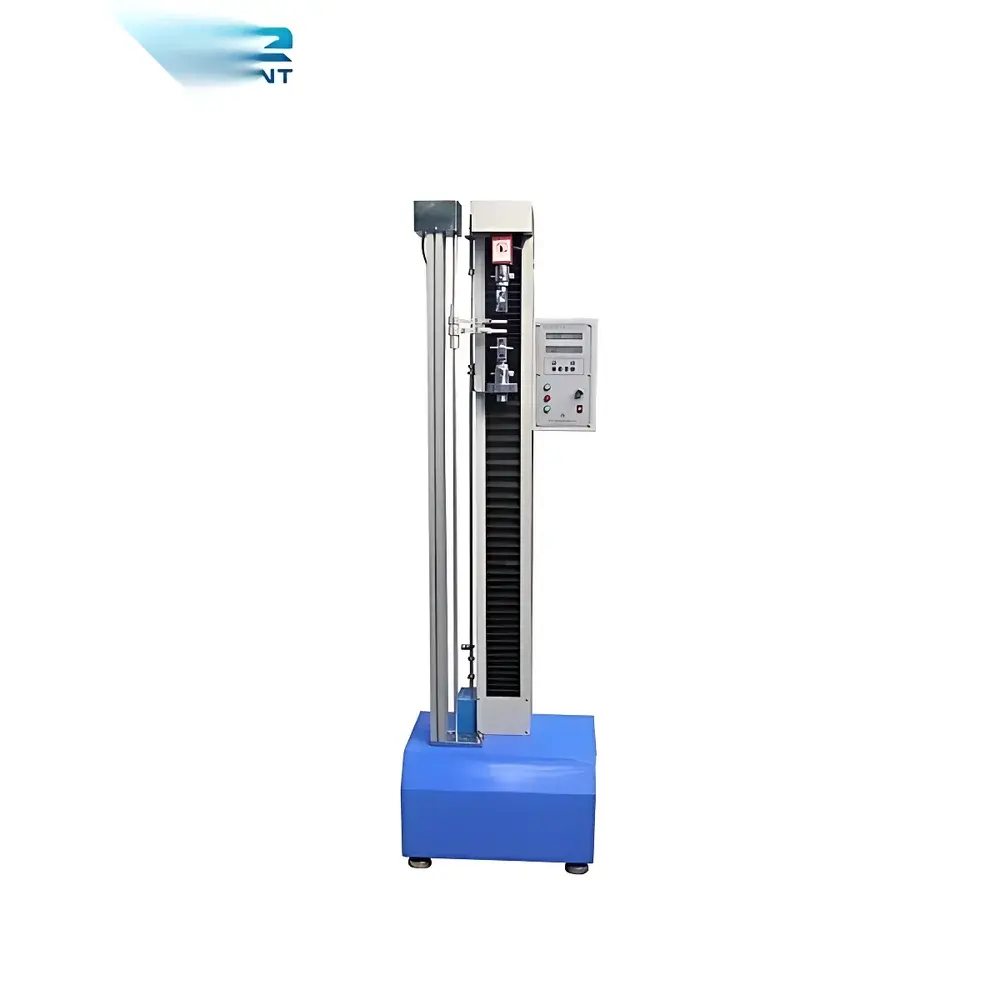
Universal Tensile Testing Machine for Elastomers and Polymers – OK-NL Series
| Brand | OK-NL |
|---|---|
| Capacity Options | 50 / 100 / 200 / 500 / 1000 kg |
| Load Resolution | 1/100,000 (1/250,000 for ≤1 kN models) |
| Load Accuracy | ≤0.5% FS (≤0.25% FS for ≤1 kN models) |
| Crosshead Travel | 1000 mm (excluding grips) |
| Test Speed Range | 5–300 mm/min (software-controlled, stepless adjustment) |
| Drive System | Panasonic AC servo motor + servo driver |
| Transmission | Precision ground ball screw + timing belt + Liming gearbox |
| Force Transducer | High-stability explosion-proof load cell with auto-thermal compensation, zero drift <0.01% FS/°C, repeatability ±0.03% FS, overload capacity 150% FS |
| Position Feedback | 2500 PPR optical encoder |
| Data Acquisition Resolution | 1/100,000 full scale |
| Compliance Standards | ASTM D412, D3574, D5035, D2061, D1445, D2290, D3759/M |
| Safety Features | Mechanical stroke limit switch, real-time overload warning, automatic stop-on-break, software-imposed force and displacement limits |
| Software Functions | Real-time stress–strain curve plotting, peak hold, auto-stop on specimen rupture, unit conversion (g/kg/N/kN/lb), report generation (customizable templates), data export (CSV, Excel), audit trail support for GLP/GMP environments |
| Dimensions (L×W×H) | 985 × 510 × 1600 mm |
| Power Supply | 220 V, 50/60 Hz |
Overview
The OK-NL Series Universal Tensile Testing Machine is an electromechanical static testing system engineered for high-fidelity mechanical characterization of elastomeric, polymeric, fibrous, and metallic materials under uniaxial loading conditions. It operates on the fundamental principle of controlled displacement actuation—where a precision ball screw-driven crosshead applies tensile, compressive, or flexural loads to specimens mounted between standardized grips—while simultaneously capturing force and displacement data via calibrated transducers and high-resolution encoders. Designed specifically for rubber, thermoplastic elastomers, vulcanized compounds, foams, films, textiles, composites, and wire/cable assemblies, this system delivers traceable, repeatable measurements aligned with international mechanical testing standards including ASTM, ISO, GB/T, JIS, and DIN. Its architecture integrates metrological-grade components—including Panasonic servo drives, explosion-proof load cells with thermal self-compensation, and optical position feedback—to ensure long-term stability and minimal signal drift across ambient laboratory environments.
Key Features
- High-precision ball screw transmission system coupled with low-backlash timing belt and Liming planetary gearbox ensures smooth, noise-free motion and exceptional positional fidelity over full travel (1000 mm).
- Explosion-proof load cell with ±0.03% FS repeatability, 150% transient overload tolerance, and active thermal compensation eliminates temperature-induced zero drift—critical for extended-duration creep or relaxation tests.
- Real-time data acquisition at 1/100,000 resolution (up to 1/250,000 for sub-1 kN configurations) enables accurate detection of subtle yield points, modulus transitions, and failure initiation in soft elastomers and viscoelastic polymers.
- Software-enforced safety protocols include dual-limit overload protection (hardware + software), automatic stop-on-fracture, programmable displacement ceilings, and audible/visual alert triggers for out-of-specification events.
- Modular grip interface accommodates pneumatic, wedge, roller, peel, and custom fixtures—enabling seamless transition between tensile, 90°/180° peel, tear, shear, and compression modes per ISO 2285, ASTM D3759, and GB/T 2790.
- Fully compliant with FDA 21 CFR Part 11 requirements for electronic records and signatures when deployed with validated software configuration—supporting audit-ready workflows in regulated QC/QA laboratories.
Sample Compatibility & Compliance
The OK-NL platform supports mechanical evaluation of heterogeneous material classes—from low-modulus silicone rubbers (0.1–10 MPa) to high-strength alloy wires (>1000 MPa)—through configurable capacity modules (50–1000 kg). Standardized test geometries include dumbbell-shaped tensile bars (ASTM D412 Type I–IV), dog-bone specimens (ISO 37), film strips (ASTM D882), and cord/tape samples (GB/T 3690). All hardware and firmware are validated against national and international reference standards, including ISO/IEC 17025 traceability pathways. The system meets essential requirements for GLP-compliant testing environments: full audit trail logging, user-access controls, electronic signature capture, and immutable data archiving. Calibration certificates are issued per ISO/IEC 17025-accredited procedures, with optional NIST-traceable verification reports available upon request.
Software & Data Management
Control and analysis are performed using OK-NL’s proprietary Windows-based software suite, which provides ISO 17025-aligned instrument control, real-time curve visualization (stress–strain, load–extension, force–time), and automated parameter extraction (tensile strength, elongation at break, Young’s modulus, yield point, secant modulus, tear resistance). Raw data is stored in encrypted binary format with metadata tagging (operator ID, timestamp, environmental conditions, calibration status). Export options include CSV, XLSX, PDF, and XML for LIMS integration. Reporting templates conform to ASTM E1434 and ISO 14644-1 documentation guidelines, supporting both internal QA reviews and regulatory submissions. Optional 21 CFR Part 11 add-on module enables role-based access, electronic signatures, and revision-controlled protocol management—fully auditable during FDA or EU MDR inspections.
Applications
- Quality control of vulcanized rubber compounds (e.g., natural rubber, SBR, EPDM) per ASTM D412 and GB/T 528.
- Mechanical screening of thermoplastic elastomer (TPE) formulations during R&D, including Shore hardness correlation studies.
- Peel adhesion testing of pressure-sensitive tapes and laminated packaging per PSTC-7, ASTM D3330, and GB/T 2792.
- Tear propagation resistance assessment of synthetic leather, conveyor belts, and automotive interior trim per ISO 34-1 and ASTM D624.
- Compression set evaluation of sponge rubber gaskets and seals following ASTM D395 and ISO 1856.
- Wire and cable jacket integrity verification under tensile stress per UL 1581 and IEC 60811-501.
FAQ
What is the recommended load cell capacity selection guideline?
For optimal resolution and accuracy, select a capacity where the expected maximum load falls within 20–80% of full scale—typically 3× to 10× the anticipated breaking force of representative specimens.
Does the system support multi-step test profiles (e.g., cyclic loading or relaxation sequences)?
Yes—the software allows creation of programmable test sequences with up to 10 independent segments, including dwell periods, speed ramps, and conditional triggers based on load or displacement thresholds.
Can test data be integrated into enterprise LIMS or MES platforms?
Yes—via ODBC-compliant database connectors and RESTful API endpoints, enabling bidirectional synchronization with LabWare, Thermo Fisher SampleManager, and Siemens Opcenter Quality.
Is third-party calibration certification included with delivery?
Each unit ships with a factory calibration certificate traceable to national metrology institutes; ISO/IEC 17025-accredited recalibration services are available through authorized service centers worldwide.
How is software validation handled for regulated industries?
The OK-NL software package includes IQ/OQ documentation kits, UAT checklists, and 21 CFR Part 11 compliance packages—validated in accordance with GAMP 5 principles and suitable for submission to regulatory authorities.



