
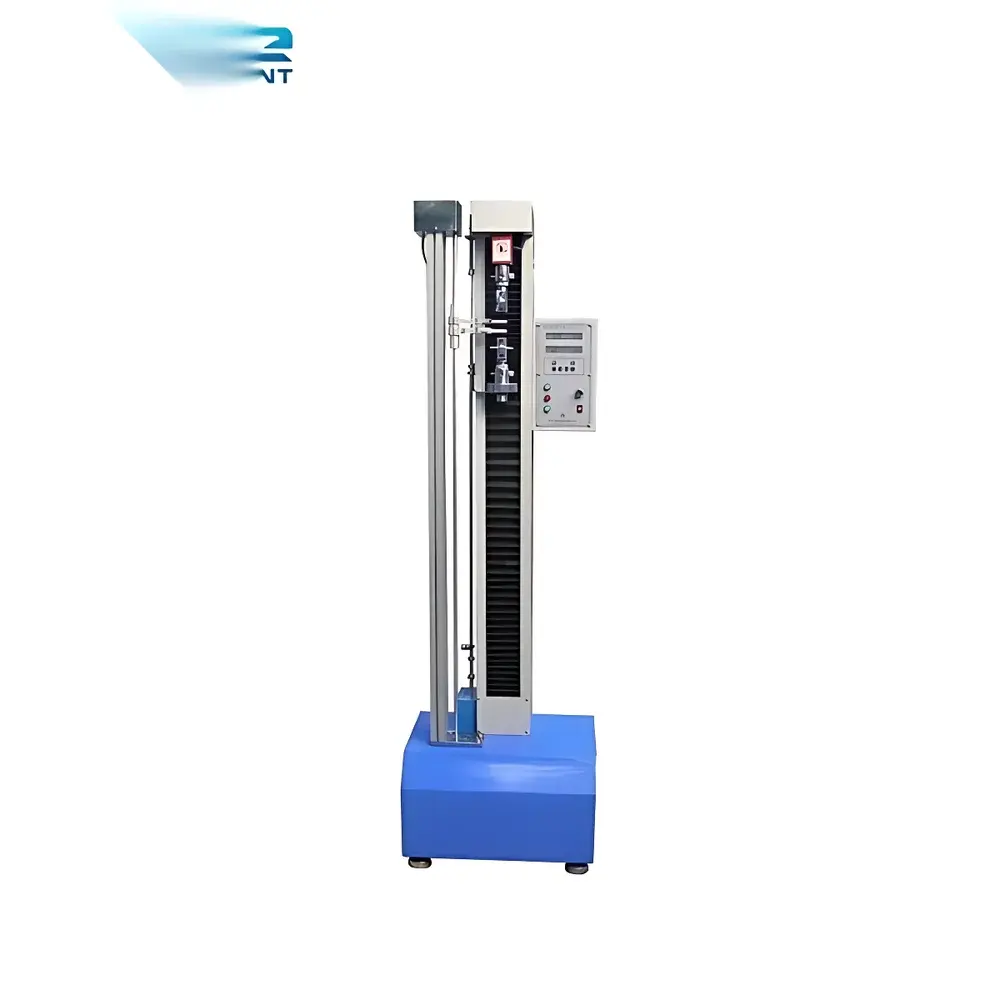
Universal Tensile Testing Machine for Spring and Material Mechanical Characterization
| Brand | OEM / Custom-Branded |
|---|---|
| Origin | Imported |
| Manufacturer Type | Authorized Distributor |
| Price | USD 3,500 (FOB) |
| Load Capacity Options | 50–1000 kgf |
| Force Resolution | 1/100,000 (up to 1 ton), 1/250,000 (≤1 ton) |
| Force Accuracy | ≤0.5% FS (≤0.25% FS for ≤1 ton) |
| Crosshead Travel | 1000 mm (excluding grips) |
| Test Speed Range | 5–300 mm/min (software-controlled, stepless adjustment) |
| Drive System | Panasonic AC servo motor + servo driver |
| Transmission | Precision ground ball screw + Liming reducer + synchronous belt |
| Load Cell | High-stability explosion-proof strain-gauge type, zero drift compensation, overload capacity 150% FS, repeatability ±0.03% FS |
| Position Feedback | 2500 PPR optical encoder |
| Compliance Standards | ASTM D412, D3574, D5035, D2061, ISO 37, 2285, 34-1, 34-2, GB/T 16491, GB/T 1040, GB/T 2790–2792, EN ISO 1798, DIN 53507-A, JIS K6854 |
Overview
The Universal Tensile Testing Machine for Spring and Material Mechanical Characterization is an electromechanical force-testing system engineered for precision static mechanical evaluation of linear elastic and viscoelastic materials. Based on the fundamental principle of uniaxial load application under controlled displacement or load-rate conditions, it measures tensile strength, compressive yield, flexural modulus, peel adhesion, tear resistance, elongation at break, and spring rate (k-value) across a broad spectrum of compliant and rigid specimens. Its architecture conforms to the core design philosophy of universal testing machines defined in ISO 7500-1 (Class 0.5 or Class 1 accuracy per configuration), with integrated safeguards ensuring traceable force measurement, repeatable kinematic control, and structural integrity during high-cycle or high-force testing. The system is not intended for dynamic fatigue or creep testing but excels in standardized quasi-static mechanical characterization required in QC labs, R&D facilities, and third-party certification laboratories.
Key Features
- High-fidelity force transduction via temperature-compensated, explosion-rated load cells offering ±0.03% full-scale repeatability and 150% transient overload tolerance.
- Precision motion control enabled by a Panasonic AC servo drive system coupled with a ground ball screw and low-backlash planetary reduction gearbox — delivering smooth, low-noise crosshead travel with <0.01 mm positioning resolution.
- Real-time data acquisition at up to 10 kHz sampling rate, supporting high-resolution stress–strain curve generation, peak load capture, automatic rupture detection, and programmable stop-on-break logic.
- Comprehensive software suite compliant with FDA 21 CFR Part 11 requirements for audit trail, electronic signature, and data integrity — including user-level access control, test method templates, and GLP/GMP-ready reporting.
- Dual-mode operation: closed-loop displacement control (for modulus and elongation tests) and closed-loop load control (for adhesion and peel protocols), configurable via intuitive GUI.
- Integrated mechanical safety systems: hardware-limited travel end-stops, real-time over-force cutoff, and visual/audible overload alerts synchronized with software lockout.
Sample Compatibility & Compliance
This tester accommodates specimens ranging from sub-millimeter polymer filaments and metal wire springs to 100-mm-wide composite laminates and automotive safety belt assemblies. Standardized fixtures include pneumatic wedge grips, roller-type peel jigs (90° and 180°), compression platens, bend supports, and spring compression collars — all calibrated per ASTM E4 and ISO 7500-1. The machine meets essential metrological and procedural requirements for conformance testing under ASTM D412 (rubber vulcanizates), ASTM D3574 (flexible polyurethane foam), ISO 37 (vulcanized rubber), GB/T 16491 (Chinese universal testing standard), and EN ISO 1798 (foam tensile properties). All calibration certificates are NIST-traceable, and optional UKAS-accredited verification is available upon request.
Software & Data Management
The embedded Windows-based control software provides ISO 17025-aligned test sequencing, multi-channel real-time plotting (force vs. displacement, stress vs. strain), and automated calculation of key mechanical parameters — including Young’s modulus, yield point, breaking strength, elongation percentage, and spring constant. Raw data exports to CSV, Excel, and XML formats; reports comply with ISO/IEC 17025 documentation requirements and support digital signature workflows. Audit trails record operator ID, timestamp, parameter changes, and result modifications — satisfying FDA 21 CFR Part 11 and EU Annex 11 validation prerequisites. Optional LIMS integration via OPC UA or REST API enables seamless data flow into enterprise quality management systems.
Applications
- Spring characterization: linear/nonlinear stiffness (k), hysteresis loop analysis, set loss, and relaxation behavior under static loading.
- Polymer and elastomer testing: tensile strength, tear propagation (ASTM D624), peel adhesion (ASTM D903), and puncture resistance of films and foams.
- Wire and cable mechanical integrity: tensile break load, elongation, and conductor–insulation bond strength.
- Textile and nonwoven performance: tensile strength of woven fabrics (ISO 13934-1), seam slippage, and geotextile grab strength.
- Medical device component validation: tensile properties of suture materials (ISO 10555), catheter shaft stiffness, and balloon burst pressure correlation.
- Automotive QA: seatbelt webbing strength (FMVSS 209), airbag tether tensile load, and gasket compression set evaluation.
FAQ
What load cell accuracy class does this system meet?
It complies with ISO 7500-1 Class 0.5 (≤1 ton capacity) or Class 1 (higher capacities), verified annually with certified deadweight standards traceable to NIST.
Can the system perform ASTM D3574 foam compression set testing?
Yes — when equipped with the optional compression fixture and thermal enclosure (±2°C stability), it supports Method A (constant load) and Method B (constant deflection) per ASTM D3574 Annex A1.
Is the software validated for regulated environments?
The base software includes IQ/OQ documentation templates and supports full 21 CFR Part 11 implementation, including role-based permissions, electronic signatures, and immutable audit logs.
What is the maximum specimen thickness supported in compression mode?
With standard platens, maximum clearance is 120 mm; custom platens extend this to 250 mm — confirmed via mechanical interference check prior to shipment.
Does the system support multi-step cyclic testing?
No — this is a quasi-static universal tester; for cyclic loading, a dedicated servo-hydraulic or electrodynamic fatigue system is recommended.



