
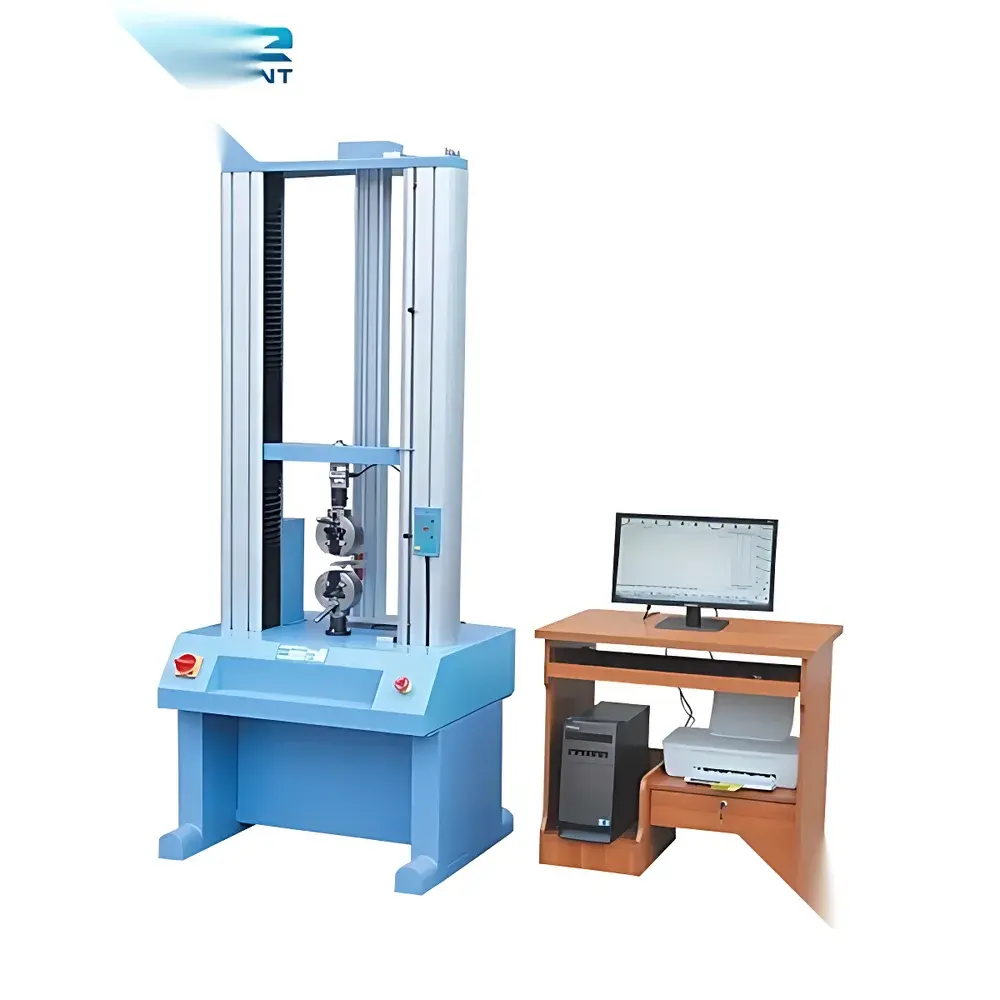
Universal Testing Machine OK-NL Series
| Key Features | AC servo motor drive |
|---|---|
| Test speed | 5–300 mm/min (software-controlled) |
| Stroke | 1000 mm (excluding grips) |
| Dimensions | 985 × 510 × 1600 mm (L×W×H) |
| Power | 220 V, 50/60 Hz |
| Compliance | ASTM D412, D3574, D5035, ISO 37, 1421, 1798, GB/T 16491, GB/T 1040, and over 40 additional international standards |
| Load capacity options | 50, 100, 200, 500, 1000 kg |
| Unit switching | g, kg, N, kN, lbf |
| Software | Real-time curve plotting, peak hold, auto-stop at break, overload protection, data export, customizable reporting |
Overview
The OK-NL Series Universal Testing Machine is an electromechanical static testing system engineered for high-fidelity mechanical property characterization of both metallic and non-metallic materials. It operates on the principle of controlled uniaxial force application—via a precision ball screw-driven crosshead—to generate standardized tensile, compression, flexural, peel, shear, and tear deformation profiles in accordance with ISO, ASTM, GB/T, JIS, DIN, and BS EN test methodologies. Designed for laboratory and quality control environments, the system delivers traceable, repeatable mechanical data—including modulus, yield strength, ultimate tensile strength, elongation at break, and secant modulus—across a broad spectrum of specimen geometries and compliance classes. Its architecture integrates closed-loop position and load control, enabling precise strain-rate regulation and dynamic response fidelity essential for R&D validation and production lot release.
Key Features
- High-stability mechanical drivetrain: Panasonic AC servo motor coupled with a high-rigidity ball screw assembly and preloaded linear guides ensures smooth, low-noise motion with minimal backlash and thermal drift.
- Explosion-rated load cell with integrated temperature compensation: Delivers long-term zero stability and repeatability of ±0.03% full scale (F.S.), with transient overload tolerance up to 150% F.S., meeting stringent metrological requirements for accredited labs.
- Dual-resolution digital acquisition: 1/100,000 internal resolution (enhanced to 1/250,000 for models ≤1 ton capacity) supports accurate quantification of micro-force transitions during yielding or viscoelastic relaxation phases.
- Intelligent safety architecture: Includes hardware-based stroke limit switches, software-configurable load upper/lower bounds, automatic halt upon specimen rupture, and real-time overload warning to safeguard transducers and operator integrity.
- Multi-standard test protocol library: Preloaded routines compliant with ASTM D412 (rubber vulcanizates), ISO 37 (tensile properties of rubber), GB/T 1040 (plastics), and EN ISO 1798 (flexible cellular polymeric materials) eliminate manual parameter setup errors.
Sample Compatibility & Compliance
The OK-NL accommodates specimens ranging from sub-millimeter polymer films and fiber filaments to structural metal coupons and composite laminates. Standard fixtures include wedge-action tensile grips, compression platens, 90°/180° peel fixtures, and shear adapters—each designed to minimize stress concentration and ensure uniform load distribution. The system conforms to ISO/IEC 17025 calibration traceability requirements and supports GLP/GMP audit readiness through timestamped, user-logged test records. All mechanical and electrical components comply with CE directives (2014/30/EU EMC, 2014/35/EU LVD), and software functionality aligns with FDA 21 CFR Part 11 expectations for electronic record integrity, including audit trail generation and role-based access control.
Software & Data Management
Control and analysis are executed via a dedicated Windows-based application supporting real-time dual-axis (load vs. displacement) curve rendering with adjustable sampling rates up to 1 kHz. The interface enables programmable multi-step test sequences (e.g., preload → ramp → hold → return), automatic calculation of derived parameters (modulus, Poisson’s ratio, toughness), and export of raw ASCII or Excel-compatible datasets. Reports adhere to ISO 14289-1 (PDF/A-1b) archival standards and support configurable templates compliant with internal SOPs or external certification bodies (e.g., SGS, BV, TÜV). Data encryption, user authentication logs, and revision-controlled method storage ensure regulatory defensibility across ISO 9001, IATF 16949, and AS9100 workflows.
Applications
This system serves as a core instrument in polymer formulation labs evaluating elastomer hysteresis and creep resistance; in wire-and-cable manufacturing for tensile integrity verification per ASTM D1445; in medical device R&D for suture strength and catheter kink resistance per ISO 10993-12; and in automotive Tier-1 suppliers validating gasket compressive set and seatbelt webbing energy absorption. It is routinely deployed for QC screening of packaging films (ASTM D882), geotextiles (ASTM D4595), adhesives (ASTM D3164), and battery electrode coatings (ISO 2409 cross-hatch adhesion), where mechanical robustness directly correlates with field performance and regulatory pass/fail thresholds.
FAQ
What load capacities are available for the OK-NL series?
Standard configurations offer selectable capacities of 50 kg, 100 kg, 200 kg, 500 kg, and 1000 kg. Selection should follow the 3×–10× rule relative to expected maximum specimen load to optimize signal-to-noise ratio and measurement linearity.
Is the system compatible with third-party environmental chambers?
Yes—the machine features standardized mounting interfaces and analog/digital I/O ports (0–10 V, RS-232, Ethernet) for synchronized operation with temperature/humidity chambers per ASTM D638 Annex A3 or ISO 62 procedures.
Does the software support automated report generation for ISO/IEC 17025 accreditation?
Yes—reports include instrument ID, calibration certificate expiry dates, operator credentials, environmental conditions (if logged), statistical summaries (n ≥ 5), and uncertainty budgets calculated per GUM (JCGM 100:2008) methodology.
Can test methods be password-protected or locked for production use?
Yes—administrators may assign read-only or edit permissions per user group and enforce method version control with mandatory change justification logging.
What maintenance intervals are recommended for long-term accuracy retention?
Annual recalibration of the load cell and displacement encoder is advised; biannual inspection of ball screw preload and grip jaw alignment is required per ISO 7500-1 Class 1 verification protocols.



