
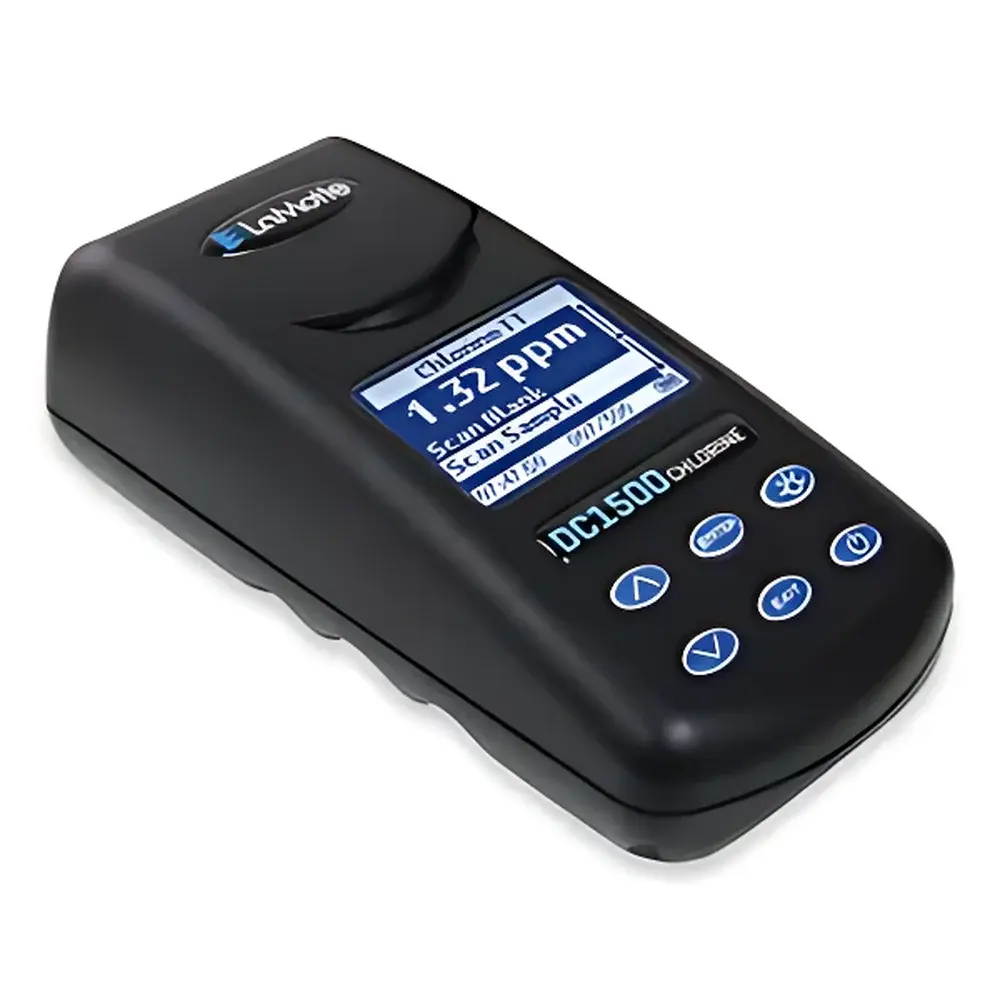
Urea Analyzer DC1500-U
| Brand | — |
|---|---|
| Origin | United Kingdom |
| Manufacturer Type | Authorized Distributor |
| Origin Category | Imported |
| Model | DC1500-U |
| Price | Upon Request |
Overview
The DC1500-U Urea Analyzer is a portable, microprocessor-controlled photometric instrument engineered for rapid, field-deployable quantification of urea in aqueous samples—primarily swimming pool water, wastewater effluents, hospital hygiene monitoring streams, and aquaculture systems. It operates on the principle of enzymatic-colorimetric detection: urease catalyzes the hydrolysis of urea to ammonia and carbon dioxide; the liberated ammonia then reacts with α-ketoglutarate and NADPH in the presence of glutamate dehydrogenase (GLDH), resulting in a stoichiometric decrease in NADPH absorbance at 340 nm. This change is measured via dual-beam photometry using a high-stability LED light source and an integrated interference filter (10 nm bandwidth), enabling precise, reagent-based quantification without thermal digestion or distillation steps. The system eliminates reliance on hazardous reagents (e.g., diacetyl monoxime) or time-intensive wet-chemistry protocols, delivering trace-level accuracy under variable ambient conditions.
Key Features
- Optimized optical architecture: 340 nm LED source with ±2% full-scale wavelength accuracy and silicon photodiode detector featuring built-in interference filter for minimal spectral drift
- IP67-rated enclosure: Fully sealed against dust ingress and immersion up to 1 m for 30 minutes—validated for continuous operation in humid, chlorinated, or splash-prone environments
- Integrated rechargeable lithium-ion battery (3.7 V, 2.5 × 75 mm): Supports ≥380 assays with backlight enabled, or >1,000 assays with backlight disabled; 500-cycle service life
- Programmable auto-shutdown: Configurable intervals (5, 10, 50 min) to conserve power without compromising assay readiness
- 25 mm diameter sample chamber: Accommodates standard round-bottom cuvettes; sealed design prevents cross-contamination and protects internal optics from aerosol exposure
- Multi-language interface: English, Spanish, French, Portuguese, Italian, Chinese, Japanese—fully localized menus and error prompts
- Mini-USB connectivity: Enables direct data export to LIMS-compatible spreadsheets or laboratory information management systems; supports firmware updates and calibration file synchronization
Sample Compatibility & Compliance
The DC1500-U is validated for use with clarified, non-turbid water matrices including chlorinated pool water (free chlorine ≤5 mg/L), tertiary-treated wastewater, hospital sterilization rinse water, and recirculating aquaculture system (RAS) effluent. It complies with EN 14925:2018 (swimming pool water quality — determination of urea by enzymatic method) and aligns with ISO 15705:2002 (water quality — guidance on enzymatic methods for nitrogenous compounds). While not certified under FDA 21 CFR Part 11, its audit trail functionality—including timestamped result logs, operator ID fields, and calibration history storage—supports GLP-compliant documentation workflows. CE marking confirms conformity with EU Electromagnetic Compatibility (2014/30/EU) and Low Voltage (2014/35/EU) directives.
Software & Data Management
Data acquisition and reporting are managed through embedded firmware supporting three operational modes: pre-programmed urea assay (0.00–6.00 mg/L range), raw absorbance (A), and transmittance (%T). All measurements are stored with metadata (date/time, operator ID, calibration status, batch ID). USB export generates CSV files compatible with Excel, LabArchives, or custom SQL-based QA databases. No proprietary software installation is required—plug-and-play recognition on Windows, macOS, and Linux platforms. Firmware versioning and calibration certificate import are supported via Mini-USB; no cloud dependency or subscription model.
Applications
- Swimming pool and spa facility management: Real-time urea trending to assess bather load and optimize disinfection efficiency per WHO and CDC guidelines
- Hospital environmental services: Monitoring urea accumulation in sterilization equipment rinse cycles as a surrogate for organic residue
- Municipal wastewater treatment plants: Tracking urea removal efficacy across biological nitrification stages
- Aquaculture and hatchery operations: Assessing nitrogen loading in closed-loop systems to prevent ammonia toxicity events
- Research laboratories: Method validation studies comparing enzymatic vs. HPLC-UV quantification of low-molecular-weight nitrogen species
FAQ
What is the measurement principle used by the DC1500-U?
It employs a two-enzyme cascade (urease + glutamate dehydrogenase) coupled with NADPH-dependent spectrophotometry at 340 nm.
Does the instrument require external calibration standards for each test?
No—factory-calibrated with NIST-traceable urea reference materials; user-performed 1-point verification is optional and supported via included calibrant vials.
Can the DC1500-U be used with turbid or colored samples?
Only after filtration (0.45 µm membrane) or centrifugation; high turbidity or absorbance above 1.5 AU at 340 nm invalidates results due to inner-filter effects.
Is the reagent kit stable at ambient temperature?
Yes—lyophilized enzyme tablets retain activity for 24 months when stored desiccated at 2–8 °C; reconstituted reagent is stable for 7 days at 4 °C.
How is data integrity ensured during field use?
Each measurement record includes digital signature, UTC timestamp, instrument serial number, and firmware revision—enabling full traceability in audit-ready formats.
Related Products







