
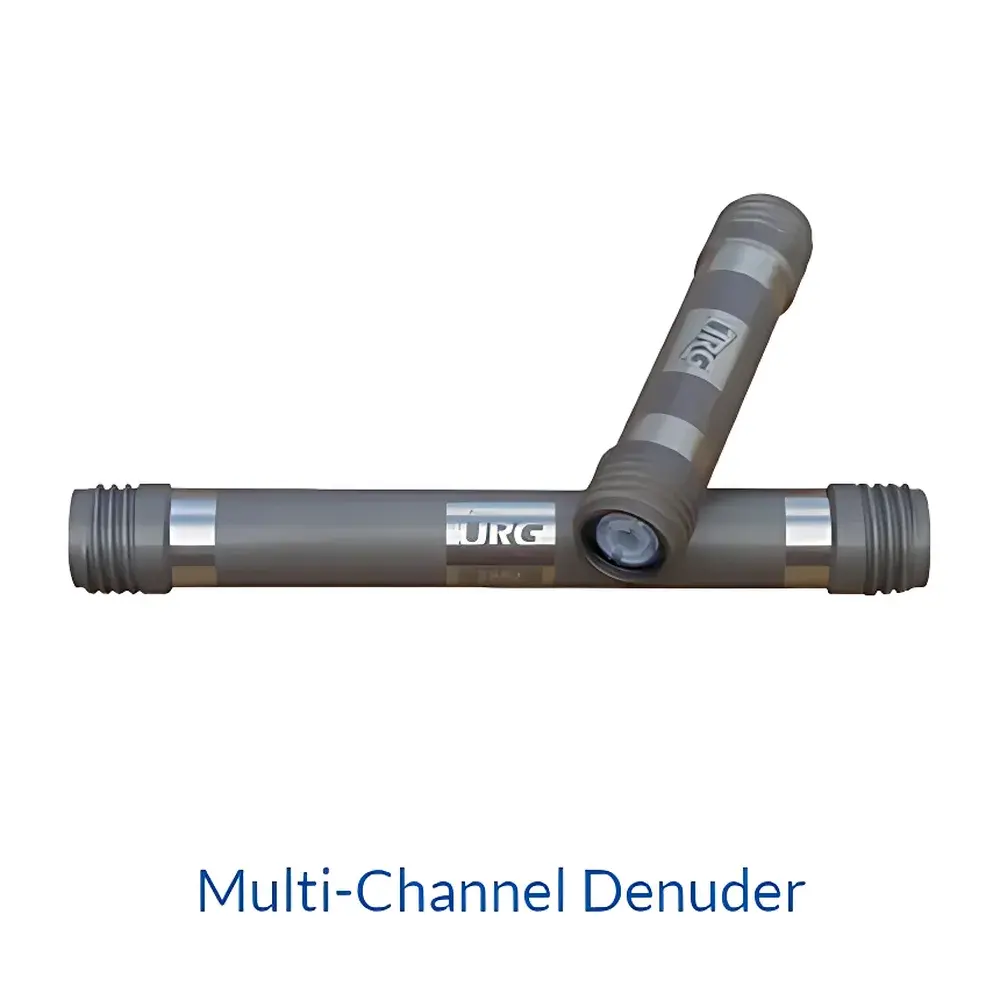
URG URG-2000-30×242-3CSS Triple-Channel Annular Denuder
| Brand | URG |
|---|---|
| Origin | USA |
| Model | URG-2000-30×242-3CSS |
| Number of Channels | 3 |
| Annular Spacing | 1 mm |
| Length | 242 mm |
| End Fittings | Dual #30 Threaded Ports |
| Flow Straightener | PTFE-Coated on One End |
| Housing Material | Stainless Steel |
| Etched Glass Surface | Yes |
| Protective End Caps | Included |
Overview
The URG URG-2000-30×242-3CSS Triple-Channel Annular Denuder is a precision-engineered gas-phase sampling device designed for selective removal and quantitative collection of reactive gaseous species—particularly acidic gases (e.g., HNO3, HCl, SO2) and basic vapors (e.g., NH3)—from ambient or stack air streams. Operating on the principle of diffusion-controlled surface absorption, the denuder integrates three parallel annular flow channels formed between concentric etched glass tubes and a stainless-steel outer housing. This geometry maximizes the available reactive surface area while maintaining laminar, low-turbulence flow—critical for achieving high collection efficiency (>95% for target analytes under calibrated flow rates) and minimizing particle penetration or wall loss artifacts. The device is not a passive sampler but a dynamic, flow-through component intended for integration into multi-stage sampling trains, including cyclone pre-separators, filter holders, and impingers, in compliance with EPA Method TO-15, ISO 19278:2019, and ASTM D6381–22 protocols for speciated gas monitoring.
Key Features
- Triple-channel annular design with 1 mm inter-channel spacing ensures uniform residence time distribution and minimizes axial dispersion, enhancing analytical reproducibility across replicate samples.
- Internally etched borosilicate glass surfaces increase effective coating area by >40% compared to smooth-bore denuders, improving reagent loading capacity and analyte capture kinetics for coated configurations (e.g., Na2CO3 for acid gases; citric acid for NH3).
- Dual #30 threaded ports (per ANSI/ASME B1.20.1) enable direct, leak-tight mechanical coupling to URG cyclones (e.g., URG-2000-SC), filter holders (URG-2000-FH), and manifold assemblies—eliminating need for adapters or compression fittings that introduce dead volume or flow disruption.
- Integrated PTFE-coated flow straightener at the inlet end suppresses vortex formation and mitigates particle impaction, preserving denuder integrity during high-dust-concentration sampling (e.g., near industrial stacks or roadways).
- Robust 316 stainless-steel outer housing provides mechanical stability, thermal inertia, and corrosion resistance during extended field deployments (–20 °C to +50 °C operational range) and routine solvent-based extraction procedures.
- Supplied with inert polypropylene protective end caps to prevent contamination during coating, storage, and post-sampling solvent extraction—supporting GLP-compliant handling workflows.
Sample Compatibility & Compliance
The URG-2000-30×242-3CSS is validated for use with aqueous- and solvent-based coatings (e.g., glycerol, K2CO3/glycerol, citric acid/methanol) and supports both offline IC/ICP-MS analysis and online coupling to GC-MS systems via thermal desorption interfaces. Its geometric consistency and material compatibility meet requirements for EPA Compendium Method IO-3.2 (for nitric acid), ISO/CD 19278 Annex C (multi-pollutant denuder validation), and EU Directive 2008/50/EC Annex IX QA/QC criteria. Device calibration traceability aligns with NIST SRM 2788 (trace metals in air particulate matter) when used in tandem with gravimetric or ICP-MS quantification of extracted analytes.
Software & Data Management
As a hardware-only sampling component, the URG-2000-30×242-3CSS does not incorporate embedded firmware or digital interfaces. However, it is fully compatible with industry-standard data acquisition ecosystems: flow controllers (e.g., Brooks SLA Series), pressure transducers (Setra 230), and centralized logging platforms (LabVIEW, EPICS, or custom Python-based DAQ) used in regulatory-grade ambient monitoring networks. Sample metadata—including flow rate, temperature, duration, coating lot number, and extraction batch ID—must be recorded manually or via LIMS integration to satisfy 21 CFR Part 11 audit trail requirements for environmental compliance reporting.
Applications
- Ambient air quality monitoring of semi-volatile acidic and basic gases in urban, rural, and coastal environments.
- Source apportionment studies requiring speciated gas-to-particle conversion ratio estimation (e.g., NH3 + HNO3 → NH4NO3).
- Indoor air assessment in laboratories, cleanrooms, and pharmaceutical manufacturing facilities where reactive vapor control is critical.
- Stack emission testing for regulated gaseous pollutants under EPA Performance Specification 18 (PS-18) and EN 14181.
- Method development and inter-laboratory comparison exercises organized under ILMO (International Laboratory Measurement Organization) frameworks.
FAQ
Can this denuder be reused after solvent extraction?
Yes—provided the etched glass surface remains intact and free of micro-scratches or coating residue buildup, the unit may undergo up to five full cleaning cycles using ultrasonic-assisted acetone/methanol rinses followed by nitrogen purging. Visual inspection under 10× magnification is recommended prior to each reuse.
What is the recommended maximum sampling flow rate?
For optimal collection efficiency and minimal breakthrough, URG specifies 16.7 L/min (1.0 m³/h) at standard temperature and pressure (25 °C, 1 atm) for all three channels operating in parallel. Higher flows increase Reynolds number and risk turbulent mixing, reducing effective residence time.
Is the PTFE flow straightener replaceable?
Yes—the straightener is a field-serviceable component secured with a retaining ring; replacement kits (URG-PFS-30-PTFE) are available separately and maintain identical dimensional tolerances per ASME Y14.5.
Does the device comply with ISO/IEC 17025 accreditation requirements for testing laboratories?
When operated within documented SOPs—including pre-use leak testing, flow calibration against a primary standard (e.g., NIST-traceable bubble meter), and coating homogeneity verification—the URG-2000-30×242-3CSS supports ISO/IEC 17025:2017 Clause 7.2.2 (method validation) and Clause 7.7 (uncertainty estimation).
Can it be used for ozone (O3) removal?
No—ozone reacts rapidly with unsaturated organics and iodide-coated surfaces, but the URG-2000-30×242-3CSS is not configured for such chemistries. For O3 scrubbing, URG recommends the URG-2000-O3 series with potassium iodide-impregnated glass wool packing.







